

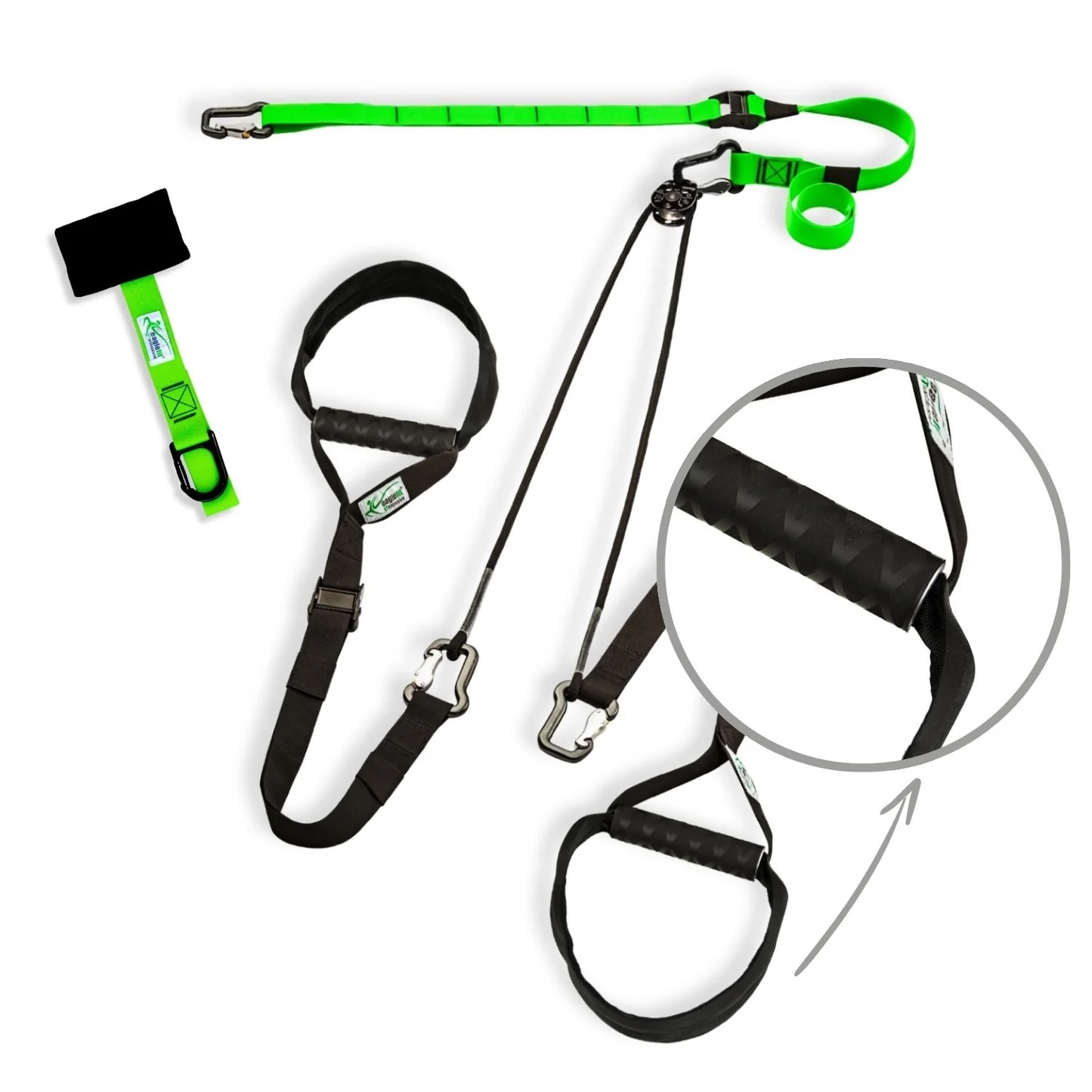
Variety makes movement healthy—why the Sling Trainer fits perfectly into YogaDoc
Movement is healthy when it is varied. This is more than simply enjoying a change: the body is built to push, pull, carry, rotate and stabilise at different angles, speeds and loads. Repetition of the same limited patterns creates problems over time: the same movements, the same distribution of weight and the same stimuli.
YogaDoc classes therefore deliberately include a substantial strength component: dynamic and “helical”, with spiral lines, rotational impulses and active whole-body stability. This is a structural necessity, because strength provides the foundation that prevents mobility from becoming instability.
Even so, a gap remains. Biomechanically, many floor exercises almost always involve more pushing than pulling. You support yourself, press down and push away from the floor—even in many core exercises. What is often missing is controlled, well-executed pulling through the shoulder girdle and back in coordinated movement chains. This is where the Sling Trainer becomes a precise tool: it provides pulling patterns without requiring a pull-up bar, machines or heavy weights, while demanding stable control.
The best part: three simple exercises essentially cover the whole body, with a high degree of transfer to other movements.
1) Pushing—like push-ups, using the Sling Trainer
Push-up variations on the Sling Trainer are easy to adjust: the angle, foot position and tempo immediately change the load. The redirection and movement of the suspension add a constant demand for stabilisation. The result is better neuromuscular interaction—better coordination rather than simply more muscle. Scapular control, trunk engagement, and wrist and shoulder stability all benefit directly.
2) Pulling—like pull-ups, using the Sling Trainer
Pulling is the missing link in many floor-based systems. The Sling Trainer lets you scale the principle of a pull-up: the more upright you stand, the easier it is; the more horizontal you become, the more demanding. Again, the system's instability requires precise muscle activation: latissimus dorsi, rhomboids, rear shoulders and biceps, but above all the coordinated movement of shoulder blade and arm. The emphasis is on neuromuscular interaction, rather than simply pushing harder.
3) Squats—with or without the sling, but with instability
Squats are the foundation of lower-body strength and do not necessarily require a sling. An unstable surface, such as a shoulderstand pad, adds another dimension. The stimulus calls for finer control. The ankles, knees, hips and pelvis learn to distribute load effectively. Once again, this develops neuromuscular interaction: better stability, responsiveness and control.
Conclusion: For varied movement, you need pulling patterns alongside work that pushes against the floor. The Sling Trainer fills this gap effectively: adjustable, gentle on the joints and demanding for coordination. Three exercises—pushing, pulling and squatting—give you a complete foundation of functional strength that fits perfectly into YogaDoc.