

skandha स्कन्ध – trunk
substantive masculine
Dictionary sources
AYI dictionary substantive masculine
trunk
Cappeller 1891 substantive masculine
Original text · English · substantive masculine
skandhá ·m. shoulder, stem or trunk of a tree; section, chapter of a book, mass, multitude, a whole or aggregate.
Monier-Williams 1872 substantive masculine
Original text · English · substantive masculine
skandha skandha, as, m. (according to Uṇā- di-s. IV. 206. fr. rt. 3. skand, ‘to rise’), the shoulder, upper part of the back or the region from the neck to the shoulder-joint (in men and animals); the body; the stem or trunk of a tree (especially that part of the stem where the branches begin); a large branch or bough; a branch or department of human knowledge (five of which are enumerated); a sec- tion, chapter, division of a book; a division of an army, form of military array; war, battle; a body of men &c., troop, multitude, quantity, (see kari-sk˚, nara-sk˚, turaṅga-sk˚); the five objects of sense, (see viṣaya); the elements of being or the five forms of mundane consciousness (according to the Buddhist philosophy); the regalia or other articles used at the coronation of a king (as a jar filled with holy water, a parasol, a chowri, &c.); a king, prince; a sage, wise man, seer, teacher; equality of height in the humps of a pair of draught oxen; a road, path, way; an engagement, agreement; a sort of metre; a heron; N. of a poet; = bhadrādi (accord- ing to Śabda-k.); (ā), f. a branch; a creeper; [cf. perhaps Gr. σπάθη: Lat. scapula: Angl. Sax. scul- dor, sculder, scoldr: Old Germ. scultra, sculdra, scultarra: Armor. skoaz: Cambro-Brit. ysgwyz; perhaps Hib. guala for sguada or sguana.]
Petersburger 1855 substantive masculine
Original text · German · substantive masculine
skandhá 1〉 m. SIDDH. K. 250,a,4. am Ende eines adj. comp. f. ā. a〉 Schulter (an Menschen und Thieren) NIR. 6,17. AK. 2,6,2,29. TRIK. 3,3,224. H. 588. H. 1224. H. an. 2,253. MED. dh. 22. HALĀY. 2,62. pl. AV. 6,135,1. AV. 9,7,3. AV. 10,2,4. AV. 10,9,20. AV. 12,5,67. VS. 25,6. TS. 7,3,16,1. sg.: vicala TS. 5,7,18,1. ˚mātra KĀTY. ŚR. 26,2,8. asita˚ KAUŚ. 40. — MBH. 1,5930. MBH. 3,16488. HARIV. 3720. SUŚR. 1,124,10. SUŚR. 1,208,2. SUŚR. 1,350,13. MĀLATĪM. 84,17. Spr. (II) 7595. VARĀH. BṚH. S. 51,42. VARĀH. BṚH. S. 52,4. VARĀH. BṚH. S. 53,111. skandhamudvahati gopatitulyam BṚH. 26,5. KATHĀS. 49,130. Verz. d. Oxf. H. 103,a,30. Verz. d. Oxf. H. 202,b,13. VET. in LA. (III) 13,15. BHĀG. P. 5,23,6. vāhyamānamayaḥkhaṇḍaṃ skandhaṃ naivāpakṛntati Spr. (II) 6053. cīramekaṃ sā svasminskandhe samāsṛjat R. GORR. 2,37,12. udakumbhaṃ skandhe kṛtvā PĀR. GṚHY. 1,8. PAÑCAT. 144,23. PAÑCAT. 169,10. skandhenādāya musalam M. 8,315. skandhe paraśumādāya R. GORR. 1,76,20. skandhaiḥ samādāya kumārānvidrutāḥ HARIV. 11200. mṛtakaṃ skandhe dhṛtvā VET. in LA. (III) 4,11. VET. in LA. (III) 12,15. bhāraṃ skandhena sa ādhatte BHĀG. P. 4,29,33. āruroha ca tasyaiva skandhe KATHĀS. 18,156. tasya skandha upāviśat KATHĀS. 49,134. skandhenāpi vahecchatrūn Spr. (II) 1706. Spr. (II) 6013. Spr. (II) 7182. kumbhaḥ skandhagaḥ VARĀH. BṚH. 26,30. dvijaskandhādhirūḍhā agnayaḥ R. 2,45,21. SARVADARŚANAS. 153,11. andhena paṅguḥ skandhamāropitaḥ SARVADARŚANAS. 153,9. SARVADARŚANAS. 153,10. skandhāsaktasamitkuśaiḥ RAGH. ed. Calc. 1,50. avaropya giriṃ skandhāt BHĀG. P. 8,6,39. gaja˚ R. 1,19,19. SUŚR. 1,98,9. Spr. (II) 728. RĀJA-TAR. 4,263. vṛṣa˚ Spr. (II) 7047. asaṃjātakiṇa˚ Spr. (II) 2135. viṣāṇollikhita˚ Spr. (II) 2326. ṛṣabha˚ adj. MBH. 1,8035. vṛṣabha˚ adj. MBH. 3,17130. R. 3,74,26. eines Pferdes RAGH. 4,67. VARĀH. BṚH. S. 93,3. suparṇa˚ BHĀG. P. 4,30,5. eines Blutegels SUŚR. 1,42,6. — b〉 der Theil des Baumstammes, an den sich die Aeste ansetzen, Baumstamm überh. AK. 2,4,1,10. H. 1119. H. an. MED. HALĀY. 2,27. ŚĀṄKH. GṚHY. 1,20. MBH. 2,826. MBH. 3,11032. HARIV. 3707. HARIV. 12380. R. 2,96,13 (R. 2,105,12 GORR.). R. 2,97,19. R. GORR. 2,43,24. R. GORR. 3,78,22. R. GORR. 3,79,7. R. GORR. 4,18,23. KĀM. NĪTIS. 16,37. KĀM. NĪTIS. 16,39. MEGH. 54. RAGH. 4,57. ŚĀK. 32. ŚĀK. 167. Spr. (II) 1129. Spr. (II) 1326. VARĀH. BṚH. S. 55,5. VARĀH. BṚH. S. 55,7. KATHĀS. 17,106. KATHĀS. 25,181. BHĀG. P. 5,16,25. BHĀG. P. 8,5,49. PAÑCAR. 1,7,13. PAÑCAT. III, 149. PAÑCAT. III,134,5. DAŚAK. 201,1. SARVADARŚANAS. 25,10 — c〉 Abtheilung, Theil: eines Heeres MBH. 5,7630. catuḥskandheva camūḥ RAGH. 4,30. = vyūha H. an. eines Berges MBH. 2,619. trayo dharmaskandhāḥ yajño 'dhyayanaṃ dānamiti CHĀND. UP. 2,23,1. sieben Striche, Regionen oder Bahnen (vgl. mārga und skandhaḥ = panthāḥ ŚABDAR._im_ŚKDR.) der Winde MBH. 3,14569. fg. HARIV. 2479. HARIV. 2620. HARIV. 6827; vgl. den Comm. zu R. 6,82,63_bei_GORR. X, 303,76. Abtheilung eines Lehrbuchs, einer Doctrin: kaṭuka˚, tikta˚ CARAKA 3,8. jyotiḥśāstraṃ ˚trayādhiṣṭhitam VARĀH. BṚH. S. 1,9. BṚH. 27,6. Verz. d. B. H. No. 862. Verz. d. B. H. No. 939. Verz. d. Cambr. H. 37. MUIR, ST. 2,170. zwölf des BHĀG. P. PAÑCAR. 2,7,28. — Verz. d. Oxf. H. 79,b, No. 136. Verz. d. Oxf. H. 189,b,21. BURNOUF, Intr. 462. ˚samanvita, pratiskandhaṃ bhinnaḥ PRATĀPAR. 19,b,3. — d〉 Menge, die ganze Menge, Gesammtheit, Complex AK. 3,4,18,103. H. an. MED. pakṣmaṇo 'pi nipātena yeṣāṃ (sūkṣmayonīnāṃ bhūtānāṃ) syātskandhaparyayaḥ MBH. 12,449. von Menschen, Elephanten, Pferden KĀŚ._zu_P. 4,2,51. H. 1413. HALĀY. 5,25. dhana˚ SADDH. P. 4,11,a. puṇya˚ BHĀG. P. 11,23,10. śīla˚, upādāna˚ BURNOUF, Intr. 513. die fünf Skandha bei den Buddhisten sind rūpa˚, vijñāna˚, vedanā˚, saṃjñā˚ und saṃskāra˚ H. 233, Schol. H. an. BURNOUF, Intr. 475, N. 1. BURNOUF, Intr. 475,491. BURNOUF, Intr. 475,511. fgg. WASSILJEW 94 u. s. w. SARVADARŚANAS. 20,10. fgg. SARVADARŚANAS. 22,8. fgg. SARVADARŚANAS. 23,21. ŚIŚ. 2,28. pañcaskandhakṛtin Verz. d. Oxf. H. 264,a,2. — e〉 bei den Jaina = piṇḍa Körper im weitesten Sinne: dvyaṇukādayaḥ skandhāḥ SARVADARŚANAS. 36,3. fgg. SARVADARŚANAS. 38,19. = kāya H. an. MED. — f〉 ein best. Āryā-Metrum MED. COLEBR. Misc. Ess. 2,154,a; vgl. skandhaka. — g〉 bildliche Bez. eines Fürsten (der Stamm des Ganzen) H. an. MED.; vgl. KĀM. NĪTIS. 16,37. KĀM. NĪTIS. 16,39 und skandhāvāra. — h〉 = saṃparāya und bhadrādi MED. a heron; an engagement, an agreement; a wise old man; a learned man, a teacher; match or equality in the humps of a pair of draft oxen WILSON nach ŚABDĀRTHAK. — i〉 N. pr. eines Schlangendämons MBH. 1,2160 (nach der Lesart der ed. Bomb.). eines Mannes gaṇa śaunakādi zu P. 4,3,106. eines Dichters Z. d. d. m. G. 27,77. — k〉 öfters fehlerhaft für skanda, z. B. MBH. 13,907 (ed. Bomb. skanda). KATHĀS. 53,173. BHĀG. P. 6,6,14 (ed. Bomb. skanda). PAÑCAR. 4,3,140. — 2〉 f. ā Zweig; eine kriechende Pflanze ŚABDĀRTHAK._bei_WILSON. — Vgl. aṃhri˚, kapi˚, karīra˚, kālla˚, guru˚, jaya˚, turaṃga˚, dharma˚, dhīra˚, nara˚, nīla˚, pīta˚, pṛthu˚, prati˚, maṇi˚, mahā˚, rāja˚, vāta˚, vāyu˚, viṣkandha, vṛṣa˚ (auch R. 3,55,4. RAGH. 1,13. RAGH. 12,34), śiva˚, sa˚, siṃha˚ (auch MBH. 3,10880. R. 2,59,26 = GORR. 2,59,24. GORR. 3,62,4. VARĀH. BṚH. S. 61,12), su˚, sura˚ und skandhas.
Böhtlingk 1879 substantive masculine
Original text · German · substantive masculine
skandhá — 1〉 m. (adj. Comp. f. ā) — a〉 Sg. und Pl. Schulter (an Menschen und Thieren, sogar an Blutegeln.) — b〉 Theil des Baumstammes, an den sich die Aeste ansetzen, Baumstamm überh. — c〉 Abtheilung, Theil ŚIŚ. 18,14. — d〉 Strich, Region, Bahn (der Winde, deren sieben). — e〉 Abtheilung eines Lehrbuchs, — einer Doctrin. — f〉 Menge, Masse (BĀLAR. 191,23. JĀTAKAM. 6), die ganze Menge, Gesammtheit, Complex. — g〉 bei den Jaina Körper im weitesten Sinne. — h〉 ein best. Āryā-Metrum. [Page7-197-c] Vgl. skandaka und skandhaka. — i〉 bildliche Bez. eines Fürsten. — k〉 *= saṃparāya bhadrādi a heron; an engagement; an agreement; a wise old man; a learned man, a teacher; match or equality in the humps of a pair of draught oxen. — l〉 N. pr. — α〉 eines Schlangendämons MBH. 1,57,19. — β〉 eines Dichters. — m〉 häufig fehlerhaft für skanda. — 2〉 f. skandhā — a〉 Zweig. — b〉 eine kriechende Pflanze.
Cappeller 1887 substantive masculine
Original text · German · substantive masculine
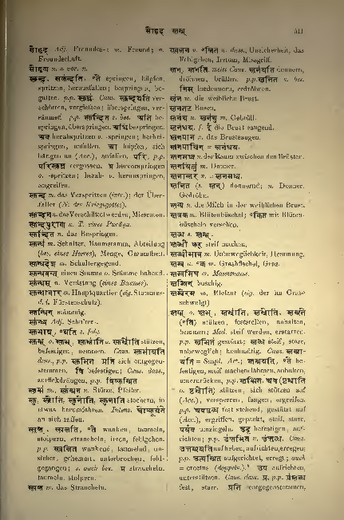
skandhá m. Schulter, Baumstamm, Abteilung (bes. eines Heeres), Menge, Gesamtheit.
Burnouf 1866 substantive masculine
Original text · French · substantive masculine
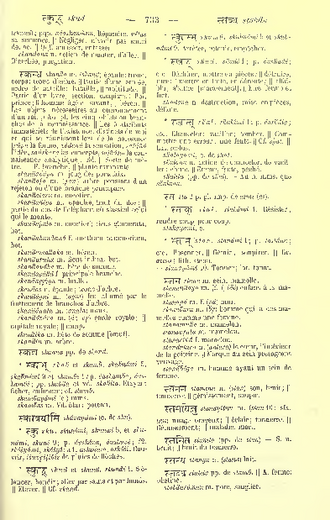
skandha skandha m. (skand) épaule; tronc, corps; tronc d'arbre. Partie d'une armée, ordre de bataille; bataille; multitude. Partie d'un livre, section, chapitre. Roi, prince; homme âgé et savant; héron. Les objets nécessaires au couronnement d'un roi. Au pl. les cinq objets ou branches de la connaissance. Les 5 attributs immatériels de l'existence, distincts du moi et qui se réunissent lors de la naissance [rūpa la forme, vedanā la sensation, sañjñā l'idée, saṃskāra les concepts, vijñāna la connaissance analytique]. Bd. Sorte de mètre. — F. branche; plante rampante. skandhacāpa m. joug des portefaix. skandhaja m. (jan) arbre poussant d'un rejeton ou d'une branche principale. skandhataru m. cocotier. skandhadeśa m. épaules, haut du dos; partie du dos de l'éléphant où s'assied celui qui le monte. skandhaphala m. cocotier; ficus glomerata, bot. skandhabandhanā f. anethum pammorium, bot. skandhamallaka m. héron. skandharuha m. ficus indica, bot. skandhavāha m. bête de somme. skandhaśākhā f. principale branche. skandhaśṛṅga m. buffle. skandhas n. épaule; tronc d'arbre. skandhāgni m. (agni) feu allumé par le frottement de branches d'arbre. skandhānala m. (anala) mms. skandhāvāra m. (ā; vṛ) garde royale; capitale royale; camp. skandhika m. bête de somme [bœuf]. skandhin m. arbre.
Occurrences in source texts (1)
HP 1 occurrence
Continue with AYI Free
Image source: AYI archive.