

svar स्वर् – light; heaven
particle · verbal root · substantive neuter · Word type unspecified · verb
Dictionary sources
AYI dictionary substantive neuter
light; heaven
Cappeller 1891 verb
Original text · English · verb
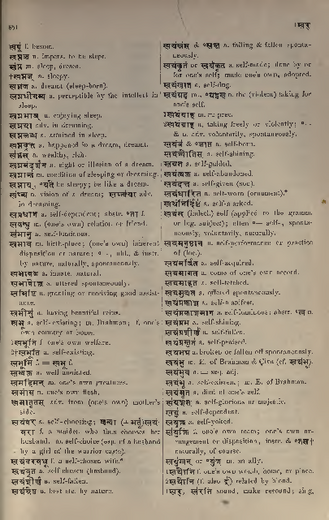
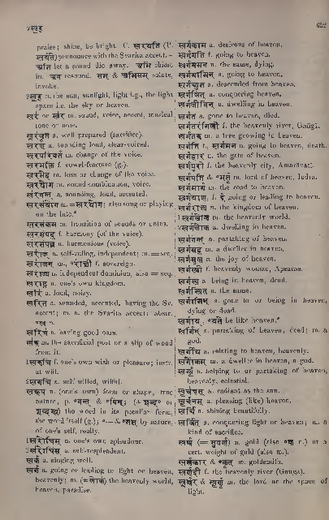
svar svárati1 ·v sound, make resound; sing, praise; shine, be bright. C. svarayati (P. svaryate) pronounce with the Svarita accent. -- ati let a sound die away. abhi chime in. ava resound. sam & abhisam salute, invoke.
Monier-Williams 1872 particle · verb
Original text · English · particle
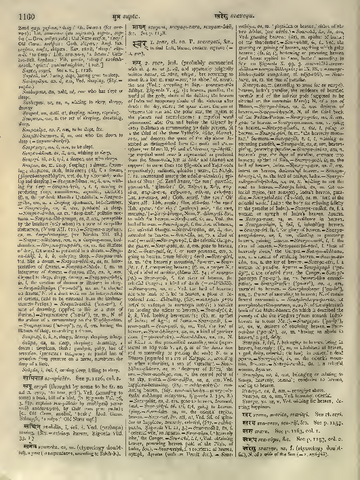
svar 2 . svar, ind. (probably connected with rt. 4. su or 3. sū, and apparently originally written suvar, cf. sūra, sūrya; but according to some fr. a lost rt. svar = sur, ‘to shine,’ cf. sura), the sun (Ved.; according to Sāy. = svaraṇa-śīla āditya, Ṛg-veda V. 45, 1); heaven, paradise, the world of the gods, abode of the deities; the heaven of Indra and temporary abode of the virtuous after death; the sky, ether; the space above the sun or between the sun and the polar star, the region of the planets and constellations; a mystical word pronounced after Om and before the Gāyatrī by every Brāhman in commencing his daily prayers, (it is the third of the three Vyāhṛtis, bhūr, bhuvaḥ, svar, and denotes the space of the sky above de- scribed as distinguished from the earth and atmo- sphere, see Manu II. 76. and cf. bhuvas, vy-āhṛti; the mystical word svar is represented as produced from the Sāma-veda, just as bhūr and bhuvaḥ are supposed to come from the Ṛg-veda and Yajur-veda respectively); radiance, splendor; water, (in Naigh. I. 12. enumerated among the udaka-nāmāni); epi- thet of Śiva; [cf. Zend hvare, ‘the sun;’ qaretha, qarenanh, ‘splendor:’ Gr. Σείρ-ιο-ς, Σείρ, σειρ-ιά-ω, σειρ-ία-σι-ς, σείρ-ινο-ς, σέλ-ας, σελ-ήνη: Lat. ser-enu-s, sol: Goth. sauil, ‘the sun:’ Old Norse sôl: Lith. saule: Slav. slŭ-nĭce, ‘the sun:’ Hib. speur, ‘the sky;’ (perhaps) soir, ‘the east, morning.’]
Original text · English · verb
svar 1 . svar, cl. 10. P. svarayati, &c., to find fault, blame, censure, reprove (= rt. sur).
Petersburger 1855 substantive neuter · Word type unspecified
Original text · German · substantive neuter
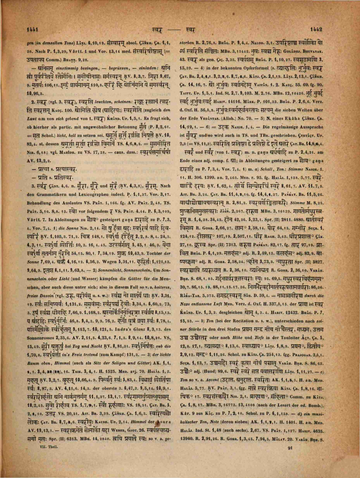
3. svàr ŚĀNT. 4,6. n. sū́rā, sū́re und sūré (ṚV. 4,3,8), sū́ras. Nach den Grammatikern und Lexicographen indecl. P. 1,1,37. VOP. 3,17. Behandlung des Auslautes VS. PRĀT. 1,166. fg. AV. PRĀT. 2,48. TS. PRĀT. 5,10. TS. PRĀT. 8,8. TS. PRĀT. 8,13. svo vor folgendem ra VS. PRĀT. 4,44. P. 6,3,109, Vārtt. 7. In Ableitungen zu sauva˚ gesteigert gaṇa dvārādi zu P. 7,3,4. VOP. 7,4. 1〉 die Sonne NIR. 2,14. mo ṣu dèvā a̱daḥ sva1̱̀ravà pādi di̱vasparì ṚV. 1,105,3. ṚV. 1,71,2. citra ṚV. 1,148,1. sva1̱̀rṇa dīdèt ṚV. 2,2,8. ṚV. 2,8,4. ṚV. 2,24,3. ṚV. 4,3,11. sva1̱̀rṇa jyotìḥ ṚV. 10,3. ṚV. 16,4. ṚV. 4,45. utsvàrgāt ṚV. 5,45,1. ṚV. 5,46,3. yenā̱ sva1̱̀rṇa ta̱tanā̀ma̱ nṝm̐ra̱bhi ṚV. 54,15. ṚV. 80,1. ṚV. 7,34,19. śukra ṚV. 10,43,9. Tochter der Sonne ṚV. 7,69,4. cakra ṚV. 4,16,12. ṚV. 6,56,3. Wagen ṚV. 5,31,11. ha̱ritàḥ ṚV. 1,121,13. ṚV. 9,64,9. etaśa ṚV. 8,1,11. ṚV. 9,63,8. — 2〉 Sonnenlicht, Sonnenschein. Um Sonnenschein oder Licht (und Wasser) kämpfen die Götter für die Menschen, aber auch diese unter sich; also in diesem Fall so v. a. heiteres, freies Dasein (vgl. uru, varīyaṃs u. s. w.): svàśca no sā̱tayè dhāḥ ṚV. 3,31,19. svàḥ sani̱ṣyavàḥ ṚV. 1,131,2. sa̱sa̱vāṃsa̱ḥ svàra̱paścà de̱vīḥ ṚV. 3,34,8. ṚV. 6,60,2. ṚV. 6,73,3. iṣa̱ṃ svàśca dhīmahi ṚV. 7,66,9. ṚV. 1,168,2. a̱smākèbhi̱rnṛbhi̱ratrā̱ svàrjaya ṚV. 8,15,12. ya ā̀da̱diḥ sva1̱̀rnṛbhìḥ ṚV. 46,8. ṚV. 9,4,2. ṚV. 9,9. ṚV. 76,2. hanò vṛ̱traṃ jayā̱ svàḥ ṚV. 8,78,4. yasmìm̐llo̱ke svàrhi̱tam ṚV. 9,113,7. ṚV. 10,121,5. Indraʼs Glanz ṚV. 8,3,13. des Sonnenrosses ṚV. 2,35,6. AV. 2,11,5. AV. 4,23,6. AV. 7,1,2. AV. 8,9,14. AV. 10,8,21. VS. 15,49. sūrò a̱ktuṣù bei Tag und Nacht ṚV. 8,81,31. sva1̱̀rniṣàttaḥ sub dio ṚV. 1,70,8. sva1̱̀ryantā̀ inʼs Freie tretend (zum Kampf) ṚV. 1,131,3. — 3〉 der lichte Raum oben, Himmel (auch als Sitz der Seligen und Götter) AK. 1,1,1,1. AK. 3,4,32 (28), 16. TRIK. 3,4,1. H. 1525. MED. avy. 70. HALĀY. 1,3. ma̱hat ṚV. 3,2,7. bṛ̱hat ṚV. 10,66,4. ṚV. 10,66,9. pinvàte̱ svàḥ ṚV. 5,83,4. vi̱bhrāja̱ṃ jyotìṣā̱ svàḥ ṚV. 8,87,3. AV. 4,11,6. AV. 4,14,2. der oberste AV. 4,11,3. AV. 6,47,3. AV. 9,5,14. AV. 10,9,1. svàrā̱rohànto a̱bhi nākàmu̱ttamàm AV. 11,1,37. AV. 13,1,7. svàragā̱māyùṣmānbhūyāsam AV. 18,2,45. suvo̱ rohā̀va TS. 1,7,9,1. svò ruhā̀ṇāḥ VS. 18,51. ŚAT. BR. 5,2,1,10. uttara VS. 20,21. AIT. BR. 3,39. ŚĀṄKH. ŚR. 1,6,3. svarityasau lokaḥ ŚAT. BR. 8,7,4,6. svarīyuḥ KAUṢ. UP. 2,14. Himmel der Asura AV. 19,13,1. — svarākramete somārkau yadā WEBER, JYOT. 26. svaryātyavyasanī mṛtaḥ Spr. (II) 6313. MBH. 14,2840. tvayi prayāte svaḥ so v. a. gestorben R. 2,76,8. BHĀG. P. 9,4,4. NALOD. 3,1. upariṣṭācca svarloko yo 'yaṃ svariti saṃjñitaḥ MBH. 3,15442. bhuvaḥ svaśca meruḥ GOLĀDHY. BHUVANAK. 43. svar als gen. ŚIŚ. 3,35. svaryaśas BHĀG. P. 1,10,27. svaścūḍāmaṇi BHĀG. P. 3,15,39. — 4〉 in der bekannten Opferformel (s. vyāhṛti) bhūrbhuvaḥ svar ŚAT. BR. 2,4,1,1. ŚAT. BR. 3,2,2,6. ŚAT. BR. 8,7,4,6. KĀTY. ŚR. 2,1,19. LĀṬY. 2,13,1. ŚĀṄKH. ŚR. 14,16,7. o bhūrbhuvaḥ svarjanadom VAITĀN. 1. VAITĀN. 2. KAUŚ. 55. fg. KAUŚ. 69. fg. KAUŚ. 90. TAITT. UP. 1,5,1. Ind. St. 2,7. Ind. St. 9,103. M. 2,76. MBH. 12,10426. bhūrda bhuvarda svarda bhūrbhuvaḥsvarda HARIV. 14116. MĀRK. P. 101,23. BHĀG. P. 2,6,6. Verz. d. Oxf. H. 56,b,2. bhūrbhuvaḥsvarmaharjanastapaḥ satyam die sieben Welten über der Erde VEDĀNTAS. (Allah.) No. 70. — 5〉 N. eines Ekāha ŚĀṄKH. ŚR. 14,19,1. — 6〉 = udaka NAIGH. 1,4. — Die regelmässige Aussprache ist súvar und so wird auch in TS. und TBR. geschrieben. ŚVETĀŚV. UP. 2,3 (= VS. 11,3). svariti pratiṣṭhā dve pratiṣṭhe dve ete akṣare ŚAT. BR. 14,8,6,4.
Original text · German · Word type unspecified
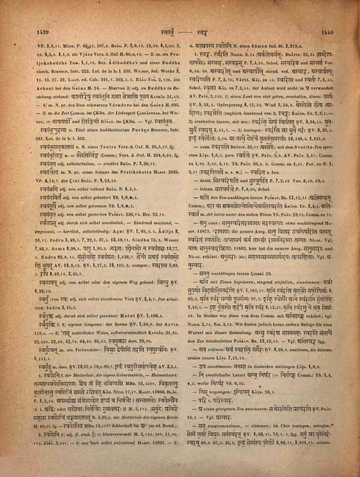
1. √svar , svárati NAIGH. 3,14 (arcatikarman). DHĀTUP. 22,34 (śabdopatāpayoḥ). sasvāra, sasvarus P. 7,4,10, Schol. sasvaritha und sasvartha VOP. 8,46. VOP. 8,90. asvārīt und asvārṣīt ebend. ved. asvār, asvārṣṭām; svariṣyati P. 7,2,70, Vārtt. KĀŚ._zu_P. 7,2,44. svaritā und svartā P. 7,2,44, Schol. svṛtvā KĀŚ._zu_P. 7,2,44. der Anlaut wird nicht in ṣa verwandelt AV. PRĀT. 2,102. 1〉 einen Laut von sich geben, erschallen, tönen: āpàḥ ṚV. 5,54,2. Opfergesang ṚV. 8,12,32. Wind ṚV. 5,54,8. omiti hyeṣa (ādityaḥ) svaranneti (zugleich leuchtend von 2. svar) CHĀND. UP. 1,5,1. — 2〉 erschallen lassen, mit acc.: svarànti̱ ghoṣa̱ṃ vitàtam ṚV. 5,54,12. ghṛ̱ta̱ścutàṃ svā̱ram ṚV. 2,11,7. — 3〉 besingen: svarànti tvā su̱te naràḥ ṚV. 8,33,2. indra̱ṃ stomèbhiḥ ṚV. 8,3,16. ā yaste̱ yonìṃ ghṛ̱tavànta̱masvā̀ḥ ṚV. 10,148,5. ṚV. 1,151,5. — caus. svarayati DHĀTUP. 35,11 (ākṣepe). mit dem Svarita-Ton sprechen LĀṬY. 1,6,3 pass. svaryate ṚV. PRĀT. 3,9. AV. PRĀT. 3,67. Comm. zu AV. PRĀT. 1,93. AV. PRĀT. 3,56. AV. PRĀT. 4,11. TS. PRĀT. 20,2. TS. PRĀT. 20,3. Comm. zu TS. PRĀT. 1,41. PAT._zu_P. 1,3,11 (svarayiṣyate u. s. w.). — svarita s. bes. — desid. sisvariṣati und susvūrṣati P. 7,2,49. VOP. 8,46. VOP. 19,8. — intens. sāsvaryate P. 7,4,30, Schol. — ati den Ton ausklingen lassen PAÑCAV. BR. 13,12,11 (atimandram Comm.). yadā vā ṛcamāpnotyomityevātisvarati CHĀND. UP. 1,4,4. atisvārya m. der letzte unter den sieben Tönen TS. PRĀT. 23,12. Comm. zu TS. PRĀT. 13. — anu caus.: sānusvaritarāgāyāḥ sarasvatyāḥ etwa nachklingend HARIV. 11873. ˚rāmāyāḥ die neuere Ausg. sānu śikhara upaniṣaditi yāvat svaritaṃ svargatiḥ tatsādhanaṃ karma tābhyāṃ rāmābhirāmā tasyāḥ NĪLAK. Vgl. vācaḥ sānusvārakriyāḥ HARIV. 11882. hier hat die neuere Ausg. sānusārāḥ und NĪLAK. erklärt: anusarāḥ (sic) sahāyāścamasādhvaryādayaḥ tatsahitāḥ Vgl. anusvāra. — samanu nachklingen lassen ŚIKṢĀ 29. — abhi mit Tönen begrüssen, singend einfallen, einstimmen: yatrā̀ supa̱rṇā vi̱dathā̀bhi̱svarànti ṚV. 1,164,21. a̱bhi svàranti ba̱havò manī̱ṣiṇàḥ ṚV. 9,85,3. a̱bhi svàra̱ dhanvā̀ pū̱yamā̀naḥ ṚV. 9,97,3. ehi̱ svomā̀m̐ a̱bhi svàrā̱bhi gṛ̀ṇīhi ṚV. 1,10,4. — i̱ha yùjā̱no harī̀ a̱bhi svàra ṚV. 8,13,27. a̱bhi svàrantu̱ ye tava̱ viśàḥ ṚV. 8,13,28. In Stellen wie diese von dem Comm. mit abhigaccha erklärt; vgl. NAIGH. 2,14. NIR. 3,12. Wir finden jedoch keine andern Belege für eine Wurzel mit dieser Bedeutung. abhyu svareṇa saptamamahaḥ svarati saṃtatyai den Ton hinüberleiten PAÑCAV. BR. 13,12,13. — Vgl. abhisvar fgg. — ava ertönen: avà svarāti̱ gargàraḥ ṚV. 8,58,8. austönen, die Stimme sinken lassen LĀṬY. 7,11,12. — upa einstimmen: manasā in Gedanken mitsingen LĀṬY. 1,8,9. — ni zweifelhafte Lesart amba̱ niṣvàra (= nirgaccha Comm.) TS. 1,4,1,2, wofür niṣpàra VS. 6,36. — nis wegsingen: indriyam KĀṬH. 26,1. — pari s. parisvāra. — pra einen gezogenen Ton ausstossen: sa o3miti prasvarati ṚV. PRĀT. 15,3. — Vgl. prasvāra. — sam zusammentönen, — stimmen; im Chor besingen, anrufen: somàṃ ma̱tī viprā̱ḥ samàsvaran ṚV. 9,63,21. ṚV. 9,73,1. ṚV. 9,63,4. fgg. samù tvā dhī̱bhiràsvaran ṚV. 66,8. ṚV. 67,9. ṚV. 45,5. indra̱ṃ somàsya pī̱tayè ṚV. 8,86,11. ṚV. 9,101,11. mitsingen (in demselben Tone) LĀṬY. 6,10,19. saṃsvāram absol. ŚĀṄKH. ŚR. 1,1,30. Nach P. 1,3,29, Vārtt. 1 und VOP. 13,14 med. saṃsvariṣīṣṭhās (= upatāpaya Comm.) BHAṬṬ. 9,28. — abhisam einstimmig besingen, — begrüssen, — einladen: a̱bhi tvā̀ pū̱rvapī̀taye̱ stomèbhiḥ . sa̱mī̱cī̱nāsa̱ḥ samàsvaran ṚV. 8,3,7. gi̱rā ṚV. 9,67,9. ma̱tayàḥ ṚV. 9,106,11. indra̱ṃ jāyàmānam ṚV. 9,110,8. hari̱ṃ hi yonìmabhi ye sa̱masvàran ṚV. 10,96,2.
Original text · German · Word type unspecified
2. svar (vgl. 3. svar), svarati leuchten, scheinen: rāhū rājānaṃ tsarati svarantam KAUŚ. 100. omiti hyeṣa (ādityaḥ) svaranneti (zugleich den Laut om von sich gebend von 1. svar) CHĀND. UP. 1,5,1. Es fragt sich, ob hierher als partic. mit ungewöhnlicher Betonung sū́rta (P. 8,2,61. = sṛta Schol.) licht, hell zu setzen sei. a̱sūrte̱ sūrte̱ rajàsi niṣa̱tte ṚV. 10,82,4. st. dessen a̱sūrtā̱ sūrtā̱ rajàso vi̱mānè TS. 4,6,2,2. = susamīrita NIR. 6,18; vgl. MAHĪDH._zu_VS. 17,28. — caus. dass.: sva̱rayàntama̱rciṣā̀ AV. 13,2,2. — pratyā s. pratyāsvara. — prati s. pratisvara.
Böhtlingk 1879 particle · verbal root
Original text · German · particle
3. svàr, súar, súvar (TS. TBR.) Indecl. im Sinne eines Nomin., Acc., Loc. (ṚV. HEMĀDRI 1,449,20), Abl. (NAIṢ. 6,99) und Gen. — 1〉 die Sonne. — 2〉 Sonnenlicht, Sonnenschein. — 3〉 Licht, Glanz. — 4〉 das Freie, der freie Raum. — 5〉 der lichte Raum oben, Himmel (auch als Sitz der Seligen und Götter, aber auch der Asura). svaḥ prayātaḥ so v. a. gestorben. — 6〉 in der Opferformel bhū́rbhúvaḥsvàḥ. Bei der Annahme von 14 Welten nimmt svar die 3te Stelle unter den 7 aufsteigenden Welten ein. — 7〉 ein best. Ekāha. — 8〉 *Wasser.
Original text · German · verbal root
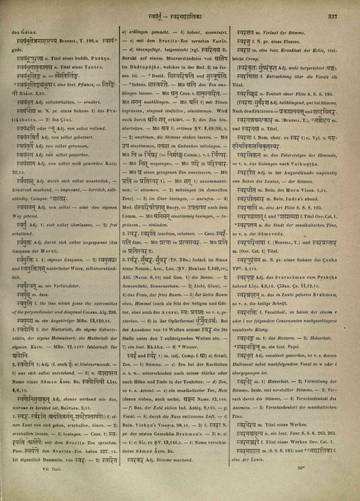
1. √svar , svárati (arcatikarman, śabdopatāpayoḥ) — 1〉 einen Laut von sich geben, erschallen, tönen. — 2〉 erschallen lassen. — 3〉 besingen. — Caus. — 1〉 svarayati (ākṣepe) mit dem Svarita-Ton sprechen. Pass. svaryate den Svarita-Ton haben Chr. 227,14. Ist eigentlich Denomin. von svara. — 2〉 svarita [Page7-237-b] — a〉 erklingen gemacht. — b〉 betont, accentuirt. — c〉 mit dem Svarita-Ton versehen VAITĀN. — d〉 hinzugefügt, beigemischt (vgl. svaritatva 3〉. Beruht auf einem Missverständniss von ākṣepa im Dhātupāṭha, welches in der Bed. 5) zu fassen ist. — *Desid. sisvariṣati und susvūrṣati — *Intens. sāsvaryate. — Mit ati den Ton ausklingen lassen. — Mit anu. Caus. s. sānusvarita. — Mit samanu nachklingen. — Mit abhi — 1〉 mit Tönen begrüssen, singend einfallen, einstimmen. Wird auch durch abhi-gam erklärt. — 2〉 den Ton hinüberleiten. — Mit ava — 1〉 ertönen ṚV. 8,69 (58),9. — 2〉 austönen, die Stimme sinken lassen. — Mit upa einstimmen. manasā in Gedanken mitsingen. — Mit ni in níṣvara (= nirgaccha Comm.). v. l. níṣpara. — Mit nis wegsingen. — Mit pari in parisvāra. — Mit pra einen gezogenen Ton ausstossen. — Mit prati in pratisvara 1〉. — Mit sam — 1〉 zusammentönen, — stimmen. — 2〉 mitsingen (in demselben Tone). — 3〉 im Chor besingen, — anrufen. — 4〉 Med. saṃsvariṣīṣṭhās BHAṬṬ. = upatāpaya nach dem Comm. — Mit abhisam einstimmig besingen, — begrüssen, — einladen.
Original text · German · verbal root
2. √svar , svarati leuchten, scheinen. — Caus. svaráyati dass. — Mit pratyā in pratyāsvara. — Mit prati in pratisvara 2〉.
Whitney Roots 1885 verbal root
Original text · English · verbal root
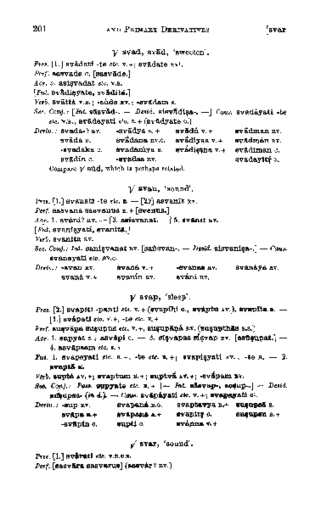
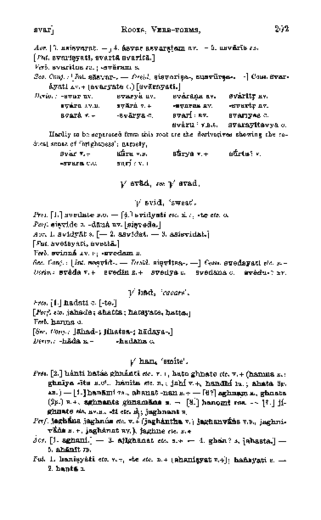
svar — sound
Apte 1890 particle · verbal root
Original text · English · particle
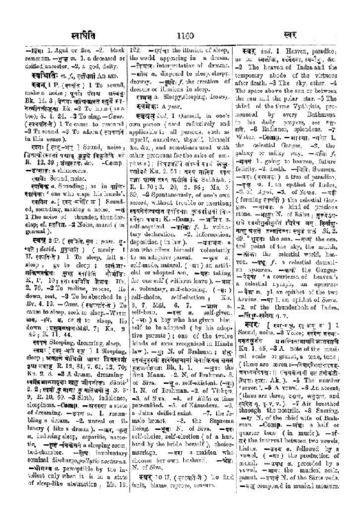
svar ind. 1 Heaven, paradise; as in svarloka, svarveśyā, svarbhānuḥ, &c. 2 The heaven of Indra and the temporary abode of the virtuous after death. 3 The sky, ether. 4 The space above the sun or between the sun and the polar star. 5 The third of the three Vyāhṛtis, pronounced by every Brāhmaṇa in his daily prayers, see vyāhṛti. 6 Radiance, splendour. 7 Water. Comp. — āpagā, -gaṃgā 1 the celestial Ganges. 2 the galaxy or milky way. — gatiḥ f. — gamanaṃ 1 going to heaven, future felicity. 2 death. — giriḥ Sumeru. — taruḥ (svastaruḥ) a tree of paradise. — ṭṭaś m. 1 an epithet of Indra. 2 of Agni. 3 of Soma. — nadī (forming svarṇadī) the celestial Ganges. — bhānavaḥ a kind of precious stone. — bhānuḥ N. of Rāhu; tulye' parādhe svarbhānurbhānumaṃtaṃ cireṇa yat . himāṃśumāśu grasate tanmradimnaḥ sphuṭaṃ phalaṃ Śi. 2. 49. ˚sūdanaḥ the sun. — madhyaṃ the central point of the sky, the zenith, — lokaḥ the celestial world, heaven. — vadhūḥ f. a celestial damselan apsaras. — vāpī the Ganges. — veśyā ‘a courtezan of heaven’, a celestial nymph, an apsaras. — vaidya m. pl. an epithet of the two Aśvins. — ṣā 1 an epithet of Soma. 2 of the thunderbolt of Indra. — siṃdhu = svargaṃgā q. v.
Original text · English · verbal root
svar 10 U. (svarayati-te) To find fault, blame, reprove, censure.
Cappeller 1887 verb
Original text · German · verb
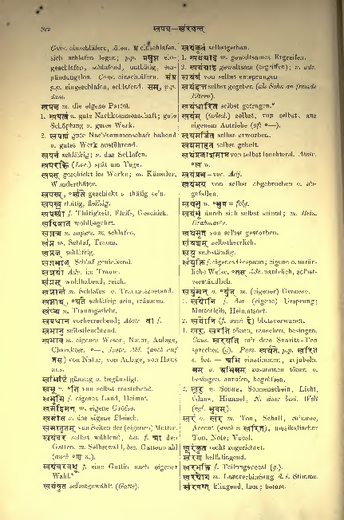
1. svar, svárati tönen, rauschen, besingen. Caus. svarayati mit dem Svarita-Ton sprechen (g.). Pass. svaryate, p. p. svarita s. bes. — abhi einstimmen, zujubeln. sam u. abhisam zusammen tönen o. besingen, anrufen, begrüßen.
Burnouf 1866 particle · verbal root
Original text · French · particle
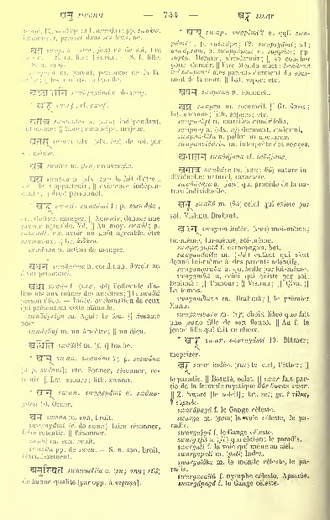
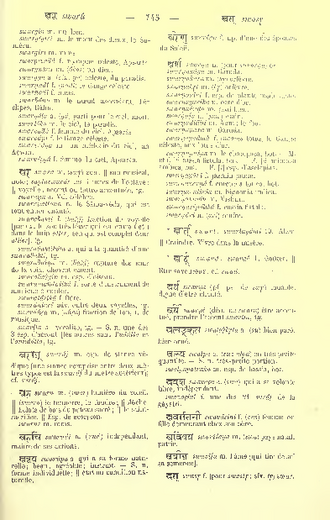
svar svar indéc. (sur) le ciel, l'éther; le paradis. Beauté, éclat. svar fait partie de la formule mystique bhūr bhuvas svar. Z. hware [le soleil]; lat. sol; gr. ? σέλας, ? οὐρανός svarāpagā f. le Gange céleste. svarga m. (gam) la voie céleste, le paradis. svargaṅgā f. le Gange céleste. svargajit a. (ji) qui obtient le paradis. svargati f. la voie qui mène au ciel. svargapati m. (pati) Indra. svargaloka m. le monde céleste, le paradis. svargavadhū f. nymphe céleste, Apsaras. svargāpagā f. le Gange céleste. [Page745-1] svargin m. un dieu. svargigiri m. le mont des dieux, le Sumeru. svargiri m. mms. svargivadhū f. nymphe céleste, Apsaras. svargaukas m. (okas) un dieu. svargya a. (sfx. ya) céleste, du paradis. svarṇadī f. (nadī) le Gange céleste. svarnadī f. mms. svarbhānu m. le nœud ascendant, l'éclipse, Rāhu. svaryāta a. (yā) parti pour le ciel, mort. svarloka m. le ciel, le paradis. svarvadhū f. femme du ciel, Apsaras. svarvāpī f. le Gange céleste. svarvedya m. un médecin du ciel, un Aśvin. svarveśyā f. femme du ciel, Apsaras.
Original text · French · verbal root
*svar svar. svarayāmi 10. Blâmer; mépriser.
Occurrences in source texts (2)
MAN 1 occurrence
SVU 1 occurrence
Continue with AYI Free
Image source: AYI archive.