


How many vowels does that give us? Five!
Each of these five vowels can be pronounced either short or long. Long vowels have a line above the letter and are pronounced twice as long as short vowels. This gives us a total of 10 vowels.
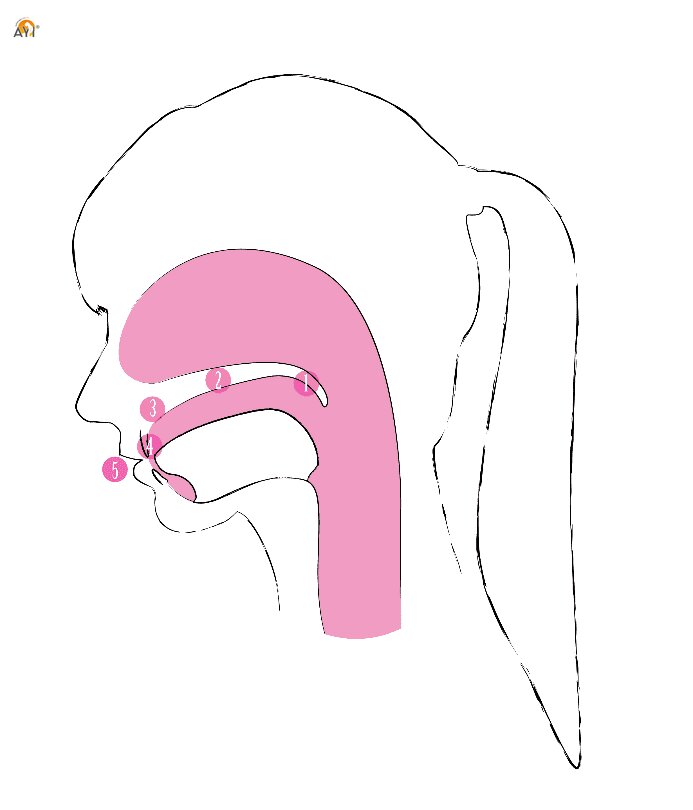
In this sequence, the vowels are arranged by their place of articulation in the mouth:
a, ā, i, ī, ṛ, ṝ, ḷ, ḹ, u, ū
- a, ā (throat, 1),
- i, ī (palate, 2),
- ṛ, ṝ (retroflex, 3),
- ḷ, ḹ (dental, 4),
- u, ū (labial, 5)
Note: For simplicity, the two sonant pairs ṛ, ṝ and ḷ, ḹ have been counted as vowels.
Retroflex articulation (ṛ, ṝ) is unfamiliar to German speakers. To pronounce it, curl the tip of your tongue upwards behind your teeth without touching them. The American English r in “we are” uses a similar tongue position. A familiar Saṃskṛt word is Kṛṣṇa (Krishna). The retroflex ṛ sounds like ri.
Now pronounce the vowels, paying attention to where each one is formed in your mouth. Move from the guttural a at the back, through i at the palate, ṛ behind the teeth and ḷ at, almost between, the teeth, forwards to u at the lips.
Once you understand this sequence from back to front, you already understand the basic structure of the alphabet.
Alongside the vowels, there are diphthongs. These are always pronounced long because they can be formed by merging two vowels: e, ai, o, au.
This is enough for an introduction. To explore the vowels in greater depth, visit this page: Vowels — AṣṭāṅgaYoga.info
Consonants
A consonant, such as k, combines with a vowel, such as a, or a diphthong (e, ai, o, au) to form a syllable, such as ka.
The consonant can be pronounced hard (ka), hard and aspirated (kha), soft (ga), soft and aspirated (gha), or nasalised (ṅa).
At one place of articulation, such as the throat, there are therefore five possible consonants: ka, kha, ga, gha, ṅa.
The order is always:
- Voiceless (hard),
- voiceless and aspirated,
- voiced (soft),
- voiced and aspirated,
- nasalised.
25 Sparśa consonants / Plosive sounds
Applying this pattern to every place of articulation gives us five consonants at each of five places:
- Throat: ka, kha, ga, gha, ṅa
- Palate: ca, cha, ja, jha, ña
- Retroflex: ṭa, ṭha, ḍa, ḍha, ṇa
- Dental: ta, tha, da, dha, na
- Labial: pa, pha, ba, bha, ma
These are also called the 25 Sparśa consonants. Sparśa means “contact”, because the airflow is blocked during their articulation.
Say a: the air can flow out freely. Now say ka. Can you feel how the root of your tongue briefly blocks the airflow in your throat to form k, then releases it so that a can sound?
- In the throat, sound is formed with the help of the back of the tongue, or tongue root.
- At the hard palate, the middle of the tongue is involved.
- Retroflex sounds use the tip of the tongue.
- Dental articulation also uses the tip of the tongue.
- At the labial place of articulation, the lips move.
You can recognise the retroflex sounds (ṭa, ṭha, ḍa, ḍha, ṇa) by a dot under the letter.
Aspirated sounds have an “h” after the consonant. Note that the combination counts as one consonant. The aspirated h should be audible in pronunciation.
Example: ka as in the German word kann, kha as in the German word Kahn.
In German, sounds aspirated in this way are often familiar only from compound words, so German speakers need to practise this pronunciation. Try the following exercise:
- Repeat ka - ha several times, with a short pause after ka: ka - ha, ka - ha.
- Then imagine leaving out the first a: k - ha, k - ha, k - ha, still with a short pause after k.
- Now let the letters merge without a pause: kha.
- Try to breathe out the ha for as long as possible.
The difference between the unaspirated and aspirated sounds should be audible, since otherwise the meaning of the word changes.
Example: phala means fruit, whereas pala means flesh!
This is enough to continue for now. You can explore the consonants in greater depth here: Plosives — AṣṭāṅgaYoga.info
4 Usṣman consonants / Sibilants
In Saṃskṛt, the Uṣman sounds are classified as fricatives or sibilants. This group typically includes sounds created by friction in the airflow at particular points in the mouth, producing a characteristic hissing sound.
With five places of articulation, we would also expect five Uṣman sounds. However, the labial sibilant has no separate written character in Saṃskṛt.
This leaves four Uṣman sounds:
- h: Guttural
- ś: Palatal
- ṣ: Retroflex
- s: Dental
This is enough to continue for now. You can explore the sibilants in greater depth here: Sibilants — AṣṭāṅgaYoga.info
4 Antastha consonants / Semivowels
The Antastha sounds occupy an intermediate position between contact sounds (Sparśa) and friction sounds (Uṣman). Their articulation requires neither full contact nor pure friction. We can also call these sounds semivowels.
With five places of articulation, we would also expect five Antastha sounds. However, the guttural Antastha sound has no separate written character in Saṃskṛt.
This leaves four Antastha sounds:
- y: Palatal
- r: Retroflex
- l: Dental
- v: Labial
This is enough to continue for now. You can explore the semivowels in greater depth here: Semivowels — AṣṭāṅgaYoga.info
5 Anunāsika consonants / Nasal sounds
In Saṃskṛt, the five nasal sounds are called “Anunāsika”. These sounds correspond to the five phonetic areas and are often used in combination with other consonants to emphasise the nasal quality.
With five places of articulation, we expect five Anunāsika sounds, and here we do indeed have five:
- ṅ: Guttural
- ñ: Palatal
- ṇ: Retroflex
- n: Dental
- m: Labial
This, too, is enough to continue for now. You can explore the nasal sounds in greater depth here: Nasals — AṣṭāṅgaYoga.info
A living language
Saṃskṛt is not a dead language. There are thought to be a handful of Indian villages in Madhya Pradesh and Karnataka where people are trying to use it as an everyday language. One well-known village is Mattur, about 300 km from Bangalore. Mattur is home to the Sankethis, an old Brahmin community that migrated from Kerala around 600 years ago. In 1981, the villagers of Mattur readopted Saṃskṛt as their main language in an effort to preserve it. Children learn Saṃskṛt as their first language at school, although a dialect is still often used in everyday life.
Continue with AYI Free
Test Your Knowledge of the Article
5 questions to deepen this article.


Please log in to write a message. Go to login