

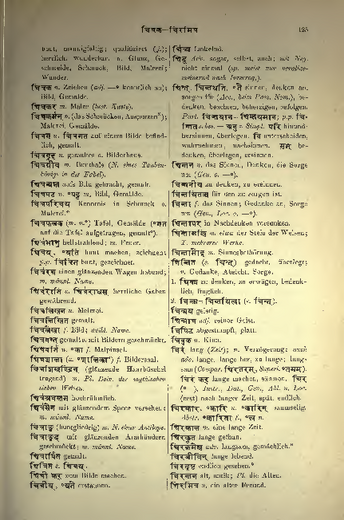
cid चिद् – sogar, selbst, auch
Adverb · Partikel · Worttyp nicht bestimmt
Wörterbuchquellen
Cappeller 1891 Adverb
Originaltext · Englisch · Adverb
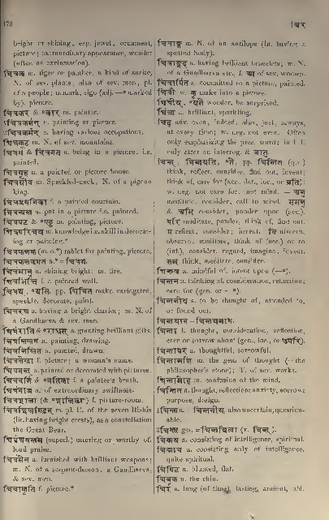
cid ·adv. even, indeed, also, just, always, at every time; w. neg. not even. Often only emphasizing the prec. word; in l. l. only after an interrog. & jātu.
Monier-Williams 1872 Partikel · Worttyp nicht bestimmt
Originaltext · Englisch · Partikel
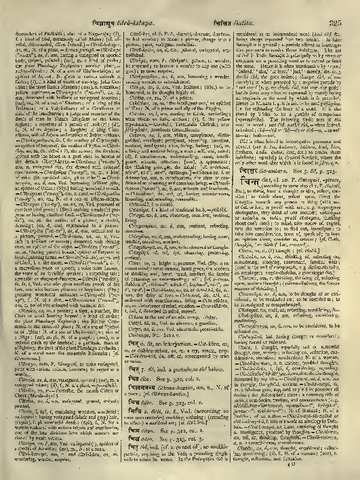
cid cid, ind. [cf. 2. ca and id], an enclitic particle, requiring in the Veda a preceding simple verb to retain its accent. In the Pada-pāṭha cid is considered as an independent word (kaś cid &c. being always separated into two words). In later Sanskrit it is generally a particle affixed to interroga- tive pronouns to render them indefinite. The use of cid in Vedic Sanskrit is principally to lay stress or emphasis on a preceding word or to extend or limit the sense. Hence it is often translateable by ‘even,’ ‘indeed,’ ‘also,’ ‘at least,’ ‘just,’ ‘merely,’ &c. (e. g. devāś cid, the gods indeed; ekasya cid, of one merely); or when preceded by a negative particle by ‘not even’ (e. g. na devāś cid, not even the gods): but its force may often be expressed by merely laying an emphasis on the word by which it is preceded. Hence in Nirukta I. 4. it is said to be used pūjāyām, i. e. for enhancing the force of a word. It is also stated by Yāska to be a particle of comparison (upamārthe). The following Vedic uses of cid may be noted; yac cid, yathā cid, = when indeed, as indeed; cid — cid or cid — ca or cid — u, = as well as — as; both — and.
Originaltext · Englisch · Worttyp nicht bestimmt
Cid is often joined to interrogative pronouns and adverbs (see 2. ka, katama, katara, kad, kim, katham, kadā, kutas, kva, &c.) to render them indefinite; especially in classical Sanskrit, where the only other word after which it is found is jātu, q. v.
Petersburger 1855 Worttyp nicht bestimmt
Originaltext · Deutsch · Worttyp nicht bestimmt
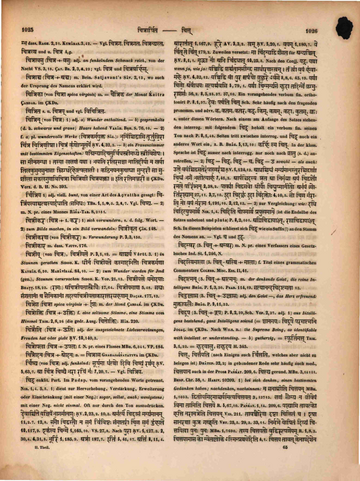
cid enklit. Part. Im Padapāṭha padap. vom vorangehenden Worte getrennt. NIR. 1,4. NIR. 5,5. 1〉 dient zur Hervorhebung, Verstärkung, Erweiterung oder Einschränkung (mit einer Neg.): sogar, selbst, auch; wenigstens; mit einer Neg. nicht einmal. Oft nur durch den Ton auszudrücken. de̱vāścìtte ya̱jñiyàṃ bhā̱gamā̀naśuḥ ṚV. 2,23,2. ṚV. 2,10,3. amàrtyaṃ ciddā̱saṃ manyàmānam ṚV. 11,2. ṚV. 2,7. ṚV. 12,8. sa̱mau ci̱ddhastau̱ na sa̱maṃ vìviṣṭaḥ saṃmā̱tarā̀ ci̱nna sa̱maṃ dùhāte ṚV. 10,117,9. ekàsya cinme ṚV. 1,165,10. VS. 27,8. Nach pu̱rā ṚV. 1,127,3. ṚV. 2,30,4. ṚV. 4,31,8. bhūrì ṚV. 1,185,9. atrā̀ ṚV. 1,187,7. itì ṚV. 5,41,17. antì ṚV. 8,11,4. ā̱rāttā̀t ṚV. 1,167,9. dū̱re AV. 3,3,2. tvam ṚV. 5,20,1. va̱yam ṚV. 1,180,7. ye cìt te cìt ṚV. 1,179,2. Zuweilen versetzt: mā cìda̱nyadvi śàṃsata für anyaccit ṚV. 8,1,1. mṛ̱ḻā nò a̱bhi cìdva̱dhāt ṚV. 10,25,3. Nach den Conjj. yad, yathā wenn ja, wie ja: yacci̱ddhi śaśvàtā̱masīndra̱ sādhā̀raṇa̱stvam . taṃ tvā̀ va̱yaṃ hàvāmahe ṚV. 4,32,12. yacci̱ddhi vāṃ pu̱ra ṛṣàyo juhu̱re 'vàse ṚV. 8,8,6. ṚV. 8,45,19. yathā̀ cinno̱ abòdhayaḥ sa̱tyaśràvasi ṚV. 5,79,1. yathā̀ ci̱nmanyàse hṛ̱dā tadinmè jagmurā̱śasàḥ ṚV. 56,2. ṚV. 8,5,25. ṚV. 5,37. ṚV. 57,10. Ein vorangehendes verbum fin. orthotonirt P. 8,1,57. de̱vaḥ pacàti cit Sch. Sehr häufig nach den fragenden pronomm. und advv. ka, katama, katara, kad, kim, katham, kadā, kutas, kva; s. unter diesen Wörtern. Nach einem am Anfange des Satzes stehenden interrog. mit folgendem cid behält ein verbum fin. seinen Ton nach P. 8,1,48. Selten tritt zwischen interrog. und cid noch ein anderes Wort ein, z. B. BHĀG. 5,13,10: karhi sma cit. In der klass. Sprache ist cid ausser nach interrogg. nur noch nach jātu (s. d.) anzutreffen. — 2〉 cid — cid, cid — ca, cid — u sowohl — als auch: utte̱ vayàścidvasa̱teràpapta̱nnaràśca ṚV. 1,124,12. ā̱dhraści̱dyaṃ manyàmānastu̱raści̱drājā̀ ci̱dyaṃ bhagàṃ bha̱kṣītyāhà ṚV. 7,41,2. āpàścidasya vra̱ta ā nimṛ̀grā a̱yaṃ ci̱dvātò ramate̱ parìjman ṚV. 2,38,2. pā̱kyā̀ cidvasavo dhī̱ryā̀ cidyu̱ṣmānī̀to̱ abhàya̱ṃ jyotìraśyām ṚV. 27,11. ṚV. 3,7,10. i̱dā ci̱dahnà i̱dā cìda̱ktoḥ ṚV. 4,10,5. so ci̱nna màrāti̱ no va̱yaṃ màrāma ṚV. 1,191,10. ṚV. 2,12,13. — 3〉 zur Vergleichung: wie: dadhi cidityupamārthe NIR. 1,4. ciditi copamārthe prayujyamāne (ist die Endsilbe des Satzes unbetont und pluta) P. 8,2,101. agnicidbhāyā3t, rājacidbhāyā3t Sch. In diesen Beispielen schliesst sich cid wie ein Suffix (!) an den Stamm des Nomens an. — Vgl. ca und id.
Böhtlingk 1879 Adverb
Originaltext · Deutsch · Adverb
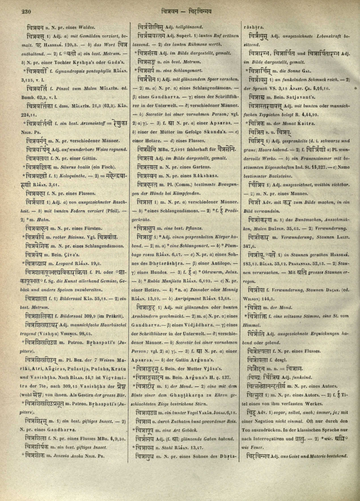
cid Adv. — 1〉 sogar, selbst, auch; immer, je; mit einer Negation nicht einmal. Oft nur durch den Ton auszudrücken. In der klassischen Sprache nur nach Interrogativen und jātu. — 2〉 *wie. agni˚ wie Feuer.
Cappeller 1887 Adverb
Originaltext · Deutsch · Adverb
cid Adv. sogar, selbst, auch; mit Neg nicht einmal (sp. meist nur verallgemeinernd nach Interrog).
Quelltextfundstellen (1)
SiSa 1 Fundstelle
Mit AYI Free weitermachen
Bildquelle: AYI Archiv.