

śāka शाक – herb; vegetable
adjective · substantive masculine · substantive neuter · Word type unspecified
Dictionary sources
AYI dictionary substantive neuter
herb; vegetable
Cappeller 1891 adjective · substantive masculine · substantive neuter
Original text · English · substantive masculine
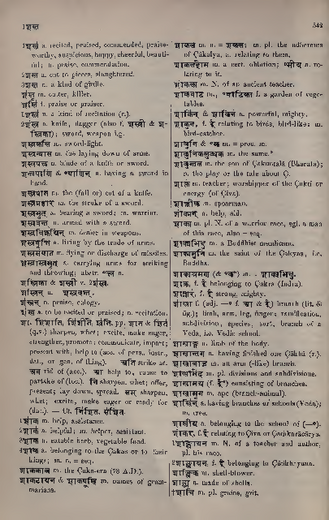
śā́ka1 ·m. help, assistance.
Original text · English · adjective
śāká2 ·a. helpful; m. helper, assistant.
Original text · English · adjective
śāka4 ·a. belonging to the Śakas or to their kings; m. n. = seq.
Original text · English · substantive neuter
śāka3 ·n. eatable herb, vegetable food.
Monier-Williams 1872 adjective
Original text · English · adjective
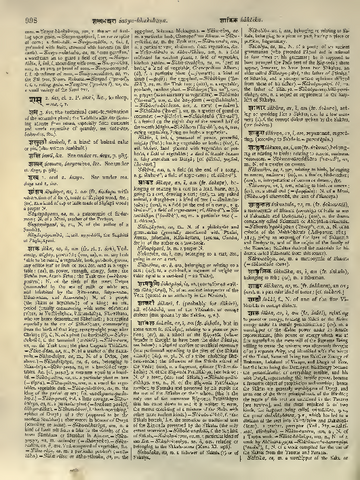
śāka śāka, as, ā, am (fr. rt. 1. śak), Ved. strong, mighty, powerful; (am, as), n. m. any herb ‘able to be eaten,’ a vegetable, herb, pot-herb, greens, any edible leaf or fruit or root &c. used as a vege- table; (as), m. power, strength, energy, force; the Śirīṣa tree, Acacia Sirīsa; the Teak tree (= khara- pattra); N. of the sixth of the seven Dvīpas (surrounded by the sea of milk or white sea, and inhabited by the Ṛta-vratas, Satya-vratas, Dāna-vratas, and Anu-vratas); N. of a people (the Śākas or Scythians); of a king; an era, period (usually commencing with some celebrated prince, as Yudhi-ṣṭhira, Vikramāditya, Śāli-vāhana, who are hence denominated Śākeśvarās; but applied especially to the era of Śāli-vāhana, commencing from the birth of that king, seventy-eight years after Christ); (ā), f., N. of a plant (= harītakī).
Petersburger 1855 adjective · substantive masculine
Original text · German · adjective
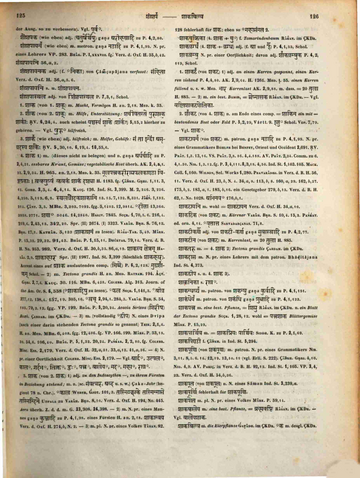
3. śāká (wie eben) adj. hilfreich; m. Helfer, Gehilfe: saṃ tā indrò asṛjadasya śā̱kaiḥ ṚV. 5,30,10. ṚV. 6,19,4. ṚV. 10,55,6.
Original text · German · adjective · substantive masculine
5. śāka (von 2. śaka) 1〉 adj. zu den Indoscythen —, zu ihrem Fürsten in Beziehung stehend; m.n. (sc. saṃvatsara, abda u. s. w.) Śaka-Jahr (beginnt 78 n. Chr.). ˚kāla WEBER, JYOT. 101,3. tasmiñchāke tasminmāse tasmindine UTPALA_zu_VARĀH. BṚH. 8,10. Verz. d. Oxf. H. 194, No. 445. Aera überh. Z. d. d. m. G. 23,308. Z. d. d. m. G. 24,398. — 2〉 m. N. pr. eines Mannes gaṇa kuñjādi zu P. 4,1,98. eines Fürsten H. an. 2,18. śākānvaya Verz. d. Oxf. H. 274,b, N. 2. — 3〉 m. pl. N. pr. eines Volkes TĀRAN. 82. TĀRAN. 128 fehlerhaft für śaka; eben so ˚mahāsaṃmata 2.
Original text · German · substantive masculine
1. śāka (von 1. śak) m. Macht, Vermögen H. an. 2,18. MED. k. 35.
Original text · German · substantive masculine
2. śā́ka (von 2. śak) m. Hilfe, Unterstützung: śacī̀vataste puruśāka̱ śākā̀ḥ ṚV. 6,24,4. auch scheint ya̱jñasyà śā̱ke (śākè?) ṚV. 5,15,2. hierher zu gehören. — Vgl. puru˚ hilfreich.
Original text · German · substantive masculine
4. śāka 1〉 m. (dieses nicht zu belegen) und n. gaṇa ardharcādi zu P. 2,4,31. essbares Kraut, Gemüse; vegetabilische Kost überh. AK. 2,4,5,1. AK. 2,4,5,23. AK. 2,2,9,34. H. 965. H. an. 2,18. MED. k. 35. mūlapattrakarīrāgraphalakāṇḍā virūḍhakāḥ . tvakpuṣpaṃ kavakaṃ śākaṃ daśadhā H. 1183. fg. ŚĀṄKH. GṚHY. 1,11. ŚĀṄKH. GṚHY. 3,12. GOBH. 3,5,4. GOBH. 4,4,14. KAUŚ. 126. Ind. St. 3,399. M. 2,246. M. 3,226. M. 4,250. M. 5,119. M. 6,5. sthalajaudakaśākāni M. 13. M. 15. M. 7,132. M. 8,331. YĀJÑ. 1,182. YĀJÑ. 1,214. ŚĀNT. 3,5. MBH. 3,203. fgg. MBH. 3,7092. MBH. 5,1402. fgg. MBH. 12,9814. ˚dīkṣā MBH. 13,360. MBH. 13,2938. MBH. 13,2771. śaṇa˚ MBH. 13,5046. MBH. 14,2840. HARIV. 7845. SUŚR. 1,70,5. SUŚR. 1,70,6. SUŚR. 1,216,4. SUŚR. 1,219,6. SUŚR. 2,45,15. SUŚR. 2,342,20. Spr. (II) 2674. Spr. (II) (I) 3323. VARĀH. BṚH. S. 76,12. BṚH. 17,1. KATHĀS. 5,133 (śākāśanaṃ zu lesen). RĀJA-TAR. 5,49. MĀRK. P. 15,32. MĀRK. P. 29,32. MĀRK. P. 91,43. BHĀG. P. 1,15,11. DHŪRTAS. 79,14. Verz. d. B. H. No. 953. Verz. d. B. H. No. 989. Verz. d. Oxf. H. 30,b,35. Verz. d. Oxf. H. 86,a,19. śākasya kṣetram HALĀY. 2,9. śākāhāra Spr. (II) 1987. Ind. St. 3,399 (fälschlich śākahāra). Accent eines auf śāka auslautenden comp. (miśre) P. 6,2,128. mudgaśā́kam Schol. — 2〉 m. Tectona grandis H. an. MED. RATNAM. 194. ĀŚV. GṚHY. 2,7,6. KAUŚ. 30. KAUŚ. 116. MBH. 6,428. COLEBR. Alg. 315. Journ. of the Am. Or. S. 6,558 (˚śākādiṣu zu lesen). ˚phala SUŚR. 1,141,3. ˚bīja SUŚR. 377,12. SUŚR. 138,4. SUŚR. 157,19. SUŚR. 305,16. ˚tvac SUŚR. 2,94,1. SUŚR. 2,284,3. VARĀH. BṚH. S. 54,105. VARĀH. BṚH. S. 79,2. VARĀH. BṚH. S. 79,13. fgg. VP. 199. BHĀG. P. 5,20,24. Acacia Sirissa (śirīṣa) Roxb. ŚABDAR._im_ŚKDR. — 3〉 m. (vollständig ˚dvīpa) N. eines Dvīpa (nach einer darin stehenden Tectona grandis so genannt) TRIK. 2,1,4. H. an. MED. MBH. 6,408. fgg. MBH. 12,406. fg. VP. 166. VP. 199. MĀRK. P. 53,18. MĀRK. P. 53,30. MĀRK. P. 54,6. MĀRK. P. 106,40. BHĀG. P. 5,1,32. BHĀG. P. 5,20,24. PAÑCAR. 2,2,80. fg. COLEBR. Misc. Ess. 2,179. Verz. d. Oxf. H. 32,a,31. Verz. d. Oxf. H. 33,a,13. Verz. d. Oxf. H. 41,a,36. — 4〉 N. pr. einer Oertlichkeit COLEBR. Misc. Ess. 2,179. — Vgl. ārdra˚, utpala˚, kāla˚, gardabha˚, tikta˚, duḥ˚, pattra˚, bāleya˚, mada˚, mahā˚, rāja˚.
Böhtlingk 1879 adjective · substantive masculine · substantive neuter
Original text · German · adjective
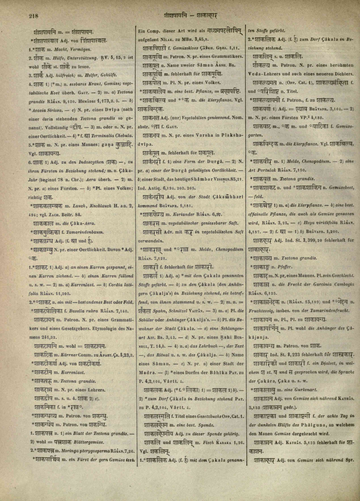
3. śāká Adj. hülfreich; m. Helfer, Gehülfe.
Original text · German · adjective · substantive masculine
6. śāka — 1〉 Adj. zu den Indoscythen (śaka) —, zu ihren Fürsten in Beziehung stehend. m. n. Śāka Jahr (beginnt 78 n. Chr.); Aera überh. — 2〉 m. N. pr. — a〉 eines Fürsten. — b〉 *Pl. eines Volkes; richtig śaka.
Original text · German · substantive masculine
1. *śāka m. Macht, Vermögen.
Original text · German · substantive masculine
2. śā́ka m. Hülfe, Unterstützung. ṚV. 5,15,2 ist wohl śā́ke st. śāké zu lesen.
Original text · German · substantive masculine · substantive neuter
4. śāka — 1〉 (*m.) n. essbares Kraut, Gemüse; vegetabilische Kost überh. GAUT. — 2〉 m. — a〉 Tectona grandis RĀJAN. 9,130. HEMĀDRI 1,173,2. 5. — b〉 *Acacia sirissa. — c〉 N. pr. eines Dvīpa (nach einer darin stehenden Tectona grandis so genannt). Vollständig ˚dvīpa. — 3〉 m. oder n. N. pr. einer Oertlichkeit. — 4〉 *f. ā Terminalia chebula.
Original text · German · substantive masculine
5. *śāka m. N. pr. eines Mannes; gaṇa kuñjādi. Vgl. śākāyanya.
Apte 1890 substantive masculine · substantive neuter
Original text · English · substantive masculine
śākaḥ -kaṃ [śak-ghañ] 1 A vegetable, potherb, herb, any edible leaf, fruit or root used as a vegetable; dillīśvaro vā jagadīśvaro vā manorathān pūrayituṃ samarthaḥ . anyairnṛpālaiḥ paridīyamānaṃ śākāya vā syāllavaṇāya vā syāt Jag. — kaḥ 1 Power, strength, energy. 2 The teak tree. 3 The Śirīṣa tree. 4 N. of a people; see śaka. 5 An era; especially the era of Sālivāhana. 6 N. of the sixth Dvīpa. Comp. — aṃgaṃ pepper. — amlaṃ hog-plum. ˚bhedanaṃ sorrel. — ākhayaḥ the teak tree. — (khayaṃ) a vegetable. — āhāraḥ a vegetarian (living only on herbs &c.) — cukrikā the tamarind. — taruḥ the teak tree. — paṇaḥ 1 a measure equal to a handful. 2 a handful of vegetables. — patraḥ the Śigru tree. — pārthivaḥ a king fond of an era; see madhyamapadalopin. — prati ind. a little of herbs. — yogyaḥ coriander. — vṛkṣaḥ the teak tree. — śākaṭaṃ, śākitaṃ a field of vegetables, a kitchen-garden.
Original text · English · substantive masculine · substantive neuter
śākaḥ -kaṃ [śak-ghañ] 1 A vegetable, potherb, herb, any edible leaf, fruit or root used as a vegetable; dillīśvaro vā jagadīśvaro vā manorathān pūrayituṃ samarthaḥ . anyairnṛpālaiḥ paridīyamānaṃ śākāya vā syāllavaṇāya vā syāt Jag. — kaḥ 1 Power, strength, energy. 2 The teak tree. 3 The Śirīṣa tree. 4 N. of a people; see śaka. 5 An era; especially the era of Sālivāhana. 6 N. of the sixth Dvīpa. Comp. — aṃgaṃ pepper. — amlaṃ hog-plum. ˚bhedanaṃ sorrel. — ākhayaḥ the teak tree. — (khayaṃ) a vegetable. — āhāraḥ a vegetarian (living only on herbs &c.) — cukrikā the tamarind. — taruḥ the teak tree. — paṇaḥ 1 a measure equal to a handful. 2 a handful of vegetables. — patraḥ the Śigru tree. — pārthivaḥ a king fond of an era; see madhyamapadalopin. — prati ind. a little of herbs. — yogyaḥ coriander. — vṛkṣaḥ the teak tree. — śākaṭaṃ, śākitaṃ a field of vegetables, a kitchen-garden.
Cappeller 1887 substantive masculine · Word type unspecified
Original text · German · substantive masculine
1. śā́ka m. Kraft, Hilfe.

Original text · German · substantive masculine
3. śāka m. Kraut, Gemüse.
Original text · German · Word type unspecified
2. śāká kräftig, hinfreich; m. Helfer.
Original text · German · Word type unspecified
4. śāka zu den Śaka gehörig; m. n. ŚakaJahr (von 78 n. Chr.), Ära überh.
Burnouf 1866 substantive masculine · substantive neuter
Original text · French · substantive masculine · substantive neuter
śāka śāka m. n. herbe, toute matière herbacée comestible. — M. (śak) pouvoir, force. Le 6ᵉ grand dvīpa, entouré par la mer de lait. Ere, en gén.; l'ère de Śālivāhana a [78 ans ap. J.-C.]. Mimosa śirīṣa; tectona grandis [bois de tek], bot.
Occurrences in source texts (3)
Continue with AYI Free
Image source: AYI archive.