
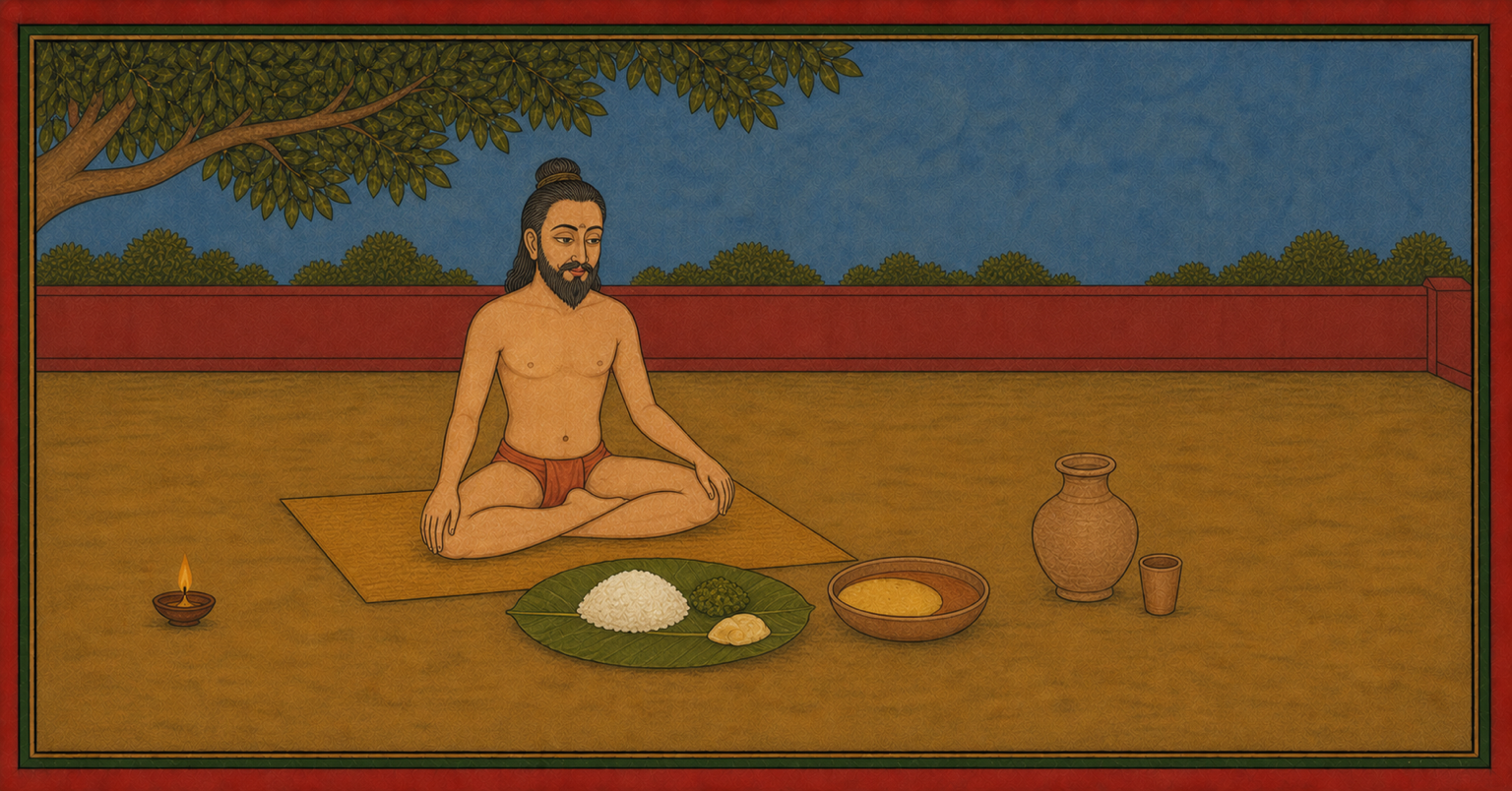

Haṭha Pradīpikā 1.59
कट्वम्लतीक्ष्णलवणोष्णहरीतशाकसौवीरतैलतिलसर्षपमत्स्यमद्यम् |
kaṭv amla-tīkṣṇa-lavaṇoṣṇa-harīta-śāka;-sauvīra-taila-tila-sarṣapa-matsya-madyam | Analysis ▾ Analysis ▴
|
kaṭu
|
pungent, biting | |
|
amla
|
sour | |
|
tīkṣṇa
|
sharp, intense | |
|
lavaṇa
|
salty | |
|
uṣṇa
|
hot | |
|
harīta
|
green, harītaka | |
|
śāka
|
vegetable, herb | |
|
sauvīra
|
sauvīraka, sour-gruel drink | |
|
taila
|
oil | |
|
tila
|
sesame | |
|
sarṣapa
|
mustard | |
|
matsya
|
fish | |
|
madyam
|
alcohol, intoxicating drink |
आजादिमांसदधितक्रकुलत्थकोलपिण्याकहिङ्गुलशुनाद्यमपथ्यमाहुः ||59||
ājādi-māṃsa-dadhi-takra-kulattha-kola;-piṇyāka-hiṅgu-laśunādyam apathyam āhuḥ ||59|| Analysis ▾ Analysis ▴
|
āja
|
of the goat | |
|
ādi
|
and so forth | |
|
māṃsa
|
meat | |
|
dadhi
|
curd, yoghurt | |
|
takra
|
buttermilk | |
|
kulattha
|
kulattha, horse gram | |
|
kola
|
jujube | |
|
piṇyāka
|
oil cake | |
|
hiṅgu
|
asafoetida | |
|
laśuna
|
garlic | |
|
ādyam
|
and the like | |
|
apathyam
|
unwholesome | |
|
āhuḥ
|
they call |
Metre: Vasantatilakā
Pungent, sour, sharp, salty, hot foods and green vegetables (kaṭu-amla-tīkṣṇa-lavaṇa-uṣṇa-harīta-śāka), sour gruel, oil, sesame, mustard, fish, and alcohol (sauvīra-taila-tila-sarṣapa-matsya-madyam | acc sg), goat meat and the like, meat, curds, buttermilk, horse gram, and jujube (ājādi-māṃsa-dadhi-takra-kulattha-kola), and oilcake, asafoetida, garlic, and the like (piṇyāka-hiṅgu-laśuna-ādyam | acc sg n), they call (āhuḥ | 3p pl act perf) unwholesome (apathyam | acc sg n).
Strongly stimulating, heavy, fermenting, or burdensome foods are to be avoided: anything excessively pungent, sour, salty, hot, oily, alcoholic, meat-based, or difficult to digest.
sauvīratailatilasarṣapamatsyamadyam MBHDL2026 ] sauvīratailatilasarṣapamadyamatsyān NS1882
Bitter, sour, saltish, hot, green vegetables, fermented, oily, mixed with til seed, rape seed, intoxicating liquors, fish, meat, curds, chhaasa pulses, plums, oil-cake, asafœtida (hînga), garlic, onion, etc., should not be eaten.
The following things are considered as unsalutary to the Yogis: things that are sharp, sour, pungent and hot, myrobalans, betel-nut and leaves, the ordinary conjee, oil, sesamum, mustard, liquors, fish, flesh of animals like the goat, curds, buttermilk, gram, fruit of the jujube, oil-cakes, asafoetida and garlic.
Unpassende Speise nennt man: Beissendes (wie die Kürbisart Momordica Charantia, Com.), Saures (wie die Tamarindenfrucht), Scharfes (wie der Pfeffer), Salziges, Heisses (wie Syrup, Com.), Harîtaşâka (eine Gemüseart), sauern Reisschleim, Sesamöl, Sesam, Senf, berauschende Getränke, Fische, Fleischsorten wie Ziegenfleisch etc., geronnene Milch, Buttermilch, Kulattha (eine Hülsenfrucht), Judendorn, Oelkuchen, Asa foetida, Knoblauch u. s. w.
Haṭha Pradīpikā 1.60
भोजनमहितं विद्यात्पुनरप्युष्णीकृतं रूक्षम् |
अतिलवणमम्लपृक्तं कदशनशाकोत्कटं दुष्टम् ||60||
Metre: Upagīti
One should know (vidyāt | 3p sg act opt) food (bhojanam | acc sg) to be unwholesome (ahitam | acc sg n) when it has again (punar), even (api), been reheated (uṣṇī-kṛtam | acc sg n ppp), is dry (rūkṣam | acc sg n), excessively salty (ati-lavaṇam | acc sg n), mixed with sour food (amla-pṛktam | acc sg n ppp), consists of poor, heavy food and too many vegetables (kad-aśana-śāka-utkaṭam | acc sg n), or is spoiled (duṣṭam | acc sg n ppp).
Food is unsuitable when reheated, dry, overly salty or sour, heavy, dominated by leafy vegetables, or spoiled.
punar apy uṣṇīkṛtaṃ MBHDL2026 ] punar asyoṣṇīkṛtaṃ NS1882
amlapṛktaṃ MBHDL2026 ] amlayuktaṃ NS1882
duṣṭam MBHDL2026 ] varjyam NS1882
amlapṛktaṃ MBHDL2026 ] amlayuktaṃ NS1882
duṣṭam MBHDL2026 ] varjyam NS1882
Food heated again, dry, having too much salt, sour, minor grains, and vegetables that cause burning sensation, should not be eaten, Fire, women, travelling, etc., should be avoided.
Diet of the following nature should be avoided as being unhealthy: food that, having been once cooked, has grown cold and is heated again; that has an excess of salt and sourness; that is indigestible; and that has the leaves of the woody quassia mixed with it.
Unpassende Nahrung soll der Yogin kennen; es sind von ihm ferner zu meiden: Warmes, Rauhes, Versalzenes, Saures, verdorbene Speisen, Şâkotkața.
Haṭha Pradīpikā 1.61
वर्जयेद्दुर्जनप्रान्तं वह्निस्त्रीपथसेवनम् |
प्रातःस्नानोपवासादि कायक्लेशविधिं तथा ||61||
Metre: Anuṣṭubh
One should avoid (varjayet | 3p sg act opt) proximity to bad people (durjana-prāntam | acc sg), frequenting fire, women, and roads (vahni-strī-patha-sevanam | acc sg), as well as (tathā) observances that afflict the body (kāya-kleśa-vidhim | acc sg), such as early bathing, fasting, and the like (prātaḥ-snāna-upavāsa-ādi | tp gen).
Unsuitable surroundings, distracting company, and ascetic extremes that merely burden the body should also be avoided.
According to Brahmānanda, the prohibitions apply especially at the beginning of practice. Once practice is established, a householder may again warm himself by a fire in winter, have intercourse with his wife at the prescribed time, and undertake pilgrimages. Early cold baths, fasting, and strenuous physical labor are avoided, however, because they are said to promote cold, bile, and exhaustion.
om. MBHDL2026 ] add. vahnistrīpathisevānām ādau varjanam ācaret NS1882 ante varjayed durjanaprāntaṃ
As said by Gorakṣa, one should keep aloof from the society of the evil-minded, fire, women, travelling, early morning bath, fasting, and all kinds of bodily exertion.
Goraksha says, he should avoid in the beginning bad company, basking near the fire during winter, sexual relations and long journeys, bathing early in the morning, fasting, and hard physical work.
Auch soll er sich zu Anfang von Feuer, Weibern und Reisen fernhalten.
Haṭha Pradīpikā 1.62
गोधूमशालियवषष्टिकशोभनान्नं क्षीराज्यमण्डनवनीतसितामधूनि |
godhūma-śāli-yava-ṣaṣṭika-śobhanānnaṃ; kṣīrājya-maṇḍa-navanīta-sitā-madhūni | Analysis ▾ Analysis ▴
शुण्ठीपटोलकफलादि च पञ्चशाकं मुद्गादि दिव्यमुदकंच यमीन्द्रपथ्यम् ||62||
śuṇṭhī-paṭolaka-phalādi ca pañca-śākaṃ; mudgādi divyam udakaṃ ca yamīndra-pathyam ||62|| Analysis ▾ Analysis ▴
|
śuṇṭhī
|
dried ginger | |
|
paṭolaka
|
paṭolaka, pointed gourd | |
|
phala
|
fruit | |
|
ādi
|
and so forth | |
|
ca
|
and | |
|
pañca
|
five | |
|
śākam
|
vegetables | |
|
mudga
|
mung bean | |
|
ādi
|
and so forth | |
|
divyam
|
pure, heavenly | |
|
udakam
|
water | |
|
ca
|
and | |
|
yamīndra
|
best yamin, ascetic | |
|
pathyam
|
wholesome |
Metre: Vasantatilakā
Wheat, Śāli rice, barley, and sixty-day rice as fine food (godhūma-śāli-yava-ṣaṣṭika-śobhana-annam | acc sg), milk, ghee, cream, fresh butter, sugar, and honey (kṣīra-ājya-maṇḍa-navanīta-sitā-madhūni | acc pl), dried ginger, pointed-gourd fruit, and the like (śuṇṭhī-paṭolaka-phala-ādi | tp gen), as well as (ca) the five vegetables (pañca-śākam | acc sg), mung beans and the like (mudga-ādi | tp gen), and pure water (divyam udakam | acc sg) are wholesome for the foremost ascetic (yamīndra-pathyam | acc sg n).
Suitable foods are simple, pure, and nourishing: grains, dairy products, honey or sugar, mild vegetables, mung beans, and good water.
yavaṣaṣṭikaśobhanānnaṃ MBHDL2026 ] yavaṣāṣṭikaśobhanānnaṃ NS1882
kṣīrājyamaṇḍanavanītasitāmadhūni MBHDL2026 ] kṣīrājyakhaṇḍanavanītasitāmadhūni NS1882
kṣīrājyamaṇḍanavanītasitāmadhūni MBHDL2026 ] kṣīrājyakhaṇḍanavanītasitāmadhūni NS1882
Wheat, rice, barley, shâstik (a kind of rice), good corns, milk, ghee, sugar, butter, sugarcandy, honey, dried ginger, Parwal (a vegetable) the five vegetables, moong, pure water, these are very beneficial to those who practise Yoga.
The following things can be safely taken by the Yogi: Wheat, rice (there are two kinds: the first is called in Tamil, Senuel, and the second is called in Tamil, Samba, and that which is reaped in 60 days is called in Tamil, Kurway), barley, milk, ghee, sugarcandy, butter, honey, dry ginger, cucumber, and the five potherbs (called in Sanskrit jivanti), kidney beans (Payaran), and good water.
So lautet auch die Vorschrift des Goraksha: " Man vermeide die Nähe von bösen Menschen, den Gebrauch von Feuer, Weiber, das Reisen, das Morgenbad, Fasten u. s. w., und Beschäftigungen, die den Körper ermüden. " Passende Nahrung: Gute Speisen aus Weizen, Reis, Gerste, Shashtika (dem Com. zufolge eine Getreideart, die in sechzig Tagen reif wird); ferner Milch, zerlassene Butter, Sandzucker, frische Butter, Zucker, Honig, getrockneter Ingwer, die fünf Gemüse, deren erstes die Patola-Frucht ist (nach Com. heisst die PatolaFrucht vulgo paravara), Mudga u. a. und reines Wasser; das passt für einen grossen Weisen.
Haṭha Pradīpikā 1.63
मृष्टंसुमधुरं स्निग्धं गव्यं धातुप्रपोषणम् |
mṛṣṭaṃ su-madhuraṃ snigdhaṃ; gavyaṃ dhātu-prapoṣaṇam | Analysis ▾ Analysis ▴
मनोऽभिलषितं योग्यं योगी भोजनमाचरेत् ||63||
Metre: Anuṣṭubh
The yogi (yogī | nom sg) should consume (ācaret | 3p sg act opt) food (bhojanam | acc sg) that is delicious (mṛṣṭam | acc sg n), very sweet (su-madhuram | acc sg n), nourishing (snigdham | acc sg n), derived from cows (gavyam | acc sg n), strengthening the bodily constituents (dhātu-prapoṣaṇam | acc sg), desired by the mind (manas-abhilaṣitam | acc sg n ppp), and suitable (yogyam | acc sg n).
The yogi's food should be pleasant, nourishing, appropriate, and inwardly agreeable.
If cow's milk and cow's ghee are unavailable, Brahmānanda permits corresponding buffalo products. For him, “as desired” permits a choice among foods that are digestible and allowed by the presupposed rules. Moderate nourishment should sustain and please.
mṛṣṭaṃ MBHDL2026 ] puṣṭaṃ NS1882
A Yogî should eat tonics (things giving strength), well sweetened, greasy (made with ghee), milk, butter, etc., which may increase humors of the body, according to his desire.
The Yogi should take a nourishing and sweet food mixed with milk; it should be pleasing to the senses and nutritive to the Dhatus (humours.)
Nährende, süsse, fette, aus Milch bestehende, die drei humores des Körpers unterhaltende, angenehme, passende Speise soll der Yogin zu sich nehmen.
Continue with AYI Free
Illustrations: AI-generated.

Please log in to write a message. Go to login
No messages yet.