

dhātṛ धातृ – one who places or lays, a founder [cf. Lat. con-ditor], maker, creator, originator, author
substantive masculine · Word type unspecified
Dictionary sources
Cappeller 1891 substantive masculine
Original text · English · substantive masculine
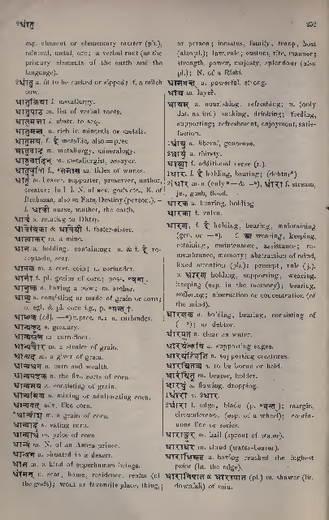
dhātṛ́ ·m. bearer, supporter, preserver, author, creator; in l. l. N. of sev. gods etc., E. of Brahman, also = Fate, Destiny (person.). -- f. dhātrī nurse, mother, the earth.
Monier-Williams 1872 substantive masculine · Word type unspecified
Original text · English · substantive masculine
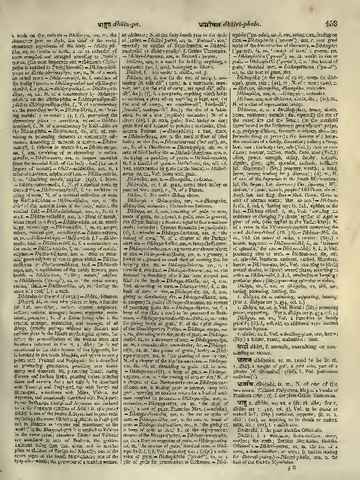
Dhātṛ, tā, m. one who places or lays, a founder [cf. Lat. con-ditor], maker, creator, originator, author; orderer, arranger; bearer, supporter, main- tainer, preserver; N. of a divine being who is the creator, arranger, maintainer, and manager of all things, (strictly perhaps without any distinct and definite place in the Hindū mythological system, but rather the personification of the various ideas and functions inherent in the rt. 1. dhā; he is not mentioned in the older hymns of the Ṛg-veda, but is invoked in the tenth Maṇḍala, and agrees in many points with Tvaṣṭṛ and Prajā-pati; he is described as promoting generation, presiding over matri- mony and domestic life, preserving health, curing diseases and broken limbs, granting riches, ordering times and seasons, &c.; not only is he associated with Tvaṣṭṛ and Prajā-pati, but with Savitṛ and Bṛhas-pati; sometimes with Mitra, Viṣṇu, and Aryaman, and occasionally identified with Prajā-pati: in one Brāhmaṇa Dhātṛ and Aryaman are declared to be the first-born children of Aditi: in epic poetry Dhātṛ is one of the twelve Ādityas, and in post-vedic mythology the name Dhātṛ is applicable to Prajā-pati and to Brahmā as ‘creator and maintainer of the world;’ in the Bhagavad-gītā it is applied to Kṛṣṇa in the same sense; elsewhere Dhātṛ and Vidhātṛ are associated as sons of Brahmā, the goddess Lakṣmī being then their sister, and in another place as children of Bhṛgu and Khyāti); one of the seven sages of the fourth Manv-antara; one of the forty-nine winds; the paramour of a married woman, an adulterer; N. of the forty-fourth year in the cycle of Jupiter.
Original text · English · Word type unspecified
dhātṛ dhātṛ. See p. 453, col. 1.
Apte 1890 substantive masculine
Original text · English · substantive masculine
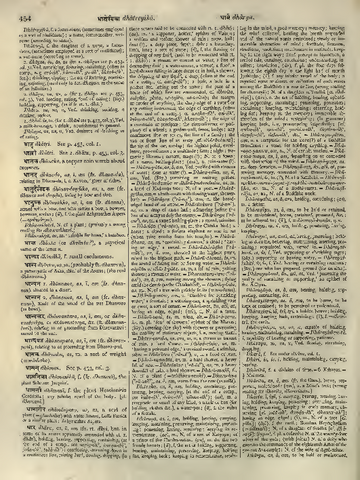
dhātṛ m. [dhā-tṛc] 1 A maker, creator, originator, author. 2 A bearer, preserver, supporter. 3 An epithet of Brahmā, the creator of the world; manye durjanacittavṛttiharaṇe dhātāpi bhagnodyamaḥ H. 2. 165; R. 13. 6; Śi. 1. 13; Ku. 7. 44; Ki. 12. 33. 4 An epithet of Viṣṇu. 5 The soul. 6 N. for the seven sages (saptarṣi) being the first creation of Brahmā; cf. Ku. 6. 9. 7 A married woman's paramour, adulterer. 8 One of the forty-nine winds. 9 An arranger. 10 One who nourishes. Comp. — putraḥ an epithet of Sanatkumāra.
Burnouf 1866 substantive masculine
Original text · French · substantive masculine
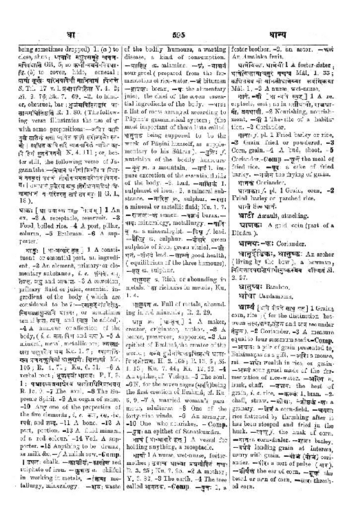
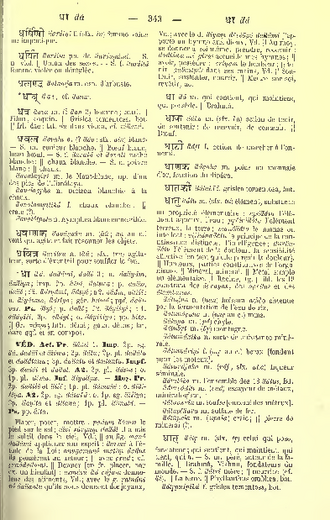
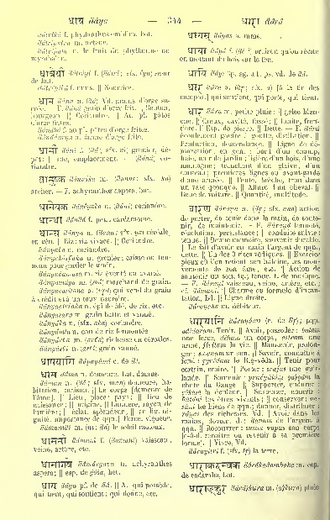
dhātṛ dhātṛ m. (sfx. tṛ) celui qui pose, fondateur; qui soutient, qui maintient, qui tient, qui a. — S. m. père, auteur de la famille. Brahmā, Viṣṇu, fondateurs du monde. — S. f. dhātrī mère; nourrice (cf. dhe). La terre. Phyllanthus emblica, bot. dhātṛpuṣpikā f. grislea tomentosa, bot. [Page344-1] dhātrīkā f. phyllanthus emblica, bot. dhātrīputra m. acteur. dhātrīphala n. le fruit du phyllanthe ou myrobalan.
Occurrences in source texts (1)
HTK 1 occurrence
Continue with AYI Free
Image source: AYI archive.