

maṇḍapa मण्डप – porch; pavilion
adjective · substantive · substantive masculine · substantive neuter · Word type unspecified
Dictionary sources
AYI dictionary substantive neuter
porch; pavilion
Cappeller 1891 substantive
Original text · English · substantive
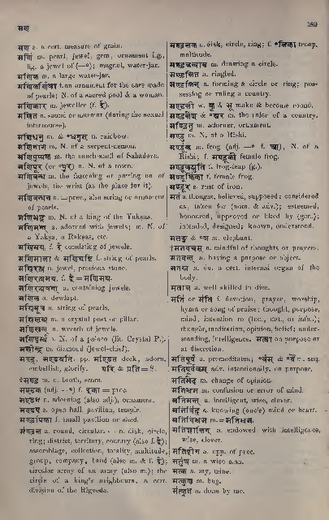
maṇḍapa ·s. open hall, pavilion, temple.
Monier-Williams 1872 adjective · Word type unspecified
Original text · English · adjective
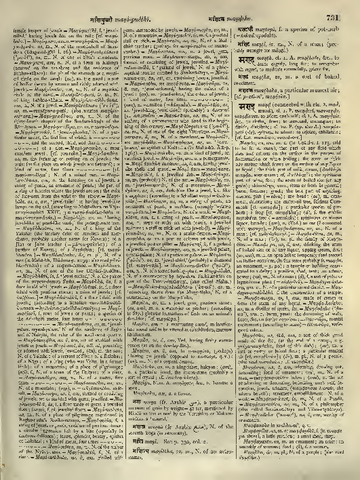
—Maṇḍa-pa, as, ā, am, drinking the scum of boiled rice or of any liquor, sipping cream, &c.; (as, am), m. n. an open hall or temporary shed erected on festive occasions, (in this sense probably fr. maṇḍa, an ornament, + 3. pā); a temple or building conse- crated to a deity; a pavilion, shed, tent; an arbour, bower; (as), m., N. of a man; (ā), f. a sort of pulse or leguminous plant (= niṣpāvī).
Original text · English · Word type unspecified
maṇḍapa maṇḍa-pa. See under maṇḍa, p. 731, col. 3.
Petersburger 1855 adjective · substantive masculine · substantive neuter
Original text · German · adjective · substantive masculine · substantive neuter
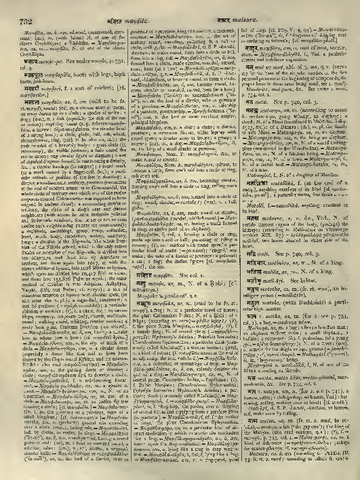
maṇḍapá UJJVAL._zu_UṆĀDIS. 3,145. 1〉 adj. (maṇḍa + 1. pa) Reisschleim —, Rahm oder die Blume vom Weine schlürfend PAÑCAR. 4,8,41; vgl. UJJVAL. — 2〉 m.n. gaṇa ardharcādi zu P. 2,4,31. TRIK. 3,5,13. eine offene Halle, Pavillon, Tempel; = janāśraya AK. 2,2,8. H. 1003. HALĀY. 2,143. = devādidattaveśman ŚABDAR._im_ŚKDR. Verz. d. Oxf. H. 43,a,10. Verz. d. Oxf. H. 281,b,23. Verz. d. B. H. 189,3. Verz. d. B. H. 189,4. PAÑCAR. 3,7,8. PAÑCAR. 3,9,10. BURN. Intr. 175. aṣṭastambhamaṇḍapāt . bahirdattārgalāt (also auch zum Verschliessen) RĀJA-TAR. 6,96. rājamārgāsannaśreṣṭhigṛhadvāri racitamaṇḍapavedikāyām PAÑCAT. 129,17. Schol. zu KĀTY. ŚR. 696,2 v. u. havirdhāna˚ KĀTY. ŚR. 694. KĀTY. ŚR. 3 v. u. abhiṣeka˚ PAÑCAR. 3,9,13. āsthāna˚ HARIV. 14438. adhikaraṇa˚ MṚCCH. 138,4. sabhā˚ VYUTP. 131. yatkīrtivratatiḥ sarvaṃ vyāpa brahmāṇḍamaṇḍapam Inschr. in Journ. of the Am. Or. S. 6,503, Śl. 10. trailokyamaṇḍapastambhāścatvāro haribāhavaḥ Verz. d. Oxf. H. 77,a, No. 131. ratnojjvalamahitamahā˚ WEBER, RĀMAT. UP. 283,4. ratnojjvalita˚ WEBER, RĀMAT. UP. 324, N. paṭa˚ Zelt RAGH. 5,73. taru˚ ein natürlicher, aus Bäumen gebildeter Pavillon, Laube KATHĀS. 20,55. mādhavī˚ MEGH. 76. drākṣā˚ Verz. d. Oxf. H. 17,b,30. Auch maṇḍapī f.: śivasya vṛṣamaṇḍapyāṃ budhairgopuṭikaṃ smṛtam TRIK. 2,2,9. maṇḍapakuṇḍasiddhi Titel einer Schrift Verz. d. B. H. No. 1088. Vgl. kukkuṭa˚, keli˚, garbha˚, jñāna˚, nirvāṇa˚, bhūmimaṇḍapabhūṣaṇā, mañca˚, maṇi˚, latā˚. — 3〉 m. N. pr. eines Mannes Verz. d. Oxf. H. 28,a, No. 71. — 4〉 f. ā eine best. Hülsenfrucht, = niṣpāvī RĀJAN._im_ŚKDR.
Böhtlingk 1879 adjective · substantive masculine
Original text · German · adjective · substantive masculine
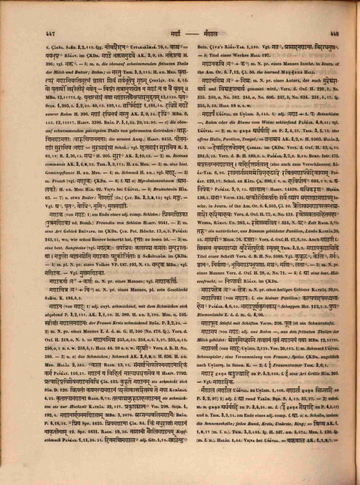
maṇḍapa — 1〉 Adj. Reisschleim —, Rahm —, oder die Blume vom Weine schlürfend. — 2〉 (*m. f. ī und n.) Halle, Pavillon, Tempel. In Comp. mit Pflanzennamen Laube. — 3〉 m. N. pr. eines Mannes. — 4〉 *f. ā eine best. Hülsenfrucht, = niṣpāvī RĀJAN. 7,187. — 5〉 *f. ī s. u. maṇṭapī.
Cappeller 1887 Word type unspecified
Original text · German · Word type unspecified
maṇḍapa Reisschleim o. Rahm schlürfend; Halle, Tempel, Laube.
Burnouf 1866 substantive masculine · substantive neuter
Original text · French · substantive masculine · substantive neuter
maṇḍapa m. n. (pā) esp. de pavillon ou de reposoir, orné de fleurs et de pierreries, que l'on élève aux jours de fête. Edifice consacré à une divinité.
Occurrences in source texts (1)
HP 1 occurrence
Continue with AYI Free
Image source: AYI archive.