
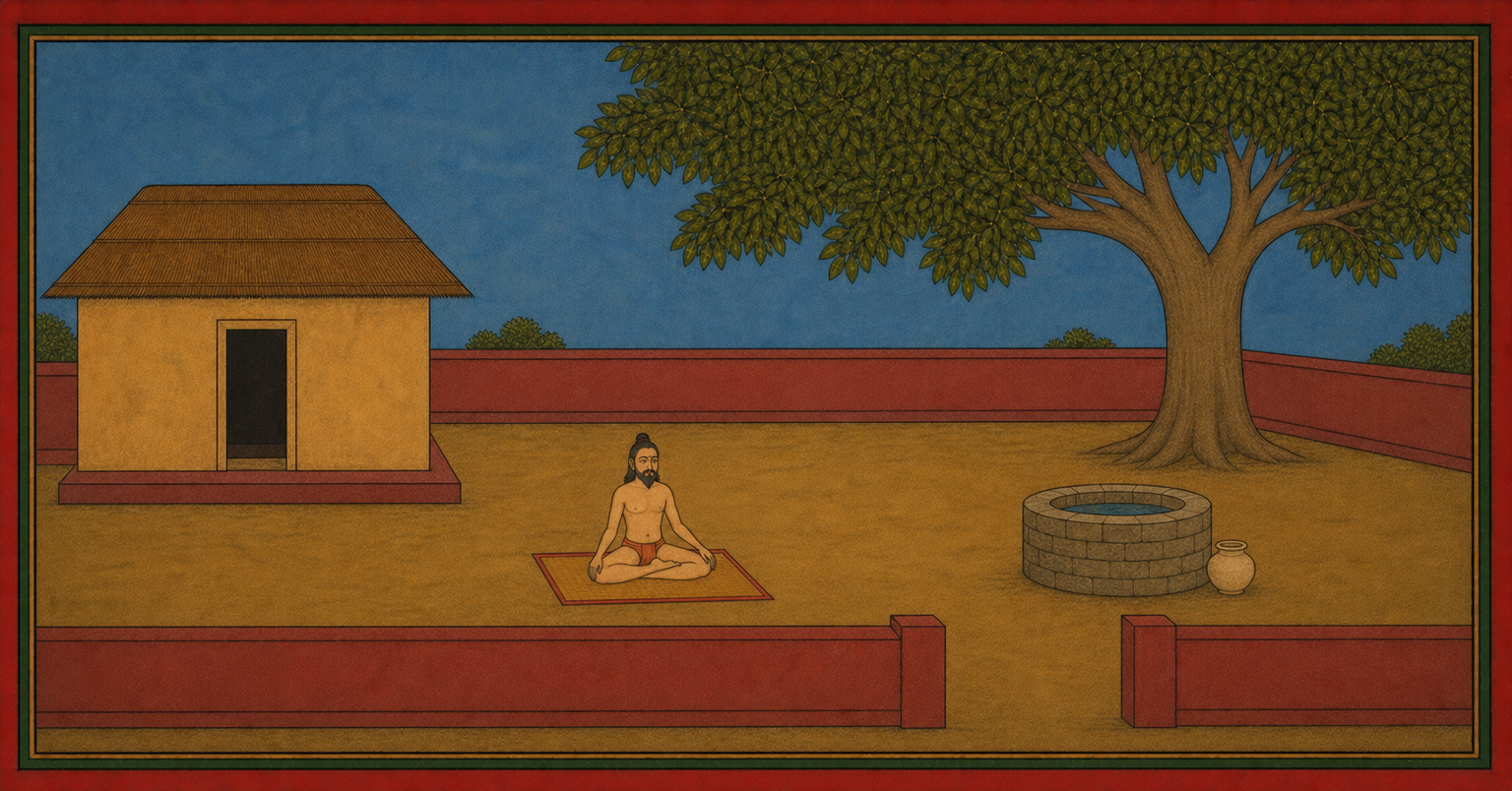
Illustration for the Haṭha Pradīpikā section “HP 1.12-1.14: Place of Practice”.

Haṭha Pradīpikā 1.12-1.14: Place of Practice and Retreat

The text describes the region, hermitage, and inner attitude of the practitioner: protected, clean, secluded, and sustained by the path of the Guru.

Dr. Ronald Steiner Dr. Ronald Steiner
Haṭha Pradīpikā 1.12
सुराज्ये धार्मिके देशे सुभिक्षे निरुपद्रवे |
su-rājye dhārmike deśe; su-bhikṣe nir-upadrave | Analysis ▾ Analysis ▴
su
karmadhāraya-compound
previx
good
rājye
lokative singular
substantive neuter
in a kingdom, country
dhārmike
lokative singular masculine
adjective
righteous
deśe
lokative singular
substantive masculine
in a region
su
karmadhāraya-compound
previx
good, abundant
bhikṣe
lokative singular masculine
adjective
rich in food, well supplied
nir
bahuvrīhi-compund
previx
free from
upadrave
lokative singular masculine
substantive masculine
disturbance, affliction
एकान्तमठिकामध्ये स्थातव्यं हठयोगिनाम् ||12||
ekānta-maṭhikā-madhye; sthātavyaṃ haṭha-yoginām ||12|| Analysis ▾ Analysis ▴
ekānta
karmadhāraya-compound
adjective
secluded
maṭhikā
tatpuruṣa-compound genitive
substantive feminine
small hut, hermitage
madhye
lokative singular
substantive neuter
in the middle
sthātavyam
nominative singular neuter future participle passive
verbal root
to remain, dwell
haṭha
tatpuruṣa-compound genitive
substantive masculine
Haṭha
yoginām
genitive plural
substantive masculine
of the yogins
Metre: Anuṣṭubh
The Haṭhayogis (haṭha-yoginām | gen pl) should dwell (sthātavyam | nom sg n pfp) in an isolated small hut (ekānta-maṭhikā-madhye | loc sg), in a well-ruled country (su-rājye | loc sg), in a righteous region (dhārmike deśe | loc sg) that has plentiful food (su-bhikṣe | loc sg m) and is free from disturbance (nir-upadrave | loc sg m).
Dr. Ronald Steiner - 2026 - historically literal
Haṭha yogis should live in seclusion in a small hut. The place should be well governed, grounded in Dharma, amply supplied with food, and free from disturbance.
Dr. Ronald Steiner - 2026 - modern transfer

Brahmānanda explains the measure of one bow as roughly four handbreadths around the place of practice. Stones, fire, and water should be absent so that neither injuries nor intense heat, cold, or dampness disturb the practitioner. Good government, provisions, and seclusion ensure food, the possibility of a longer stay, and protection from conflict.

Brahmānanda's Jyotsnā - 19th c.
om. MBHDL2026 ] add. dhanuḥpramāṇaparyantaṃ śilāgnijalavarjite NS1882 post surājye dhārmike deśe subhikṣe nirupadrave
Critical Apparatus
The Yogî should practise Haṭha Yoga in a small room, situated in a solitary place, being 4 cubits square, and free from stones, fire, water, disturbances of all kinds, and in a country where justice is properly administered, where good people live, and food can be obtained easily and plentifully.
Pancham Sinh - 1915
The practiser of Hathayoga should live alone in a small Matha or monastery situated in a place free from rocks, water and fire; of the extent of a bow's length and in a fertile country ruled over by a virtuous king where he will not be disturbed.
Srinivasa Iyangar - 1893
In einem wohlregirten, rechtschaffenen Lande, an einem ruhigen, mit Lebensmitteln wohl versehenen Ort, in einer einsamen Zelle, die auf eine Entfernung von einer Bogenlänge von Felsen, Feuer und Wasser abliegt, soll der Hathayogin wohnen.
Hermann Walter - 1893
Haṭha Pradīpikā 1.13
अल्पद्वारमरन्ध्रगर्तपिटकं नात्युच्चनीचायतं सम्यग्गोमयसान्द्रलिप्तममलं निःशेषबाधोज्झितम् |
alpa-dvāram arandhra-garta-piṭakaṃ, nāty-ucca-nīcāyataṃ; samyag-gomaya-sāndra-liptam amalaṃ, niḥśeṣa-bādhojjhitam | Analysis ▾ Analysis ▴
alpa
karmadhāraya-compound
adjective
small
dvāram
nominative singular
substantive neuter
door
arandhra
karmadhāraya-compound
adjective
without cracks or openings
garta
dvandva-compound
substantive neuter
pit, hole
piṭakam
nominative singular
substantive neuter
unevenness, projection
na
particle
not, neither
ati
karmadhāraya-compound
previx
excessively
ucca
dvandva-compound
adjective
high
nīca
dvandva-compound
adjective
low
āyatam
nominative singular neuter
adjective
long, spacious
samyak
karmadhāraya-compound
adverb
properly, thoroughly
gomaya
tatpuruṣa-compound instrumental case
substantive neuter
cow dung
sāndra
karmadhāraya-compound
adjective
dense, thick
liptam
nominative singular neuter past participle passive
verbal root
plastered
amalam
nominative singular neuter
adjective
spotless
niḥśeṣa
karmadhāraya-compound
adjective
entirely, completely
bādhā
tatpuruṣa-compound ablative
substantive feminine
disturbance, affliction
ujjhitam
nominative singular neuter past participle passive
previx
verbal root
free from, abandoned by
बाह्ये मण्डपवेदिकूपरुचिरं प्राकारसंवेष्टितं प्रोक्तं योगमठस्य लक्षणमिदं सिद्धैर्हठाभ्यासिभिः ||13||
bāhye maṇḍapa-vedi-kūpa-ruciraṃ, prākāra-saṃveṣṭitaṃ; proktaṃ yoga-maṭhasya lakṣaṇam idaṃ, siddhair haṭhābhyāsibhiḥ ||13|| Analysis ▾ Analysis ▴
bāhye
lokative singular neuter
adjective
outside
maṇḍapa
tatpuruṣa-compound instrumental case
substantive neuter
pavilion, porch
vedi
tatpuruṣa-compound instrumental case
substantive feminine
altar, platform
kūpa
tatpuruṣa-compound instrumental case
substantive neuter
well
ruciram
nominative singular neuter
adjective
beautiful, pleasing
prākāra
tatpuruṣa-compound instrumental case
substantive neuter
wall, enclosure
saṃveṣṭitam
nominative singular neuter past participle passive
previx
verbal root
surrounded
proktam
nominative singular neuter past participle passive
previx
verbal root
taught, said
yoga
tatpuruṣa-compound genitive
substantive masculine
yoga
maṭhasya
genitive singular
substantive masculine
hut, hermitage
lakṣaṇam
nominative singular
substantive neuter
mark, characteristic
idam
nominative singular neuter
pronoun dem
this
siddhaiḥ
instrumental case plural
substantive masculine
by the siddhas
haṭha
tatpuruṣa-compound genitive
substantive masculine
Haṭha
abhyāsibhiḥ
instrumental case plural
substantive masculine
by practitioners
Metre: Śārdūlavikrīḍita
Having a small door (alpa-dvāram | nom sg), no cracks, holes, or unevenness (arandhra-garta-piṭakam | nom sg), being neither excessively high nor low nor spacious (na-ati-ucca-nīca-āyatam | nom sg n), properly and thickly smeared with cow dung (samyak-gomaya-sāndra-liptam | nom sg n ppp), clean (amalam | nom sg n), and entirely free from disturbances (niḥśeṣa-bādhā-ujjhitam | nom sg n ppp), pleasing outside (bāhye | loc sg n) with a porch, platform, and well (maṇḍapa-vedi-kūpa-ruciram | nom sg n), and surrounded by a wall (prākāra-saṃveṣṭitam | nom sg n ppp): this (idam | nom sg n) has been taught (proktam | nom sg n ppp) by the adepts (siddhaiḥ | ins pl), the practitioners of Haṭha (haṭha-abhyāsibhiḥ | ins pl), as the defining feature (lakṣaṇam | nom sg) of a yoga hut (yoga-maṭhasya | gen sg).
Dr. Ronald Steiner - 2026 - historically literal
The yoga hut should have a small door and be free from cracks, holes, and uneven surfaces. It should be neither too high nor too low or spacious, but thoroughly plastered with cow dung, clean, and free from disturbance. Outside should be a veranda, a raised platform, and a well, with a wall enclosing the grounds. This is how experienced Haṭha yogis describe a suitable place for practice.
Dr. Ronald Steiner - 2026 - modern transfer

Drawing on a source attributed to Nandikeśvara, Brahmānanda adds a deliberately designed environment. Images of serene sages and Siddhas are meant to foster mental composure and enthusiasm for practice. Depictions of the cycle of existences, the cremation ground, and the hells are meant to produce disillusionment with a world understood as full of suffering. The design of the yoga room thus supports inner orientation.

Brahmānanda's Jyotsnā - 19th c.
arandhragartapiṭakaṃ MBHDL2026 ] arandhragartavivaraṃ NS1882

niḥśeṣabādhojjhitam MBHDL2026 ] niḥśeṣajantūjjhitam NS1882
Critical Apparatus
The room should have a small door, be free from holes, hollows, neither too high nor too low, well plastered with cow-dung and free from dirt, filth and insects. On its outside there should be bowers, raised platform (chabootrâ), a well, and a compound. These characteristics of a room for Haṭha Yogîs have been described by adepts in the practice of Haṭha.
Pancham Sinh - 1915
The Matha should have a very small door, and should be without any windows; it should be level and without any holes; it should be neither too high nor too long. It should be very clean, being daily smeared over with cowdung and should be free from all insects. Outside it should have a small corridor with a raised seat and a well, and the whole should be surrounded by a wall. These are the characteristics of a Yoga Matha as laid down by the Siddhas who have practised Hathayoga.
Srinivasa Iyangar - 1893
Die Zelle sei mit einer kleinen Thüre versehen, aber ohne Fenster, Vertiefung und sonstige Oeffnungen; sie sei weder zu hoch, noch zu tief, noch zu lang; sie sei vorschriftsgemäss mit Kuhmist dick bestrichen und frei von jeglichem Ungeziefer. Aussen sei sie durch Laube, Altar und Brunnen verschönt und von einer Mauer umgeben; so wird von den Vollendeten, welche den Hathayoga üben, das Aussehen einer Yogazelle geschildert.
Hermann Walter - 1893
Haṭha Pradīpikā 1.14
एवंविधे मठे स्थित्वा सर्वचिन्ताविवर्जितः |
evaṃ-vidhe maṭhe sthitvā; sarva-cintā-vivarjitaḥ | Analysis ▾ Analysis ▴
evam
karmadhāraya-compound
adverb
thus, such
vidhe
lokative singular masculine
adjective
being of this kind
maṭhe
lokative singular
substantive masculine
in the hut
sthitvā
absolutus
verbal root
having remained, dwelt
sarva
karmadhāraya-compound
adjective
all
cintā
tatpuruṣa-compound ablative
substantive feminine
concern, thought
vivarjitaḥ
nominative singular masculine past participle passive
previx
verbal root
free from
गुरूपदिष्टमार्गेण योगमेव सदाभ्यसेत् ||14||
gurūpadiṣṭa-mārgeṇa; yogam eva sadābhyaset ||14|| Analysis ▾ Analysis ▴
guru
tatpuruṣa-compound instrumental case
substantive masculine
guru, teacher
upadiṣṭa
karmadhāraya-compound past participle passive
previx
verbal root
taught, instructed
mārgeṇa
instrumental case singular
substantive masculine
on the path
yogam
accusative singular
substantive masculine
yoga
eva
particle
alone, precisely
sadā
adverb
always, regularly
abhyaset
3rd person singular aktive optative
previx
verbal root
he should practise
Metre: Anuṣṭubh
Having stayed (sthitvā | abs) in a hut of this kind (evam-vidhe maṭhe | loc sg), free from all concerns (sarva-cintā-vivarjitaḥ | nom sg m ppp), one should regularly (sadā) practise (abhyaset | 3p sg act opt) yoga (yogam | acc sg) alone (eva), following the path taught by the guru (guru-upadiṣṭa-mārgeṇa | ins sg).
Dr. Ronald Steiner - 2026 - historically literal
In such a hut, the yogi should let go of every concern and regularly practise yoga alone, following precisely the path taught by the guru.
Dr. Ronald Steiner - 2026 - modern transfer

Brahmānanda understands the restrictive phrase “yoga alone” to mean that competing activities can disrupt concentration. At the same time, he assembles numerous passages showing that breath control and the eight limbs of yoga must be learned from an experienced guru. Knowledge of scripture describes the path, but does not replace practical instruction.

Brahmānanda's Jyotsnā - 19th c.
sadābhyaset MBHDL2026 ] samabhyaset NS1882
Critical Apparatus
Having seated in such a room and free from all anxieties, he should practise Yoga, as instructed by his guru.
Pancham Sinh - 1915
Living in such a place, the Yogi should free his mind from all cares and practise the Yoga as taught by his Guru.
Srinivasa Iyangar - 1893
In einer solchen Zelle wohnend, allem Denken entsagend möge er auf die vom Lehrer gezeigte Weise den Yoga üben.
Hermann Walter - 1893

Continue with AYI Free

Illustrations: AI-generated.

Editor

Dr. Ronald Steiner

From Ulm

The "Yoga Doc" - Dr. Ronald Steiner is the founder of the AYI method. This method links traditional Ashtanga Yoga with innovative Yogatherapy and living Philosophy. This forms a practice that is personal for each and... more ›

Messages and ratings
0 messages

Please log in to write a message. Go to login

No messages yet.