

manu मनु – thought, mental faculty (= manana-śakti)
adjective · substantive feminine · substantive masculine · Word type unspecified
Dictionary sources
Cappeller 1891 substantive masculine
Original text · English · substantive masculine
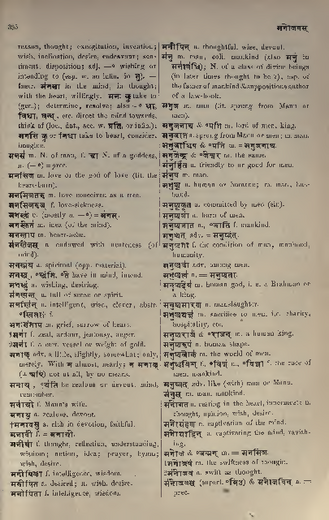
mánu ·m. man, coll. mankind (also manú in manā́vádhi); N. of a class of divine beings (in later times thought to be 7), esp. of the father of mankind & suppositious author of a law-book.
Monier-Williams 1872 substantive masculine · Word type unspecified
Original text · English · substantive masculine
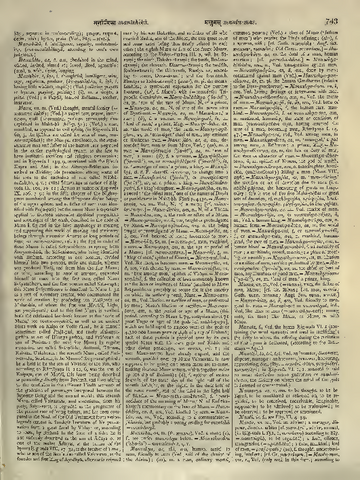
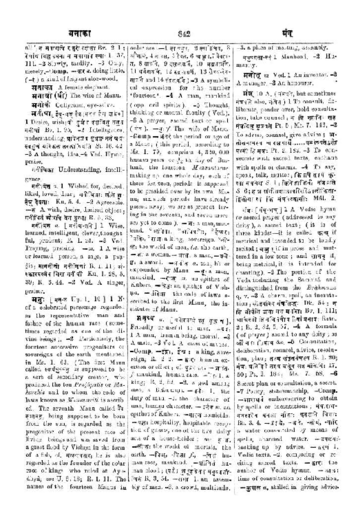
Manu, us, m. (Ved.) thought, mental faculty (= manana-śakti); (Ved.) a sacred text, prayer, incan- tation, spell (= mantra, perhaps erroneously thus explained in Mahā-bh. Ādi-p. 52); (Ved.) a man, mankind, as opposed to evil spirits, (in Ṛg-veda III. 60, 3, the Ṛbhus are called the sons of man, ma- nor napātaḥ); the Man par excellence, or the repre- sentative man and father of the human race (regarded in the earlier mythological system as the first to have instituted sacrifices and religious ceremonies; and in Ṛg-veda 1. 139, 9, associated with the Ṛṣis Kaṇva and Atri; in the Aitareya-Brāhmaṇa de- scribed as dividing his possessions among some of his sons to the exclusion of one called Nābhā- nediṣṭha, q. v.; called Sāmvaraṇa as author of Ṛg- veda IX. 101, 10-12; Āpsava as author of Rig-veda IX. 106, 7-9; in the fifth chapter of the Nighaṇ- ṭavas numbered among the thirty-one divine beings of the upper sphere, and as father of men even iden- tified with Prajā-pati; but the name Manu is especially applied to fourteen successive mythical progenitors and sovereigns of the earth, described in the code of Manu 1. 63 and in the later mythology as creating and supporting this world of moving and stationary beings through successive Antaras or long periods of time, see manv-antara, col. 2: the first in order of these Manus is called Svāyambhuva, as sprung from Svayam-bhū, the Self-existent, who being identified with Brahmā, according to one account, divided himself into two persons, male and female, whence was produced Virāj, and from him the first Manu; or who, according to another account, converted himself at once into the first man called Manu Svāyambhuva, and the first woman called Śata-rūpā; this Manu Svāyambhuva is described in Manu 1. 34 as a sort of secondary creator, who commenced the work of creation by producing ten Prajāpatis or Maharṣis, of whom the first was Marici, Light, see prajā-pati; and to this first Manu is ascribed both the celebrated law-book known as the ‘code of Manu,’ see manu-saṃhitā, as well as an ancient Sūtra work on Kalpa or Vedic ritual; he is himself sometimes called Prajā-pati, and rarely Hairaṇya- garbha as son of Hiraṇya-garbha, and Prācetasa as son of Pracetas: the next five Manus in regular succession are called Svārociṣa, Auttami, Tāmasa. Raivata, Cākṣuṣa: the seventh Manu, called Vai- vasvata, Sun-born, is the Manu of the present period; he is held to be the son of Vivasvat or the Sun, who according to Rāmāyaṇa 11. 110, 6, was the son of Kaśyapa, son of Marīci, this latter being described as proceeding directly from Brahmā, and thus adding to the confusion in the different Hindū accounts of the gradation of personages interposed between the Supreme Being and the created world; this seventh Manu, called Vaivasvata, and sometimes, from his piety, Satya-vrata, is regarded as the progenitor of the present race of living beings, and has been com- pared to the Noah of the Old Testament from various legends current in Sanskrit literature of his preser- vation from a great flood by Viṣṇu or, according to some, by Brahmā in the form of a fish: he is also variously described as the son of Āditya or as one of the twelve Ādityas, as the author of the hymns Ṛg-veda VIII. 27-31, as the brother of Yama, who as son of the Sun is also called Vaivasvata, as the founder and first king of Ayodhyā, afterwards reigned over by his son Ikṣvāku, and as father of Ilā who married Budha, son of the Moon, the two great solar and lunar races being thus nearly related to each other; the eighth Manu or first of the future Manus, according to the Viṣṇu-Purāṇa 111. 2, will be Sā- varṇi; the ninth, Dakṣa-sāvarṇi; the tenth, Brahma- sāvarṇi; the eleventh, Dharma-sāvarṇi; the twelfth, Rudra-sāvarṇi; the thirteenth, Raucya or, accord- ing to some, Deva-sāvarṇi; and the fourteenth, Bhautya or Indra-sāvarṇi); (avas), m. pl. the mental faculties; a symbolical expression for the number fourteen; (us), f. Manu's wife (= manāvī); Tri- gonella Corniculata.
Original text · English · Word type unspecified
manu manu. See p. 743, col. 1.
Petersburger 1855 adjective · substantive feminine · substantive masculine
Original text · German · adjective · substantive feminine · substantive masculine
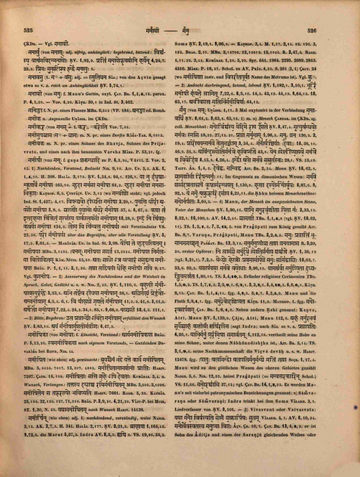
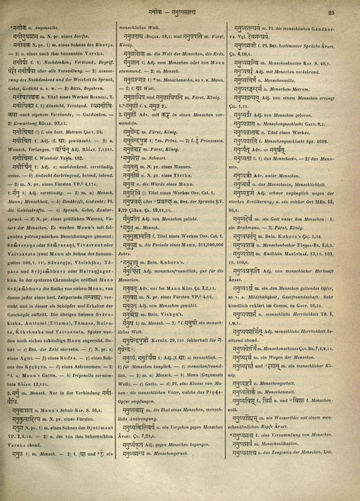
mánu (von man) UṆĀDIS. 1,11. UṆĀDIS. 1,3 Mal oxytonirt in der Verbindung ma̱nāvadhì ṚV. 8,61,2. ṚV. 9,63,8. ṚV. 9,65,16. 1〉 m. a〉 Mensch ŚABDAR._im_ŚKDR. sg. coll. Menschheit: mano̱rviśvàsya̱ ghedi̱me rā̱ya ī̀śate ṚV. 8,47,4. mṛ̱tyubàndhavo̱ manàvaḥ smasi ṚV. 18,22. ṚV. 27,14. ṚV. 8,21. pra̱jā manū̀nām ṚV. 1,96,2. manu, jana ṚV. 130,5. ṚV. 2,19,4. prāròcaya̱nmanàve ke̱tumahnā̀m ṚV. 3,34,4. manòrya̱jñiyā̀ḥ (devāḥ) ṚV. 10,36,10. ṚV. 10,46,9. ṚV. 10,51,5. avìnda̱jjyoti̱rmanàve ha̱viṣmàte ṚV. 10,43,8. yena̱ jyotī̀ṃṣyā̱yave̱ manàve ca vi̱vedìtha ṚV. 8,15,5. ṚV. 4,26,4. indrò a̱po manàve sa̱srutàskaḥ ṚV. 4,28,1. VS. 15,49. TAITT. ĀR. 1,4,3. deveddha, manviddha AIT. BR. 2,34. Mann ṚV. 10,62,8. grā̱ma̱ṇīrmā rìṣa̱nmanùḥ ṚV. 10,62,11. Im Gegensatz zu dämonischen Wesen: manàve̱ śāsàdavra̱tāntvacàṃ kṛ̱ṣṇāmàrandhayat ṚV. 1,130,8. ha̱ntā dasyo̱rmanòrvṛ̱dhaḥ ṚV. 8,87,6. ṚV. 9,92,5. ye manùṃ ca̱krurupàra̱ṃ dasā̀ya ṚV. 6,21,11. die Ṛbhu heissen Menschensöhne: mano̱rnapā̀taḥ ṚV. 3,60,3. — b〉 Manu, der Mensch im ausgezeichneten Sinne, Vater der Menschen ṚV. 1,80,16. yāni̱ manu̱ravṛ̀ṇītā pi̱tā nàḥ ṚV. 2,33,13. ṚV. 8,52,1. ṚV. 10,100,5. AV. 14,2,41. grāmaṇī TBR. 1,1,4,8 ?(vgl. ṚV. 10,62,11). TS. 1,5,1,3. TS. 7,5,15,3. von Prajāpati zum König gesalbt AIT. BR. 8,7. Varuṇa, Prājāpati, Manu TBR. 2,2,5,3. manuḥ prajātiṃ bhū- mānamagacchat PAÑCAV. BR. 13,3,15. manurmanuṣyāṃśca tathā janayāmāsa R. 3,20,30. erster Opferer: ni tvāmàgne̱ manùrdadhe̱ jyoti̱rjanā̀ya̱ śaśvàte ṚV. 1,36,19 (vgl. ṚV. 5,21,1). ṚV. 7,2,3. yebhyo̱ hotrā̀ṃ pratha̱māmā̀ye̱je manu̱ḥ samìddhāgniḥ ṚV. 10,63,7. ṚV. 10,53,6. ṚV. 10,69,3. yathāpàvathā̱ manàve vayo̱dhāḥ ṚV. 9,96,12. yāmathàrvā̱ manùṣpi̱tā da̱dhya- ṅdhiya̱matnàta ṚV. 1,80,16. TS. 5,4,10,5. Erfinder religiöser Cerimonien TBR. 1,5,6,3. TS. 1,7,1,3. TS. 2,5,9,1. TS. 2,6,7,1. TS. 3,3,2,1. TS. 5,4,10,5. TS. 5,4,6,6. TS. 5,4,6,1. KĀṬH. 8,15. ŚAT. BR. 1,1,4,14. fgg. ŚAT. BR. 1,4,2,5. ŚAT. BR. 1,5,1,7. fgg. ŚAT. BR. 6,2,5,3. Manu und die Fluth ŚAT. BR. 1,8,1,1. fgg. manurevodaśiṣyata KĀṬH. 11,2. MATSYOP. 1. fgg. mano- ravasarpaṇam ŚAT. BR. 1,8,1,8. Neben andern Ṛṣi genannt: Kaṇva, Atri, Manu ṚV. 1,139,9. Śāyu, Atri, Manu ṚV. 1,112,6. a̱haṃ manùrabhava̱ṃ sūryàścā̱haṃ ka̱kṣīvā̱m̐ ṛṣìrasmi (sagt Indra; nach SĀY. so v. a. prajāpati) ṚV. 4,26,1. yābhi̱rmanu̱ṃ śūràmi̱ṣā sa̱māvàtam ṚV. 1,112,18. vertheilt seine Habe an seine Söhne, unter denen Nābhānediṣṭha ist, AIT. BR. 5,14. TS. 3,1,9,4. seine Nachkommenschaft die Viśve devāḥ u. s. w. HARIV. 12478. fgg. (pātu) balamindro balapatirmanurmanye matiṃ tathā SUŚR. 1,17,4. Manu wird zu den göttlichen Wesen des oberen Gebietes gezahlt NAIGH. 5,6. NIR. 12,33. heisst Prajāpati (= manvantarakārin Schol.) VS. 11,66. mano̱raśvā̀si VS. 37,12; vgl. ŚAT. BR. 14,1,3,25. Es werden Ma- nuʼs mit vielerlei patronymischen Bezeichnungen genannt: α〉 Sāṃva- raṇa oder Sāṃvaraṇi; Indra trinkt bei ihm Soma VĀLAKH. 3,1. Liedverfasser von ṚV. 9,101. — β〉 Vivasvant oder Vaivasvata: yathā manau̱ vivàsvati̱ somàṃ śa̱krāpìbaḥ su̱tam VĀLAKH. 4,1. AV. 8,10,24. manorvaivasvatasya manuṣyā viśaḥ ĀŚV. ŚR. 10,7. ŚAT. BR. 13,4,3,3. er ist Sohn des Āditya und eines der Saraṇyū gleichenden Weibes oder weiblichen Trugbildes (tatsavarṇāṃ chāyāprabhavāṃ kṛtvā DURGA) NIR. 12,10. Liedverfasser von ṚV. 8,27,31. vivasvant, manu, ikṣvāku BHAG. 4,1. R. 1,70,20. HARIV. 2953. RAGH. 1,11. Verz. d. Oxf. H. 41,b,40. Verz. d. Oxf. H. 52,a,12. Verz. d. Oxf. H. 56,b,3. Bruder Yamaʼs MBH. 1,3137. fgg. manave sūryaputrāya MBH. 12,6187. baut Ayodhyā R. 1,5,6. erster König R. 1,6,4. RAGH. 4,7. RĀJA-TAR. 4,640. Ilā (s. u. iḍā 6.) ist eine Tochter des Manu Āditya MBH. 13,6831. Manu unter den MBH. 13,12 Āditya HARIV. 11549. — ξ〉 Vāsiṣṭha, Liedverfasser von ṚV. 9,97. — δ〉 Tāpasa, Liedverfasser von ṚV. 10,83. ṚV. 10,84. — ε〉 Āpsava, Liedverfasser von ṚV. 9,106. — ζ〉 Svāyaṃbhuva NIR. 3,4. Gatte der Śatarūpā HARIV. 57. VP. 51. BHĀG. P. 3,12,52. BHĀG. P. 3,13,6. angeblicher Verfasser eines Gesetzbuchs M. 1,61. M. 1,63. M. 1,102. M. 6,54. M. 8,124. M. 9,158. YĀJÑ. 1,4. eines Kalpasūtra HALL 164. er heisst auch Hairaṇ- yagarbha oder Sohn Hiraṇyagarbhaʼs M. 3,194. HARIV. 12440. Prā- ketasa MBH. 12,2089. Prajāpati M. 10,78. M. 12,123. In der späteren Chronologie eröffnet M. Svāyaṃbhuva die Reihe der Manu, von denen jeder einer bestimmten grossen Zeitperiode (s. manvantara) vorsteht und in dieser als Schöpfer und Erhalter der Geschöpfe auftritt. Die ältere Zeit kennt nur sieben solcher Manu M. 1,63. MBH. 13,991. es sind dies: Svāyaṃbhuva, Svārociṣa, Auttami (später auch Uttama ge- nannt), Tāmasa (vgl. oben tāpasa u. δ), Raivata, Cākṣuṣa und Vaivasvata (s. oben u. β) M. 1,61. fg. Später werden noch sieben zukünftige Manu angereiht SŪRYAS. 1,19. SŪRYAS. 1,22. SŪRYAS. 1,45. VP. 23. Verz. d. Oxf. H. 25,a,27. Verz. d. Oxf. H. 53,b,41. ihre Namen lauten: Sāvarṇi (Sāvarṇa die neuere Ausg.), Bhautya, Raucya und vier Merusāvarṇa HARIV. 409. fgg. Sāvarṇi, Dakṣasāvarṇi, Brahmasāvarṇi, Dharma- sāvarṇi, Rudrasāvarṇi, Raucya und Bhautya VP. 259. fgg. statt der beiden letzten Devasāvarṇi und Indrasāvarṇi BHĀG. P. 8,13,1. fgg. Daher ist manavaḥ eine Bez. für die Zahl vierzehn SŪRYAS. 1,43. SŪRYAS. 2,34. SŪRYAS. 8,2. vor dem Manvantara des Svāyaṃbhuva noch zwei HARIV. 51. fgg. (HARIV. 52 liest die neuere Ausg. dvitīyamāpavasyaivaṃ). Svāyaṃbhu- vaʼs Periode währt HARIV. 71 Yuga HARIV. 57. vier Manu (vom Scholiasten anders erklärt) BHAG. 10,6. Manu unter den Rudra VP. 59, N. 4. BHĀG. P. 3,12,12. ein Agni MBH. 3,14180. mit Viṣṇu identificirt (vgl. manuśreṣṭha) TRIK. 1,1,32 (ŚKDR. und WILSON nach ders. Aut. ein best. Jina). Sohn Kṛśāśvaʼs BHĀG. P. 6,6,20. Astronom Ind. St. 2,247. Verz. d. B. H. No. 862. — c〉 = mananaśakti (Comm.) TBR. 2,3,8,3. Gedanke (manas VS. 9,7) KĀṬH. 13,14. KĀṬH. 14,6. TS. 1,7,7,2. TBR. 1,3,5,3. NIR. 1,5. pl. die Geisteskräfte (= antaḥkaraṇāni Schol.) BHĀG. P. 6,4,25. — d〉 = mantra Spruch, Gebet, Zauberformel JAṬĀDH._im_ŚKDR. WEBER, RĀMAT. UP. 308. WEBER, RĀMAT. UP. 316. WEBER, RĀMAT. UP. 344. WEBER, RĀMAT. UP. 354. PAÑCAR. 1,9,9. PAÑCAR. 1,11,27. PAÑCAR. 3,3,2. PAÑCAR. 3,3,8. Verz. d. B. H. No. 1314. Verz. d. Oxf. H. 93,b,1. fgg. Verz. d. Oxf. H. 98,a,10. Verz. d. Oxf. H. 99,b,2. fgg. Verz. d. Oxf. H. 105,a,10. fgg. Verz. d. Oxf. H. 105,b,36. PRATĀPAR. 61,a (s. u. pratīti 2.). manu MBH. 1,52 von einigen Erklärern, aber wohl mit Unrecht, in dieser Bedeutung aufgefasst. — 2〉 adj. so v. a. verständig (nach Comm.) VS. 15,49. ŚAT. BR. 8,6,3,18. — 3〉 f. a〉 Manuʼs Gattin AK. 3,6,5,38. P. 4,1,38, Sch. — b〉 Trigonella corniculata Lin. RĀJAN._im_ŚKDR. — Vgl. bṛhanmanu, vṛddha˚, manus.

Böhtlingk 1879 adjective · substantive feminine · substantive masculine
Original text · German · adjective · substantive feminine · substantive masculine
1. mánu — 1〉 Adj. verständig. — 2〉 m. — a〉 Mensch, Mann; Menschheit. — b〉 Denkkraft, Gedanke; Pl. die Geisteskräfte. — c〉 Spruch, Gebet, Zauber, -spruch. — d〉 N. pr. eines göttlichen Wesens, Vaters der Menschen. Es werden Manuʼs mit folgenden patronymischen Bezeichnungen genannt; Sāṃvaraṇa oder Sāṃvaraṇi, Vivasvant oder Vaivasvata (zwei Manu als Söhne des Sonnengottes Chr. 100,7. Chr. 100,11), Sāvarṇya, Vāsiṣṭha, Tāpasa und Svāyaṃbhuva oder Hairaṇyagarbha. In der späteren Chronologie eröffnet Manu Svāyaṃbhuva die Reihe von sieben Manu, von denen jeder einer best. Zeitperiode (manvantar) vorsteht und in dieser als Schöpfer und Erhalter der Geschöpfe auftritt. Die übrigen heissen Svārociṣa, Auttami (Uttama), Tāmasa, Raivata, Cākṣuṣa und Vaivasvata. Später werden noch sieben zukünftige Manu angereiht. Daher — e〉 Bez. der Zahl vierzehn. — f〉 N. pr. — α〉 eines Agni. — β〉 eines Rudra. — γ〉 eines Sohnes des Kṛśāśva. — δ〉 eines Astronomen. — 3〉 *f. — a〉 Manuʼs Gattin. — b〉 Trigonella corniculata RĀJAN. 12,134.
Original text · German · substantive masculine
2. manú m. Mensch. Nur in der Verbindung manā́vádhi.
Apte 1890 substantive masculine
Original text · English · substantive masculine
manuḥ [man-u Uṇ. 1. 10] 1 N. of a celebrated personage regarded as the representative man and father of the human race (sometimes regarded as one of the divine beings). 2 Particularly, the fourteen successive progenitors on sovereigns of the earth mentioned in Ms. 1. 63. The first Manu called svapyaṃbhuvamanu is supposed to be a sort of secondary creator, who produced the ten Prajāpatis or Maharshis and to whom the code of laws known as Manusmṛti is ascribed. The seventh Manu called vaivasvatamanu, being supposed to be born from the sun, is regarded as the progenitor of the present race of living beings and was saved from a great flood by Viṣṇu in the form of a fish, cf. matsyāvatāra; he is also regarded as the founder of the solar race of kings who ruled at Ayodhyā; see U. 6. 18; R. 1. 11. The names of the fourteen Manus in ([Page 0842-b]) order are: 1 svāyaṃbhuva, 2 svārociṣa, 3 auttami, 4 tāmasa, . raivata, 6 cākṣuṣa 7 vaivasvata, 8 sāvarṇi, 9 dakṣasāvarṇi, 10 brahmasāvarṇi, 11 dharmasāvarṇi, 12 rudrasāvarṇi, 13 raucya-daivasāvarṇi and 14 iṃdrasa varṇi. 3 A symbolical expression for the number ‘fourteen’. 4 A man, mankind (opp. evil spirits). 5 Thought, thinking or mental faculty (Ved.). 6 A prayer, sacred text or sped (maṃtra). — nuḥ f. The wife of Manu. Comp. — aṃtaraṃ the period or age of a Manu; this period, according to Ms. 1. 79, comprises 4,320,000 human years or one-fourteenth day of Brahmā, the fourteen Manvantaras making up one whole day; each of these fourteen, periods is supposed to be presided over by its own Manu; six such periods have already passed away; we are at present living in the seventh, and seven more are yet to come. — jaḥ a man, mankind. ˚adhipaḥ, ˚adhipatiḥ, ˚īśvaraḥ ˚patiḥ, ˚rājaḥ a king, sovereign. ˚lokaḥ the world of men, i. e. the earth. — jā a woman. — jātaḥ a man. — jyeṣṭhaḥ a sword. — praṇīta a. taught or expounded by Manu — bhūḥ a man. mankind. — rāj m. an epithet of Kubera. — śreṣṭhaḥ an epithet of Viṣṇu. — saṃhitā the code of laws ascribed to the first Manu, the institutes of Manu.
Cappeller 1887 substantive masculine
Original text · German · substantive masculine
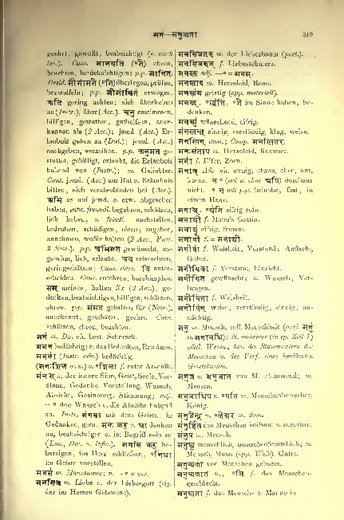
mánu m. Mensch, coll. Menschheit (auch manú in manā́vádhi); N. mehrerer (im sp. Zeit 7) göttl. Wesen, bes. des Stammvaters der Menschen u. des Verf. eines berühmten Gesetzbuches.
Burnouf 1866 substantive masculine
Original text · French · substantive masculine
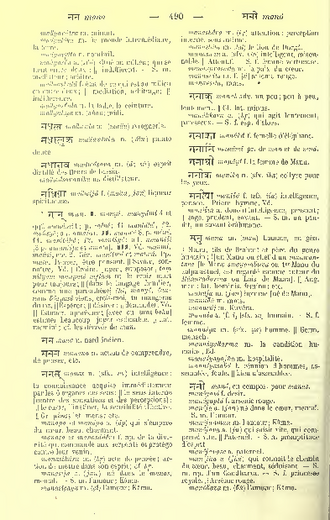
manu manu m. (man) homme, en gén. Manu, fils de Brahmā et père du genre humain; un Manu ou chef d'un manvantara [le Manu svayambhuva ou 1ᵉʳ Manu du kalpa actuel, est regardé comme auteur du Mānavadharma ou Lois de Manu]. Ang. man; lat. hominis, femina; etc. manuja m. (jan) homme [né de Manu]. manubhū m. mms. manurāj m. Kuvera. manuṣa a. [f. ī] [sfx. sa] humain. — S. f. femme. manuṣya m. (sfx. ya) homme. Germ. mensch. manuṣyadharma m. la condition humaine, Bd. manuṣyayajña m. hospitalité. manuṣyasabhā f. réunion d'hommes, assemblée, foule. Lieu d'assemblée.
Occurrences in source texts (1)
HTK 1 occurrence
Continue with AYI Free
Image source: AYI archive.