
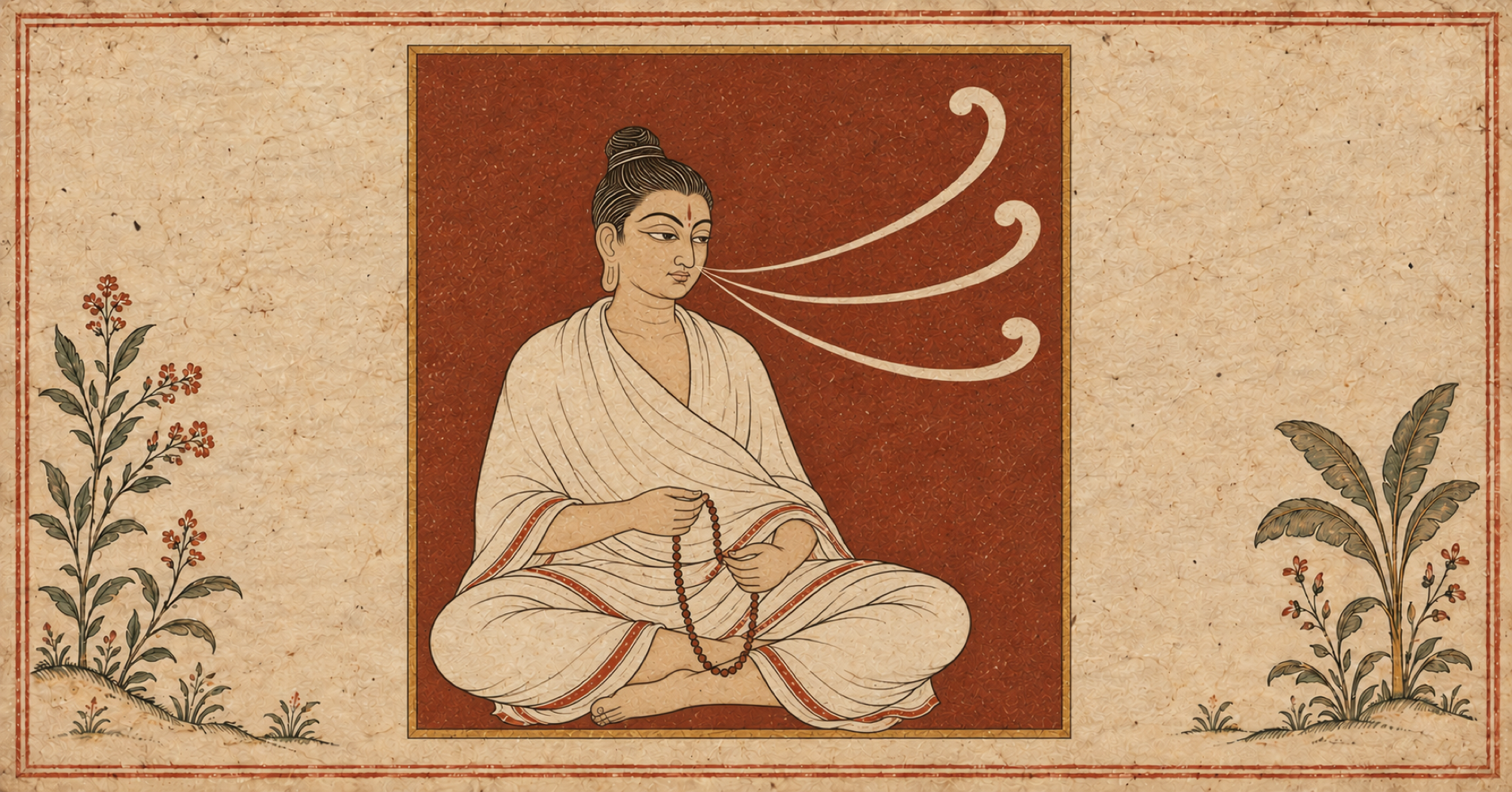
Seated person holding counting beads beside three arcs of breath.

Haṭhatattvakaumudī 10.44–46*1: Ekameru, Dvimeru and Trimeru: Extending and timing breath phases

Ekameru extends retention; Dvimeru includes inhalation, and Trimeru exhalation as well. Observation and counting establish the time units.

Dr. Ronald Steiner Dr. Ronald Steiner
Haṭhatattvakaumudī 10.44
बाह्याभ्यन्तरविषये सञ्चारज्ञानतो मन्दम् |
bāhyābhyantara-viṣaye, sañcāra-jñānato mandam | Analysis ▾ Analysis ▴
bāhya
dvandva-compound
adjective
external
abhyantara
karmadhāraya-compound
adjective
internal
viṣaye
lokative singular
substantive masculine
in the region
sañcāra
tatpuruṣa-compound genitive
substantive masculine
of movement
jñānataḥ
adverb
through knowledge
mandam
mandam
adverb
slowly
मात्रासंख्या श्वासप्रमाणसमयावधारणतः ||44||
mātrā-saṃkhyā śvāsa,-pramāṇa-samayāvadhāraṇataḥ ||44|| Analysis ▾ Analysis ▴
mātrā
tatpuruṣa-compound genitive
substantive feminine
of the time units
saṃkhyā
nominative singular
substantive feminine
number
śvāsa
tatpuruṣa-compound genitive
substantive masculine
of the breath
pramāṇa
tatpuruṣa-compound genitive
substantive neuter
of the measure
samaya
tatpuruṣa-compound genitive
substantive masculine
of time
avadhāraṇataḥ
avadhāraṇatas
adverb
through determining
Metre: Upagīti
The number of time units (mātrā-saṃkhyā | nom sg) [can be established] slowly (mandam), through knowledge of movement (sañcāra-jñānataḥ) in the external and internal domain (bāhyābhyantara-viṣaye | loc sg), [and] through determining the duration of the breath measure (śvāsa-pramāṇa-samayāvadhāraṇataḥ).
Dr. Ronald Steiner - 2026 - historically literal

I make nominative mātrāsaṃkhyā the subject of “[can be determined]”. I understand the expressions ending in -tas as the means of determining it and connect mandam with the supplied verb.

Translation Comment
Observe one natural breath just by following its course, then another with silent counting. Compare how these two tasks engage your attention.
Dr. Ronald Steiner - 2026 - modern transfer
śvāsapramāṇa conj. ed. ] śvāsapramiti GDJ2007; śvāsamiti GDJ2007-b
Critical Apparatus
Haṭhatattvakaumudī 10.45
मनुगणनैर् वा क्रमशः प्रवर्धते यत्र वै कुम्भः |
manu-gaṇanair vā kramaśaḥ, pravardhate yatra vai kumbhaḥ | Analysis ▾ Analysis ▴
manu
tatpuruṣa-compound genitive
substantive masculine
of fourteen; numerical designation (Monier-Williams, p. 784; following GDJ2007)
gaṇanaiḥ
instrumental case plural
substantive neuter
through counts
vā
particle
or
kramaśaḥ
adverb
gradually
pravardhate
3rd person singular medial present
previx
verbal root
increases
yatra
adverb
where
vai
particle
certainly
kumbhaḥ
nominative singular
substantive masculine
breath retention
अयम् एकमेरुर् उक्तो योगरहस्यं महेशेन ||45||
ayam eka-merur ukto, yoga-rahasyaṃ maheśena ||45|| Analysis ▾ Analysis ▴
ayam
nominative singular masculine
pronoun dem
this
eka
dvigu-compound
numeral
one
meruḥ
nominative singular
substantive masculine
Meru
uktaḥ
nominative singular masculine past participle passive
verbal root
called
yoga
tatpuruṣa-compound genitive
substantive masculine
of yoga
rahasyam
nominative singular
substantive neuter
secret
maheśena
instrumental case singular
substantive masculine
by Maheśa
Metre: Upagīti
Or (vā) [one may establish it] by counts of fourteen [time units] (manu-gaṇanaiḥ | ins pl). Where (yatra) breath retention (kumbhaḥ | nom sg) indeed (vai) lengthens (pravardhate | 3p sg med pres) gradually (kramaśaḥ), this (ayam | nom sg m) [is] called (uktaḥ | nom sg m ppp) Ekameru (eka-meruḥ | nom sg) by Maheśa (maheśena | ins sg), [a] secret of yoga (yoga-rahasyam | nom sg).
Dr. Ronald Steiner - 2026 - historically literal

The mātrā count in 10.44 and the subsequent increase support the numerical meaning “fourteen” for manu, rather than its other attested meaning “mantra”. I therefore translate manu-gaṇanaiḥ as “by counts of fourteen [time units]”, supplying the counting unit from context.

Translation Comment
Counting or a repeated word can provide a point of reference in practice. Change the framework only once you can describe your experience with it so far.
Dr. Ronald Steiner - 2026 - modern transfer
ayameka GDJ2007 ] ajayameka GDJ2007-a

maheśena GDJ2007 ] maheśīnaḥ GDJ2007-b
Critical Apparatus
Haṭhatattvakaumudī 10.46
पूरकेणाभिवृद्धेन द्विमेरु मेरुरोहणात् |
pūrakeṇābhivṛddhena; dvimeru meru-rohaṇāt | Analysis ▾ Analysis ▴
pūrakeṇa
instrumental case singular
substantive masculine
through inhalation
abhivṛddhena
instrumental case singular masculine past participle passive
previx
verbal root
extended
dvimeru
unclear: name Dvimeru, two Merus; ending unresolved
meru
tatpuruṣa-compound genitive
substantive masculine
of Meru
rohaṇāt
ablative singular
substantive neuter
through ascending
रेचकेनापि वृद्धेन त्रिमेरुः सिद्धिदायकः ||46||
recakenāpi vṛddhena; tri-meruḥ siddhi-dāyakaḥ ||46|| Analysis ▾ Analysis ▴
recakena
instrumental case singular
substantive masculine
through exhalation
api
particle
also
vṛddhena
instrumental case singular masculine past participle passive
verbal root
extended
tri
dvigu-compound
numeral
three
meruḥ
nominative singular
substantive masculine
Meru
siddhi
upapada-compound
substantive feminine
accomplishment
dāyakaḥ
nominative singular masculine
adjective
bestowing
Metre: Anuṣṭubh
Through extended inhalation (pūrakeṇābhivṛddhena | ins sg) [and] through ascending Meru (meru-rohaṇāt | abl sg), [the breath retention is called] Dvimeru (dvimeru). Through exhalation (recakena | ins sg) also (api), [when it is] extended (vṛddhena | ins sg m ppp), [it is called] Trimeru (tri-meruḥ | nom sg), [and] bestows accomplishment (siddhi-dāyakaḥ | nom sg m).
Dr. Ronald Steiner - 2026 - historically literal

Before merurohaṇāt, dvimeru lacks the expected final r; I treat it as a quoted name and supply “[the breath retention is called]”. At trimeru, I supply the corresponding predicate.

Translation Comment
First consider inhaling and exhaling separately: what do you notice about the course of each? The image of a gradual ascent can suggest this process of increasingly precise observation.
Dr. Ronald Steiner - 2026 - modern transfer
dvimeru GDJ2007 ] tadvimeru GDJ2007-b
Critical Apparatus
Haṭhatattvakaumudī 10.46*1
इति मेरुकुम्भकः |
iti meru-kumbhakaḥ | Analysis ▾ Analysis ▴
iti
particle
thus ends
meru
karmadhāraya-compound
substantive masculine
Meru
kumbhakaḥ
nominative singular
substantive masculine
breath retention
Metre: none
Thus (iti) [ends] the Meru breath retention (meru-kumbhakaḥ | nom sg).
Dr. Ronald Steiner - 2026 - historically literal
At the end, note one small step you have taken in getting to know your breath. A more clearly phrased question can be such a step.
Dr. Ronald Steiner - 2026 - modern transfer

Continue with AYI Free

Illustrations: AI-generated.

Editor

Dr. Ronald Steiner

From Ulm

The "Yoga Doc" - Dr. Ronald Steiner is the founder of the AYI method. This method links traditional Ashtanga Yoga with innovative Yogatherapy and living Philosophy. This forms a practice that is personal for each and... more ›

Messages and ratings
0 messages

Please log in to write a message. Go to login

No messages yet.