

puṇḍra पुण्ड्र – forehead mark; sectarian mark
substantive masculine · substantive neuter
Dictionary sources
AYI dictionary substantive neuter
forehead mark; sectarian mark
Cappeller 1891 substantive masculine
Original text · English · substantive masculine
puṇḍra ·m. N. of an ancient hero; pl. N. of a people.
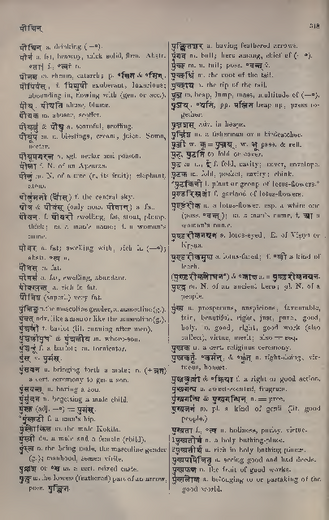
Monier-Williams 1872 substantive masculine
Original text · English · substantive masculine
puṇḍra puṇḍra, as, m. a red variety of the common sugar-cane, Saccharum Officinarum; a white lotus, a lotus in general; a species of tree (= hrasva- plakṣa); a kind of creeper, Gærtnera Racemosa (= ati-muktaka, vāsantī); a mark or line made on the forehead with sandal &c., sectarial mark; a worm; N. of a Daitya or infernal being considered incarnate in Śiśu-pāla; N. of a son of Bali; (ās), m. pl., N. of a people and of their country (the modern Bengal and Behar, ‘the country of the sugar-cane’); N. of a mythical city between the mountains Hima-vat and Hema-kūṭa.

Petersburger 1855 substantive masculine
Original text · German · substantive masculine
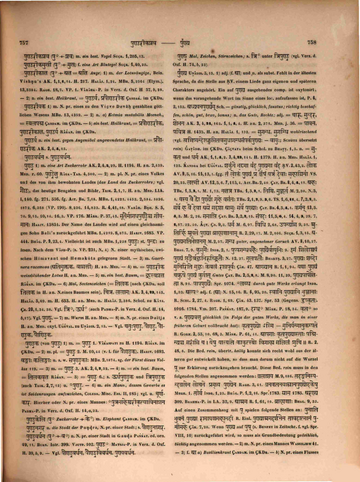
puṇḍra 1〉 m. eine Art Zuckerrohr AK. 2,4,5,29. H. 1194. H. an. 2,439. MED. r. 60. puṇḍrekṣu RĀJA-TAR. 4,500. — 2〉 m. pl. N. pr. eines Volkes und des von ihm bewohnten Landes (das Land des Zuckerrohrs; vgl. gauḍa), das heutige Bengalen und Bihār, TRIK. 2,1,7. H. an. MED. LIA. I, 140. fg. LIA. I,271. fg. LIA. I,556. fg. AIT. BR. 7,18. MBH. 1,4221. MBH. 1,4453. MBH. 2,584. MBH. 2,1096. MBH. 2,1872. MBH. 6,358 (VP. 190). MBH. 8,236. MBH. 14,832. R. 4,41,18. VARĀH. BṚH. S. 5,70. VARĀH. BṚH. S. 9,15. VARĀH. BṚH. S. 10,14. VARĀH. BṚH. S. 16,3. VP. 176. MĀRK. P. 57,45. sūtairmāgadhapuṇḍraiśca gīyamānaḥ HARIV. 15851. Der Name des Landes wird auf einen gleichnamigen Sohn Baliʼs zurückgeführt MBH. 1,4219. MBH. 8,875. HARIV. 1685. VP. 444. BHĀG. P. 9,23,4. Vielleicht ist auch MBH. 1,228 puṇḍraḥ st. pundraḥ zu lesen. Nach dem VĀYU-P. (s. VP. 231, N. 4) N. einer mythischen, zwischen Himavant und Hemakūta gelegenen Stadt. — 3〉 m. Gaertnera racemosa (atimuktaka, vāsantī) H. an. MED. — 4〉 m. = puṇḍarīka weissblühender Lotus H. an. MED. — 5〉 m. ein best. Baum, = hrasvaplakṣa RĀJAN._im_ŚKDR. — 6〉 Mal, Sectenzeichen (= tilaka [nach ŚKDR. soll tilaka in H. an. N. eines Baumes sein], citra, lalāma) AK. 3,4,23,145. HALĀY. 5,69. m. H. 653. H. an. MED. n. HALĀY. 2,386. Schol. zu KĀTY. ŚR. 20,1,34. KĀTY. ŚR. 20,1,38. Vgl. tri˚, ūrdhva˚ (auch PADMA-P._in_Verz. d. Oxf. H. 14,b,17). Vgl. puṇḍhra. — 7〉 m. Wurm H. an. MED. — 8〉 m. N. pr. eines Daitya H. an. MED. oxyt. UJJVAL._zu_UṆĀDIS. 2,13. — Vgl. catuḥpuṇḍra, pauṇḍra, pauṇḍraka, pauṇḍrika.
Böhtlingk 1879 substantive masculine · substantive neuter
Original text · German · substantive masculine · substantive neuter
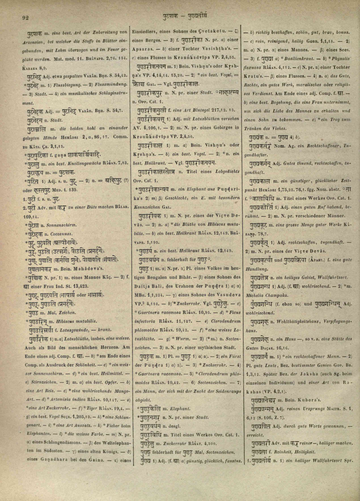
puṇḍra — 1〉 m. — a〉 N. pr. — α〉 Pl. eines Volkes im heutigen Bengalen und Bihār. — β〉 eines Sohnes des Daitya Bali, des Urahnen der Puṇḍra 1〉a〉α〉 MBH. 1,1,234. — γ〉 eines Sohnes des Vasudeva VP.² 4,110. — b〉 *Zuckerrohr. Vgl. purṇdrekṣu. — c〉 *Gaertnera racemosa RĀJAN. 10,95. — d〉 *Ficus infectoria RĀJAN. 11,127. — e〉 Clerodendrum phlomoides RĀJAN. 10,42. — f〉 *eine weisse Lotusblüthe. — g〉 *Wurm. — 2〉 (*m.) n. Sectenzeichen. — 3〉 n. N. pr. einer mythischen Stadt.
Cappeller 1887 substantive masculine
Original text · German · substantive masculine
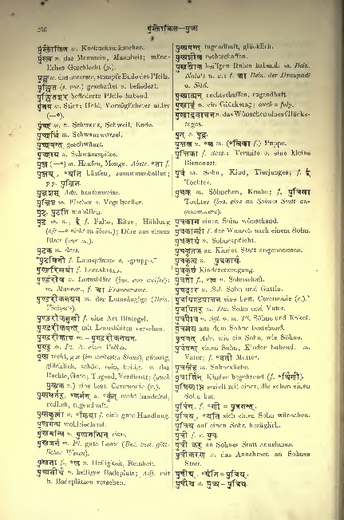
puṇḍra m. Pl. N. eines Volkes.
Burnouf 1866 substantive masculine
Original text · French · substantive masculine
puṇḍra puṇḍra m. lotus blanc. Gærtnera racemosa, bot. La canne à sucre [variété rouge]. Le tilaka. Ver. Np. d'un Daitya. Np. d'un pays faisant partie du Bengale et du Bihar [le Tchédi]; au pl. les habitants de ce pays. puṇḍraka m. gærtnera racemosa, bot. Canne à sucre [variété rouge]. puṇḍrakeli m. éléphant [qui aime la canne à sucre].
Occurrences in source texts (1)
DYS 1 occurrence
Continue with AYI Free
Image source: AYI archive.