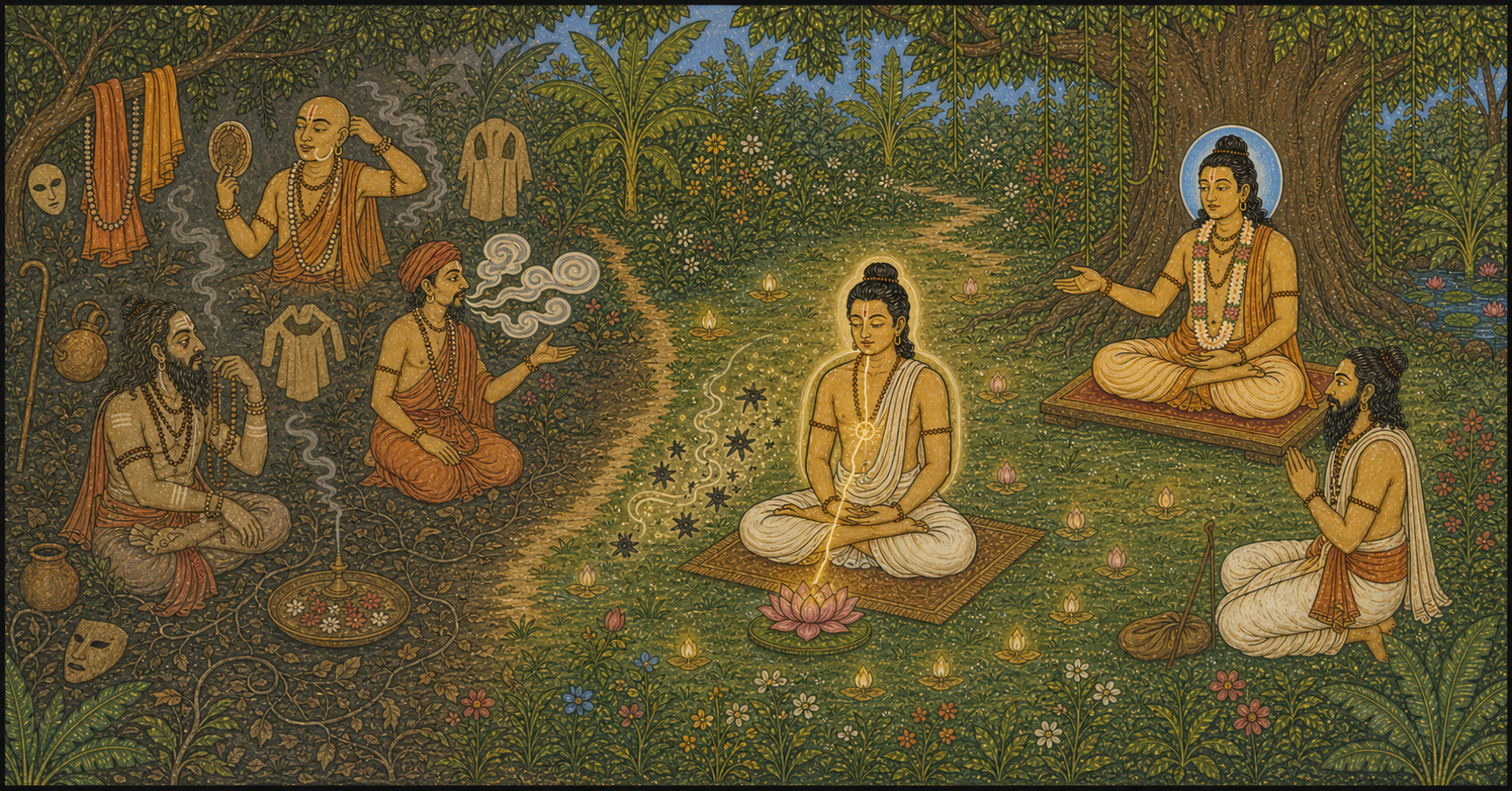
DYS 43–49: False Yogis

Dattātreyayogaśāstra 43–49: Outer Signs Cannot Replace Practice

Clothing, hairstyle, religious speech, and public performance do not make a yogi; those who live from yoga without practising deceive others and obstruct the path.

Dr. Ronald Steiner Dr. Ronald Steiner Nils Jacob Liersch Nils Jacob Liersch
Dattātreyayogaśāstra 43
न शास्त्रपाठमात्रेण योगसिद्धिः प्रजायते |
na śāstra-pāṭha-mātreṇa; yoga-siddhiḥ prajāyate | Analysis ▾ Analysis ▴
na
particle
not
śāstra
tatpuruṣa-compound genitive
substantive neuter
of the teaching
pāṭha
tatpuruṣa-compound genitive
substantive masculine
study, recitation
mātreṇa
instrumental case singular neuter
adjective
merely by
yoga
tatpuruṣa-compound genitive
substantive masculine
yoga
siddhiḥ
nominative singular
substantive feminine
perfection
prajāyate
3rd person singular medial present
previx
verbal root
arises
मुण्डितो दण्डधारी वा काषायवसनो ऽपि वा ||43||
muṇḍito daṇḍa-dhārī vā; kāṣāya-vasano 'pi vā ||43|| Analysis ▾ Analysis ▴
muṇḍitaḥ
nominative singular masculine past participle passive
verbal root
with the head shaved
daṇḍa
tatpuruṣa-compound genitive
substantive masculine
staff, spine
dhārī
nominative singular masculine
adjective
bearing
vā
particle
or
kāṣāya
tatpuruṣa-compound instrumental case
substantive neuter
ochre robe
vasanaḥ
nominative singular masculine
substantive neuter
dressed
api
particle
also
vā
particle
or
Metre: Anuṣṭubh
Accomplishment in yoga does not arise (na yoga-siddhiḥ prajāyate) merely through the study of scripture (śāstra-pāṭha-mātreṇa | ins sg), whether one has a shaven head (muṇḍitaḥ), carries a staff (daṇḍa-dhārī), or wears ochre robes (kāṣāya-vasanaḥ).
Dr. Ronald Steiner - 2026 - historically literal
Success in yoga does not come from merely studying scripture. A shaved head, a staff, and ochre robes are no substitute for practice.
Dr. Ronald Steiner - 2026 - modern transfer
yogasiddhiḥ JM2024 ] kā cit siddhiḥ DYŚ
Critical Apparatus
Dattātreyayogaśāstra 44
नारायणवदो वापि जटिलो भस्मलेपनः |
nārāyaṇa-vado vāpi; jaṭilo bhasma-lepanaḥ | Analysis ▾ Analysis ▴
nārāyaṇa
tatpuruṣa-compound accusative
substantive masculine
Nārāyaṇa
vadaḥ
nominative singular masculine
adjective
saying
vā
particle
or
api
particle
also
jaṭilaḥ
nominative singular masculine
adjective
wearing matted hair
bhasma
bahuvrīhi-compund
substantive neuter
ashes
lepanaḥ
nominative singular masculine
substantive neuter
smeared
नमःशिवायवाक्यो वा बाह्यार्चापूजको ऽपि वा ||44||
namaḥ-śivāya-vākyo vā; bāhyārcā-pūjako 'pi vā ||44|| Analysis ▾ Analysis ▴
namaḥ
karmadhāraya-compound
substantive neuter
homage, salutation
śivāya
karmadhāraya-compound
substantive masculine
to Śiva
vākyaḥ
nominative singular masculine
substantive neuter
whose utterance is “namaḥ śivāya”
vā
particle
or
bāhya
karmadhāraya-compound
adjective
external
arcā
tatpuruṣa-compound genitive
substantive feminine
image, worship
pūjakaḥ
nominative singular
substantive masculine
worshipper
api
particle
also
vā
particle
or
Metre: Anuṣṭubh
[One may] say “Nārāyaṇa” (nārāyaṇa-vadaḥ | nom sg), wear matted hair (jaṭilaḥ | nom sg), and be smeared with ash (bhasma-lepanaḥ | nom sg); or have “Namaḥ Śivāya” as one’s utterance (namaḥ-śivāya-vākyaḥ | nom sg), or be a worshipper of external images (bāhya-arcā-pūjakaḥ | nom sg).
Dr. Ronald Steiner - 2026 - historically literal
Sacred names, matted hair, ash on the skin, and external rituals are not enough either.
Dr. Ronald Steiner - 2026 - modern transfer
namaḥśivāyavākyo JM2024 ] namaḥśivāyavācī DYŚ
Critical Apparatus
Dattātreyayogaśāstra 45
स्थानद्वादशपुण्ड्रो वा मालाभिर्बहुभूषितः |
sthāna-dvādaśa-puṇḍro vā; mālābhir bahu-bhūṣitaḥ | Analysis ▾ Analysis ▴
sthāna
tatpuruṣa-compound lokative
substantive neuter
place
dvādaśa
karmadhāraya-compound
numeral
twelve
puṇḍraḥ
nominative singular masculine
substantive neuter
bearing twelve sectarian marks
vā
particle
or
mālābhiḥ
instrumental case plural
substantive feminine
with necklaces
bahu
karmadhāraya-compound
adjective
many
bhūṣitaḥ
nominative singular masculine past participle passive
verbal root
adorned
क्रियाविहीनो वा क्रूरः कथं सिद्धिमवाप्नुयात् ||45||
kriyā-vihīno vā krūraḥ; kathaṃ siddhim avāpnuyāt ||45|| Analysis ▾ Analysis ▴
kriyā
tatpuruṣa-compound instrumental case
substantive feminine
through practice
vihīnaḥ
nominative singular masculine past participle passive
previx
verbal root
devoid of
vā
particle
or
krūraḥ
nominative singular masculine
adjective
cruel
katham
adverb
how
siddhim
accusative singular
substantive feminine
accomplishment
avāpnuyāt
3rd person singular aktive optative
previx
verbal root
could attain
Metre: Anuṣṭubh
[One may] be marked with Puṇḍra signs at twelve places (sthāna-dvādaśa-puṇḍraḥ | nom sg) or richly adorned (bahu-bhūṣitaḥ | nom sg) with necklaces (mālābhiḥ | ins pl). If devoid of practice (kriyā-vihīnaḥ | nom sg) or cruel (krūraḥ | nom sg), how (katham) could one attain (avāpnuyāt | 3p sg act opt) accomplishment (siddhim | acc sg)?
Dr. Ronald Steiner - 2026 - historically literal
Religious marks, necklaces, and outward display bring no success in yoga when genuine practice is absent or a person acts cruelly.
Dr. Ronald Steiner - 2026 - modern transfer
sthānadvādaśapuṇḍro vā mālābhir bahubhūṣitaḥ JM2024 ] sthānadvādaśapūjo vā bahuvatsalapūjitam DYŚ
Critical Apparatus
Dattātreyayogaśāstra 46
न वेषधारणं सिद्धेः कारणं न च तत्कथा |
na veṣa-dhāraṇaṃ siddheḥ; kāraṇaṃ na ca tat-kathā | Analysis ▾ Analysis ▴
na
particle
not
veṣa
tatpuruṣa-compound genitive
substantive masculine
religious garb
dhāraṇam
nominative singular
substantive neuter
holding, retention
siddheḥ
genitive singular
substantive feminine
of accomplishment
kāraṇam
nominative singular
substantive neuter
the cause
na
particle
not
ca
particle
and
tat
tatpuruṣa-compound genitive
pronoun
about it
kathā
nominative singular
substantive feminine
talk, discourse
क्रियैव कारणं सिद्धेः सत्यमेव तु सांकृते ||46||
kriyaiva kāraṇaṃ siddheḥ; satyam eva tu sāṃkṛte ||46|| Analysis ▾ Analysis ▴
kriyā
nominative singular
substantive feminine
practice
eva
particle
alone
kāraṇam
nominative singular
substantive neuter
the cause
siddheḥ
genitive singular
substantive feminine
of accomplishment
satyam
adverb
truly
eva
particle
indeed
tu
particle
in fact
sāṃkṛte
vokative singular
substantive masculine
O Sāṃkṛti
Metre: Anuṣṭubh
Neither (na) wearing religious garb (veṣa-dhāraṇam | nom sg) nor (na ca) talk about it (tat-kathā | nom sg) is the cause (kāraṇam | nom sg) of accomplishment (siddheḥ | gen sg). Practice (kriyā | nom sg) alone (eva) is the cause (kāraṇam | nom sg) of accomplishment. This is indeed (tu) true (satyam), O Sāṃkṛti (sāṃkṛte | voc sg).
Dr. Ronald Steiner - 2026 - historically literal
Neither clothing nor talk leads to the goal. Only sustained practice brings accomplishment—that is the truth.
Dr. Ronald Steiner - 2026 - modern transfer
tatkathā JM2024 ] tat tathā DYŚ
Critical Apparatus
Dattātreyayogaśāstra 47
शिश्नोदरार्थं योगस्य कथया वेषधारिणः |
śiśnodarārthaṃ yogasya; kathayā veṣa-dhāriṇaḥ | Analysis ▾ Analysis ▴
śiśna
dvandva-compound
substantive neuter
the penis
udara
tatpuruṣa-compound genitive
substantive neuter
belly
artham
accusative singular
substantive masculine
for the sake
yogasya
genitive singular
substantive masculine
of yoga
kathayā
instrumental case singular
substantive feminine
through talk
veṣa
tatpuruṣa-compound genitive
substantive masculine
religious garb
dhāriṇaḥ
nominative plural masculine
adjective
wearers
अनुष्ठानविहीनास्तु वञ्चयन्ति जनान्किल ||47||
anuṣṭhāna-vihīnās tu; vañcayanti janān kila ||47|| Analysis ▾ Analysis ▴
anuṣṭhāna
tatpuruṣa-compound genitive
substantive neuter
practice
vihīnāḥ
nominative plural masculine past participle passive
previx
verbal root
devoid of
tu
particle
indeed
vañcayanti
3rd person plural aktive present
verbal root
deceive
janān
accusative plural
substantive masculine
people
kila
particle
surely
Metre: Anuṣṭubh
In order to satisfy penis and belly (śiśnodarārtham), wearers of religious garb (veṣa-dhāriṇaḥ | nom pl) who are devoid of actual practice (anuṣṭhāna-vihīnāḥ | nom pl) deceive (vañcayanti | 3p pl act pres) people (janān | acc pl) by talking about yoga (yogasya kathayā).
Dr. Ronald Steiner - 2026 - historically literal
People who wear religious garb but do not practise, serving only their sexual and material appetites, deceive others with their talk about yoga.
Dr. Ronald Steiner - 2026 - modern transfer
Dattātreyayogaśāstra 48
उच्चावचैर्विप्रलम्भैर्यतन्ते ऽकुशला नराः |
uccāvacair vipralambhair; yatante 'kuśalā narāḥ | Analysis ▾ Analysis ▴
ucca
dvandva-compound
adjective
high
avacaiḥ
instrumental case plural masculine
adjective
low, varied
vipralambhaiḥ
instrumental case plural
substantive masculine
deceptions
yatante
3rd person plural medial present
verbal root
strive
akuśalāḥ
nominative plural masculine
adjective
malevolent
narāḥ
nominative plural
substantive masculine
men
योगिनो वयमित्येवं मूढा भोगपरायणाः ||48||
yogino vayam ity evaṃ; mūḍhā bhoga-parāyaṇāḥ ||48|| Analysis ▾ Analysis ▴
yoginaḥ
nominative plural
substantive masculine
yogins
vayam
nominative plural
pronoun pers 1p
we
iti
particle
thus
evam
adverb
in this way
mūḍhāḥ
nominative plural masculine
adjective
fools
bhoga
tatpuruṣa-compound genitive
substantive masculine
pleasure; sensual enjoyment
parāyaṇāḥ
nominative plural masculine
adjective
devoted
Metre: Anuṣṭubh
Malevolent men (akuśalā narāḥ | nom pl) exert themselves through all manner of deceptions (uccāvacair vipralambhaiḥ | ins pl). “We are yogins” (yogino vayam iti), say these fools (mūḍhāḥ | nom pl), wholly devoted to enjoyment (bhoga-parāyaṇāḥ | nom pl).
Dr. Ronald Steiner - 2026 - historically literal
Such malevolent people employ all kinds of deception. They call themselves yogins but remain fools wholly devoted to enjoyment.
Dr. Ronald Steiner - 2026 - modern transfer
vipralambhair yatante ’kuśalā JM2024 ] vipralambhaiḥ yatante kuśalāḥ DYŚ
Critical Apparatus
Dattātreyayogaśāstra 49
शनैस्तथाविधान्ज्ञात्वा योगाभ्यासविवर्जितान् |
śanais tathā-vidhān jñātvā; yogābhyāsa-vivarjitān | Analysis ▾ Analysis ▴
śanaiḥ
adverb
gradually
tathā
bahuvrīhi-compund
adverb
such
vidhān
accusative plural masculine
adjective
kinds
jñātvā
absolutus
verbal root
having recognized
yoga
tatpuruṣa-compound genitive
substantive masculine
yoga
abhyāsa
tatpuruṣa-compound genitive
substantive masculine
practice
vivarjitān
accusative plural masculine past participle passive
previx
verbal root
devoid of
कृतार्थान्वचनैरेव वर्जयेद्वेषधारिणः ||49||
kṛtārthān vacanair eva; varjayed veṣa-dhāriṇaḥ ||49|| Analysis ▾ Analysis ▴
kṛta
bahuvrīhi-compund past participle passive
verbal root
fulfilled
arthān
accusative plural masculine
substantive masculine
aims, purposes
vacanaiḥ
instrumental case plural
substantive neuter
through words
eva
particle
alone
varjayet
3rd person singular aktive optative
verbal root
one should avoid
veṣa
tatpuruṣa-compound genitive
substantive masculine
religious garb
dhāriṇaḥ
accusative plural masculine
adjective
wearers
Metre: Anuṣṭubh
Having gradually (śanaiḥ) recognized (jñātvā | abs) that such people (tathā-vidhān | acc pl) lack yoga practice (yogābhyāsa-vivarjitān | acc pl) and have achieved their purpose by words alone (kṛtārthān vacanaiḥ eva | acc pl), one should avoid (varjayet | 3p sg act opt) these wearers of religious garb (veṣa-dhāriṇaḥ | acc pl).
Dr. Ronald Steiner - 2026 - historically literal
Anyone who recognizes that a person merely talks and does not practise should keep away from such sham yogins.
Dr. Ronald Steiner - 2026 - modern transfer
kṛtārthān vacanair JM2024 ] kṛtārthanvacanair DYŚ
Critical Apparatus

Continue with AYI Free

Illustrations: AI-generated.

Editor

Dr. Ronald Steiner

From Ulm

The "Yoga Doc" - Dr. Ronald Steiner is the founder of the AYI method. This method links traditional Ashtanga Yoga with innovative Yogatherapy and living Philosophy. This forms a practice that is personal for each and... more ›

Nils Jacob Liersch

Meine Begeisterung für Yoga, indische Philosophie und Sanskrit führte mich zum Studium der Indologie und Religionswissenschaft an der Universität Heidelberg. Seit 2004 befinde ich mich auf meinem persönlichen Yogaweg... more ›

Messages and ratings
2 messages Ø

Please log in to write a message. Go to login

Es geht NUR durch den Körper und MIT der bewußten Atmung! Vielleicht eine der wenigen absoluten Wahrheiten.