

rāma राम – rāma
adjective · substantive masculine · substantive neuter · Word type unspecified
Dictionary sources
AYI dictionary substantive masculine
Monier-Williams 1872 adjective
Original text · English · adjective
rāma rāma, as, ā, am (fr. rt. ram), pleasing, delighting, rejoicing; lovely, beautiful, charming, pleasant; obscure, dark-coloured, dark, black [cf. rātri]; white; (as), m. joy, pleasure; ‘the pleasing or beautiful one,’ N. of three celebrated mytholo- gical personages, commonly called Paraśu-rāma, Rāma-candra, and Bala-rāma, (of these the first two are always regarded as Avatāras of Viṣṇu, one born at the beginning, the other at the end of the second age: the first or Paraśu-rāma, ‘Rāma with the axe,’ forms the sixth Avatāra; he is sometimes called Jāmadagnya, as son of the sage Jamad-agni by Reṇukā, and sometimes Bhārgava, as descended from Bhṛgu, and he is the type of Brāhmanism arrayed in opposition to the military caste, see paraśu-rāma: the second, Rāma-candra, forms Viṣṇu's seventh Avatāra, and is the hero of the great epic poem called Rāmāyaṇa; his wife, Sītā, is sometimes re- garded as an Avatāra of Lakṣmī; he has the patro- nymic Dāśarathi, as son of Daśa-ratha, a king of the solar dynasty, and Rāghava, as descended from Raghu [see Raghu], and he typifies the conquering Kṣa- triyas advancing southwards and subjugating the bar- barous aborigines represented by the demon Rāvaṇa and his followers, the Rākṣasas: the third, Bala- rāma, ‘the strong Rāma,’ born in the third age, is a kind of Hindū Hercules, the seventh son of Vasu- deva and elder brother of Kṛṣṇa, both being de- scended from Yadu [who with Puru formed the two branches of the lunar dynasty]; he is sometimes called Halāyudha, ‘armed with a plough,’ sometimes Musalin, ‘club-armed,’ and although occasionally regarded as Viṣṇu's eighth Avatāra, is more properly an incarnation of the great serpent Śeṣa, see bala- deva, bala-rāma: according to Jainas, a Rāma is enumerated among the nine white Balas [see bala]: in Viṣṇu-Purāṇa III. 2. a Rāma is mentioned among the seven Ṛṣis of the eighth Manvantara presided over by Manu Sāvarṇi, cf. Hari-vaṃśa 453); N. of the author of Ṛg-veda X. 110 (with the pa- tronymic Jāmadagnya belonging to Paraśu-rāma); N. of Varuṇa; of a person with the patronymic Mārgaveya; of various others persons or teachers; of a king of Malla-pura; of a king of Śṛṅga-vera; a lover; a kind of deer; a horse; (ās), m. pl., N. of a people; (ā), f. a beautiful female, handsome woman, a young and charming woman, a woman in general; a woman of low origin; N. of various plants (= śveta-kaṇṭakārī, gṛha-kanyā, ārāma- śītalā, aśoka); Asa Fœtida (= hiṅgu); vermilion (= hiṅgula); a kind of pigment (= go-rocanā); ruddle; a river; a kind of metre, ˘¯˘¯¯˘˘¯˘ ¯¯, ˘¯˘¯¯˘˘¯˘¯¯, ¯¯˘¯¯˘˘¯˘¯¯, ¯ ¯˘¯¯˘˘¯˘¯¯; N. of an Apsaras; of a daughter of Kumbhāṇḍa; of the mother of the ninth Arhat of the present Ava-sarpiṇī; (ī), f., Ved. darkness, night [cf. rātri]; (am), n. darkness; Chenopodium Album; = kuṣṭha; = tamāla-pattra.
Petersburger 1855 adjective · substantive masculine · substantive neuter · Word type unspecified
Original text · German · adjective · substantive masculine · substantive neuter
1. rāmá (wohl desselben Ursprungs wie rātrī) 1〉 adj. (f. ā) dunkelfarbig, schwarz NIR. 12,13. AK. 3,4,23,143. H. 1397. H. an. 2,334. MED. m. 26. fg. HALĀY. 4,49. rāme̱ kṛṣṇe̱ asìkni ca AV. 1,23,1. Schaf AV. 12,2,19. nāsya rāma (= ramaṇīyaḥ putraḥ Comm.) ucchiṣṭaṃ pibet TAITT. ĀR. 5,8,13. rāmā eine Dunkle d. i. ein Weib gemeiner Herkunft: nāgniṃ ci̱tvā rā̱māmupèyāt TS. 5,6,8,3. TAITT. ĀR. 5,8,13. Schol. zu KĀTY. ŚR. 18,6,27. Auch die Bedeutung 2. rāma 2〉c〉(α) wäre indessen hier möglich. Nach AK. H. an. und MED. auch weiss. — 2〉 m. a〉 eine Hirschart AK. 2,5,11. TRIK. 3,3,302. H. an. MED. — b〉 Pferd MED. — c〉 N. pr. eines Mannes ṚV. 10,93,14. mit dem patron. Mārgaveya AIT. BR. 7,27. AIT. BR. 7,34. Aupatasvini ŚAT. BR. 4,6,1,7. Jāmadagnya, Verfassers von ṚV. 10,110. Im Epos und später erscheinen drei Rāma (daher rāma als Bez. der Zahl drei VARĀH. BṚH. S. 8,20), von denen die beiden ersten für Incarnationen Viṣṇuʼs gelten: α〉 mit dem patron. Jāmadagnya oder Bhārgava, ein Sohn der Reṇukā, auch paraśurāma genannt, TRIK. 3,3,302. H. 848. H. an. MED. (wo raiṇukeye st. vaiṇukeye zu lesen ist). rāmaḥ śastrabhṛtāmaham (vgl. HARIV. 5869) sagt Kṛṣṇa BHAG. 10,31. MBH. 1,272. fgg. MBH. 1,2612. MBH. 3,8658. fgg. MBH. 8,1584. MBH. 12,1715. fgg. MBH. 12,12948. HARIV. 2313. fgg. HARIV. 5869. fg. rāmarāmavivāda R. 1,3,11 (R. 1,3,5 GORR.). R. 74,22. fg. R. 76,1. R. GORR. 1,77,23. R. GORR. 1,77,37. RAGH. 11,68. — β〉 mit dem patron. Rāghava oder Dāśarathi TRIK. 2,8,3. TRIK. 3,3,302. H. 703. H. an. MED. MBH. 3,11197. MBH. 3,15933. MBH. 12,12949. HARIV. 822. fgg. HARIV. 2324. HARIV. 3065. fgg. HARIV. 5871. fgg. HARIV. 7373. R. 1,1,10. R. 1,1,17. R. 1,1,20. rāmarāmavivāda R. 1,3,11 (R. 1,3,5 GORR.). ramayatyeva sa guṇairudāraistairimāḥ prajāḥ . yasmādato rāma iti nāmaitattasya viśrutam .. R. GORR. 1,1,22. R. GORR. 1,6,102. RAGH. 11,68. VARĀH. BṚH. S. 58,30. VP. 384. BHĀG. P. 9,10. fgg. Spr. 2630. rāmo hemamṛgaṃ ma rvetti Spr. 2631. ramante yogino 'nante satyānande cidātmani . iti rāmapadenāsau paraṃ brahmābhidhīyate .. WEBER, RĀMAT. UP. 286. — γ〉 = Balarāma, Halāyudha, ein älterer Bruder Kṛṣṇaʼs AK. 1,1,1,18. AK. 3,4,23,143. H. 224. H. an. MED. HALĀY. 1,29. BHĀG. P. 1,11,17. BHĀG. P. 10,1,8. WEBER, KṚṢṆAJ. 268. WEBER, KṚṢṆAJ. 281. WEBER, KṚṢṆAJ. 284. WEBER, KṚṢṆAJ. 289. erscheint bei den Jaina unter den 9 weissen (s. oben u. 1) Balaʼs H. 698. — Rāma unter den sieben Weisen eines Manu HARIV. 453. MĀRK. P. 80,4. Rāma ist ein auch später häufig vorkommender Name: so heisst z. B. ein Sohn Tārāvalokaʼs und einer Mādrī und Zwillingsbruder Lakṣmaṇaʼs KATHĀS. 113,32. verschiedene Lehrer, Autoren u. s. w. BURN. Intr. 567 (neben bhadanta˚). COLEBR. Misc. Ess. II, 49. Verz. d. B. H. No. 109. Verz. d. B. H. No. 833. Ind. St. 8,389. HALL 84. HALL. 119. Verz. d. Oxf. H. 126,b, No. 220. fgg. Verz. d. Oxf. H. 129,b, No. 234. Verz. d. Oxf. H. 148,a,9. fgg. Verz. d. Oxf. H. 151,b, No. 321. Verz. d. Oxf. H. 335,b, No. 788. fgg. Verz. d. Oxf. H. 341,b, N. 358,a, No. 853. fgg. Verz. d. Oxf. H. 386,a, No. 505. ein Fürst von Mallapura Verz. d. Oxf. H. 148,b,15. Verz. d. Oxf. H. 148,b,18. von Śṛṅgavera Verz. d. Oxf. H. 165,a,7. Verz. d. Oxf. H. 178,a,16. — RĀJA-TAR. 8,785. KṢITĪŚ. 10,7. fgg. — d〉 Bein. Varuṇaʼs MED. — e〉 pl. N. pr. eines Volkes VP. 177. — 3〉 f. ā a〉 ein Weib niedriger Herkunft; s. u. 1〉. — b〉 = hiṅgu Asa foetida H. an. MED. = hiṅgula Mennig ŚABDAR._im_ŚKDR. — 4〉 f. ī Dunkel, Nacht: u̱ṣā na rā̱mīràru̱ṇairapòrṇute ṚV. 2,34,11. — 5〉 n. a〉 Dunkel: a̱gnī ruśàdbhi̱rvarṇaìra̱bhi rā̱mamàsthāt ṚV. 10,3,3. — b〉 = vāstuka (Chenopodium album) und kuṣṭha (in welcher Bed. ?) H. an. MED. = tamālapattra RĀJAN._im_ŚKDR. — Vgl. adho˚, paraśu˚, bala˚, bhadanta˚, maṇi˚, manasā˚.
Original text · German · Word type unspecified
2. rāma (von ram) 1〉 nom. act. Lust, Freude: svakuṭumba˚ adj. BHĀG. P. 7,6,14. — 2〉 oxyt. nom. ag. gaṇa jvalādi zu P. 3,1,140. a〉 adj. (f. a) erfreuend, entzückend, lieblich, reizend AK. 3,4,23,143. H. an. 2,334. MED. m. 26. fg. rāmasya lokarāmasya R. 1,19,20. bhāvena rāmā MBH. 1,1812. R. 2,44,24. KATHĀS. 65,27. mṛgī MĀRK. P. 65,22. rāmādrāmaṃ jagadabhūdrāme rājyaṃ praśāsati lieblicher als lieblich MBH. 7,2246. BHAṬṬ. 10,2. NALOD. 1,5. — b〉 m. Liebhaber VARĀH. BṚH. S. 19,5. — c〉 f. ā α〉 eine Schöne, ein junges reizendes Weib, Geliebte, Frau AK. 2,6,1,4. TRIK. 2,6,1. H. 505. H. an. MED. HALĀY. 2,326. KAṬHOP. 1,25. MBH. 1,3039. R. 5,11,20. RAGH. 5,49. RAGH. 12,23. RAGH. 16,15. VIKR. 114. Spr. 24. Spr. 691. Spr. 1456. Spr. 2629. Spr. 2651. Spr. 4817. Spr. 4931. Spr. 5274. VARĀH. BṚH. S. 19,5. GĪT. 1,44. KATHĀS. 18,12. KATHĀS. 56,425. RĀJA-TAR. 1,370. arundhatī satīnāṃ tu rāmāsu ca tilottamā Verz. d. Oxf. H. 39,b,36. BHĀG. P. 3,23,40. BHĀG. P. 3,23,44. BHĀG. P. 4,26,14. BHĀG. P. 4,28,59. PAÑCAR. 2,3,32. PAÑCAR. 2,4,5. PAÑCAR. 2,3,48. DHŪRTAS. 87,15. — β〉 Bez. verschiedener Pflanzen: = śvetakaṇṭakārī, gṛhakanyā, ārāmaśītalā, aśoka RĀJAN._im_ŚKDR. — γ〉 ein best. Pigment (gorocanā) RĀJAN. — δ〉 Röthel, rubrica ŚABDAC._im_ŚKDR. — ε〉 Fluss MED. auch in H. an. ist wohl hiṅgu nadīstriyoḥ zu lesen. — ζ〉 ein best. Metrum: ⏑ – ⏑ – – ⏑ ⏑ – ⏑ – –, ⏑ – ⏑ – – ⏑ ⏑ – ⏑ –; – – ⏑ – – ⏑ ⏑ – ⏑ – –, – – ⏑ – – ⏑ ⏑ – ⏑ – – Journ. of the Am. Or. S. 6,514. — η〉 N. pr. einer Apsaras VYĀḌI beim Schol. zu H. 183. einer Tochter Kumbhāṇḍaʼs HARIV. 9973. HARIV. 11026. fg. der Mutter des 9ten Arhantʼs der gegenwärtigen Avasarpiṇī H. 39. — Vgl. su˚.
Böhtlingk 1879 adjective · substantive masculine · substantive neuter
Original text · German · adjective · substantive masculine · substantive neuter
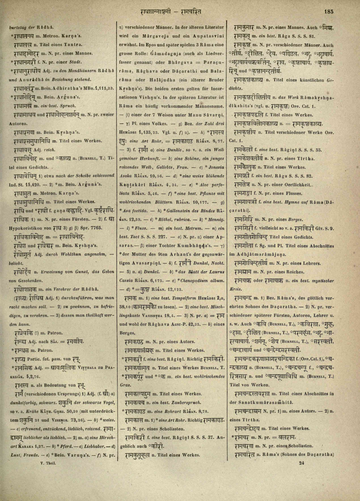
rāmá (verschiedenen Ursprungs) — 1〉 Adj. (f. ā́) — a〉 dunkelfarbig, schwarz. śakuni der schwarze Vogel, so v. a. Krähe KĀṬH. GṚHY. 50,20 (mit unterdrücktem śakuni KĀṬH. GṚHY. 50,21 und VIṢṆUS. 73,26). — b〉 *weiss. — c〉 erfreuend, entzückend, lieblich, reizend. rāmādrāmam lieblicher als lieblich. — 2〉 m. — a〉 eine Hirschart CARAKA. 1,27. — b〉 *Pferd. — c〉 Liebhaber. — d〉 Lust, Freude. — e〉 *Bein. Varuṇaʼs. — f〉 N. pr. [Page5-185-b] — α〉 verschiedener Männer. In der ältern Literatur wird ein Mārgaveya und ein Aupatasvini erwähnt. Im Epos und später spielen 3 Rāma eine grosse Rolle; Jāmadagnya (auch als Liedverfasser genannt) oder Bhārgava = Paraśurāma, Rāghava oder Dāśarathi und Balarāma oder Halāyudha (ein älterer Bruder Kṛṣṇaʼs). Die beiden ersten gelten für Incarnationen Viṣṇuʼs. In der späteren Literatur ist Rāma ein häufig vorkommender Mannesname. — β〉 einer der 7 Weisen unter Manu Sāvarṇi. — γ〉 Pl. eines Volkes. — g〉 Bez. der Zahl drei HEMĀDRI 1,125,23. Vgl. u. f〉α〉. — h〉 *rāmasya iṣuḥ eine Art Rohr, = rāmakāṇḍa RĀJAN. 8,77. — 3〉 f. rāmā́ — a〉 eine Dunkle, so v. a. ein Weib gemeiner Herkunft. — b〉 eine Schöne, ein junges reizendes Weib, Geliebte, Frau. — c〉 *Jonesia asoca RĀJAN. 10,56. — d〉 *eine weiss blühende Kaṇṭakārī RĀJAN. 4,34. — e〉 *Aloe perfoliata RĀJAN. 5,46. — f〉 *eine best. Pflanze mit wohlriechenden Blättern RĀJAN. 10,177. — g〉 *Asa foetida. — h〉 *Gallenstein des Rindes RĀJAN. 12,59. — i〉 *Röthel, rubrica. — k〉 *Mennig. — l〉 *Fluss. — m〉 ein best. Metrum. — n〉 ein best. Tact. S. S. S. 227. — o〉 N. pr. — α〉 einer Apsaras. — β〉 einer Tochter Kumbhāṇḍaʼs. — γ〉 *der Mutter des 9ten Arhantʼs der gegenwärtigen Avasarpiṇī. — 4〉 f. rāmī́ Dunkel, Nacht. — 5〉 n. — a〉 Dunkel. — b〉 *das Blatt der Laurus cassia RĀJAN. 6,175. — c〉 *Chenopodium album. — d〉 *= kuṣṭha RĀJAN. 12,122.
Apte 1890 adjective · substantive masculine · substantive neuter
Original text · English · adjective · substantive masculine · substantive neuter
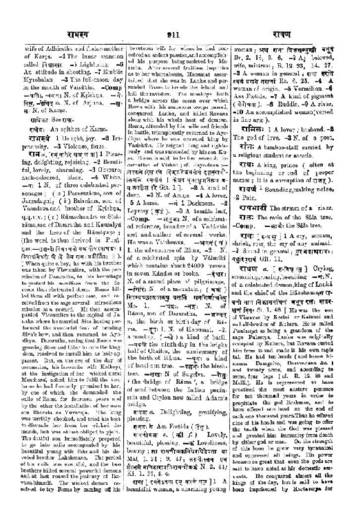
rāma a. [ram kartari ghañ ṇa vā] 1 Pleasing, delighting, rejoicing. 2 Beautiful, lovely, charming. 3 Obscure; dark-coloured, black. 4 White. — maḥ 1 N. of three celebrated personages; (a) Paraśurāma, son of Jamadagni; (b) Balarāma, son of Vasudeva and brother of Kṛṣṇa, q.q. v.v.; (c) Rāmacandra or Sītārāma, son of Daśaratha and Kausalyā and the hero of the Rāmāyaṇa; (the word is thus derived in Purāṇas: -rāśabdo viśvavacano maścāpīśvaravācakaḥ . viśvādhīneśvaro yo hi tena rāmaḥ prakīrtitaḥ ..). [When quite a boy, he with his brother was taken by Viśvāmitra, with the permission of Daśaratha, to his hermitage to protect his sacrifices from the demons that obstructed them. Rāma killed them all with perfect ease, and received from the sage several miraculous missiles as a reward. He then accompanied Viśvāmitra to the capital of Janaka where he married Sītā having performed the wonderful feat of bending Śiva's bow, and then returned to Ayodhyā. Daśaratha, seeing that Rāma was growing fitter and fitter to rule the kingdom, resolved to install him as heir-apparent. But, on the eve of the day of coronation, his favourite wife Kaikeyī, at the instigation of her wicked nurse Mantharā, asked him to fulfil the two boons he had formerly promised to her, by one of which she demanded the exile of Rāma for fourteen years and by the other the installation of her own son Bharata as Yuvarāja. The king was terribly shocked, and tried his best to dissuade her from her wicked demands, but was at last obliged to yield. The dutiful son immediately prepared to go into exile accompanied by his beautiful young wife Sītā and his devoted brother Lakṣmaṇa. The period of his exile was eventful, and the two brothers killed several powerful demons and at last roused the jealousy of Rāvaṇa himself. The wicked demon resolved to try Rāma by carrying off his ([Page 0911-b]) beauteous wife for whom he had conceived an ardent passion, and accomplished his purpose being assisted by Mārīcha. After several fruitless inquiries as to her whereabouts, Hanumat ascertained that she was in Laṅkā and persuaded Rāma to invade the island and kill the ravisher. The monkeys built a bridge across the ocean over which Rāma with his numerous troops passed, conquered Laṅkā, and killed Rāvaṇa along with his whole host of demons. Rāma, attended by his wife and friends in battle, triumphantly returned to Ayodhyā where he was crowned king by Vasiṣṭha. He reigned long and righteously and was succeeded by his son Kuśa. Rāma is said to be the seventh incarnation of Viṣṇu; cf. Jayadeva: -vitarasi dikṣu raṇe dikpatikamanīyaṃ daśamukhamaulibaliṃ ramaṇīyaṃ . keśava dhṛtaraghupatirūpa jaya jagadīśa hare Gīt. 1 ]. 2 A kind of deer. 3 N. of Aruṇa. 4 A lover. 5 A horse. — maṃ 1 Darkness. 2 Leprosy (kuṣṭhaṃ). 3 A tamāla leaf. Comp. — anujaḥ N. of a celebrated reformer, founder of a Vedāntic sect and author of several works. He was a Vaiṣṇava. — ayanaṃ (ṇaṃ) 1 the adventures of Rāma. 2 N. of a celebrated epic by Vālmīki which contains about 24000 verses in seven Kāṇḍas or books. — īśvaraḥ N. of a sacred place of pilgrimage. — giriḥ N. of a mountain; (cakre) snigdhacchāyāttaruṣu vasatiṃ rāmagiryāśrameṣu Me. 1. — candraḥ, -bhadraḥ N. of Rāma, son of Daśaratha. — janman n. the birth or birth-day of Rāma. — dūtaḥ 1 N. of Hanumat. 2 a monkey. — (tī) a kind of basil. — navamī the ninth day in the bright half of Chaitra, the anniversary of the birth of Rāma. — pūgaḥ a kind of betel-nut tree. — vallabhaḥ the birchtree. — sakhaḥ N. of Sugrīva. — setuḥ ‘the bridge of Rāma’, a bridge of sand between the Indian peninsula and Ceylon now called Adam's bridge.
Cappeller 1887 Word type unspecified
Original text · German · Word type unspecified
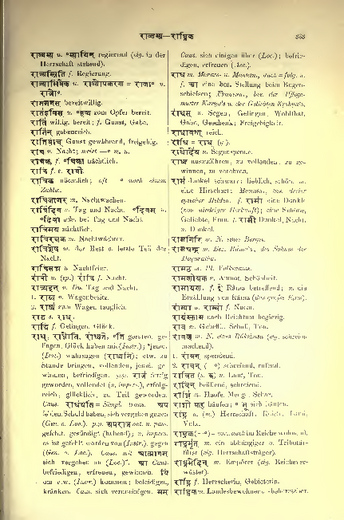
rāmá dunkel schwarz; lieblich, schön. m. eine Hirschart; Mannsn., bes. dreier epischer Helden. f. rāmā́ eine Dunkle (von niedriger Herkunft); eine Schöne, Geliebte, Frau. f. rāmī́ Dunkel, Nacht. n. Dunkel.
Burnouf 1866 adjective
Original text · French · adjective
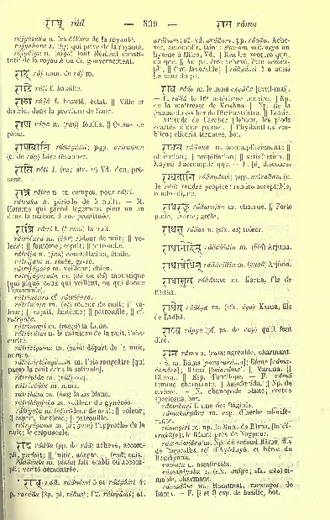
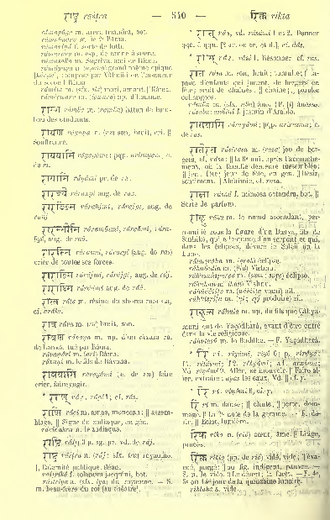
rāma rāma a. (ram) agréable, charmant. — S. m. Rāma [paraśurāma]; Rāma [rāmacandra]; Rāma [balarāma]. Varuṇa. Cheval. Esp. d'antilope. — F. rāmā femme charmante. Assafœtida. Np. de rivière. — N. chenopode blanc; costus speciosus, bot. rāmakarī f. une des Rāgīṇīs. rāmakarpūra m. esp. d'herbe odoriférante. rāmagiri m. np. le Mont de Rāma, [le citrakūṭa]; le Râmti près de Nagpour. rāmacandra m. Np. du second Rāma, fils de Daśaratha roi d'Ayodhyā, et héros du Rāmāyaṇa. rāmaṭa n. assafœtida. rāmaṇīyaka a. (sfx. anīya; sfx. aka) aimable, charmant. rāmadūta m. Hanumat, messager de Rāma. — F. [i et ī] esp. de basilic, bot. [Page540-1] rāmapūga m. areca triandra, bot. rāmabhadra m. le 2ᵉ Rāma. rāmavīṇā f. sorte de luth. rāmaśara m. esp. de canne à sucre. rāmasakha m. Sugrīva, ami de Rāma. rāmāyaṇa n. (ayana) grand poème épique [kāvya], composé par Vālmīki en l'honneur du second Rāma. rāmila m. (sfx. ila) mari, amant. Kāma. rāmeśvara m. (īśvara) np. d'homme.
Occurrences in source texts (1)
HP 1 occurrence
Continue with AYI Free
Image source: AYI archive.