

śaiva शैव – Belonging to Śiva, Śaiva
adjective · substantive masculine · substantive neuter · Word type unspecified
Dictionary sources
AYI dictionary adjective
Cappeller 1891 Word type unspecified
Original text · English · Word type unspecified
śaiva ·f. ī relating to Śiva, Śiva's; m. a worshipper of Ś.
Monier-Williams 1872 adjective
Original text · English · adjective
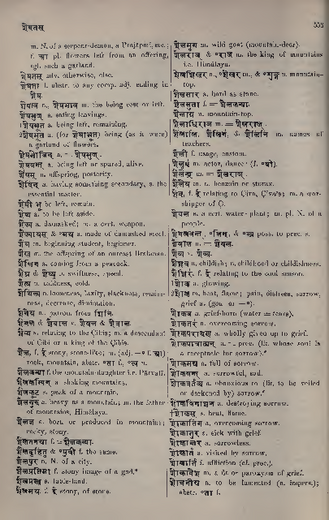
śaiva śaiva, as, ī, am (fr. śiva), relating or belonging to the god Śiva; (as), m. ‘a worshipper or follower of Śiva,’ N. of one of the three great divisions of modern Hindū sects, (the other two being the Vaiṣṇavas and Śāktas, see vaiṣṇava, śākta; the Śaivas believe in the superiority of Śiva to the other gods of the Tri-mūrti, and identify him with the Supreme Being as the destroying principle as well as source and essence of the whole universe; the temples dedicated to him in his popular symbol of the Liṅga [see śiva] are very numerous every- where, but the doctrines of the Śaivas as represented by their great teachers, such as Śaṅkara, are too philosophical for the majority of the people, who are more attracted by Viṣṇu, especially in his forms of Kṛṣṇa and Rāma: various divisions of Śaiva sects have prevailed at different times, the earlier divisions being those of the Raudras who have the Tri-śūla or trident marked on their foreheads, the Ugras who have the Ḍamaru or drum on their arms, the Bhāktas who have the Liṅga on their foreheads, the Jaṅgamas who have that symbol on their heads, and the Pāśupatas who have it marked on other parts of their bodies; the more modern divisions being the Daṇḍins or mendicant staff- bearers, including the Daś-nāmī-daṇḍins [cf. śaṅka- rācārya], the Yogins who cultivate absorption into Śiva by suppression of breathing, fixing of the eyes, and eighty-four different attitudes, the Jaṅgamas or Liṅgavats, the Parama-haṃsas, the Aghorins, the Ūrdhva-bāhus, the Ākāśa-mukhins, and many others); a particular religious rite in honour of Durgā (con- sisting of devout meditation and prostration of the body); the thorn-apple; another plant or tree, = vasuka; (ī), f., N. of the goddess Manasā; (am), n. the Śiva-Purāṇa; the aquatic plant Vallisneria Octandra (= śaivāla).
Petersburger 1855 adjective · substantive masculine · substantive neuter · Word type unspecified
Original text · German · adjective · substantive masculine · substantive neuter
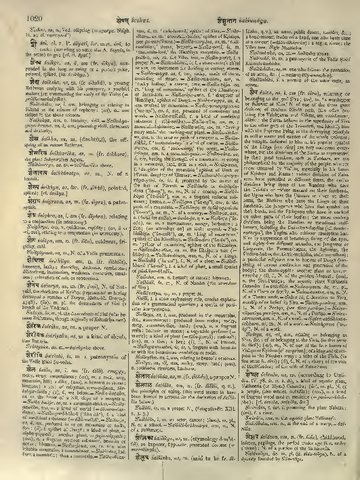
1. śaivá 1〉 adj. zu Śiva in Beziehung stehend, von ihm kommend, ihm geweiht u. s. w.: śūla R. 1,29,6. dhanus R. 1,66,19. devakula KATHĀS. 10,30. āyatana KATHĀS. 40,89. mantrāḥ WEBER, RĀMAT. UP. 355. Verz. d. Oxf. H. 91,a,23. purāṇa VP. 3,6,19. MĀRK. P. S. 659, Z. 3. WEBER, KṚṢṆAJ. 234. Verz. d. Oxf. H. 8,a,1. Verz. d. Oxf. H. 30,a, No. 75. Verz. d. Oxf. H. 59,a,37. Verz. d. Oxf. H. 65,a,34. Verz. d. Oxf. H. 65,b,22. Verz. d. Oxf. H. 271,a,5. Ind. St. 1,18,8. WILSON, Sel. Works 1,210. pañcarātra PAÑCAR. 1,1,57. śāstra oder n. mit Ergänzung dieses Wortes Verz. d. B. H. No. 810. Verz. d. Oxf. H. 46,a,4. Verz. d. Oxf. H. 91,a,17. Verz. d. Oxf. H. 247,a, N. 3. Verz. d. Oxf. H. 276,b,15. ˚tantra Verz. d. Oxf. H. 108,b, No. 169. dass. ohne tantra Verz. d. Oxf. H. 104,a,26. — 2〉 m. a〉 patron. von Śiva P. 4,1,112. VOP. 7,1. VOP. 7,10. — b〉 ein Verehrer Śivaʼs (auch Bez. einer best. Śivaitischen Secte) TRIK. 3,1,23. WILSON, Sel. Works passim; COLEBR. Misc. Ess. 1,196. fgg. PRAB. 86,6. WEBER, RĀMAT. UP. 335. Verz. d. B. H. No. 543. Verz. d. B. H. No. 616. Verz. d. Oxf. H. 16,a, N. 1. Verz. d. Oxf. H. 74,b,19. Verz. d. Oxf. H. 92,a,18. Verz. d. Oxf. H. 242,b, No. 599. Verz. d. Oxf. H. 247,b,2 v. u. 248,a,7. Verz. d. Oxf. H. 258,b,3. VOP. 3,132. VOP. 7,23. ˚darśana SARVADARŚANAS. 80. fgg. der Śivait als ein Sohn Vasiṣṭhaʼs angesehen Verz. d. Oxf. H. 46,a,6. Verz. d. Oxf. H. 276,b,16. — c〉 N. pr. des 5ten schwarzen Vāsudeva H. 696. — d〉 Bez. zweier Pflanzen: Stechapfel und = vasuka RĀJAN._im_ŚKDR. — 3〉 f. ī N. der Göttin Manasā Verz. d. Oxf. H. 24,b,38. — 4〉 n. Glück, Wohlfahrt: tyajāśvaśaivam BHĀG. P. 3,1,13. — Vgl. vīra˚.
Original text · German · substantive neuter
2. śaiva n. = śaivāla ŚABDAC._im_ŚKDR.
Original text · German · Word type unspecified
3. śaiva fehlerhafte Schreibart für śaiba.
Böhtlingk 1879 adjective · substantive masculine · substantive neuter · Word type unspecified
Original text · German · adjective · substantive masculine
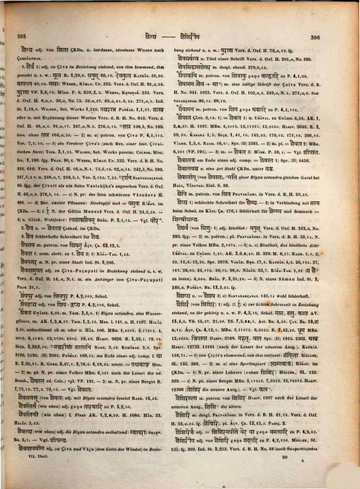
1. śaiva — 1〉 Adj. (f. ī) zu Śiva in Beziehung stehend, von ihm kommend, ihm geweiht u. s. w. Chr. 129,26. [Page6-261-a] — 2〉 m. — a〉 *Patron. von Śiva. — b〉 ein Verehrer Śivaʼs, auch Bez. einer best. Śivaʼitischen Secte. Ein solcher Verehrer wird als ein Sohn Vasiṣṭhaʼs angesehen. — c〉 *Stechapfel RĀJAN. 10,18. — d〉 *= vasuka (eine best. Pflanze) RĀJAN. 10,116. — e〉 *N. pr. des 5ten schwarzen Vāsudeva bei den Jaina. — 3〉 *f. ī Bein. der Göttin Manasā. — 4〉 — a〉 Glück, Wohlfahrt. — b〉 Titel eines Śāstra und eines Tantra.
Original text · German · substantive neuter
2. *śaiva n. = śaivāla Blyxa octandra.
Original text · German · Word type unspecified
3. śaiva fehlerhafte Schreibart für śaiba.
Apte 1890 adjective · substantive masculine · substantive neuter
Original text · English · adjective · substantive masculine · substantive neuter
śaiva a. (vī f.) [śivo devatā'sya aṇ] Relating to the god Śiva. — vaḥ 1 N. of one of the three principal Hindu sects. 2 A member of the Śaiva sect. 3 The thorn-apple. — vaṃ N. of one of the eighteen Purāṇas.
Cappeller 1887 Word type unspecified
Original text · German · Word type unspecified
śaiva, f. ī Śiva gehörig o. geweiht.
Burnouf 1866 adjective
Original text · French · adjective
śaiva śaiva a. de Śiva, relatif à Śiva. — S. m. un çivaïte ou adorateur de Śiva. — S. n. vallisneria, bot. śaivala m. vallisneria, bot. śaivalinī a. rivière [où croît la vallisneria]. śaivāla m. vallisneria, bot.
Occurrences in source texts (3)
Continue with AYI Free
Image source: AYI archive.