

bhāvin भाविन् – becoming; being; future
adjective · substantive masculine · Word type unspecified
Dictionary sources
AYI dictionary adjective
becoming; being; future
Cappeller 1891 adjective
Original text · English · adjective
bhāvin ·a. becoming, being (often --°); what ought or is about to be, impending, future. f. °nī a beautiful woman.
Monier-Williams 1872 Word type unspecified
Original text · English · Word type unspecified
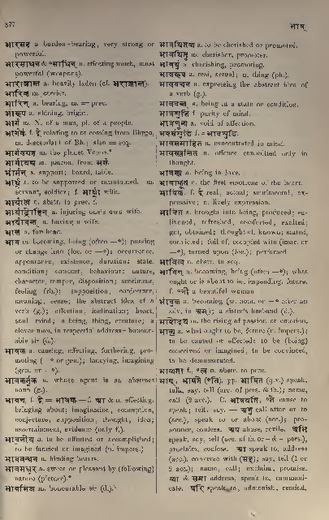
Bhāvin, i, ini, i, becoming, being, existing [cf. bhṛtya-bh˚, pūrva-bh˚]; about to be, about to come to pass, future; predestined; what ought to be; what will fall to the share of (any one); attached to, (Hari-bhāvin, attached to Hari); being pos- sessed of, (at the end of a comp., e. g. jñāna-vijñā- na-bh˚, possessing sacred and profane knowledge); beautiful, illustrious; (ī), m. (according to the Vāja- saneyi-prātiśākhya) every vowel except a and ā (perhaps so called as liable to become changed into the corresponding semivowels); N. of the caste of Śūdras in Plaksha-dvīpa; (inī), f. a distinguished or handsome woman; a lady, noble lady [cf. bha- vya]; a wanton woman; N. of one of the Mātṛs attending on Skanda; of a daughter of a Gandharva; [cf. a-niruddha-bh˚.]
Petersburger 1855 adjective · substantive masculine · Word type unspecified
Original text · German · adjective · substantive masculine
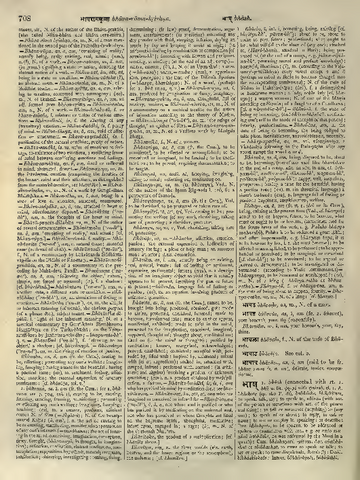
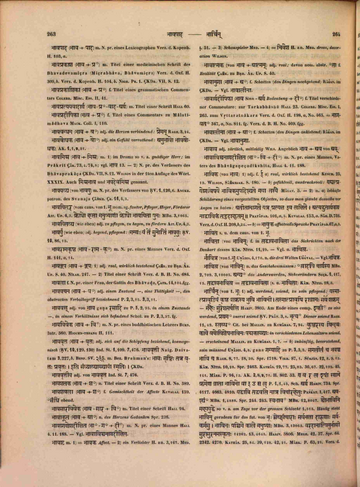
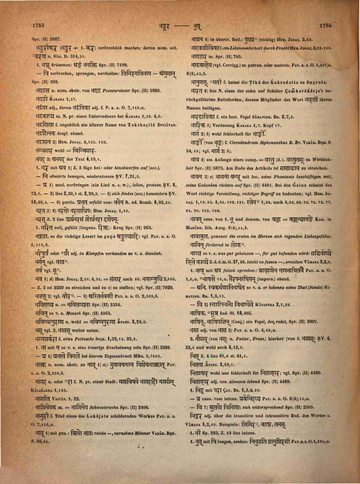
bhāvín (von 1. bhū) 1〉 adj. werdend, seiend, zu sein pflegend: yasmātprāvṛḍiyaṃ kṛṣṇa śakrasya bhuvi bhāvinī . tasmātprāvṛṣi rājānaḥ sarve śakram — mahaiḥ sureśamarcanti HARIV. 3805. Am Ende eines comp. ekī˚ zu eins werdend, prathama˚ zuerst seiend ṚV. PRĀT. 3,8. bhṛtya˚ Diener seiend RAGH. 11,49. stabdha˚ Cit. bei MALLIN._zu_KUMĀRAS. 7,94. kuñjarasya bindavaḥ kāye vayoviśeṣabhāvinaḥ padmakākhyāḥ in verschiedenen Lebensaltern seiend, — erscheinend MALLIN._zu_KUMĀRAS. 1,7. — b〉 zukünftig, bevorstehend, sein müssend UṆĀDIS. 4,8. gana gamyādi zu P. 3,3,3. samatītaṃ ca bhavacca bhāvi ca RAGH. 8,77. RAGH. 18,30. Spr. 1718. VIKR. 87,1. SŪRYAS. 12,8. SŪRYAS. 12,9. SŪRYAS. 12,12. KĀM. NĪTIS. 10,28. Spr. 2463. KATHĀS. 19,77. KATHĀS. 25,83. KATHĀS. 30,67. KATHĀS. 32,192. KATHĀS. 45,141. MĀRK. P. 94,12. AK. 2,8,2,71. H. 802. H. 53. ya va ra la eṣāṃ sthāne krameṇa jātā bhāvino vā i u ṛ ḷ P. 1,1,45. Sch. artha HARIV. 734. Spr. 4117. Spr. 4663. Spr. 4810. yadbhāvi tadbhavati nātra vicārahetuḥ PAÑCAT. I, 417. avaśyaṃ˚ MBH. 1,4888. Spr. 244. Spr. 245. svabhāva˚ MBH. 12,8047. śvobhāvini mahāyuddhe so v. a. am Tage vor der grossen Schlacht MBH. 1,515. Häufig steht bhāvin geradezu für das fut. von bhūḥ mlecchācārāḥ sarvabhakṣā dāruṇāḥ sarvakarmasu . bhāvinaḥ paścime kāle manuṣyāḥ MBH. 3,13062. varadānātpiturbhāvī surāsuranamaskṛtaḥ MBH. 3,14262. MBH. 13,4645. HARIV. 5806. MEGH. 42. MEGH. 57. Spr. 64. Spr. 2342. Spr. 4270. KATHĀS. 25,84. KATHĀS. 39,128. KATHĀS. 42,21. MĀRK. P. 63,21. Verz. d. Oxf. H. 55,a,42. HIT. 86,12. Z. d. d. m. G. 14,572,14. — c〉 am Ende eines comp. im Besitz von Etwas seiend: jñānavijñāna˚ MBH. 13,6669. — d〉 wie Jmd sein müsste: abhāvino munayaḥ (abhāvin = nāśabhāj Schol.) HARIV. 11190. — e〉 in haribhāvin (von ˚bhāva) zu Hari Zuneigung habend VOP. 6,9. — 2〉 m. a〉 jeder Vocal mit Ausnahme des a und d VS. PRĀT. 1,46. VS. PRĀT. 3,21. VS. PRĀT. 3,55. VS. PRĀT. 4,33. VS. PRĀT. 4,45. VS. PRĀT. 7,9. Vielleicht deshalb so genannt, weil sie einer Veränderung, dem Uebergange in die entsprechenden Halbvocale, unterworfen sind. — b〉 Bez. der 4ten Kaste, der Śūdra, in Plakṣadvīpa u. s. w. VP._bei_MUIR, ST. I, 191 (VP. 198). — 3〉 f. bhāvinī a〉 ein schönes (vgl. bhavya) Weib AK. 2,6,1,3. INDR. 5,37. HIḌ. 4,30. SUND. 4,24. N. 5,11. N. 11,28. N. 11,32. N. 16,32. N. 17,15. N. 17,27. N. 18,17. MBH. 1,905. MBH. 1,968. MBH. 3,16190 (nach der Lesart der ed. Bomb.). MBH. 4,76. MBH. 5,6030. MBH. 5,7014. MBH. 5,7328. MBH. 14,730. HARIV. 6696. HARIV. 7070. HARIV. 9074. R. GORR. 1,66,1. R. GORR. 3,53,39. R. GORR. 6,99,56. MĀRK. P. 63,62. MĀRK. P. 74,47. MĀRK. P. 114,24. — b〉 N. pr. einer der Mütter im Gefolge des Skanda MBH. 9,2629. der Tochter eines Gandharva MĀRK. P. 128,11. MĀRK. P. 128,17. MĀRK. P. 128,22. — Vgl. aniruddhabhāvinī, tathābhāvin, punarbhāvin, pūrva˚.
Original text · German · Word type unspecified
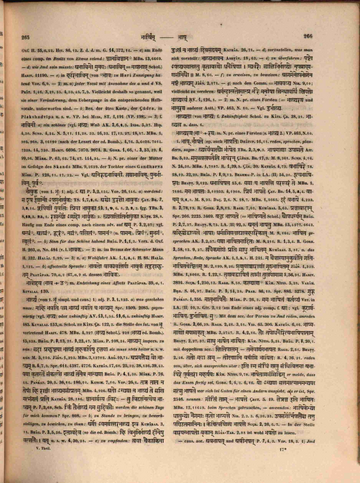
bhāvin fördernd in loka˚.
Böhtlingk 1879 adjective · substantive masculine · Word type unspecified
Original text · German · adjective · substantive masculine
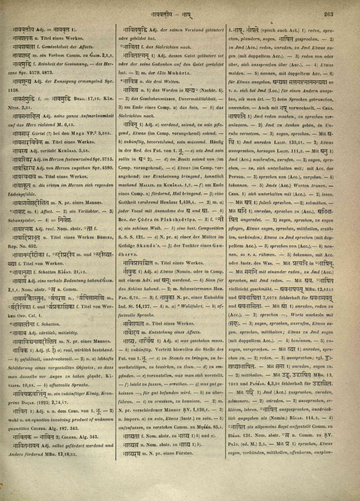
bhāvin — 1〉 Adj. — a〉 werdend, seiend, zu sein pflegend, Etwas (im Comp. vorangehend) seind. — b〉 zukünftig, bevorstehend, sein müssend. Häufig in der Bed. des Fut. 1. bhū. — c〉 wie Jmd sein Sollte in ā˚ 2〉. — d〉 im Besitz seiend von (im Comp. vorangehend). — e〉 Etwas (im Comp. vorangehend) zur Erscheinung bringend, kenntlich machend MALLIN. zu KUMĀRAS. 1,7. — f〉 am Ende eines Comp. — α〉 fördernd, Heil bringend. — β〉 eine Gottheit verehrend HEMĀDRI 1,438,4. — 2〉 m. — a〉 jeder Vocal mit Ausnahme des a und ā. — b〉 Bez. der Śūdra in Plakṣadvīpa. — 3〉 f. ˚nī — a〉 ein schönes Weib. — b〉 eine best. Composition S. S. S. 121. — c〉 N. pr. — α〉 einer der Mütter im Gefolge Skandaʼs. — β〉 der Tochter eines Gandharva.
Original text · German · Word type unspecified
bhāvin IV. 1〉b〉 Nom. abstr. ˚vitā f. DAŚAK. (1883) 164,22. [Nachtrag, Band 7]
Apte 1890 adjective · substantive masculine
Original text · English · adjective · substantive masculine
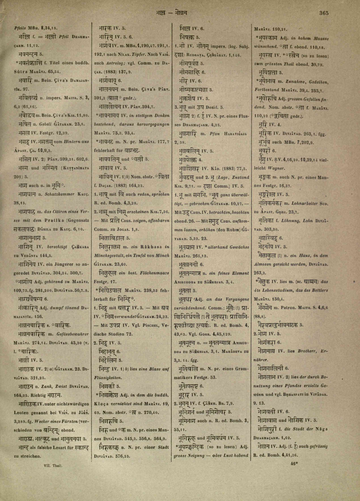
bhāvin a. [bhū-bhaviṣyati ṇini] 1 Being, becoming; bhṛtyabhāvi R. 11. 49. 2 To be or to come to pass in future, what will take place; lokena bhāvī pitureva tulyaḥ R. 18. 38; Me. 41. 3 Future; samatītaṃ ca bhavacca bhāvi ca R. 8. 78; pratyakṣā iva yadbhāvāḥ kriyaṃte bhūtabhāvinaḥ K. P. 10; N. 3. 11. 4 Capable of taking place 5 What must take place or is destined to happen, predestined; yadabhāvi na tadbhāvi bhāvi cenna tadanyathā H. 1. 6 Noble, beautiful, illustrious. 7 Attached or devoted to. 8 Possessed of (at the end of comp.). — m. N. given to every vowel except a and ā. — nī 1 A handsome woman. 2 A noble or virtuous lady; Ku. 5. 38. 3 A wanton woman.
Cappeller 1887 Word type unspecified
Original text · German · Word type unspecified
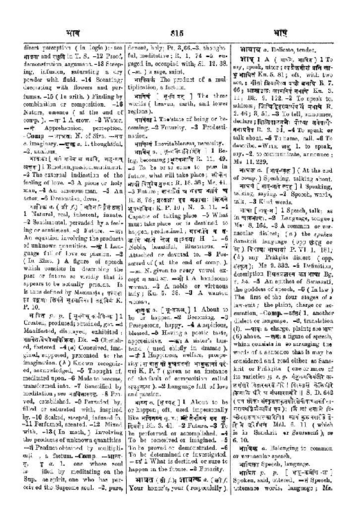
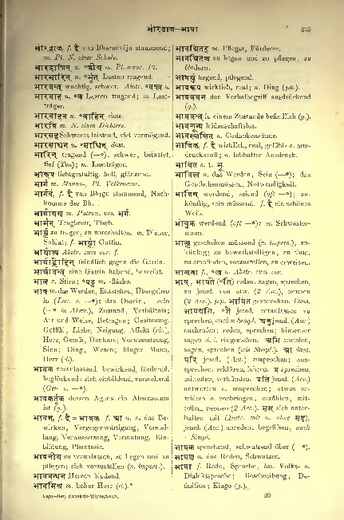
bhāvin werdend, seiend, (oft —˚); zukünftig, sein müssend. f. ī ein schönes Weib.
Burnouf 1866 adjective
Original text · French · adjective
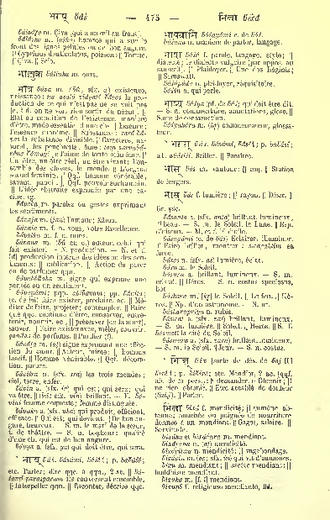
bhāvin a. (sfx. in) qui est; qui sera; qui va être. (bhā; sfx. vin) brillant. — F. bhāvinī femme coquette; femme distinguée.
Occurrences in source texts (1)
VBT 1 occurrence
Continue with AYI Free
Image source: AYI archive.