

gaṇa गण – group; host
substantive masculine · Word type unspecified
Dictionary sources
AYI dictionary substantive masculine
group; host
Cappeller 1891 substantive masculine
Original text · English · substantive masculine
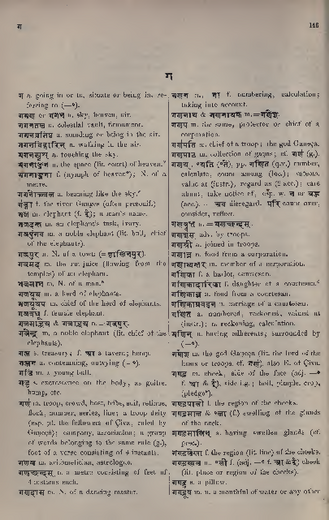
gaṇá ·m. troop, crowd, host, tribe, suit, retinue, flock, number, series, line; a troop deity (esp. pl. the followers of Śiva, ruled by Ganeśa); company, association; a group of words belonging to the same rule (g.), foot of a verse consisting of 4 instants.
Monier-Williams 1872 substantive masculine
Original text · English · substantive masculine
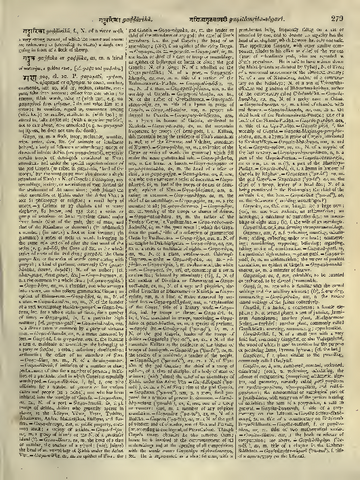
Gaṇa, as, m. a flock, troop, multitude, number, tribe, series, class, &c. (of animate or inanimate beings), a body of followers or attendants; troops or classes of inferior deities (see gaṇa-devatā), especially certain troops of demi-gods considered as Śiva's attendants and under the special superintendence of the god Gaṇeśa (so called fr. gaṇa-īśa, ‘lord of the troops,’ but the word gaṇa may also denote a single attendant of Śiva); a N. of Gaṇeśa; a company, any assemblage, society, or association of men formed for the attainment of the same aims; (with Jainas) the nine assemblies of Ṛṣis under the Arhat Vīra; a sect in philosophy or religion; a small body of troops, = 3 Gulmas or 27 chariots and as many elephants, 81 horses, and 135 foot; a series or group of asterisms or lunar mansions classed under three heads (that of the gods, that of men, and that of the Rākṣasas or demons); (in arithmetic) a number; (in metre) a foot or four instants; (in grammar) a series of roots or words belonging to the same rule and called after the first word of the series (e. g. ad-ādi, the Gaṇa ad &c. or the whole series of roots of the 2nd class; gargādi, the Gaṇa garga &c. or the series of words commencing with garga); a kind of perfume, commonly Cor (gaṇa- hāsaka, caura, caṇḍā); N. of an author; [cf. ahar-gaṇa, deva-gaṇa, &c.]
Petersburger 1855 substantive masculine · Word type unspecified
Original text · German · substantive masculine
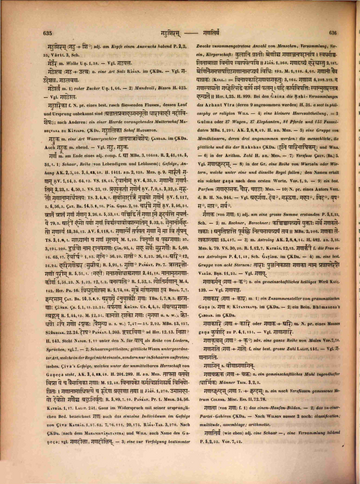
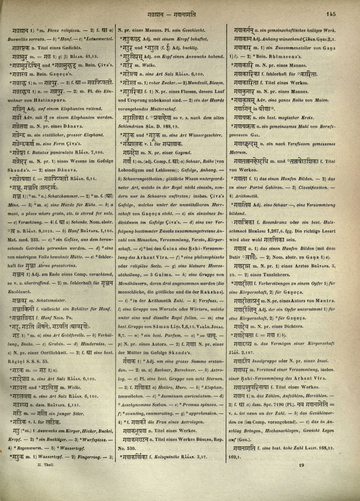
gaṇá m. am Ende eines adj. comp. f. ā MBH. 3,16608. R. 2,41,18. R. 5,51,1. 1〉 Schaar, Reihe (von Lebendigem und Leblosem); Gefolge, Anhang AK. 2,5,40. AK. 3,4,13,48. H. 1411. H. an. 2,138. MED. ṇ. 9. mārùtaṃ ga̱ṇam ṚV. 1,14,3. ṚV. 1,64,12. VS. 18,45. de̱vānā̀m ṚV. 4,35,3. ga̱ṇānā̀ṃ ga̱ṇapàtim ṚV. 2,23,1. ṚV. 4,50,5. VS. 23,19. bra̱hma̱kṛtā̀ ga̱ṇenà ṚV. 7,9,5. ṚV. 3,32,2. ma̱rutò ga̱ṇānā̱madhìpatayaḥ TS. 3,4,5,1. ṛ̱bīsā̱datrìṃ muñcatho ga̱ṇenà ṚV. 1,117,3. ṚV. 6,56,5. ŚAT. BR. 14,5,1,10. PĀR. GṚHY. 2,10. cāràthe ga̱ṇe ṚV. 8,46,31. vrātàṃ vrātaṃ ga̱ṇaṃ gàṇam ṚV. 3,26,6. ṚV. 5,53,11. yacci̱ddhi tè ga̱ṇā i̱me cha̱dayànti ma̱ghattàye ṚV. 5,79,5. ādī̀ṃ ha̱ṃso yathā̀ ga̱ṇaṃ viśvàsyāvīvaśanma̱tim ṚV. 9,32,3. se̱nā̱nīrmàha̱to ga̱ṇasyà ṚV. 10,34,12. AV. 6,118,1. ga̱ṇānmè tarpayata ga̱ṇā me̱ mā vi tṛ̀ṣan TS. 3,1,8,1. sādhyānāṃ ca gaṇaṃ sūkṣmam M. 1,22. pitṝṇāṃ ca pṛthaggaṇāḥ M. 37. M. 3,194. M. 3,200. durjayo nāma dānavagaṇaḥ ŚĀK. 95,4. saha sarvaiḥ suragaṇaiḥ R. 1,60,16. R. 1,65,17. devarṣi˚ R. 1,1,83. muni˚ R. 1,56,20. sakhī˚ N. 1,23. N. 26,14. ari˚ N. 12,34. N. 12,94. harigaṇeśvara (sugrīva) R. 5,91,1. guṇi˚ PAÑCAT. Pr. 7. trastarakṣogaṇāṃ purīm R. 5,51,1. (mahī) sanāgayodhāśvagaṇā R. 2,41,18. nānāmṛgagaṇākīrṇa R. 1,51,23. N. 1,22. N. 12,1. N. 12,2. vanaspati˚ R. 1,52,5. jyotirgaṇān M. 4,142. HIT. PR. 16. vidyudgaṇopama R. 1,74,18. sūtre maṇigaṇā iva BHAG. 7,7. chandasām ŚAT. BR. 10,3,1,9. a̱ra̱ṇye̱ 'nu̱vā̱kyò ga̱ṇaḥ TBR. 1,7,7,3. ṛggaṇāḥ ŚĀṄKH. ŚR. 1,1,18. ŚĀṄKH. ŚR. 1,1,22. ŚĀṄKH. ŚR. 1,1,24. varṣagaṇa CHĀND. UP. 4,4,5. saṃvatsaragaṇānbahūn R. 1,44,12. M. 12,54. kāmajo daśako gaṇaḥ (mṛgayā u. s. w.), krodhajo 'pi gaṇo 'ṣṭakaḥ (paiśunya u. s. w.) M. 7,47 — M. 7,51. M. 2,92. MBH. 13,157. SĀṂKHYAK. 22. SĀṂKHYAK. 24. doṣa˚ PAÑCAT. I, 205. rūpadraviṇa˚ ad HIT. 12. HIT. 13. niśā˚ H. 143. Steht NAIGH. 1,11 unter den N. für vāc als Reihe von Liedern, Sprüchen; vgl. NAIGH. 7. — 2〉 Schaarengottheiten; göttliche Wesen untergeordneter Art, welche in der Regel nicht einzeln, sondern nur in Schaaren auftreten; insbes. Śivaʼs Gefolge, welches unter der unmittelbaren Herrschaft von Gaṇeśa steht, AK. 3,4,13,48. H. 201. H. 289. H. an. MED. tāpasā yatayo viprā ye ca vaimānikā gaṇāḥ M. 12,48. vināyako karmavighnasiddhyarthaṃ viniyojitaḥ . gaṇānāmādhipatye ca rudreṇa brahmaṇā tathā .. YĀJÑ. 1,270. umāsahāyo deveśo gaṇaiśca bahubhirvṛtaḥ R. 5,89,7. R. 5,89,10 PAÑCAT. Pr. 1. MEGH. 34. MEGH. 56. KATHĀS. 1,17. LALIT. 241. Ganz im Widerspruch mit seiner ursprünglichen Bed. bezeichnet gaṇa auch das einzelne Individuum im Gefolge von Śiva KATHĀS. 1,57. KATHĀS. 1,62. KATHĀS. 7,76. KATHĀS. 7,111. KATHĀS. 20,175. RĀJA-TAR. 3,270. Nach ŚKDR. (nach dem MAHĀNIRVĀṆATANTRA) und WILS. auch Name des Gaṇeśa; vgl. gaṇadīkṣā, gaṇadīkṣin. — 3〉 eine zur Verfolgung bestimmter Zwecke zusammengetretene Anzahl von Menschen, Versammlung, Verein, Körperschaft: kulāni jātīḥ śreṇīśca gaṇāñjanapadānapi . svadharmāccalitānrājā vinīya sthāpayetpathi .. YĀJÑ. 1,360. gaṇadravyaṃ haredyastu YĀJÑ. 2,187. śreṇinaigamapāṣaṇḍigaṇānāmapyayaṃ vidhiḥ YĀJÑ. 192. M. 1,118. M. 4,61. gaṇānāṃ caiva yājakaḥ (KULL.: = vināyakādigaṇayāgakṛt) M. 3,164. gaṇānna M. 4,209. M. 4,219. na gaṇasyāgrato gacchetsiddhe kārye samaṃ phalam . yadi kāryavipattiḥ syānmukharastatra hanyate .. HIT. I, 25. H. 899. Bei den Jaina die Ṛṣi — Versammlungen des Arhant Vīra (deren 9 angenommen werden) H. 31. a sect in philosophy or religion WILS. — 4〉 eine kleinere Heeresabtheilung, = 3 Gulma oder 27 Wagen, 27 Elephanten, 81 Pferde und 135 Fusssoldaten MBH. 1,291. AK. 2,8,2,49. H. an. MED. — 5〉 eine Gruppe von Mondhäusern, deren drei angenommen werden: die menschliche, die göttliche und die der Rakṣas ŚKDR. (iti pāribhāṣikam) und WILS. — 6〉 in der Arithm. Zahl H. an. MED. — 7〉 Versfuss ŚRUT. (BR.) 5. Vgl. gaṇacchandas. — 8〉 in der Gr. eine Reihe von Wurzeln oder Wörtern, welche unter eine und dieselbe Regel fallen; den Namen erhält ein solcher gaṇa nach dem ersten Worte. VOP. 1,9. — 9〉 ein best. Parfum (gaṇahāsaka, caura, caṇḍā) MED. — 10〉 N. pr. eines Autors Verz. d. B. H. No. 944. — Vgl. ahargaṇa, deva˚, marudgaṇa, mahā˚, vida˚, vṛṣa˚ sa˚, sapta˚, sarva˚.
Original text · German · Word type unspecified
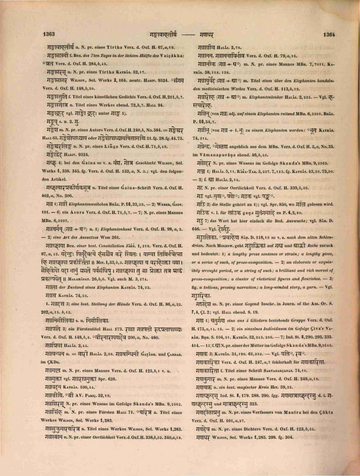
gaṇa 1〉 caturgaṇa eine aus 4 Gliedern bestehende Gruppe Verz. d. Oxf. H. 175,a,14. Verz. d. Oxf. H. 175,a,16. — 2〉 ein einzelnes Individuum im Gefolge Śivaʼs VARĀH. BṚH. S. 104,51. KATHĀS. 52,245. KATHĀS. 52,256. — 7〉 Ind. St. 8,290. Ind. St. 8,295. Ind. St. 8,335. Ind. St. 8,414. — 11〉 f. ā N. pr. einer der Mütter im Gefolge Skandaʼs MBH. 9,2645.
Böhtlingk 1879 substantive masculine
Original text · German · substantive masculine
gaṇá — 1〉 m. (adj. Comp. f. ā) — a〉 Schaar, Reihe (von Lebendigem und Leblosem); Gefolge, Anhang. — b〉 Schaarengottheiten; göttliche Wesen untergeordneter Art, welche in der Regel nicht einzeln, sondern nur in Schaaren auftreten; insbes. Śivaʼs Gefolge, welches unter der unmittelbaren Herrschaft von Gaṇeśa steht. — c〉 ein einzelnes Individuum im Gefolge Śivaʼs. — d〉 eine zur Verfolgung bestimmter Zwecke zusammengetretene Anzahl von Menschen, Versammlung, Verein, Körperschaft. — e〉 *bei den Jaina eine Ṛṣi-Versammlung des Arhant Vīra. — f〉 *eine philosophische oder religiöse Secte. — g〉 eine kleinere Heeresabtheilung, = 3 Gulma. — h〉 eine Gruppe von Mondhäusern, deren drei angenommen werden (die menschliche, die göttliche und die der Rakṣas). — i〉 *in der Arithmetik Zahl. — k〉 Versfuss. — l〉 eine Gruppe von Wurzeln oder Wörtern, welche unter eine und dieselbe Regel fallen. — m〉 eine best. Gruppe von Sāman LĀṬY. 1,6,15. VARĀH. YOGAY. 8,7. — n〉 *ein best. Parfum. — o〉 *= vāc. — p〉 N. pr. eines Autors. — 2〉 f. gaṇā N. pr. einer der Mütter im Gefolge Skandaʼs.
Apte 1890 substantive masculine
Original text · English · substantive masculine
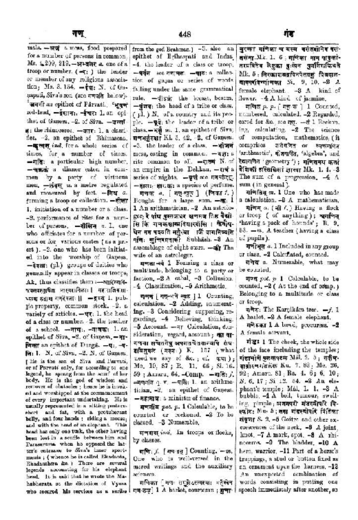
gaṇaḥ [gaṇ karmaṇi kartari vā ac] 1 A flock, multitude, group, troop, collection; guṇigaṇagaṇanā, bhagaṇaḥ &c. 2 A series, a class. 3 A body of followers or attendants. 4 Particularly, a troop of demigods consider-; ed as Śiva's attendants and under the special superintendence of Gaṇeśa a demigod of this troop; gaṇānāṃ tvā gaṇapatiṃ havāmahe kaviṃ kavīnāṃ &c.; gaṇā nameruprasavāvataṃsāḥ Ku. 1. 55, Ku. 7. 40, Ku. 7. 71; Me. 33, Me. 55, Ki. 5. 13. 5 Any assemblage or society of men formed for the attainment of the same objects 6 A company, association. 7 A tribe, class. 8 A series of lunar mansions classed under three heads (of god, men and demons). 9 A sect (in philosophy or religion). 10 A small body of troops (a subdivision of akṣauhiṇī), consisting of 27 chariots, as many elephants, 81 horses and 135 foot. 11 A number (in math.) 12 A foot (in prosody). 13 (In gram.) A series of roots or words belonging to the same rule and called after the first word of that series; e. g. bhvādigaṇa i. e. the class of roots which begin with bhū. 14 An epithet of Gaṇeśa. Comp. — agraṇī m. N. of Gaṇeśa. — acalaḥ N. of the mountain Kailāsa, as the residence of the Gaṇas of Śiva. — adhipaḥ, = adhipatiḥ 1 N. of Śiva; Śi. 9. 27. 2 N. of Gaṇeśa 3 the chief of a troop of soldiers or of a class of disciples, of a body of men or ([Page 0448-a]) animals. — annaṃ a mess, food prepared for a number of persons in common; Ms. 4. 209, Ms. 4. 219. — abhyaṃtara a. one of a troop or number. — (raḥ) the leader or member of any religious association; Ms. 3. 154. — īśaḥ N. of Gaṇapati, Śiva's son (see gaṇapati below). ˚jananī an epithet of Pārvatī. ˚bhūṣaṇaṃ red-lead. — īśānaḥ, -īśvaraḥ 1 an epithet of Gaṇeśa. 2 of Śiva. — utsāhaḥ the rhinoceros — kāraḥ 1 a classifier. 2 an epithet of Bhīmasena. — kṛtvas ind. for a whole series of times, for a number of times. — gatiḥ a particular high number. — cakrakaṃ a dinner eaten in common by a party of virtuous men. — chaṃdas n. a metre regulated and measured by feet. — titha a. forming a troop or collection. — dīkṣā 1 initiation of a number or a class. 2 performance of rites for a number of persons. — dīkṣin a. 1 one who officiates for a number of persons or for various castes (as a priest). 2 one who has been initiated into the worship of Gaṇeśa. — devatāḥ (pl.) groups of deities who generally appear in classes or troops; Ak. thus classifies them:- ādityaviśvavasavastuṣitā bhāsvarānilāḥ . mahārājikasādhyāśca rudrāśca gaṇadevatāḥ .. — dravyaṃ 1 public property, common stock. 2 a variety of articles. — dharaḥ 1 the head of a class or number. 2 the teacher of a school. — nāthaḥ, -nāyakaḥ 1 an epithet of Śiva. 2 of Gaṇeśa. — nāyikā an epithet of Durgā. — paḥ, — patiḥ 1 N. of Śiva. 2 N. of Gaṇeśa. [He is the son of Śiva and Pārvatī, or of Pārvatī only, for according to one legend; he sprang from the scurf of her body. He is the god of wisdom and remover of obstacles; hence he is invoked and worshipped at the commencement of every important undertaking. He is usually represented in a sitting postureshort and fat, with a protuberant belly, and four hands; riding a mouse; and with the head of an elephant. This head has only one tusk, the other having been lost in a scuffle between him and Paraśurāma when he opposed the latter's entrance to Śiva's inner apartments; (whence he is called Ekadanta, Ekadaṃṣṭra &c.) There are several legends accounting for his elephant head. It is said that he wrote the Mahābhārata at the dictation of Vyāsa who secured his services as a scribe ([Page 0448-b]) from the god Brahman.] 3 also an epithet of Bṛhaspati and Indra. 4 the leader of a class or troop. — parvata see gaṇācala. — pāṭhaḥ a collection of gaṇas or series of words falling under the same grammatical rule. — pīṭhakaṃ the breast, bosom. — puṃgavaḥ the head of a tribe or class. (pl.) N. of a country and its people. — pūrvaḥ the leader of a tribe or class. — bhartṛ m. 1 an epithet of Śiva; gaṇabharturukṣā Ki. 5. 42. 2 of Gaṇeśa. 3 the leader of a class. — bhojanaṃ mess, eating in common. — yajñaḥ a rite common to all. — rājyaṃ N. of an empire in the Dekkan. — rātraṃ a series of nights. — vṛttaṃ see gaṇacchaṃdas. — hāsaḥ, -hāsakaḥ a species of perfume.

Cappeller 1887 substantive masculine
Original text · German · substantive masculine
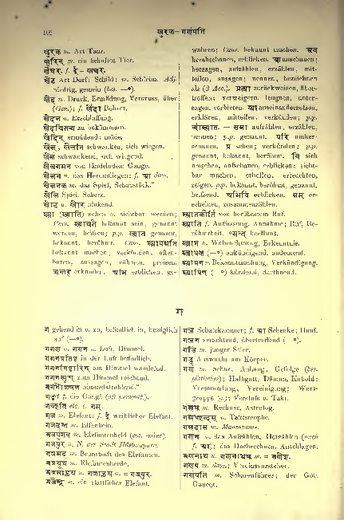
gaṇá m. Schar, Anhang, Gefolge (bes. göttliches); Halbgott, Dämon, Kobold; Versammlung, Vereinigung; Wortgruppe (g.); Versfuß o. Takt.
Burnouf 1866 substantive masculine
Original text · French · substantive masculine
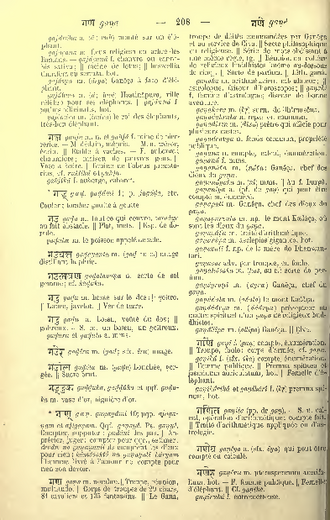
gaṇa gaṇa m. nombre. Troupe, réunion, multitude. Corps de troupes de 29 chars, 81 cavaliers et 135 fantassins. Le Gaṇa, [Page208-2] troupe de déités commandées par Gaṇeśa et au service de Śiva xx. Secte philosophique ou religieuse. Série de mots obéissant à une même règle, tg. Réunion ou collège de religieux buddhistes [même au-dessous de cinq]. Sorte de parfum. Lith. ganà. gaṇaka m. arithméticien, calculateur; astrologue, faiseur d'horoscopes; gaṇakī f. femme d'astrologue; diseuse de bonne aventure. gaṇakāra m. (kṛ) surn. de Bhīmasena. gaṇacakraka n. repas en commun. gaṇadīkṣin m. (dīkṣā) prêtre qui officie pour plusieurs castes. gaṇadravya n. fonds commun, propriété publique. gaṇana n. compte, calcul, énumération. gaṇanā f. mms. gaṇanātha m. (nātha) Gaṇeśa, chef des dieux du gaṇa. gaṇanāyaka m. (nī) mms. Au f. Durgā. gaṇanīya a. (pf. de gaṇ) qui peut être compté ou énuméré. gaṇapati m. Gaṇeśa, chef des dieux du gaṇa. gaṇaparvata m. np. le mont Kailāsa, où sont les dieux du gaṇa. gaṇapāṭha m. traité d'arithmétique. gaṇarūpa m. asclepias gigantea, bot. gaṇavatī f. np. de la mère de Dhanvantari. gaṇaśas adv. par troupes, en foule. gaṇahāsaka m. (has, au c.) sorte de parfum. gaṇāgraṇī m. (agra) Gaṇeśa, chef du gaṇa. gaṇācala m. (acala) le mont Kailāsa. gaṇācārya m. (ācārya) précepteur ou maître spirituel d'un gaṇa de religieux buddhistes. gaṇādhipa m. (adhipa) Gaṇeśa. Śiva.
Occurrences in source texts (6)
HP 2 occurrences
HTK 1 occurrence
SiSa 3 occurrences
Continue with AYI Free
Image source: AYI archive.