

Haṭhatattvakaumudī 10.0*2
तत्रादौ कुम्भकाष्टकम् |
Metre: none
At the beginning (ādau | loc sg), therein (tatra), [stands] the group of eight breath retentions (kumbhakāṣṭakam | nom sg).
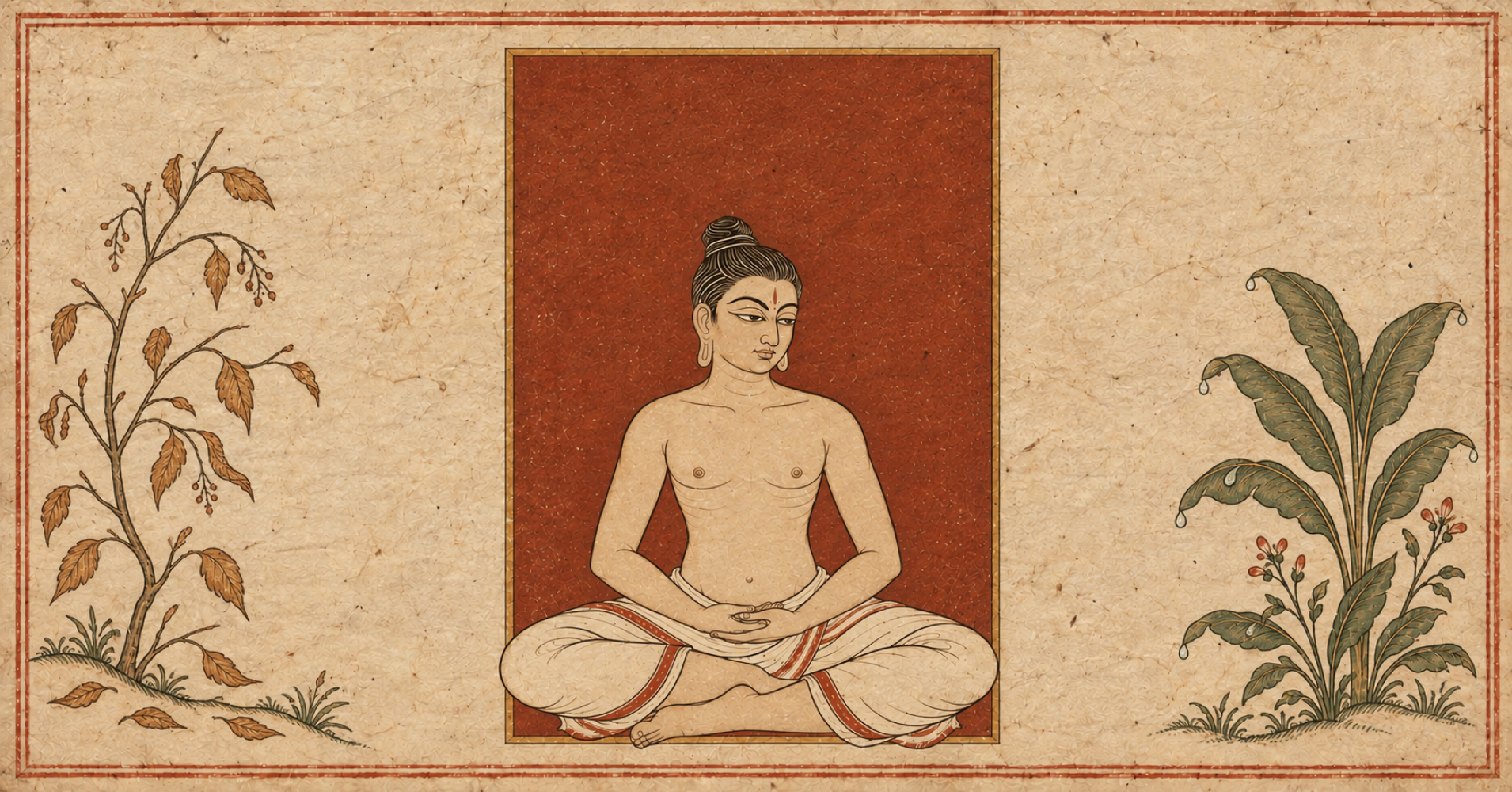
Eight forms of breathing open the collection. Consider them as different perspectives on the breath, which you can explore gradually.
kumbhakāṣṭakam GDJ2007 ] kumbhāṣṭakam GDJ2007-b
Haṭhatattvakaumudī 10.1
तृषादाहपित्तश्रमघ्नीं च सीत्कां भजेच्छीतलीं साधको वा सदैव |
tṛṣā-dāha-pitta-śrama-ghnīṃ ca sītkāṃ; bhajec chītalīṃ sādhako vā sadaiva | Analysis ▾ Analysis ▴
ज्वरादौ तथा ग्रीष्मकाले ऽथ हैमे बुधः सूर्यभेदं कफे मारुते च ||1||
jvarādau tathā grīṣma-kāle 'tha haime; budhaḥ sūrya-bhedaṃ kaphe mārute ca ||1|| Analysis ▾ Analysis ▴
|
jvara
|
of fever | |
|
ādau
|
in cases beginning with this | |
|
tathā
|
likewise | |
|
grīṣma
|
of summer | |
|
kāle
|
at the time | |
|
atha
|
then | |
|
haime
|
in the wintry | |
|
budhaḥ
|
one who understands | |
|
sūrya
|
of the sun | |
|
bhedam
|
piercing | |
|
kaphe
|
in cases of Kapha, phlegm | |
|
mārute
|
in cases of wind | |
|
ca
|
and |
Metre: Bhujaṅgaprayāta
And (ca) the practitioner (sādhakaḥ | nom sg) should always (sadā) practise (bhajet | 3p sg act opt) the hissing breath Sītkā (sītkām | acc sg), which removes thirst, burning, Pitta and fatigue (tṛṣā-dāha-pitta-śrama-ghnīm | acc sg f), or (vā) Śītalī (śītalīm | acc sg), indeed (eva) in cases of fever and the like (jvarādau | loc sg), and likewise (tathā) in summertime (grīṣma-kāle | loc sg). Then (atha), in the wintry [season] (haime | loc sg m), in cases of Kapha (kaphe | loc sg) and (ca) wind (mārute | loc sg), one who understands (budhaḥ | nom sg) [should practise] Sūryabheda, [the] piercing of the sun (sūrya-bhedam | acc sg).
Let your practice respond to how you feel today and to the conditions around you. A hot summer day asks something different of you from a cold winter morning.
tṛṣādāhapittaśramaghnīṃ GDJ2007 ] tṛṣādāhīpittaśramaghnī GDJ2007-b
Haṭhatattvakaumudī 10.2
बहुगदाकलितो ऽप्य् अबलो मुनिः पवनसन्धरणाभ्यसनाद्भृशम् |
bahu-gadākalito 'py a-balo muniḥ; pavana-sandharaṇābhyasanād bhṛśam | Analysis ▾ Analysis ▴
न मनुते शमनाद्दमनं मनाग्गतभयो भुवि संयतमानसः ||2||
na manute śamanād damanaṃ manāg; gata-bhayo bhuvi saṃyata-mānasaḥ ||2|| Analysis ▾ Analysis ▴
|
na
|
not | |
|
manute
|
he thinks, he expects | |
|
śamanāt
|
through pacification, through death (Yama; Monier-Williams, p. 1054) | |
|
damanam
|
overpowering | |
|
manāk
|
in the slightest | |
|
gata
|
departed | |
|
bhayaḥ
|
having fear | |
|
bhuvi
|
on earth | |
|
saṃyata
|
restrained | |
|
mānasaḥ
|
having a mind |
Metre: Drutavilambita
Even (api) a sage (muniḥ | nom sg) afflicted by many diseases (bahu-gadākalitaḥ | nom sg m ppp) [and] without strength (a-balaḥ | nom sg m), through intense (bhṛśam) practice of holding the breath (pavana-sandharaṇābhyasanāt | abl sg), does not (na) expect (manute | 3p sg med pres) in the slightest (manāk) to be overpowered (damanam | acc sg) by the god of death (śamanāt | abl sg). [He lives] on earth (bhuvi | loc sg), his fear gone (gata-bhayaḥ | nom sg m) [and] his mind restrained (saṃyata-mānasaḥ | nom sg m).
The statements about departed fear support taking śamana as Yama, the god of death. I therefore understand śamanād damanam as “being overpowered by Yama”.
How do you meet fear when you feel weak or vulnerable? Listening to the breath in this moment can give that question some space.
bhyasanād bhṛśam GDJ2007 ] bhyasanabhṛśaṃ GDJ2007-b
manāggatabhayo GDJ2007 ] manāgātabhāyo GDJ2007-b
manāggatabhayo GDJ2007 ] manāgātabhāyo GDJ2007-b
Haṭhatattvakaumudī 10.3
विधिवदुतिसमीरणप्ररोधैर् वपुषि शिरावलये विशोधिते ऽन्तः |
vidhivad uti-samīraṇa-prarodhair; vapuṣi śirā-valaye viśodhite 'ntaḥ | Analysis ▾ Analysis ▴
|
vidhivat
|
according to the prescribed method | |
|
ut
|
upwards; uti interpreted as a metrical expansion of ut | |
|
samīraṇa
|
of the breath | |
|
prarodhaiḥ
|
prarodha
|
through restraints |
|
vapuṣi
|
in the body | |
|
śirā
|
of the vessels | |
|
valaye
|
when the ring, the network | |
|
viśodhite
|
has been purified | |
|
antaḥ
|
within |
विशति मरुदरं महापथास्ये हठं च विना भुजगी मुखं ह्यपास्य ||3||
viśati marud araṃ mahā-pathāsye; haṭhaṃ ca* vinā bhujagī mukhaṃ hy apāsya ||3|| Analysis ▾ Analysis ▴
|
viśati
|
it enters | |
|
marut
|
the breath | |
|
aram
|
readily, easily | |
|
mahā
|
great | |
|
patha
|
of the path | |
|
āsye
|
into the mouth | |
|
haṭham
|
force | |
|
ca
|
and | |
|
vinā
|
without | |
|
bhujagī
|
the serpent (Monier-Williams, p. 759, alongside bhujaṃgī) | |
|
mukham
|
the mouth | |
|
hi
|
for | |
|
apāsya
|
having removed |
Metre: Puṣpitāgrā
When the network of vessels (śirā-valaye | loc absl sg) within (antaḥ) the body (vapuṣi | loc sg) has been purified (viśodhite | loc absl sg m ppp) according to the prescribed method (vidhivat) through restraints of the upward-directed breath (uti-samīraṇa-prarodhaiḥ | ins pl), the breath (marut | nom sg) enters (viśati | 3p sg act pres) the mouth of the great path (mahā-pathāsye | loc sg) easily (aram) [and] (ca) without (vinā) force (haṭham | acc sg). For (hi) the serpent (bhujagī | nom sg) [has] withdrawn (apāsya | abs) its mouth (mukham | acc sg).
- I understand
utias a metrical form ofut. It givessamīraṇaa direction: “upward-directed breath”. - I understand
mahāpathāsyeas the destination of the movement. - I connect
apāsyawithbhujagī; the subject thus changes from the breath to the serpent.
When you encounter resistance in practice, notice whether you are pushing too hard. The image of a path opening invites you to pay attention to what happens as effort eases.
vidhivadutisa GDJ2007-a ] vidhivadaniśasa GDJ2007
Haṭhatattvakaumudī 10.4
यदा मारुतो मध्यसञ्चारदक्षः तदा चित्तम् एतन् मुनेः स्थैर्यम् एति |
yadā māruto madhya-sañcāra-dakṣaḥ; tadā cittam etan muneḥ sthairyam eti | Analysis ▾ Analysis ▴
मनःस्थैर्यम् उक्तोन्मनीं या दशा सा हृदः स्यात्तदा शांभवीसिद्धिदास्य ||4||
manaḥ-sthairyam uktonmanīṃ yā daśā sā; hṛdaḥ syāt tadā śāṃbhavī-siddhi-dāsya ||4|| Analysis ▾ Analysis ▴
|
manaḥ
|
of the mind | |
|
sthairyam
|
steadiness | |
|
uktā
|
called | |
|
unmanīm
|
Unmanī, the state beyond thought | |
|
yā
|
which | |
|
daśā
|
the state | |
|
sā
|
that | |
|
hṛdaḥ
|
of the heart | |
|
syāt
|
it may be | |
|
tadā
|
then | |
|
śāṃbhavī
|
of Śāṃbhavī | |
|
siddhi
|
accomplishment | |
|
dā
|
giving | |
|
asya
|
for him, of this |
Metre: Bhujaṅgaprayāta
When (yadā) the breath (mārutaḥ | nom sg) [is] skilled in flowing through the middle (madhya-sañcāra-dakṣaḥ | nom sg m), then (tadā) this (etat | nom sg n) mind (cittam | nom sg) of the sage (muneḥ | gen sg) reaches (eti | 3p sg act pres) steadiness (sthairyam | acc sg). That (sā | nom sg f) state (daśā | nom sg) of the heart (hṛdaḥ | gen sg), which (yā | nom sg f) [is] called (uktā | nom sg f ppp) steadiness of mind (manaḥ-sthairyam | nom sg) [and] Unmanī (unmanīm | acc sg), may (syāt | 3p sg act opt) then (tadā) grant the accomplishment of Śāṃbhavī (śāṃbhavī-siddhi-dā | nom sg f) to him (asya | gen sg m).
I connect feminine uktā with daśā; the division manaḥ-sthairyam + uktā + unmanīm preserves the sounds of the text. I take the syntactically irregular accusative unmanīm as a name.
Stay with the breath as thoughts come and go. The centre can serve as an image for the place to which you keep returning.
dakṣaḥ GDJ2007 ] dakṣya GDJ2007-b
hṛdaḥ GDJ2007 ] syahṛdaḥ(?) GDJ2007-b
hṛdaḥ GDJ2007 ] syahṛdaḥ(?) GDJ2007-b
Haṭhatattvakaumudī 10.5
तत्सिद्धये साधुविधानविज्ञा कुर्वन्ति धीरा विविधांश्च कुम्भकान् |
tat-siddhaye sādhu-vidhāna-vijñā; kurvanti dhīrā vividhāṃś ca kumbhakān | Analysis ▾ Analysis ▴
विचित्रकुम्भाभ्यसनाद्विचित्रां सुसाधकाः सिद्धिगणान् भजन्ति ते ||5||
vicitra-kumbhābhyasanād vicitrāṃ; su-sādhakāḥ siddhi-gaṇān bhajanti te ||5|| Analysis ▾ Analysis ▴
Metre: Pāda 1: Indravajrā; Pāda 2: Indravaṃśā; Pāda 3: Upendravajrā; Pāda 4: Vaṃśastha
For its accomplishment (tat-siddhaye | dat sg), the composed [practitioners] (dhīrāḥ | nom pl m), who know the proper procedure (sādhu-vidhāna-vijñāḥ | nom pl m), also (ca) perform (kurvanti | 3p pl act pres) various (vividhān | acc pl m) breath retentions (kumbhakān | acc pl). Through practising manifold breath retentions (vicitra-kumbhābhyasanāt | abl sg), those (te | nom pl m) practitioners who practise correctly (su-sādhakāḥ | nom pl) attain (bhajanti | 3p pl act pres) varied (vicitrām | acc sg f) hosts of accomplishments (siddhi-gaṇān | acc pl).
I connect vicitrām and siddhigaṇān despite their lack of agreement: “varied hosts of perfections”.
Different forms of breathing ask different things of your attention. Give a familiar form time before moving on, and notice what you learn from it.
vicitra GDJ2007 ] vicitraṃ GDJ2007-b
bhajanti GDJ2007 ] bhajati GDJ2007-b
bhajanti GDJ2007 ] bhajati GDJ2007-b
Continue with AYI Free
Illustrations: AI-generated.

Please log in to write a message. Go to login
No messages yet.