
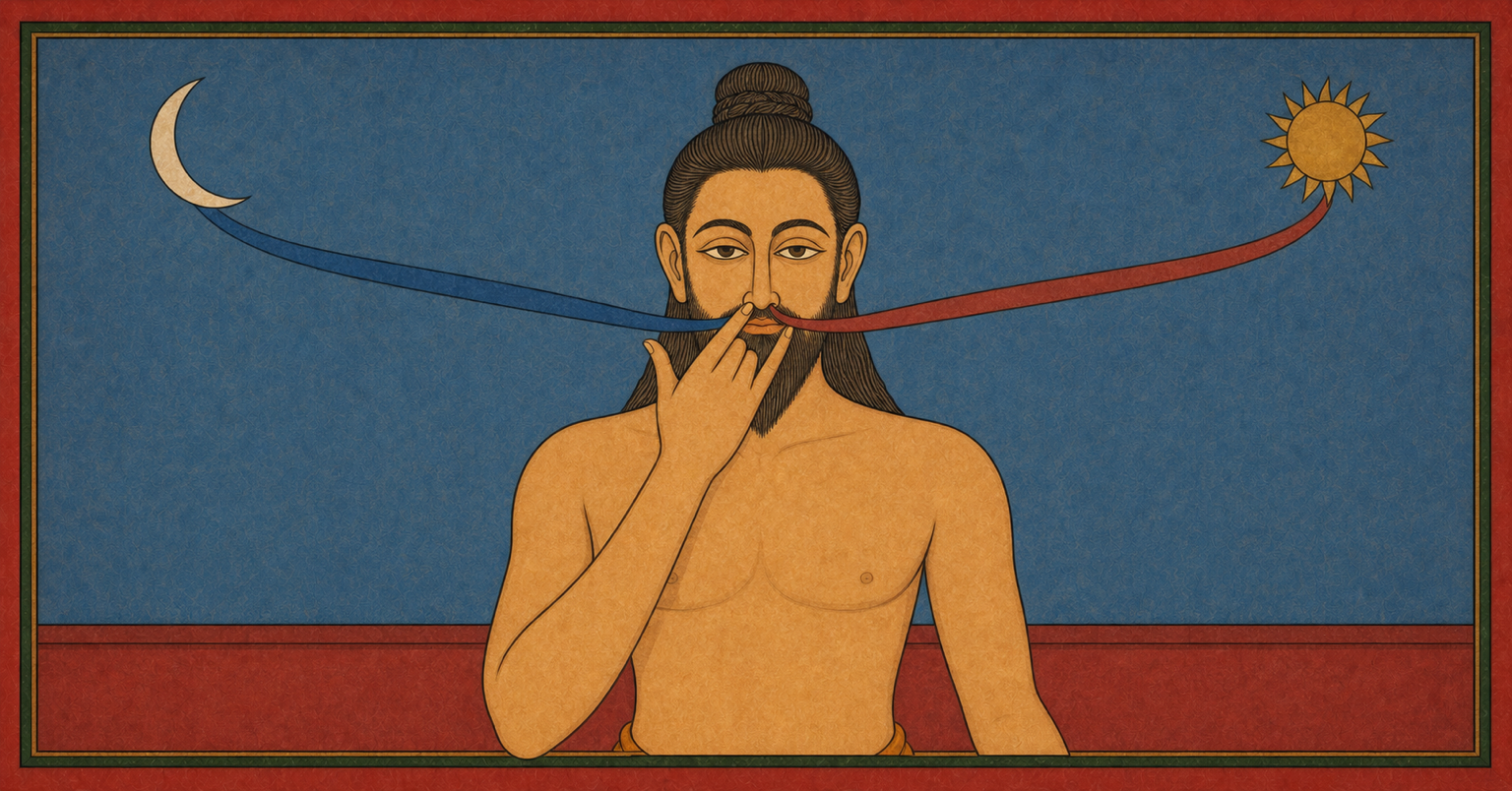

Haṭha Pradīpikā 2.8
प्राणं सूर्येण चाकृष्य पूरयेदुदरं शनैः |
विधिवत्कुम्भकं कृत्वा पुनश्चन्द्रेण रेचयेत् ||8||
vidhivat kumbhakaṃ kṛtvā; punaś candreṇa recayet ||8|| Analysis ▾ Analysis ▴
Metre: Anuṣṭubh
Then, having drawn in (ākṛṣya | abs) the breath (prāṇam | acc sg) through the sun (sūryeṇa | ins sg), he should gradually (śanaiḥ) fill (pūrayet | 3p sg act opt) the abdomen (udaram | acc sg); having performed (kṛtvā | abs) the retention (kumbhakam | acc sg) as prescribed (vidhivat), he should then (punar) exhale (recayet | 3p sg act opt) through the moon channel (candreṇa | ins sg).
Then inhale through the right, let the breath slowly “sink” into the abdomen, retain it as instructed, and exhale through the left.
Again inhaling the Prana through the Pingala, he should perform Kumbhaka as laid down in the books, and should again slowly exhale it through the Ida.
Durch Sûrya ziehe man den Athem ein, fülle langsam den Bauch, verrichte vorschriftsgemäss den Kumbhaka und stosse den Athem wieder durch Candra aus.
Haṭha Pradīpikā 2.9
येन त्यजेत्तेन पूर्य धारयेदविरोधतः |
yena tyajet, tena pūrya; dhārayed avirodhataḥ | Analysis ▾ Analysis ▴
रेचयेच्च ततो ऽन्येन शनैरेव न वेगतः ||9||
Metre: Anuṣṭubh
Through whichever channel (yena | ins sg m) he is to exhale (tyajet | 3p sg act opt), through that same one (tena | ins sg m) he should inhale again (pūrya | abs) and hold (dhārayet | 3p sg act opt caus) the breath without discomfort (avirodhataḥ). Then (tataḥ), he should exhale (recayet | 3p sg act opt caus) through the other (anyena | ins sg m), and indeed (ca eva) slowly (śanaiḥ), not forcefully (na vegataḥ | abl sg).
Inhale again through the same nostril through which you just exhaled. Retain the breath without pressure, then exhale slowly through the other side.
After exhaling through one nostril, one inhales again through that same nostril and then exhales through the opposite side. Brahmānanda connects “to the furthest limit” with signs such as perspiration or trembling. Exhalation in particular must remain slow, because according to his tradition a hurried Recaka diminishes bodily strength.
pūrya MBHDL2026 ] pītvā NS1882
avirodhataḥ MBHDL2026 ] atirodhataḥ NS1882
avirodhataḥ MBHDL2026 ] atirodhataḥ NS1882
Inhaling thus through the one, through which it was expelled, and having restrained it there, till possible, it should be exhaled through the other, slowly and not forcibly.
He should perform Puraka (inhalation) through the same nostril by which he performed Rechaka, and having restrained the breath to the utmost (till he is covered with perspiration or till his body shakes), should exhale it slowly, and never fast (as it will diminish the energy of the body).
Durch diejenige Nâdî, durch welche man den Athem ausgestossen hat, ziehe man ihn ein, halte ihn gewaltsam (atirodhatas) an, und durch die andere Nâdî lasse man ihn langsam und nicht heftig wieder heraus.
Haṭha Pradīpikā 2.10
प्राणं चेदिडया पिबेन्नियमितं भूयो ऽन्यया रेचयेत्पीत्वा पिङ्गलया समीरणमलं बद्ध्वा त्यजेद्वामया |
prāṇaṃ ced iḍayā piben niyamitaṃ, bhūyo 'nyayā recayet; pītvā piṅgalayā samīraṇam alaṃ, baddhvā tyajed vāmayā | Analysis ▾ Analysis ▴
|
prāṇam
|
the breath | |
|
cet
|
if | |
|
iḍayā
|
through Iḍā, the left channel | |
|
pibet
|
he should drink, inhale | |
|
niyamitam
|
restrained, retained | |
|
bhūyaḥ
|
then, once more | |
|
anyayā
|
through the other side | |
|
recayet
|
he should exhale | |
|
pītvā
|
having inhaled | |
|
piṅgalayā
|
through Piṅgalā, the right channel | |
|
samīraṇam
|
the wind, breath current | |
|
alam
|
sufficiently | |
|
baddhvā
|
having retained | |
|
tyajet
|
he should release, exhale | |
|
vāmayā
|
through the left side |
सूर्याचन्द्रमसोरनेन विधिना बिम्बद्वयं ध्यायतां शुद्धा नाडिगणा भवन्ति यमिनां मासत्रयादूर्ध्वतः ||10||
sūryā-candramasor anena vidhinā, bimba-dvayaṃ dhyāyatāṃ; śuddhā nāḍi-gaṇā bhavanti yamināṃ, māsa-trayād ūrdhvataḥ ||10|| Analysis ▾ Analysis ▴
|
sūrya
|
sun | |
|
candramasoḥ
|
of sun and moon | |
|
anena
|
by this | |
|
vidhinā
|
according to the rule, method | |
|
bimba
|
disc, orb | |
|
dvayam
|
pair, duality | |
|
dhyāyatām
|
of meditators | |
|
śuddhāḥ
|
pure | |
|
nāḍi
|
nāḍī | |
|
gaṇāḥ
|
groups | |
|
bhavanti
|
become | |
|
yaminām
|
of the self-controlled | |
|
māsa
|
months | |
|
trayāt
|
after three | |
|
ūrdhvataḥ
|
thereafter |
Metre: Śārdūlavikrīḍita
If (cet) he inhales (pibet | 3p sg act opt) the breath (prāṇam | acc sg) through Iḍā (iḍayā | ins sg), he should then (bhūyaḥ) exhale (recayet | 3p sg act opt caus) the restrained breath (niyamitam | acc sg m ppp) through the other side (anyayā | ins sg f). Having inhaled (pītvā | abs) the current of breath (samīraṇam | acc sg) through Piṅgalā (piṅgalayā | ins sg) and held it (baddhvā | abs) sufficiently (alam), he should release it (tyajet | 3p sg act opt) through the left side (vāmayā | ins sg f). For self-restrained practitioners (yaminām | gen pl) who meditate (dhyāyatām | gen pl m pca), by this method (anena vidhinā | ins sg), on the pair of orbs (bimba-dvayam | acc sg) of the sun and moon (sūryā-candramasoḥ | gen du), the groups of channels (nāḍi-gaṇāḥ | nom pl) become (bhavanti | 3p pl act pres) pure (śuddhāḥ | nom pl m) after three months (māsa-trayāt | abl sg n).
Inhale through Iḍā and exhale through Piṅgalā; then inhale through Piṅgalā and, after retaining the breath for a sufficient time, exhale through Iḍā. According to the text, one who meditates on the sun and moon while practising this alternate-nostril breathing purifies the Nāḍīs within three months.
alaṃ MBHDL2026 ] atho NS1882
bimbadvayaṃ dhyāyatāṃ MBHDL2026 ] abhyāsaṃ sadā tanvatāṃ NS1882
bimbadvayaṃ dhyāyatāṃ MBHDL2026 ] abhyāsaṃ sadā tanvatāṃ NS1882
If the air be inhaled through the left nostril, it should be expelled again through the other, and filling it through the right nostril, confining it there, it should be expelled through the left nostril. By practising in this way, through the right and the left nostrils alternately, the whole of the collection of the nâdîs of the yamîs (practisers) becomes clean, i.e., free from impurities, after 3 months and over.
Draw in the Prana by the Ida and exhale it by the Pingala; again draw in through the Pingala, and having retained it as long as you can, exhale it through the Ida. The Yogi who has perfected himself in Yama, by practising Pranayama through the right and left, gets his Nadis purified in not less than three months.
Wenn man den Athem durch die Idâ eingezogen hat, so halte man ihn an und lasse ihn durch die Pingala wieder heraus; und wenn man den Athem durch Pingala eingezogen hat, so lasse man ihn nach dem Anhalten durch die linke (d. h. die Ida) wieder heraus. Nach drei Monaten ist das Nâdîsystem derjenigen Yogin gereinigt, welche nach dieser Regel die Uebung von Surya und Candra beständig ausführen.
Continue with AYI Free
Illustrations: AI-generated.

Please log in to write a message. Go to login
No messages yet.