

nyāya न्याय – norm; rule; right way
substantive masculine · Word type unspecified
Dictionary sources
AYI dictionary substantive masculine
Cappeller 1891 substantive masculine
Original text · English · substantive masculine
nyāyá ·m. norm, standard (lit. that to which a thing goes back); rule, axiom, method; manner, way, esp. the right way, fitness, propriety; law-suit, judicial sentence, judgment; logical argument, syllogism, N. of a phil. system. -- Instr. & abl. in the right way, regularly, duly (also °--); in the way or after the manner of (--°).
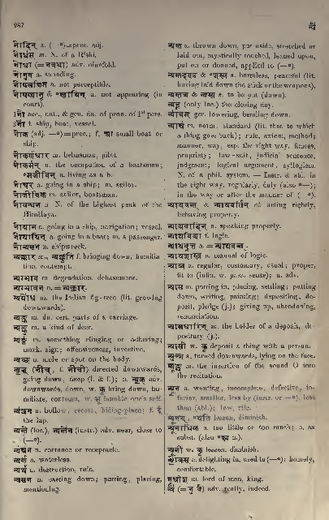
Monier-Williams 1872 substantive masculine
Original text · English · substantive masculine
nyāya ny-āya, as, m. (fr. 3. nī, i. e. rt. 5. i with ni), method, way, rule (lit. that to which any- thing goes back or in which anything goes), model, manner, system, plan, doctrine, right or fit or suitable manner, that which is fitting, fitness, propriety, right, justice, virtue, equity, law, a lawful act; (in gram.) a general or universal rule, an axiom which precedes and must be kept in view in the explanation of special rules; a lawsuit, policy, good government; decision in a lawsuit, judicial sentence, judgment; a celebrated system of Hindū philosophy delivered by Gautama or Gotama in a set of aphorisms divided into five lectures; the proper way of stating an argu- ment, logic, logical philosophy; a logical argument, a complete argument or syllogism (consisting of five members with the Naiyāyikas, viz. pratijñā, hetu, udāharaṇa, upanaya, nigamana, and of three members with the Vedāntins); likeness, analogy, apposite illustration; nyāyena, in the way of, after the manner of (e. g. līlā-nyāyena, by way of sport, as if in sport; cf. nyāya-tas below). Placed after a finite verb nyāyam is said by Pāṇini (VIII. 1, 27, 57) to express either censure or repetition.
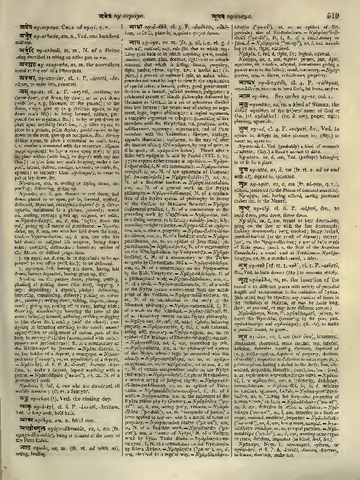
Petersburger 1855 substantive masculine · Word type unspecified
Original text · German · substantive masculine
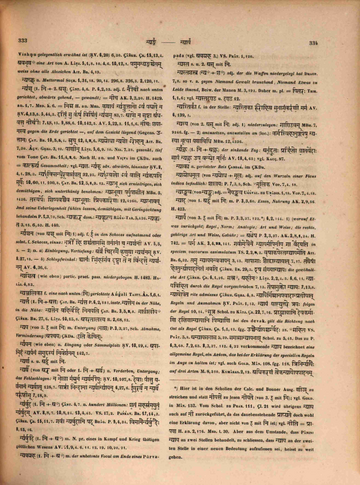
nyāyá (von 3. i mit ni) m. P. 3,3,37. P. 3,3,122.*⁾ P. 6,2,144. *⁾ Hier ist in den Scholien der Calc. und Bonner Ausg. ṇīñ zu streichen und statt nīyante zu lesen nīyate (von 3. i mit ni); vgl. GOLD._in_MĀN. 152. Vom Schol. zu PRAB. 111, Śl. 21 wird übrigens nyāya auch auf nī zurückgeführt, da das danebenstehende prāpyate doch wohl eine Erklärung davon, aber nicht von i mit ni ist; vgl. nīti = prāpaṇa H. an. 2,176. MED. t. 30. Aber aus dem Umstande, dass PĀNINI nyāya an zwei Stellen behandelt, zu schliessen, dass nyāya an der zweiten Stelle in einer neuen Bedeutung aufzufassen sei, heisst zu weit gehen. 1〉 (worauf Etwas zurückgeht) Regel, Norm; Analogie; Art und Weise; die rechte gehörige Art und Weise, Gebühr; = abhreṣa P. 3,3,37. AK. 2,8,1,24. H. 742. = dharma AK. 3,4,23,141. gavā̀me̱vainàṃ nyā̱yamàpi̱nīya̱ gā vèdayati in speciem vaccarum assimulatum TS. 2,2,8,2. vṛṣākapestannyāyameti AIT. BR. 6,32. tamu nyāyamanvavāyan AIT. BR. 3,45. nāpāgāḥ śaudrānnyāyāt AIT. BR. 7,17. tathaiṣāṃ hoturnyāyādanitaṃ bhavati ŚĀṄKH. BR. 29,3. eṣa saṃkhyānyāyaḥ die gewöhnliche Art ŚĀṄKH. ŚR. 6,1,26. sattra˚, ahīna˚ LĀṬY. 2,2,4. LĀṬY. 2,2,5. LĀṬY. 6,6,11. nyāyavihita durch die Regel vorgeschrieben LĀṬY. 7,13. teṣāmukto nyāyaḥ LĀṬY. 7,13,8. nyāyopeta rite admissus ŚĀṄKH. GṚHY. 4,8. nyāyairmiśrānapavādānpratīyāt Regeln und Ausnahmen ṚV. PRĀT. 1,13. nyāyaṃ yāntyuttare trayaḥ folgen der Regel ṚV. PRĀT. 10,14. ˚sūtra Schol. zu KĀTY. ŚR. 22,7,16. prāṅnyāyāni devakarmāṇi dakṣiṇānyāyāni pitryāṇi bei den devak. gilt die Richtung nach Ost als Regel ŚĀṄKH. ŚR. 1,1,13. fgg. uccairnyāyaścagrvedaḥ ŚĀṄKH. ŚR. 1,1,28. ˚sahita VS. PRĀT. 5,8. anyāyasamāsa VS. PRĀT. 5,39. samāsānyāyabhāj Schol. zu VS. PRĀT. 5,45. Das zu P. 6,3,68. P. 7,2,63. P. 8,3,37. P. 8,3,112. P. 8,4,22 vorkommende nyāya bezeichnet eine allgemeine Regel, ein Axiom, das bei der Erklärung der speciellen Regeln im Auge zu halten ist; vgl. auch GOLD. MĀN. 108. fgg. GOLD. MĀN. 118. tribhirnyāyaiḥ auf drei Arten M. 8,310. KUMĀRAS. 2,12. adhikaraṇaṃ tvekanyāyopapādanam Einartiges H. 255. vīcītaraṃganyāyena BHĀṢĀP. 164. prapānakarasanyāyāt SĀH. D. 27,17. eṣa krīḍati kūpayantraghaṭikānyāyaprasakto vidhiḥ MṚCCH. 178,7. VEDĀNTAS. (Allah.) No. 19. VEDĀNTAS. (Allah.) No. 69. aprayatnenaiva līlānyāyena ohne alle Anstrengung, gleichsam im Spiele ŚAṂK._in_WIND. Sancara 112. naiṣa nyāyo veśakulasya yaddāturapadeśaḥ DAŚAK._in_BENF. Chr. 193,13. ghuṇākṣaranyāyena buddheḥ sāmrājyaṃ bhavati PAÑCAT. 42,14. kumbhīpākanyāyamāpannāḥ mṛtāśca PAÑCAT. 195,9. na ca śakṣyāṃmi rājasūnurityamuṣminnyāyamācaritum DAŚAK. 143,3. jaḍavādvedmi na nyāyam RĀJA-TAR. 6,26. DAŚAK._in_BENF. Chr. 185,20. nyāyavartin der sich nach Gebühr beträgt M. 5,140. YĀJÑ. 3,22. svarāṣṭre nyāyavṛttaḥ M. 7,32. R. 3,75,47. nyāyārjita, anyāyāpahṛta auf rechtmässige, —, auf unrechtmässige Weise DAŚAK._in_BENF. Chr. 189,15. BENF. Chr. 189,16. nyāyāgatasya dravyasya MBH. 5,1029. ˚nirvapaṇa unter den Beiww. von Śiva MBH. 13,1239. nyāyena auf gehörige Weise, wie es sich gebührt YĀJÑ. 1,334. YĀJÑ. 2,306. nyāyatas dass. YĀJÑ. 1,354. M. 7,30. M. 8,201. R. 1,18,19. R. 3,4,6. nyāyato 'nyāyataḥ BHĀG. P. 6,1,66. yathānyāyam dass. M. 1,1. M. 3,135. M. 3,190. M. 5,35. M. 7,2. MBH. 2,133. MBH. 3,2468. MBH. 4,504. R. 3,51,34. R. 3,56,32. — 2〉 Rechtshandel, = akṣa HALĀY. 2,274. vīraka paścādiha bhavato nyāyaṃ drakṣyāmaḥ MṚCCH. 148,18. aho na samyagdṛṣṭo 'yaṃ nyāyaḥ PAÑCAT. 97,2. — 3〉 Schlichtung eines Rechtshandels, Entscheidung, Urtheilsspruch: nyāyena dūrīkṛtaḥ zurückgewiesen, abgewiesen MṚCCH. 137,13. MṚCCH. 137,18. nyāyānveṣaṇatatparau PAÑCAT. III, 89. rājapuruṣairnyāyaḥ kṛtaḥ . vadhyo 'yaṃ puruṣaḥ VET. in LA. 27,3. fg. — 4〉 logischer Beweis, — Schluss, Syllogismus PRAB. 111,8. Schol. zu KAP. 1. KAP. 70. KAP. 118. KAP. 157. hetubhirnyāyasaṃvaddhaiḥ R. 3,56,31. smṛtyorvirodhe nyāyastu balavānvyavahārataḥ YĀJÑ. 2,21. sūkṣmārthanyāyayukta (purāṇa) MBH. 1,18. śrutinyāyavirodhāt KAP. 1,36. parārthanyāyavādeṣu VID. 65. ˚vādin R. 3,51,34. ŚUK. in LA. 40,8. DHŪRTAS. 89,1. ein Syllogismus besteht bei den Naiyāyika aus 5 Theilen COLEBR. Misc. Ess. I. 292. bei den Vedāntin aus 3 Theilen 330. nyāyavidyā (KĀŚ._bei_GOLD. MĀN. 153), ˚śikṣā (MBH. 1,67) oder schlechtweg nyāya die Logik, das Nyāya-System des Gautama COLEBR. Misc. Ess. I, 261. fgg. MADHUS._in_Ind. St. 1,13,11. nyāya (d. i. nyāye) ānvīkṣikī pañcādhyāyī gautamena praṇītā Ind. St. 18,6 v. u. MUṆḌ. UP._in_Ind. St. 1,301. Ind. St. 1,N. ĀTMOP. ebend. 2,56. CARAṆAVYŪHA ebend. 3,260. fg. VP. 284. ˚sūtra GILD. Bibl. 416. — 5〉 nyāyam enklitisch nach einem verb. fin. als Ausdruck des Tadels oder der Wiederholung gaṇa gotrādi zu P. 8,1,27. P. 8,1,57. — Vgl. a˚, pratinyāyam, dhātunyāyamañjūṣā.
Original text · German · Word type unspecified
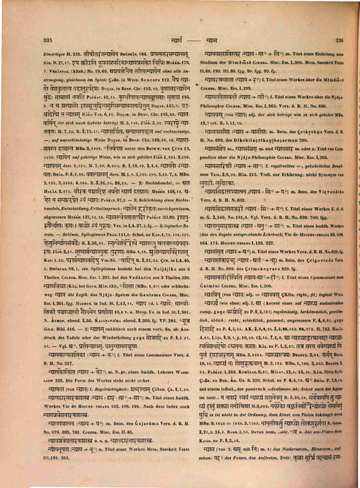
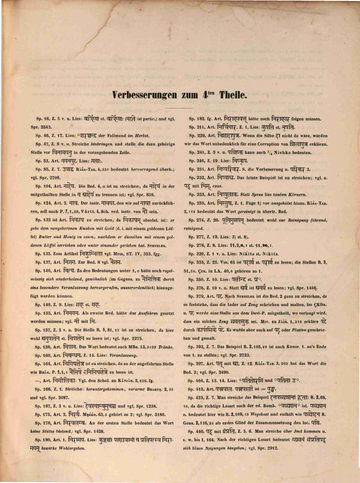
nyāyá [vgl. [4:335]] Z. 25. VID. 65 ist padārtha st. parārtha zu lesen; die Stellen R. 3,51,34. ŚUK. in LA. 40,8 gehören zu 1. (revision)
Original text · German · Word type unspecified
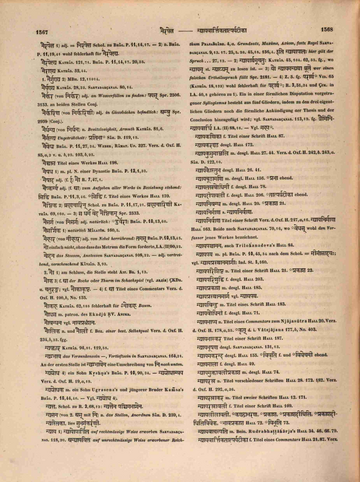
nyāya 1〉 nyāyopārjita auf rechtmässige Weise erworben SARVADARŚANAS. 118,20. anyāyavitta auf unrechtmässige Weise erworbener Reichthum PRASAṄGĀBH. 4,a. Grundsatz, Maxime, Axiom, feste Regel SARVADARŚANAS. 9,13. SARVADARŚANAS. 9,17. SARVADARŚANAS. 25,5. SARVADARŚANAS. 25,20. SARVADARŚANAS. 45,18. SARVADARŚANAS. 156,4. iti nyāyāpātaḥ hier gilt der Spruch … SARVADARŚANAS. 27,12. — 2〉 nyāyārthamūcatuḥ KATHĀS. 45,104. KATHĀS. 62,52. fg., wo nyāyam st. nyāyyam zu lesen ist. — 3〉 yo nyāyamanyathā brūte wer einen falschen Urtheilsspruch fällt Spr. 2181. — 4〉 Z. 5. fg. parārtha˚ VID. 65 (KATHĀS. 18,133) wohl fehlerhaft für padārtha˚; R. 3,51,34 und ŚUK. in LA. 40,8 gehören zu 1〉. Ein in einer förmlichen Disputation vorgetragener Syllogismus besteht aus fünf Gliedern, indem zu den drei eigentlichen Gliedern noch die förmliche Ankündigung der Thesis und der Conclusion hinzugefügt wird; vgl. SARVADARŚANAS. 113,19. fg. jaimininyāyavārdhi LA. (II) 88,18. — Vgl. mahā˚.
Böhtlingk 1879 substantive masculine
Original text · German · substantive masculine
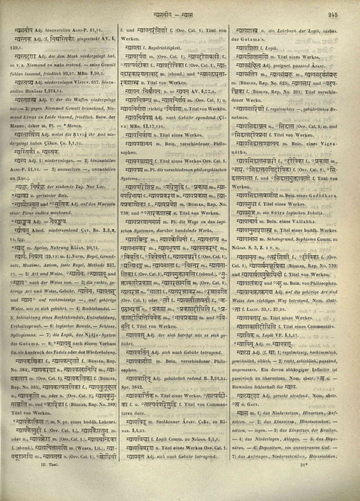
nyāyá, niāya (Chr. 25,18) m. — 1〉 Norm, Regel, Grundsatz, Maxime, Axiom, feste Regel, Methode Chr. 257,31. — 2〉 Art und Weise. ˚nyāyena, ˚nyāyāt und ˚nyāya˚ nach der Weise von. — 3〉 die rechte, gehörige Art Weise, Gebühr. nyāyena, nyāyatas und nyāya˚ auf rechtmässige —, auf gehörige Weise, wie es sich gebührt. — 4〉 Rechtshandel. — 5〉 Schlichtung eines Rechtshandels, Entscheidung, Urtheilsspruch. — 6〉 logischer Beweis, — Schluss, Syllogismus. — 7〉 die Logik, das Nyāya-System des Gotama. — 8〉 *nyāyam nach einem Verbum fin. als Ausdruck des Tadels oder der Wiederholung.
Apte 1890 substantive masculine
Original text · English · substantive masculine
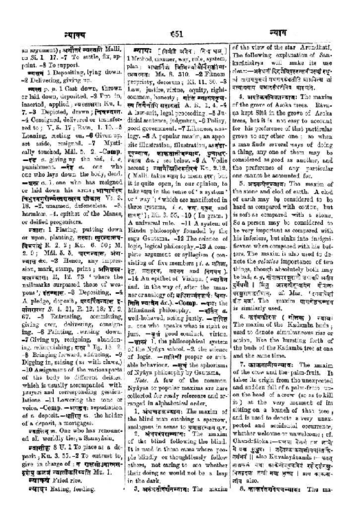
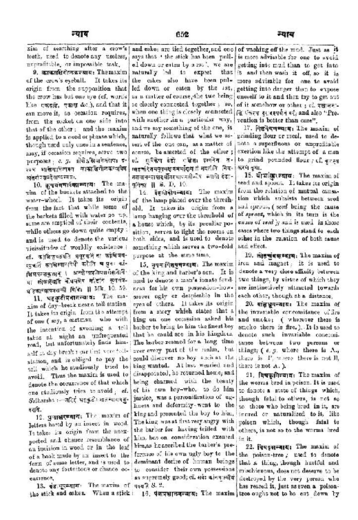
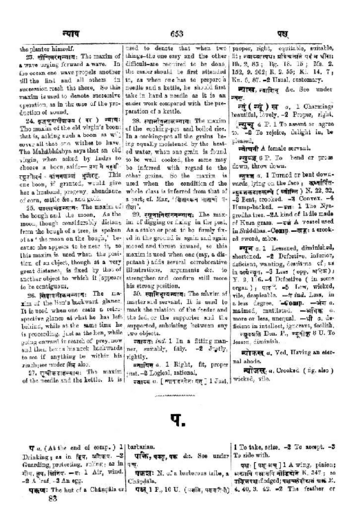
nyāyaḥ [niyaṃti anena; ni-i ghañ] 1 Method, manner, way, rule, system, plan; adhārmikaṃ tribhirnyāyairnigṛhṇīyātprayatnataḥ Ms. 8. 310. 2 Fitness propriety, decorum; Ki. 11. 30. 3 Law, justice, virtue, equity, righteousness, honesty; yāṃti nyāyapravṛttasya tiryaṃcopi sahāyatāṃ A. R. 1. A. R. 4. 4 A law-suit, legal proceeding 5 Judicial sentence, judgment. 6 Policy, good government. 7 Likeness, analogy. 8 A popular maxim, an apposite illustration, illustration, as daṃḍāpūpanyāya, kākatālīyanyāya, ghuṇākṣaranyāya &c.; see below. 9 A Vedic accent; nyāyaistribhirudīraṇaṃ Ku. 2. 12. (Malli. takes nyāya to mean svara; but it is quite open, in our opinion, to take nyāya in the sense of ‘a system’ or ‘way’; ‘which are manifested in three systems, i. e. ṛk, yajus and sāman’); Bh. 3. 55. 10 (In gram.) A universal rule. 11 A system of Hindu philosophy founded by the sage Gautama. 12 The science of logic, logical philosophy. 13 A complete argument or syllogism (consisting of five members; i. e. pratijñā, hetu, udāharaṇa, upanaya and nigamana). 14 An epithet of Viṣṇu. (nyāyena ind. in the way of, after the manner or analogy of; badhirānmaṃdakarṇaḥ śreyā niti nyāyena &c.). Comp. — pathaḥ the Mīmāṃsā philosophy. — vartin a. well-behaved, acting justly. — vādin a. one who speaks what is right or just. — vṛttaṃ good conduct, virtue. — śāstraṃ 1 the philosophical system of the Nyāya school. 2 the science of logic. — sāriṇī proper or suitable behaviour. — satraṃ the aphorisms of Nyāya philosophy by Gautama. Note. A few of the common Nyāyas or popular maxims are here collected for ready reference and arranged in alphabetical order. 1. aṃdhacaṭakanyāyaḥ The maxim of the blind man catching a sparrow, analogous in sense to ghuṇākṣaranyāya q. v. 2. aṃdhaparaṃparānyāyaḥ The maxim of the blind following the blind. It is used in those cases where people blindly or thoughtlessly follow others, not caring to see whether their doing so would not be a leap in the dark. 3. aruṃdhatīdarśananyāyaḥ The maxim ([Page 0651-c]) of the view of the star Arundhatī. The following explanation of Śankarāchārya will make its use clear: -aruṃdhatīṃ didarśayiṣustatsamīpasthāṃ sthūlāṃ tārāmamukhyāṃ prayamamaruṃdhatīti grāhayitvā tāṃ pratyākhyāya paścādaruṃdhatīmeva grāhayati. 4. aśokavanikānyāyaḥ The maxim of the grove of Aśoka trees. Rāvaṇa kept Sītā in the grove of Aśoka trees, but it is not easy to account for his preference of that particular grove to any other one; so when a man finds several ways of doing a thing, any one of them may be considered as good as another, and the preference of any particular one cannot be accounted for. 5. aśmaloṣṭranyāyaḥ The maxim of the stone and clod of earth. A clod of earth may be considered to be hard as compared with cotton, but is soft as compared with a stone. So a person may be considered to be very important as compared with his inferiors, but sinks into insignificance when compared with his betters. The maxim is also used to denote the relative importance of two things, though absolutely both may be bad; e. g. gopālaparaśurāmau ubhāvapi atīva durmedhasau . kiṃtu aśmaloṣṭranyāyena gopālaḥ paraśurāmādvarīyān. cf. Mar. ‘dagaḍāpekṣāṃ vīṭa maū’. The maxim pāṣāṇeṣṭakanyāya is similarly used. 6. kadaṃbakoraka(golaka)nyāyaḥ The maxim of the Kadamba buds; used to denote simultaneous rise or action, like the bursting forth of the buds of the Kadamba tree at one and the same time. 7. kākatālīyanyāyaḥ The maxim of the crow and the palm-fruit. It takes its origin from the unexpected and sudden fall of a palm-fruit upon the head of a crow (so as to kill it) at the very moment of its sitting on a branch of that tree; and is used to denote a very unexpected and accidental occurrence, whether welcome or unwelcome; cf. Candrāloka: -yattayā melanaṃ tatra lābho me yaśca subhruvaḥ . tadetatkākatālīyamavitarkitasaṃbhavaṃ .. also Kuvalayānanda: -patat tālaphalaṃ yathā kākemopabhuktamevaṃ rahodarśanakṣubhitahṛdayā tanvī mayā bhuktā . see kākatālīya also. 8. kākadaṃtagaveṣaṇanyāyaḥ The ([Page 0652-a]) maxim of searching after a crow's teeth, used to denote any useless, unprofitable, or impossible task. 9. kākākṣigolakanyāyaḥ The maxim of the crow's eyeball. It takes its origin from the supposition that the crow has but one eye (cf. words like ekadṛṣṭi, ekākṣa &c.), and that it can move it, as occasion requires, from the socket on one side into that of the other; and the maxim is applied to a word or phrase which, though used only once in a sentence, may, if occasion requires, serve two purposes; e. g. dvīpo'striyāmaṃtarīpaḥ ityatra astriyāmityasya kākākṣigolakanyāyema aṃtarīpaśabdenāpyanvayaḥ. 10. kūpayaṃtraghāṭikānyāyaḥ The maxim of the buckets attached to the water-wheel. It takes its origin from the fact that while some of the buckets filled with water go up, some are emptied of their contents, while others go down quite empty; and is used to denote the various vicissitudes of worldly existence; cf. -kāṃścittucchayati prapūrayati vā kāṃścinnayatyunnatiṃ kāṃścitpātavidhau karoti ca punaḥ kāṃścinnayatyākulān . anyonyapratipakṣasaṃhatimimāṃ lokasthitiṃ bodhayanneṣa krīḍati kūpayaṃtraghaṭikānyāyaprasakto vidhiḥ .. Mk. 10. 59. 11. ghaṭṭakuṭīprabhātanyāyaḥ The maxim of day-break near a toll-station. It takes its origin from the attempt of one (say, a cartman) who with the intention of avoiding a toll takes at night an unfrequented road, but unfortunately finds himself at day-break near that very tollstation, and is obliged to pay the toll which he studiously tried to avoid. Thus the maxim is used to denote the occurrence of that which one studiously tries to avoid; cf. Śrīharṣa: -tadidaṃ ghaṭṭakuṭīprabhātanyāyamanuvadati. 12. ghuṇākṣaranyāyaḥ The maxim of letters bored by an insect in wood. It takes its origin from the unexpected and chance resemblance of an incision in wood or in the leaf of a book made by an insect to the form of some letter, and is used to denote any fortuitous or chance occurrence. 13. daṃḍāpūpanyāyaḥ The maxim of the stick and cakes. When a stick ([Page 0652-b]) and cakes are tied together, and one says that ‘the stick has been pulled down or eaten by a rat’, we are naturally led to expect that the cakes also have been pulled down or eaten by the rat, as a matter of course, the two being so closely connected together; so, when one thing is closely connected with another in a particular way, and we say something of the one, it naturally follows that what we assert of the one can, as a matter of course, be asserted of the other; cf. -mūṣikeṇa daṃḍo bhakṣitaḥ ityanena tatsahacaritamapūpabhakṣaṇamarthādāyātaṃ bhavatīti niyatasamānanyāyādarthāṃtaramāpatatītyeṣa nyāyo daṃḍāpūpikā .. S. D. 10. 14 dehalīdīpanyāyaḥ The maxim of the lamp placed over the threshold. It takes its origin from a lamp hanging over the threshold of a house which, by its peculiar position, serves to light the rooms on both sides, and is used to denote something which serves a twofold purpose at the same time. 15. nṛpanāpitaputranyāyaḥ The maxim of the king and barber's son. It is used to denote a man's innate fondness for his own possession-howsoever ugly or despicable in the eyes of others. It takes its origin from a story which states that a king on one occasion asked his barber to bring to him the finest boy that he could see in his kingdom. The barber roamed for a long time over every part of the realm, but could discover no boy such as the king wanted. At last wearied and disappointed, he returned home; and being charmed with the beauty of his own boy-who, to do him justice, was a personification of ugliness and deformity-went to the king and presented the boy to him. The king was at first very angry with the barber for having trifled with him, but on consideration excused him, as he ascribed the barber's preference of his own ugly boy to the dominant desire of human beings to consider their own possessions as supremely good; cf. -sarvaḥ kāṃtamātmīyaṃ paśyati Ś. 2. 16. paṃkaprakṣālananyāyaḥ The maxim ([Page 0652-c]) of washing off the mud. Just as it is more advisable for one to avoid getting into mud than to get into it and then wash it off, so it is more advisable for one to avoid getting into danger than to expose oneself to it and then try to get out of it somehow or other; cf. -prakṣālanāddhi paṃkasya dūrādasparśanaṃ varaṃ; and also “Prevention is better than cure”. 17. piṣṭapeṣaṇanyāyaḥ The maxim of grinding flour or meal, used to denote a superfluous or unprofitable exertion like the attempt of a man to grind pounded flour; cf. kṛtasya karaṇaṃ vṛthā. 18. bījāṃkuranyāyaḥ The maxim of seed and sprout. It takes its origin from the relation of mutual causation which subsists between seed and sprout, (seed being the cause of sprout, which in its turn is the cause of seed); and is used in those cases where two things stand to each other in the relation of both cause and effect. 19. lohacuṃbakanyāyaḥ The maxim of iron and magnet; it is used to denote a very close affinity between two things, by virtue of which they are instinctively attracted towards each other, though at a distance. 20. vahnidhūmanyāyaḥ The maxim of the invariable concomitance of fire and smoke; (wherever there is smoke there is fire.). It is used to denote such invariable concomitance between two persons or things; (e. g. where there is A, there is B; where there is not B, there is not Ā.). 21. viṣakṛminyāyaḥ The maxim of the worms bred in poison. It is used to denote a state of things which, though fatal to others, is not so to those who being bred in it, are inured or naturalized to it, like poison which, though fatal to others, is not so to the worms bred in it. 22. viṣavṛkṣanyāyaḥ The maxim of the poison-tree; used to denote that a thing, though hurtful and mischievous, does not deserve to be destroyed by the very person who has reared it, just as even a poisontree ought not to be cut down by ([Page 0653-a]) the planter himself. 23. vīcitaraṃganyāyaḥ The maxim of a wave urging forward a wave. In the ocean one wave propels another till the first and all others in succession reach the shore. So this maxim is used to denote successive operation, as in the case of the production of sound. 24. vṛddhakumārīvākya(vara)nyāyaḥ The maxim of the old virgin's boon; that is, asking such a boon as will cover all that one wishes to have. The Mahābhāṣya says that an old virgin, when asked by Indra to choose a boon, said; — putrā me bahukṣīraghṛtamodanaṃ kāṃcanapātryāṃ bhuṃjīran. This one boon, if granted, would give her a husband, progeny, abundance of corn, cattle &c., and gold. 25. śākhācaṃdranyāyaḥ The maxim of the bough and the moon. As the moon, though considerably distant from the bough of a tree, is spoken of as ‘the moon on the bough,’ because she appears to be near it, so this maxim is used when the position of an object, though at a very great distance, is fixed by that of another object to which it appears to be contiguous. 26. siṃhāvalokananyāyaḥ The maxim of the lion's backward glance. It is used when one casts a retrospective glance at what he has left behind, while at the same time he is proceeding, just as the lion, while going onward in search of prey, now and then bends his neck backwards to see if anything be within his reach; see under siṃha also. 27. sūcīkaṭāhanyāyaḥ The maxim of the needle and the kettle. It is ([Page 0653-b]) used to denote that when two things-the one easy and the other difficult-are required to be done, the easier should be first attended to, as when one has to prepare a needle and a kettle, he should first take in hand a needle as it is an easier work compared with the preparation of a kettle. 28. sthālīpulākanyāyaḥ The maxim of the cooking-pot and boiled rice. In a cooking-pot all the grains being equally moistened by the heated water, when one grain is found to be well cooked, the same may be inferred with regard to the other grains. So the maxim is used when the condition of the whole class is inferred from that of a part; cf. Mar. ‘śitāvarūna bhātācī parīkṣā’. 29. sthūṇānikhanananyāyaḥ The maxim of digging or fixing in the post. As a stake or post to be firmly fixed in the ground is again and again moved and thrust inward, so this maxim is used when one (say, a disputant) adds several corroborative illustrations, arguments &c. to strengthen and confirm still more his strong position. 30. svāmibhṛtyanyāyaḥ The maxim of master and servant. It is used to mark the relation of the feeder and the fed, or the supporter and the supported, subsisting between any two objects.
Cappeller 1887 substantive masculine
Original text · German · substantive masculine
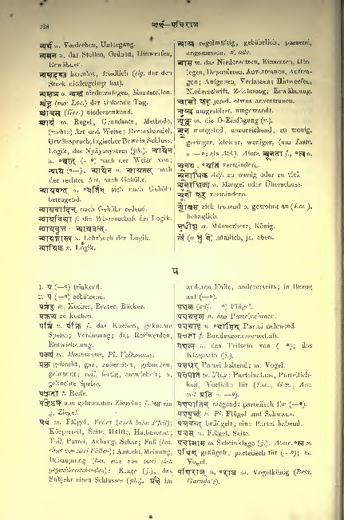
nyāyá m. Regel, Grundsatz, Methode, (rechte) Art und Weise; Rechtshandel, Urteilsspruch; logischer Beweis, Schluss, Logik, das Nyāyasystem (ph.). nyāyena u. ˚yāt (—˚) nach der Weise von; nyāya (—˚), nyāyena u. nyāyatas nach der rechten Art, nach Gebühr.
Burnouf 1866 substantive masculine
Original text · French · substantive masculine
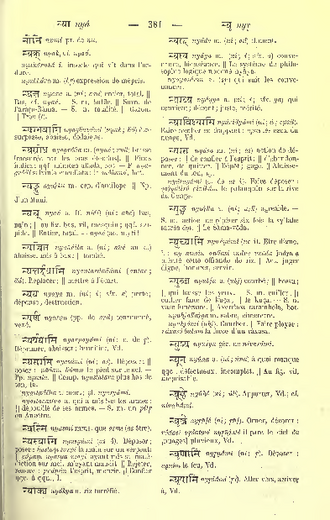
nyāya nyāya m. (ni; i; sfx. a) convenance, bienséance. Le système de philosophie logique nommé nyāya. nyāyasārin a. (sṛ) qui suit les convenances.
Occurrences in source texts (1)
MAN 1 occurrence
Continue with AYI Free
Image source: AYI archive.