

ni नि – down; into
adjective · adverb · particle · previx · Word type unspecified
Dictionary sources
AYI dictionary previx
down; into
Cappeller 1891 Word type unspecified
Original text · English · Word type unspecified
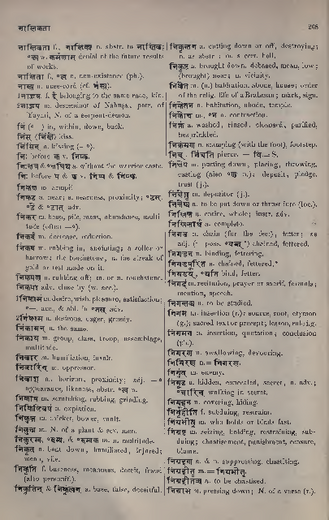
ní ·(°--) in, within, down, back.
Monier-Williams 1872 Word type unspecified
Original text · English · Word type unspecified
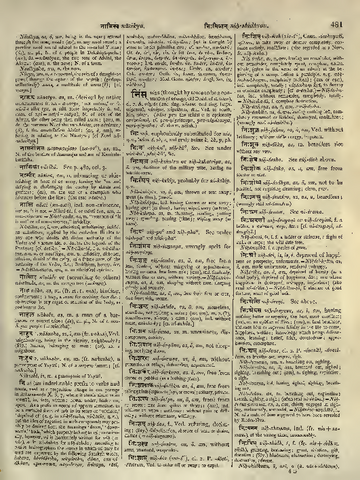
ni ni (an indeclinable prefix to verbs and nouns, used as a preposition except in one passage in Atharva-veda X. 8, 7, where it stands alone as an adverb), in, into, within; down, under, back; on, upon. As a prefix to nouns ni appears sometimes to be a curtailed form of nis in its sense of ‘without,’ ‘deprived of’ (e. g. in ni-kilviṣa, ni-khila, q. v.), but the idea of negation in such compounds may pos- sibly be derived from the meanings ‘down,’ ‘down- wards,’ ‘back,’ which properly belong to ni; occasion- ally, however, ni is inaccurately written for niḥ (= nis), as in ni-śabda for niḥ-śabda; according to native lexicographers the senses in which ni may be used are expressed by the following Sanskrit words, kṣepa, bhṛśārtha, nityārtha, dāna, san-ni- dhāna, upa-rama, saṃ-śraya, ā-śraya, rāśi, mokṣa, antar-bhāva, adho-bhāva, bandhana, kauśala, ni-veśa, vi-ny-āsa; [ni is thought by some to be for primitive ani; cf. an-tar, an-tarā; Gr. ἐν, ἐνί, εἰν, εἰς, ἐς for ἐν-ς, ἐν-τό-ς, ἔν-δο-ν, ἔσ-ω, ἔνεροι, ἔνερ-θε, ὑπ-ένερ-θε, ἐνέρ-τερο-ς, ἔντερο-ν; Lat. en-do, in-du, in, in-ter, in-trā, in- ter-ior, in-tumu-s, in-tus; Umbr. en, an-der; Osk. an-ter; Goth. in, inna, innuma, inna- thrō, un-dar; Mod. Germ. nieder; Angl. Sax. in, nidhan.]
Petersburger 1855 Word type unspecified
Original text · German · Word type unspecified
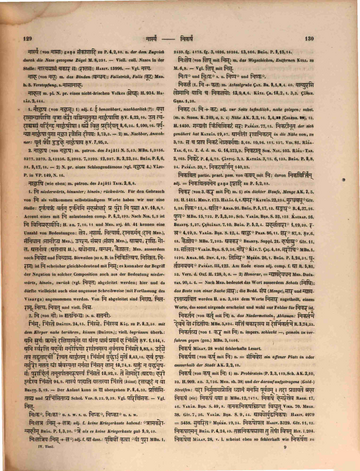
1. ni niederwärts, hinunter; hinein; rückwärts. Für den Gebrauch von ni als vollkommen selbstständigem Worte haben wir nur eine Stelle: ekàcakraṃ vartata̱ ekànemi sa̱hasrā̀kṣara̱ṃ pra pu̱ro ni pa̱ścā AV. 10,8,7. Accent eines mit ni anlautenden comp. P. 6,2,192. Nach NIR. 1,3 ist ni vinigrahārthīya; H. an. 7,10. H. an. 7,11 und MED. avy. 40. MED. avy. 41 kennen eine Unzahl von Bedeutungen: kṣepa, bhṛśārtha, nityārtha, dānakarman (dāna MED.), saṃnidhāna (sāmīpya MED.), uparama, saṃśraya (saṃśaya MED.), āśraya, rāśi, mokṣa, antarbhāva (antabhāva H.), adhobhāva, bandhana, kauśala; MED. ausserdem noch niveśa und vinyāsa. Bisweilen (so z. B. in nikilbiṣa, nikhila, nirāga) ist ni scheinbar gleichbedeutend mit nis; es kann aber der Begriff der Negation in solcher Composition auch aus der Bedeutung niederwärts, hinein, zurück (vgl. nivṛtta) abgeleitet werden; hier und da dürfte vielleicht auch eine ungenaue Schreibweise (mit Fortlassung des Visarga) angenommen werden. Von ni abgeleitet sind niṇya, nitarām, nitya, nivat und viell. nimna.
Original text · German · Word type unspecified
2. ni (von nī) in ṛtanibhyaḥ (s. u. ṛtanī).
Original text · German · Word type unspecified
3. ni die 7te Note (Abkürzung von niṣadha) Verz. d. Oxf. H. 200,b,8.
Böhtlingk 1879 adjective · adverb · Word type unspecified
Original text · German · adjective
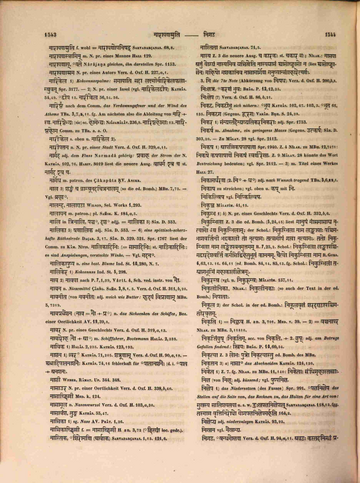
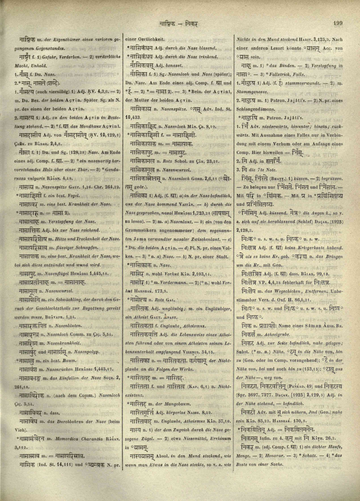
2. ni Adj. in ṛtaní.
Original text · German · adverb
1. ní Adv. niederwärts, hinunter; hinein; rückwärts. Mit Ausnahme eines Falles nur in Verbindung mit einem Verbum oder am Anfange eines Comp. Hier bisweilen = nís.
Original text · German · Word type unspecified
3. ni die 7te Note.
Apte 1890 particle
Original text · English · particle
ni ind. Mostly used as a prefix to verbs and nouns, rarely as an adverb or preposition. It is used in the following senses (according to G. M.): 1 Lowness, downward motion (‘down’, ‘under’, ‘below’); nipat, niṣad. 2 A group or collection; nikara, nikāya. 3 Intensity; nikāma, nigṛhīta. 4 Command, order; nideśa. 5 Continuance, permanence; niviśate. 6 Skill; nipuṇa. 7 Restraint, confinement; nibaṃdha. 8 Inclusion (‘into’, ‘in’); nipītamudakaṃ. 9 Proximity, nearness; nikaṭa. 10 Insult, wrong, harm; nikṛti, nikāra. 11 Showing; nidarśana. 12 Cessation; nivṛt. 13 Resort, refuge; nilaya. 14 Doubt. 15 Certainty. 16 Affirmation. 17 Throwing, giving &c. (according to Durgādāsa).
Cappeller 1887 Word type unspecified
Original text · German · Word type unspecified
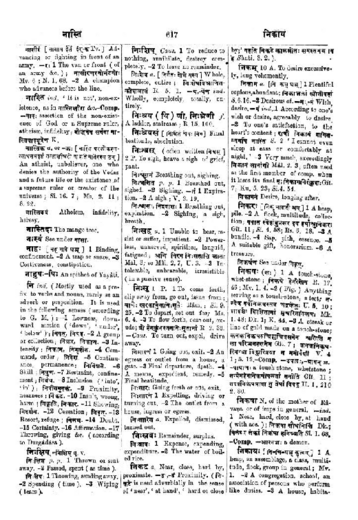
ní nieder, hinein (meist ˚—).
Burnouf 1866 Word type unspecified
Original text · French · Word type unspecified
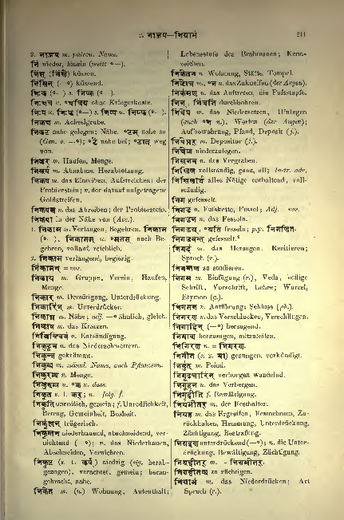
ni ni [pfx. insép.] de haut en bas; sous; hours de; manque, privation, séparation. M§ 23.

Derived words
More direct derivatives (5)
Further derivatives (1)
Occurrences in source texts (153)
DYS 11 occurrences
4 more source pages
DYS 150–153*3: Vajrolī: Secret Teaching 1 occurrence
Occurrences through derived words
-
DYS 152 Segment 7
GoS 5 occurrences
GoS 34–41: Sun, Sound and Cooling 2 occurrences
Direct occurrences
HP 35 occurrences
HP 1.17-1.32: Āsana 4 occurrences
Direct occurrences
HP 1.33-1.43: Siddhāsana 4 occurrences
Direct occurrences
Occurrences through derived words
-
HP 1.38 Segment 6
HP 1.44-1.49: Padmāsana 3 occurrences
Direct occurrences
-
HP 1.44 Segment 21
-
HP 1.45–46 Segment 19
-
HP 1.48 Segment 11
HP 2.24-2.29: Dhauti and Basti 3 occurrences
Direct occurrences
13 more source pages
HP 3.19-3.25: Mahābandha 4 occurrences
Direct occurrences
HP 3.33-3.48*1: Khecarī and Soma 3 occurrences
Direct occurrences
Occurrences through derived words
-
HP 3.35 Segment 6
HP 3.87-3.93*7: Sahajolī and Amarolī 2 occurrences
Direct occurrences
HP 4.9-4.11*4: Gaze and Lunar Nectar 1 occurrence
Occurrences through derived words
-
HP 4.11*4 Segment 16
HP 4.11*5-4.11*14: Khecarī in Space 1 occurrence
Occurrences through derived words
-
HP 4.11*12 Segment 11
HTK 2 occurrences
MAN 1 occurrence
PJH 1 occurrence
PJH 17-19: Simple Means (sukhopāyas) and Samādhi 1 occurrence
Occurrences through derived words
-
PJH 18 Segment 11
PYS 23 occurrences
PYS 1.5–11: The Five Vṛtti 2 occurrences
Occurrences through derived words
PYS 1.34–39: Six Supports 2 occurrences
Occurrences through derived words
PYS 1.50–51: Samādhi without Seed 2 occurrences
Occurrences through derived words
11 more source pages
PYS 2.27–29: Aṣṭāṅga as a Path to Liberation 1 occurrence
Occurrences through derived words
-
PYS 2.29 Segment 2
PYS 2.30–34: Vows and Counterreflection 2 occurrences
Occurrences through derived words
PYS 3.9–12: Three Transformations of Citta 3 occurrences
Occurrences through derived words
PYS 3.29–34: Bodily Locations and Knowledge 1 occurrence
Occurrences through derived words
-
PYS 3.30 Segment 5
PYS 3.49–51: Omniscience or Kaivalya 1 occurrence
Occurrences through derived words
-
PYS 3.51 Segment 2
PYS 4.25–26: Citta Flows toward Kaivalya 1 occurrence
Occurrences through derived words
-
PYS 4.25 Segment 6
SiSa 36 occurrences
SiSa 2.44-2.48: Erkenntnisweg 3 occurrences
Direct occurrences
-
SiSa 2.46 Segment 18
Occurrences through derived words
SiSa 3.34-3.38: Förderliche Mittel 2 occurrences
Occurrences through derived words
SiSa 3.41-3.48: Atemkraft und Hindernisse 2 occurrences
Occurrences through derived words
19 more source pages
SiSa 3.81-3.83: Freiheit von Wiederkehr 1 occurrence
Occurrences through derived words
-
SiSa 3.81 Segment 12
SiSa 4.81-4.90: Bindu-Bewahrung 2 occurrences
Direct occurrences
SiSa 5.48-5.71: Innere Meditation 3 occurrences
Direct occurrences
SiSa 5.156-5.181: Sahasrāra 3 occurrences
Direct occurrences
-
SiSa 5.162 Segment 6
-
SiSa 5.164 Segment 5
-
SiSa 5.165 Segment 4
SiSa 5.191-5.207: Kailāsa und Mahāśūnya 2 occurrences
Direct occurrences
-
SiSa 5.194 Segment 9
-
SiSa 5.205 Segment 4
SiSa 5.208-5.222: Rājayoga 2 occurrences
Direct occurrences
-
SiSa 5.220 Segment 12
-
SiSa 5.221 Segment 3
SS 1 occurrence
SVU 18 occurrences
SVU 3.19-3.21: Beyond the Senses 2 occurrences
Direct occurrences
-
SVU 3.20 Segment 7
Occurrences through derived words
-
SVU 3.21 Segment 13
7 more source pages
SVU 4.6-4.10: Two Birds and Māyā 3 occurrences
Direct occurrences
SVU 5.1–5.6: The Lord of Cosmic Origins 2 occurrences
Direct occurrences
SVU 6.1–6.6: Lord of Cosmic Unfolding 2 occurrences
Direct occurrences
VBT 20 occurrences
6 more source pages
VBT 57–64: Intervals and Equality 3 occurrences
Direct occurrences
VBT 75–85: Thresholds and Sky 5 occurrences
Direct occurrences
Occurrences through derived words
-
VBT 75 Segment 2
Continue with AYI Free
Image source: AYI archive.