

saṃsthāna संस्थान – as, ā, am, standing together
adjective · substantive masculine · substantive neuter · Word type unspecified
Dictionary sources
Cappeller 1891 substantive neuter
Original text · English · substantive neuter
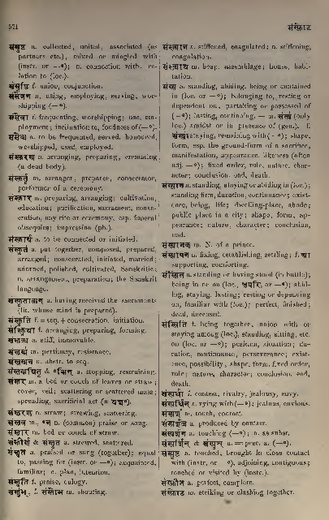
saṃsthā́na ·n. standing, staying or abiding in (loc.); standing firm, duration, continuance; existence, being, life; dwelling-place, abode; public place in a city; shape, form, appearance; nature, character; conclusion, end.
Monier-Williams 1872 adjective
Original text · English · adjective
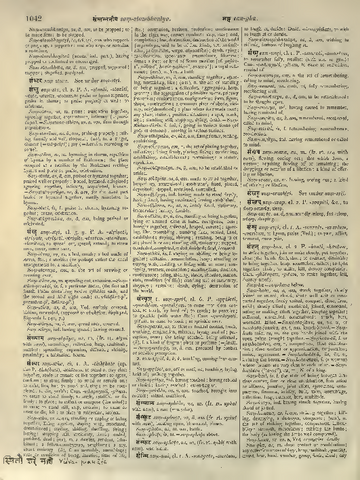
Saṃ-sthāna, as, ā, am, standing together; agree- ing, resembling, like; (am), n. the act of standing or being together; a collection, aggregation, heap, quantity; the aggregation of primitive atoms, primary formation; conformation, configuration; form, figure, shape, construction; a common place of abode, vici- nity, neighbourhood; a place where four roads meet; any place, station; position, situation; a spot, mark, sign; standing still, stopping, dying, death.
Petersburger 1855 adjective · substantive masculine · substantive neuter · Word type unspecified
Original text · German · adjective · substantive masculine · substantive neuter
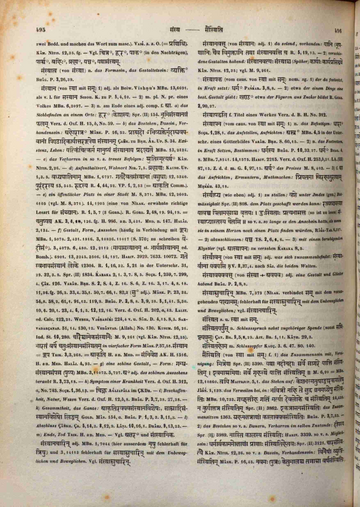
saṃsthāna (von sthā mit sam) 1〉 adj. als Beiw. Viṣṇuʼs MBH. 13,6691. als v. l. für sasthāna SIDDH. K._zu_P. 5,4,10. — 2〉 m. pl. N. pr. eines Volkes MBH. 6,2097. — 3〉 n. am Ende eines adj. comp. f. ā. a〉 das Sichbefinden an einem Orte: dūra˚ (kośasya) Spr. (II) 154. bhūmisaṃsthānajaṃ phalam Verz. d. Oxf. H. 15,b, No. 59. — b〉 das Bestehen, Dasein, Vorhandensein: ahorātra˚ MĀRK. P. 16,52. prāṅmado 'bhivyaktermṛdādyavayavānāṃ piṇḍādikāryāntararūpeṇa saṃsthānam ŚAṂK._zu_BṚH. ĀR. UP. S. 34. Existenz, Leben: yatkiṃcitkarma mānuṣyaṃ saṃsthānāya pradṛśyate MBH. 13,2424. — c〉 das Verharren in so v. a. treues Befolgen: śrutismṛtyartha˚ KĀM. NĪTIS. 2,26. — d〉 Aufenthaltsort, Wohnort NIR. 7,5. brahmaṇaḥ KAUṢ. UP. 1,3. KAUṢ. UP. 1,5. vadhyaghātinām MBH. 1,6727. gatadaivatasaṃsthānā (vasudhā) MBH. 12,5340. puraṃdarasya MBH. 15,545. rudrasya R. 4,44,52. VP. 1,2,53 (= ākṛti Comm.). — e〉 ein öffentlicher Platz in einer Stadt M. 8,371. MBH. 12,2602. MBH. 12,6105 (vgl. M. 8,371). MBH. 14,1905 (eine von NĪLAK. erwähnte richtige Lesart für saṃkhyāna). R. 1,5,7 (R. 1,5,3 GORR.). R. GORR. 2,48,19. R. GORR. 2,94,19. = catuṣpatha AK. 3,4,18,126. fg. H. 986. H. an. 3,431. MED. n. 147. HALĀY. 2,134. — f〉 Gestalt, Form, Aussehen (häufig in Verbindung mit rūpa) MBH. 1,5078. MBH. 2,431. MBH. 2,1816. MBH. 3,10826. MBH. 3,11017 (S. 570; zu schreiben vedīsaṃ˚). MBH. 5,4079. MBH. 6,480. MBH. 12,2112 (māyāsasthānam st. bhāryāsaṃsthānam ed. Bomb.). MBH. 6901. MBH. 13,3245. MBH. 13,3506. MBH. 14,187. HARIV. 3929. HARIV. 7633. HARIV. 10072. gate svabhāvasaṃsthānaṃ loke HARIV. 12304. R. 1,16,32. R. 1,5,21 in der Unterschr. R. 31,29. R. 32,3. R. 1,5. Spr. (II) 1834. CARAKA 2,1. CARAKA 3,7. CARAKA 8,5. SUŚR. 1,259,7. SUŚR. 1,299,4. ŚĀK. 126. VARĀH. BṚH. S. 2, S. 4, Z. 16. VARĀH. BṚH. S. S. 2,6, Z. 16. VARĀH. BṚH. S. S. 2,3,17. VARĀH. BṚH. S. S. 2,4,8. VARĀH. BṚH. S. S. 2, S. 4,18. VARĀH. BṚH. S. S. 2,11,26. fg. VARĀH. BṚH. S. S. 2,26,2. VARĀH. BṚH. S. S. 2,33,4. VARĀH. BṚH. S. S. 2,35,1. VARĀH. BṚH. S. S. 2,50,7. VARĀH. BṚH. S. S. 2,66,1. VARĀH. BṚH. S. S. 2,82,3 (su˚ adj.). MĀRK. P. 23,34. MĀRK. P. 54,8. MĀRK. P. 58,2. MĀRK. P. 61,1. MĀRK. P. 91,13. MĀRK. P. 119,9. BHĀG. P. 2,8,8. BHĀG. P. 3,9,28. BHĀG. P. 5,1,41. BHĀG. P. 5,5,30. BHĀG. P. 5,10,6. BHĀG. P. 5,20,1. BHĀG. P. 5,23,4. BHĀG. P. 6,1,5. BHĀG. P. 12,12,16. Verz. d. Oxf. H. 202,a,43. LALIT. ed. Calc. 122,21. WEBER, VAJRASŪCI 224,4 v. u. SĀH. D. 4,15. SĀH. D. 8,5. SARVADARŚANAS. 51,14. SARVADARŚANAS. 130,12. VEDĀNTAS. (Allah.) No. 130. KUSUM. 16,21. Ind. St. 10,280. cāraiścānekasaṃsthānaiḥ M. 9,261 (vgl. KĀM. NĪTIS. 12,35). bhārataṃ varṣaṃ catuḥsaṃsthānasaṃsthitam in vierfacher Form MĀRK. P. 57,58. saṃsthāna = rūpa TRIK. 3,3,268. = ākṛti H. an. MED. = saṃniveśa AK. H. 1516. H. an. MED. HALĀY. 4,93. — g〉 eine schöne Gestalt, — Form: gandhasaṃsthānasaṃpanna (puṣpa) MBH. 3,11073. MBH. 5,727. a˚ adj. des schönen Aussehens beraubt R. 3,73,18. — h〉 Symptom einer Krankheit Verz. d. Oxf. H. 312,a, No. 745. SUŚR. 1,36,13. = cihna AJAYAPĀLA_im_ŚKDR. — i〉 Beschaffenheit, Natur, Wesen Verz. d. Oxf. H. 12,b,8. BHĀG. P. 3,7,38. BHĀG. P. 3,27,28. — k〉 Gesammtheit, das Ganze: ākṛtiravayavasaṃsthānaviśeṣaḥ, sāsnādisaṃsthānaviśeṣo liṅgam GOLD. MĀN. 154,a. BHĀG. P. 1,3,3. BHĀG. P. 3,11,3. — l〉 Abschluss ŚĀṄKH. ŚR. 5,14,2. ŚĀṄKH. ŚR. 8,12,9. LĀṬY. 10,16,1. DRĀHY. 9,13,23. — m〉 Ende, Tod TRIK. H. an. MED. — Vgl. akṣara˚ und sāṃsthānika.
Original text · German · Word type unspecified
saṃsthāna 3〉f〉 Z. 3 lies voḍhumāyāsasthānam st. voḍhuṃ bhāryāsaṃsthānam ed. u. s. w.
Böhtlingk 1879 adjective · substantive masculine · substantive neuter
Original text · German · adjective · substantive masculine · substantive neuter
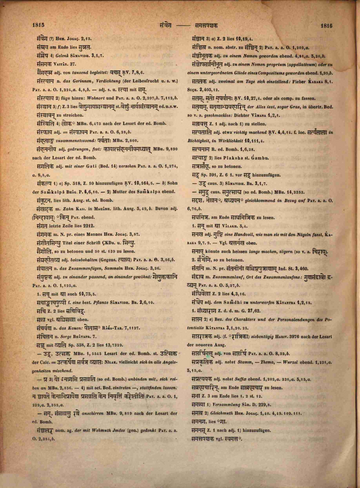
saṃsthā́na — 1〉 Adj. als Beiw. Viṣṇuʼs MBH. 13,149,55. — 2〉 m. Pl. N. pr. eines Volkes. — 3〉 n. (adj. Comp. f. ā) — a〉 das Sichbefinden an einem Orte (im Comp. vorangehend). — b〉 das Stillstehen, Standhalten. saṃgrāme GAUT. — c〉 das Bestehen, Dasein, Vorhandensein. — d〉 Existenz, Leben. — e〉 das Verharren in (im Comp. vorangehend), so v. a. treues Befolgen. — f〉 Aufenthaltsort, Wohnort. — g〉 ein öffentlicher Platz in einer Stadt. — h〉 Gestalt, Form, Aussehen (häufig in Verbindung mit rūpa.) — i〉 eine schöne Gestalt, — Form. — k〉 Symptom einer Krankheit. — l〉 Beschaffenheit, Natur, Wesen. — m〉 Gesammtheit, das Ganze. — n〉 *Abschluss MAITR. S. 2,1,8 (9,13). — o〉 *Ende, Tod.

Apte 1890 substantive neuter
Original text · English · substantive neuter
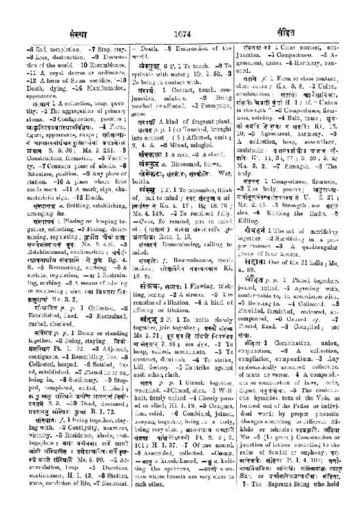
saṃsthānaṃ 1 A collection, heap, quantity. 2 The aggregation of primary atoms. 3 Configuration, position; ākṛtiravayavasaṃsthānaviśeṣaḥ. 4 Form, figure, appearance, shape; strīsasthānaṃ cāṇsarastīrthatārādutkṣipyenāṃ jyītirikaṃ jagāma Ś. 5. 30; Ms. 9. 261. 5 Construction, formation. 6 Vicinity. 7 Common place of abode. 8 Situation, position. 9 Any place or station. 10 A place where four roads meet. 11 A mark, sign, characteristic sign. 12 Death.
Cappeller 1887 substantive neuter
Original text · German · substantive neuter
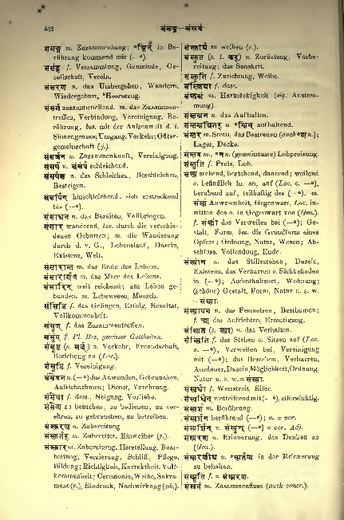
saṃsthā́na n. das Stellestehen, Dasein, Existernz, das Verharren o. Sichbefinden in (—˚); Aufenthaltsort, Wohnung; (schöne) Gestalt, Form, Natur u. s. w. = saṃsthā.
Burnouf 1866 substantive neuter
Original text · French · substantive neuter
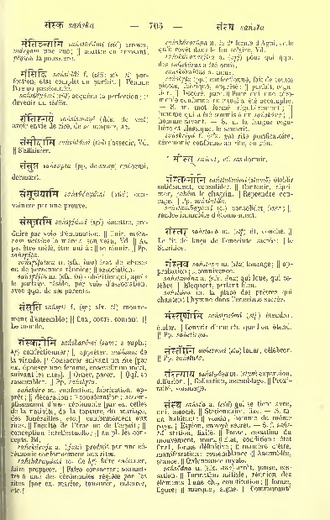
saṃsthāna n. (sfx. ana) arrêt, pause, cessation. Formation initiale, réunion des éléments d'une ch., constitution; forme, figure; marque, signe. Communauté [Page706-1] d'habitation, voisinage. Carrefour. Tas, monceau.
Occurrences in source texts (2)
SiSa 2 occurrences
Continue with AYI Free
Image source: AYI archive.