

upādhi उपाधि – deceit, deception, disguise (in the Vedānta this is especially applied to certain natural forms or properties…
substantive masculine · Word type unspecified
Dictionary sources
Cappeller 1891 substantive masculine
Original text · English · substantive masculine
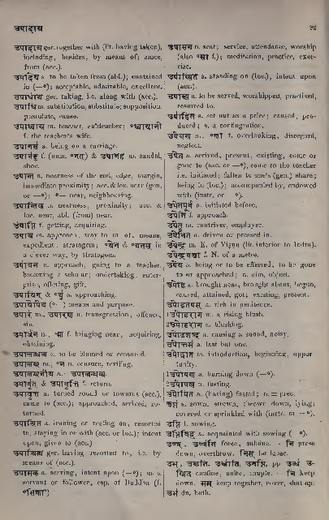
upādhi ·m. substitution, substitute; supposition, postulate, cause.
Monier-Williams 1872 substantive masculine
Original text · English · substantive masculine
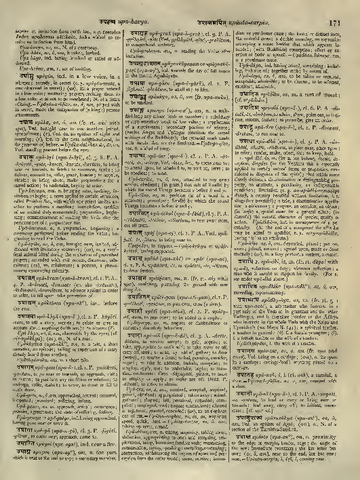
1. upā-dhi, is, m. (for 2. see below), deceit, de- ception, disguise (in the Vedānta this is especially applied to certain natural forms or properties, con- sidered as disguises of the spirit); that which more closely defines, a discriminative or distinguishing pro- perty, an attribute, a peculiarity, an indispensable condition; limitation (e. g. an-upādhi-ramaṇīyo deśaḥ, a country beautiful without limitation, i. e. altogether beautiful); a title, a discriminative appella- tion, a nickname; a purpose, an occasion, an object; (in logic) a special cause for a general effect; (in rhetoric) the natural character of species, quality or action. Upādhi-tas, ind. in consequence of a pe- culiarity. (At the end of a compound the affix ka may be added to upādhi, e. g. asty-upādhika, having ‘is’ as an attribute.)
Original text · English · substantive masculine
upādhi 2 . upā-dhi, is, m. (fr. rt. dhyai with upa-ā), reflection on duty; virtuous reflection; a man who is careful to support his family. (For 1. see under upā-dhā above.)
Petersburger 1855 substantive masculine · Word type unspecified
Original text · German · substantive masculine
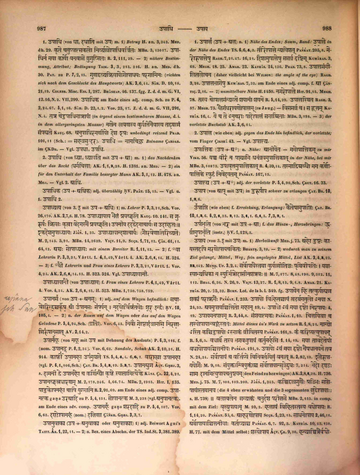
1. upādhi (von dhā, dadhāti mit upa) m. 1〉 Betrug H. an. 3,343. MED. dh. 29. kṛte catuṣpātsakalo nirvyājopādhivarjitaḥ MBH. 3,13017. upādhirna mayā kāryo vanavāse jugupsitaḥ R. 2,111,29. — 2〉 nähere Bestimmung, Attribut; Bedingung TRIK. 3,3,215. TRIK. 3,3,216. H. an. MED. dh. 30. PAT._zu_P. 7,2,15. guṇadravyakriyāyogopādhayaḥ paragāminaḥ (richten sich nach dem Geschlecht des Hauptworts) AK. 3,6,44. SĀH. D. 10,18. SĀH. D. 21,19. COLEBR. Misc. Ess. I, 287. BHĀṢAP. 46. BHĀṢAP. 137. fgg. Z. d. d. m. G. VI, 12. Z. d. d. m. G. VI,16, N. 2. Z. d. d. m. G. VI,VII, 299. upādhika am Ende eines adj. comp. Sch. zu P. 4,2,24. P. 4,2,67. P. 5,1,16. SĀH. D. 22,1. SĀH. D. 22,2. VOP. 25,17. Z. d. d. m. G. VII, 291, N. 4. tatra cedupādhimātrāyāṃ (in irgend einem bestimmbaren Maasse, d. i. in dem allergeringsten Maasse) nakhena lavaṇasya kuryāttenaivāsya tadvṛthānnaṃ saṃpadyate KAUŚ. 68. anupādhiramaṇīyo deśa eṣaḥ unbedingt reizend PRAB. 101,11 (Sch.: = sahajasundara). upādhi = nāmacihna Beiname ŚABDAR._im_ŚKDR. — Vgl. upadhā, upadhi.
Original text · German · substantive masculine
2. upādhi (von dhyā, dhyāyati mit upa + ā) m. 1〉 das Nachdenken über das Recht (dharmacintā) AK. 1,1,7,28. H. 1381. H. an. MED. — 2〉 ein für den Unterhalt der Familie besorgter Mann AK. 3,1,12. H. 478. H. an. MED. — Vgl. 2. ādhi.
Original text · German · Word type unspecified
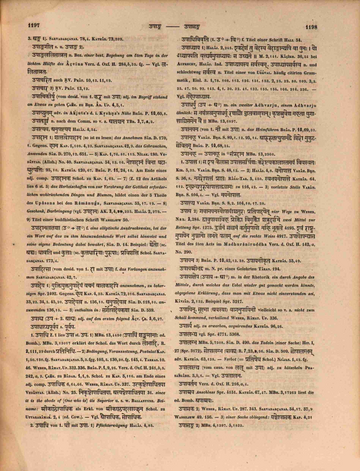
1. upādhi Z. 1 lies upā st. upa. 1〉 MBH. 13,4450 (upādhiṃ śaṅkamānāḥ ed. Bomb.). MBH. 3,13017 erklärt der Schol. das Wort durch lobhādi, R. 2,111,29 durch pratinidhi. — 2〉 Bedingung, Voraussetzung, Postulat KAP. 1,50. KAP. 1,150. fg. SARVADARŚANAS. 5,3. fgg. SARVADARŚANAS. 105,5. SARVADARŚANAS. 130,20. fg. SARVADARŚANAS. 145,4. TARKAS. 10. TARKAS. 46. WEBER, RĀMAT. UP. 332. WEBER, RĀMAT. UP. 336. BHĀG. P. 1,9,26. Verz. d. Oxf. H. 241,b,5. Verz. d. Oxf. H. 242,a,3. ŚAṂK._zu_BĀDAR. 1,1,9. Schol. zu KAP. 5,116. am Ende eines adj. comp. upādhika KAP. 6,64. KAP. 6,66. WEBER, RĀMAT. UP. 337. utkṛṣṭopādhitayā VEDĀNTAS. (Allah.) No. 25. nikṛṣṭopādhitayā, aspaṣṭopādhitayā VEDĀNTAS. (Allah.) 31. since it is the abode of [One who is] its Superior u. s. w. BALLANTYNE. Beiname: śrīkaṇṭhopādhika als Erkl. von śrīkaṇṭhapadalāñchana Schol. zu UTTARARĀMAC. 2,4 (UTTARAR. ed. Cow.). — Vgl. aupādhika, sopādhika.
Original text · German · Word type unspecified
2. upādhi von 1. dhī mit upā. 1〉 Pflichterwägung HALĀY. 4,85.
Böhtlingk 1879 substantive masculine
Original text · German · substantive masculine
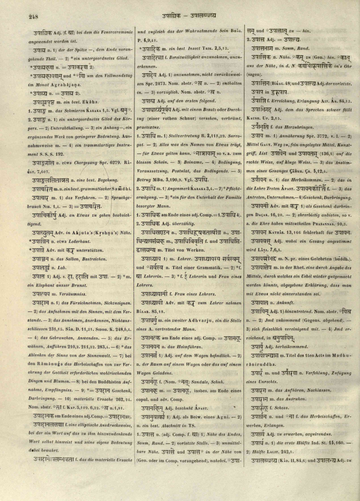
1. upādhi m. — 1〉 Stellvertretung R. 2,11,29. Surrogat. — 2〉 Alles was den Namen von Etwas trägt, — für Etwas gelten kann. ˚mātrāyām so v. a. zum blossen Schein. — 3〉 Beiname. — 4〉 Bedingung, Voraussetzung, Postulat, das Bedingende. — 5〉 Betrug MBH. 3,190,9. Vgl. upadhi.
Original text · German · substantive masculine
2. upādhi m. — 1〉 Augenmerk CARAKA. 3,4. — 2〉 *Pflichterwägung. — 3〉 *ein für den Unterhalt der Familie besorgter Mann.
Apte 1890 substantive masculine
Original text · English · substantive masculine
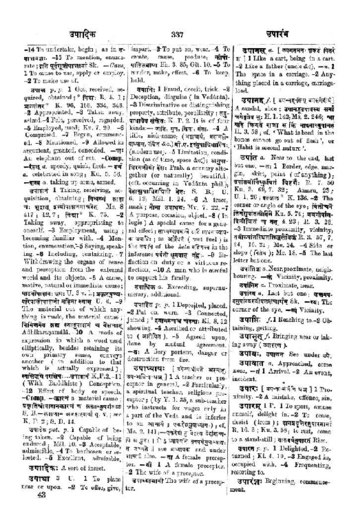
upādhiḥ 1 Fraud, deceit, trick. 2 Deception, disguise (in Vedānta). 3 Discriminative or distinguishing property, attribute, peculiarity; tadupādhāveva saṃketaḥ K. P. 2. It is of four kinds: -jāti, guṇa, kriyā, saṃjñā. 4 A title, nick-name; (bhaṭṭācārya, mahāmahopādhyāya, paṃḍita &c.); bī. e. ityupādhidhāriṇaḥ (modern use). 5 Limitation, condition (as of time, space &c.); anupādhiramaṇīyo deśaḥ Prab. a country altogether (or naturally) beautiful; (oft. occurring in Vedānta phil.); dehādyupādhiracito bhedaḥ Ś. B.; U. 6. 12; Māl. 1. 24. 6 A trace, mark; bhaumā upādhayaḥ Mv. 7. 22. 7 A purpose, occasion, object. 8 (In logic) A special cause for a general effect; sādhyavyāpakatve sati sādhanāvyāpaka upādhiḥ; as ārdredhanaṃ (wet fuel) is the upādhi of the hetu vahnimattva in the inference parvato dhūmavān vahneḥ. 9 Reflection on duty or a virtuous reflection. 10 A man who is careful to support his family.
Cappeller 1887 substantive masculine
Original text · German · substantive masculine
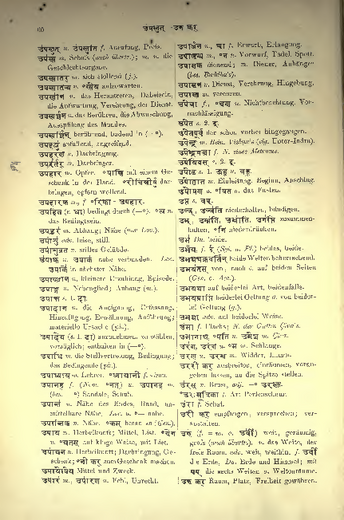
upādhi m. die Stellvertretung, Bedingung; das Bedingende (ph.).
Burnouf 1866 substantive masculine
Original text · French · substantive masculine
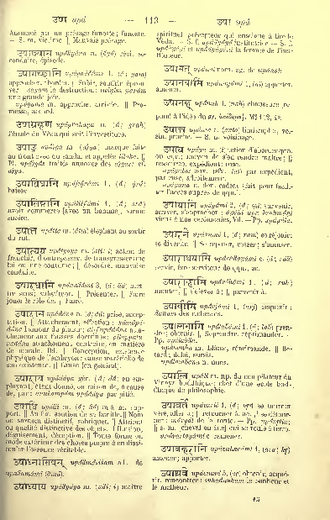
upādhi upādhi m. (ā; dhā) m à m. support. Au fig. soutien de sa famille. Nom ou surnom distinctif, sobriquet. Attribut ou qualité distinctive des objets. Illusion, déguisement, déception. Toute forme ou mode extérieur des choses propre à en dissimuler l'essence véritable.
Occurrences in source texts (4)
SiSa 4 occurrences
Continue with AYI Free
Image source: AYI archive.