

vidh विध् – worship; serve
adjective · verbal root · Word type unspecified · verb
Dictionary sources
AYI dictionary verbal root
worship; serve
Cappeller 1891 verb
Original text · English · verb
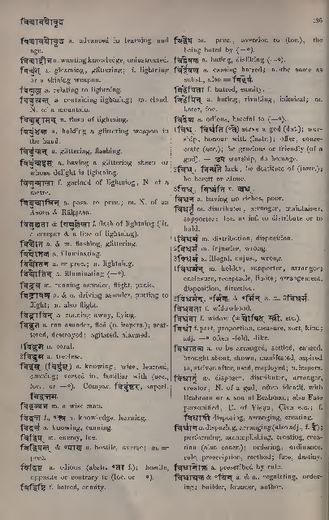
vidh vidháti1 ·v (°te) serve a god (dat.); worship, honour with (instr.); offer, consecrate (acc.); be gracious or friendly (of a god). -- upa worship, do homage.
Original text · English · verb
vidh vindháte2 ·v lack, be destitute of (instr.); be bereft or alone.
Original text · English · verb
vidh vidhyáti3 ·v -> vyadh.
Monier-Williams 1872 Word type unspecified · verb
Original text · English · Word type unspecified
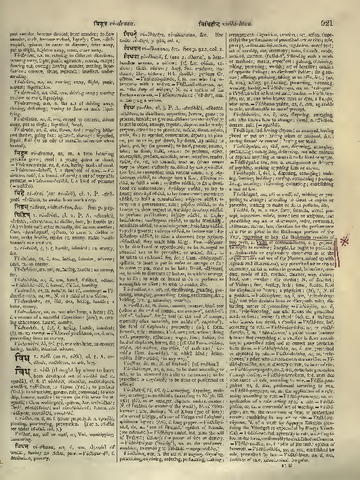
vidh 1 . vidh (= rt. vith), cl. 1. A. ve- dhate, vedhitum, to ask, beg.
Original text · English · Word type unspecified
vidh 2 . vidh (thought by some to have been developed out of vi-dhā and rt. vyadh), cl. 6. P. vidhati, vivedha, vedhiṣyati, avedhīt, vedhitum, to dispose (Ved.); to perform (Ved.); to administer, govern, rule, command; to wor- ship, honour, sacrifice; to pierce, (in this sense for rt. vyadh): Caus. vedhayati, -yitum, Aor. avīvidhat: Desid. vividhiṣati and vivedhiṣati: Intens. ve- vidhyate, vevidhīti, veveddhi.
Original text · English · Word type unspecified
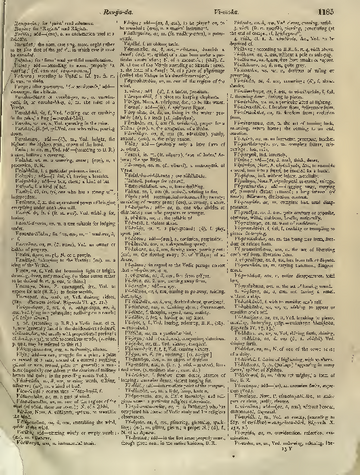
3. vidh (fr. rt. vyadh), piercing, penetrating (at the end of comps., cf. hṛdaya-v˚).
Original text · English · verb
4. vidh, cl. 1. A. vindhate, &c., Ved. to be deprived of.
Petersburger 1855 Word type unspecified
Original text · German · Word type unspecified
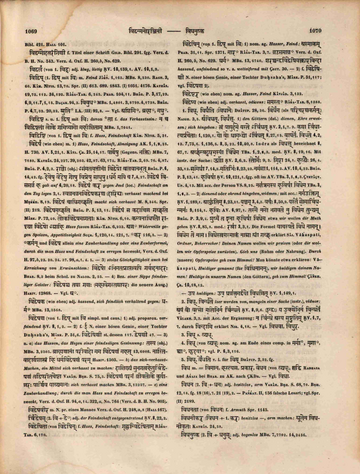
1. vidh , vidháti (vidhāne) DHĀTUP. 28,36. vidhéma (als paricaraṇakarman) NAIGH. 3,5. ávidhat, vidhánt. 1〉 den Göttern (dat.) dienen, Ehre erweisen; sich hingeben: tvaṃ pā̱yurdame̱ yaste 'vìdhat ṚV. 2,1,7. ṚV. 2,1,9. ka̱thā vìdhā̱tyapràcetāḥ ṚV. 1,120,1. yo vo̱ dhāma̱bhyo 'vìdhat ṚV. 8,27,15. vā̱ghatè, vidha̱te ṚV. 4,2,13. ṚV. 7,75,6. ṚV. 1,136,5. ṚV. 8,5,22. ṚV. 10,40,8. Indra als vidhant bezeichnet ṚV. 8,67,7. acchàmbaṭkārama̱syāṃ vìdhema TBR. 1,2,1,3. med. ṚV. 8,19,16. Mit instr. der Sache: ūrjā̀ ṚV. 2,6,2. stomaìḥ ṚV. 2,9,3. gi̱rā ṚV. 2,24,1. ha̱vyaiḥ ṚV. 26,4. ṚV. 35,12. sa̱midhā̀ ṚV. 7,14,2. ma̱tibhìḥ ṚV. 8,23,23. namàsā ṚV. 1,114,2. AV. 10,4,23. BHĀG. P. 3,13,41. ha̱viṣā̀ ṚV. 10,121,1. fgg. oft im AV. TBR. 3,1,1,3. ŚVETĀŚV. UP. 4,13. Mit acc. der Person VS. 8,25. nakṣàtramasya ha̱viṣā̀ vidhema TBR. 3,1,1,3. — 2〉 dienend oder ehrend hingeben, widmen; mit acc.: namàuktim ṚV. 1,189,1. āhùtim ṚV. 8,23,21. ya̱jñam ṚV. 3,4,2. vacàḥ ṚV. 8,50,9. yastè so̱māvìdha̱nmanàḥ ṚV. 9,114,1. ha̱viḥ AV. 6,97,1. tasmai namo bhagavate nu vidhema tubhyam BHĀG. P. 3,9,4. śuṣmàṃ ta e̱nā ha̱viṣā̀ vidhema etwa wir wollen dir Muth geben ṚV. 8,85,8. med.: ratnā̀ ṚV. 3,3,1. Die Formel vācaspate vidhe nāman . vidhema te nāma . vidhestvamasmākaṃ nāmnā dyāṃ gaccha erklärt SĀY. Vācaspati, Ordner, Beherrscher! Deinen Namen wollen wir preisen (oder dir wollen wir Opferspeise zurüsten). Gieb uns (Ruhm oder Nahrung). Durch (unsere) Opferspeise geh zum Himmel! Man könnte etwa erklären: Vācaspati, Huldiger genannt (für vidhināman), wir huldigen deinem Namen! Huldige in unserm Namen (den Göttern), geh zum Himmel! ŚĀṄKH. ŚR. 10,18,12. — upa huldigen: upa̱ dhrajànta̱madràyo vi̱dhannit ṚV. 1,149,1.
Original text · German · Word type unspecified
2. √vidh , vindháte leer werden von, mangeln einer Sache (instr.), viduor: a̱yaṃ vā̀ṃ va̱tso ma̱tibhi̱rna vìndhate ṚV. 8,9,6. (indraḥ) ya u̱kthebhi̱rna vi̱ndhatè VĀLAKH. 3,3. mit Acc. der Ergänzung: na vìndhe asya suṣṭu̱tim ṚV. 1,7,7. durch vindāmi erklärt NIR. 4,18. — Vgl. vidhavā, vidhura.
Original text · German · Word type unspecified
3. vidh s. vyadh.
Original text · German · Word type unspecified
4. √vidh (von vyadh) nom. ag. am Ende eines comp. in marmā˚, mṛgā˚, śvā˚, hṛdayā˚; vgl. P. 6,3,116.
Original text · German · Word type unspecified
5. vidh , védhati v. l. für vith DHĀTUP. 2,32. fg.
Böhtlingk 1879 adjective · verbal root
Original text · German · adjective
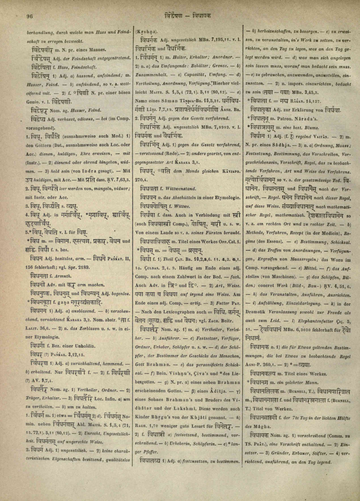
4. vidh Adj. in marmāvídh, *mṛgāvidh, śvāvídh, hṛdayāvídh.
Original text · German · verbal root
1. √vidh , vidháti (ausnahmsweise auch Med.) — 1〉 den Göttern (Dat., ausnahmsweise auch Loc. oder Acc.) dienen, huldigen, Ehre erweisen, — mit (Instr.). — 2〉 dienend oder ehrend hingeben, widmen. — 3〉 hold sein (von Indra gesagt). — Mit upa huldigen, mit Acc. — Mit prati dass. ṚV. 7,63,5.
Original text · German · verbal root
2. √vidh , vindháte leer werden von, mangeln, viduor; mit Instr. oder Acc.
Original text · German · verbal root
3. √vidh , vidhyáti s. √vyadh.
Original text · German · verbal root
5. *√vidh , vedhati v. l. für vith.
Whitney Roots 1885 verbal root
Original text · English · verbal root
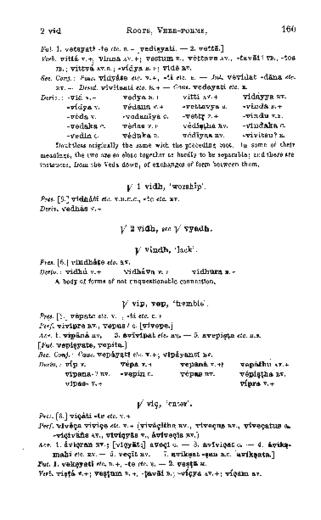
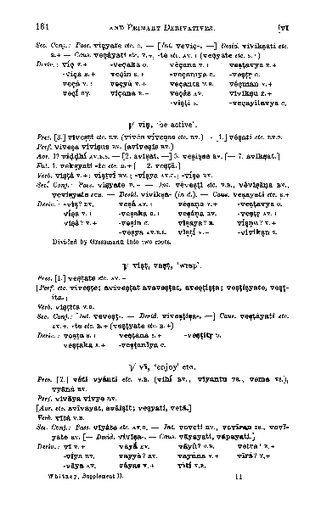
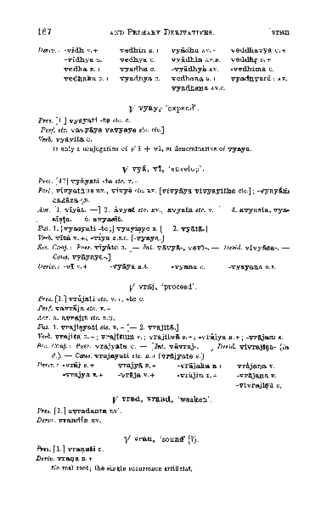
vidh [1] — worship
Original text · English · verbal root
vidh [2] → vyadh
Original text · English · verbal root
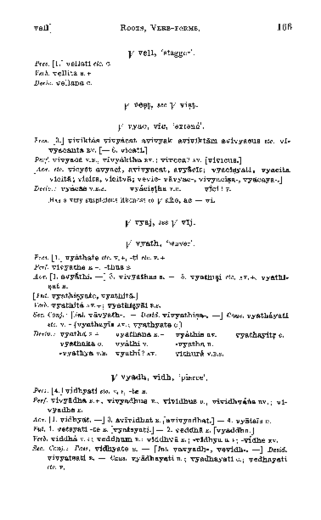
vyadh, vidh — pierce
Apte 1890 verbal root
Original text · English · verbal root
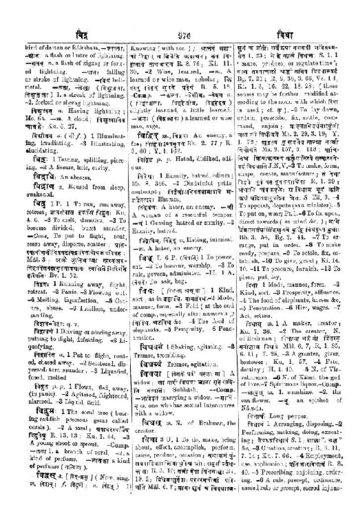
vidh I. 6 P. (vidhati) 1 To pierce, cut. 2 To honour, worship. 3 To rule, govern, administer. II. 1 A. (vedhate) To ask, beg.
Cappeller 1887 verb
Original text · German · verb
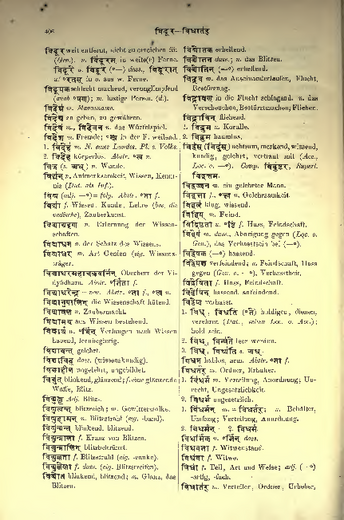
1. vidh, vidháti (˚te) huldigen, dienen, verehren (Dat., selten Loc. 0. Acc.); hold sein.
Original text · German · verb
2. vidh, vindháte leer werden.
Original text · German · verb
3. vidh, vidhyáti s. vyadh.
Original text · German · verb
1. vidh, vindháte leer werden.
Original text · German · verb
2. vidh, vidhyáti s. vyadh.
Burnouf 1866 verbal root
Original text · French · verbal root
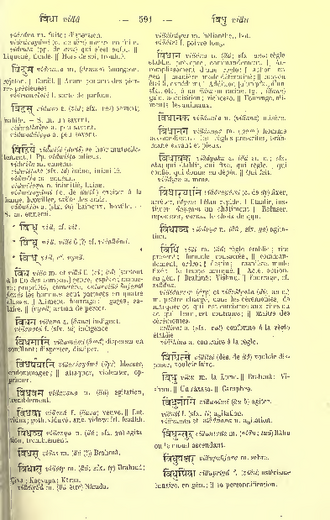
*vidh vidh, cf. vith.
Original text · French · verbal root
*vidh vidh, vidhe 6 (?) cf. vidadhāmi.
Original text · French · verbal root
*vidh vidh, cf. vyadh.
Occurrences in source texts (1)
SVU 1 occurrence
Continue with AYI Free
Image source: AYI archive.