

śaśa शश – Hase (diesen oder eine Gazelle sieht der Inder im Monde). śaśasya karṣūśayasya vratam Name eines Sāman
Substantiv Maskulin · Worttyp nicht bestimmt
Wörterbuchquellen
Cappeller 1891 Substantiv Maskulin
Originaltext · Englisch · Substantiv Maskulin
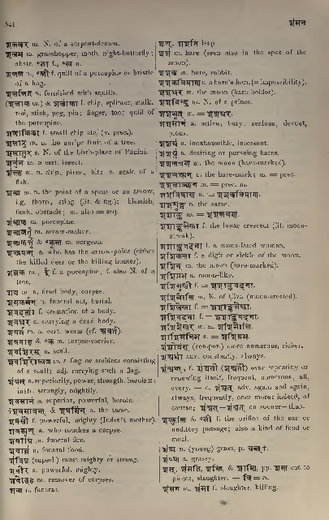
śaśá ·m. hare (seen also in the spot of the moon).
Monier-Williams 1872 Substantiv Maskulin
Originaltext · Englisch · Substantiv Maskulin
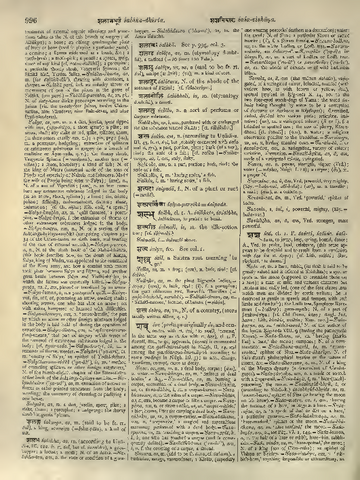
Śaśa, as, m. a hare, rabbit, (its flesh is said to be greatly valued and is offered at Śrāddhas); a spot or spots on the moon (supposed to resemble those on a hare); a man of mild and virtuous character but uxorious and easily led, (one of the four classes into which men are divided by erotic writers; he is described as gentle in speech and temper, with soft limbs and fine hair); the Lodh tree, Symplocos Race- mosa (= lodhra); gum-myrrh; N. of a part of Jambu-dvīpa; [cf. Old Germ. haso; Angl. Sax. hara; Lith. kiszkis, zuikis; Russ. zœz.]
Petersburger 1855 Substantiv Maskulin
Originaltext · Deutsch · Substantiv Maskulin
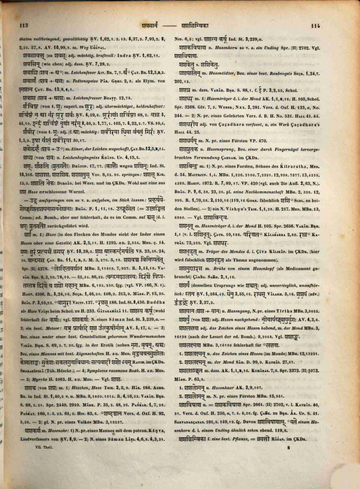
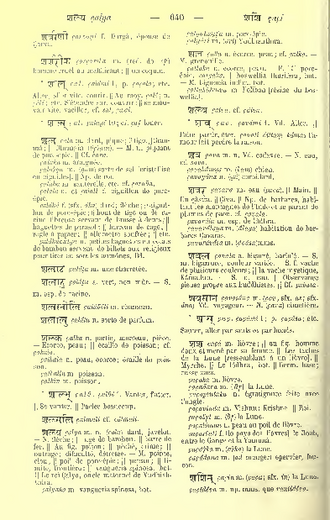
śaśá m. 1〉 Hase (in den Flecken des Mondes sieht der Inder einen Hasen oder eine Gazelle) AK. 2,5,11. H. 1295. H. an. 2,554. MED. ś. 14. śa̱śaḥ kṣu̱raṃ pra̱tyañcàṃ jagāra ṚV. 10,28,2. śa̱śa ā̱skandàmarṣati VS. 23,56. VS. 24,38. cāndramasa ŚAT. BR. 11,1,5,3. M. 3,270. M. 5,18. śaśavacca viniṣpatet Spr. (II) 4378. ˚lohitavarṇābha MBH. 3,11618. MBH. 7,997. R. 5,14,18. VARĀH. BṚH. S. 3,30. VARĀH. BṚH. S. 78,19. —VARĀH. BṚH. S. 51,34. VARĀH. BṚH. S. 86,22. (candramaṇḍalasya) dviraṃśe pippalastatra dviraṃśe ca śaśo mahān MBH. 6,192. MBH. 6,250. fgg. (vgl. VP. 166, N. 1). HARIV. 4596. R. 5,24,16. SUŚR. 1,46,20. SUŚR. 1,108,2. SUŚR. 1,315,9. MĀRK. P. 15,30. BHĀG. P. 3,10,22. ˚vāgurā VYUTP. 137. ˚rajas VYUTP. 188. Ind. St. 8,436. Buddha als Hase VYĀḌI beim Schol. zu H. 233. JĀTAKAMĀLĀ 11. śaśasya karṣū (wohl fehlerhaft für karṇaḥ; vgl. śaśakarṇa) N. eines Sāman Ind. St. 3,239,a. — 2〉 ein best. Meteor: yatra̱ prāpā̀di śa̱śa ùlku̱ṣīmā̀n AV. 5,17,4. — 3〉 Bez. eines unter einer best. Constellation geborenen Wundermenschen VARĀH. BṚH. S. 69,2. VARĀH. BṚH. S. 69,7. VARĀH. BṚH. S. 69,20. fgg. in der Erotik (neben mṛga, vṛṣan, aśva) Bez. eines Mannes mit best. Eigenschaften H. an. MED. mṛduvacanasuśīlaḥ komalāṅgaḥ sukeśaḥ sakalaguṇavidhānaḥ satyavādī śaśo 'yam RATIM._im_ŚKDR. SMARADĪPIKĀ (Tüb. Hdschr.). — 4〉 Symplocos racemosa Roxb. H. an. MED. — 5〉 Myrrhe H. 1063. H. an. MED. — Vgl. śāśa.
Böhtlingk 1879 Substantiv Maskulin · Worttyp nicht bestimmt
Originaltext · Deutsch · Substantiv Maskulin
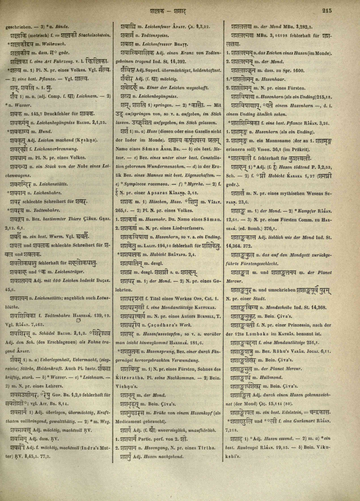
śaśá — 1〉 m. — a〉 Hase (diesen oder eine Gazelle sieht der Inder im Monde). śaśasya karṣūśayasya vratam Name eines Sāman ĀRṢ. BR. — b〉 ein best. Meteor. — c〉 Bez. eines unter einer best. Constellation geborenen Wundermenschen. — d〉 in der Erotik Bez. eines Mannes mit best. Eigenschaften. — e〉 *Symplocos racemosa. — f〉 *Myrrhe. — 2〉 f. ī N. pr. einer Apsaras KĀRAṆḌ. 3,18.
Originaltext · Deutsch · Worttyp nicht bestimmt
śaśa VI. = lodhravṛkṣa oder mṛdulomaka KĀD. (1883) 19,17. [Nachtrag, Band 7]
Apte 1890 Substantiv Maskulin
Originaltext · Englisch · Substantiv Maskulin
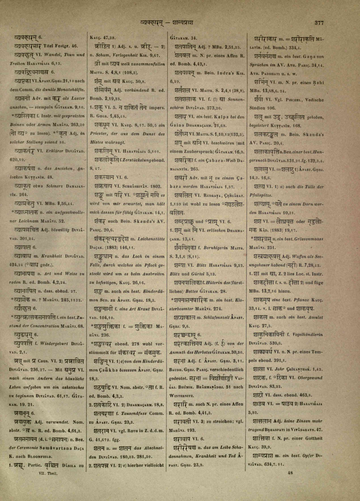
śaśaḥ 1 A hare, rabbit; Ms. 3. 270, Ms. 5. 18. 2 The spots on the moon (which are popularly considered to resemble the form of a hare). 3 One of the four classes into which men are divided by erotic writers; thus defined: -mṛduvacanasuśīlaḥ komalāṃgaḥ sukeśaḥ sakalaguṇanidhānaṃ satyavādī śaśo'yaṃ Śabdak.; see Ratimañjarī 35 also. 4 The Lodhra tree. 5 Gum-myrrh. Comp. — aṃkaḥ 1 the moon. 2 camphor. ˚ardhamukha a. crescent-headed (as an arrow). ˚mūrtiḥ an epithet of the moon. ˚lekhā the digit of the moon, lunar crescent. — adaḥ 1 a hawk, falcon. 2 N. of a son of Ikṣvāku, father of puraṃjaya. — adanaḥ a hawk, falcon. — ūrṇaṃ, -loman n. the hair of a rabbit, hair-skin. — dharaḥ 1 the moon; prasarati śaśadharaviṃbe Gīt. 7. 2 camphor. ˚mauliḥ an epithet of Śiva. — plutakaṃ a scratch with a fingernail. — bhṛt m. the moon. ˚bhṛt m. an epithet of Śiva ([Page 1037-c]) — lakṣmaṇaḥ an epithet of the moon. — laṃchanaḥ 1 the moon; Ku. 7. 6. 2 camphor. — viṃ(viṃ)duḥ 1 the moon. 2 an epithet of Viṣṇu. — viṣāṇaṃ, -śṛṃgaṃ a hair's horn; used to denote anything impossible, an utter impossibility; kadācidapi paryaṭañ śaśaviṣāṇamāsādayet Bh. 2. 5; śaśaśṛṃgadhanurdharaḥ; see khapuṣpa. — sthalī the country between the Ganges and Yamunā, the Doab.
Cappeller 1887 Substantiv Maskulin
Originaltext · Deutsch · Substantiv Maskulin
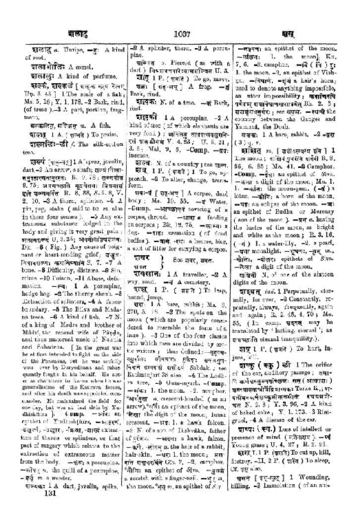
śaśá m. Hase (auch im Monde gesehen).
Burnouf 1866 Substantiv Maskulin
Originaltext · Französisch · Substantiv Maskulin
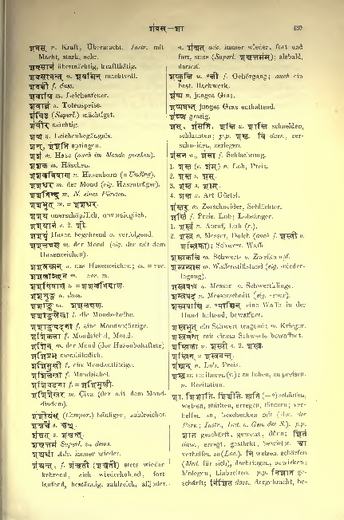
śaśa śaśa m. lièvre; au fig. homme doux et mené par sa femme. Les taches de la Lune [ressemblant à un lièvre]. Myrrhe. Le lôdhra, bot. Germ. hase; russe zaez. śaśaka m. lièvre. śaśadhara m. (dhṛ) la Lune. śaśaplutaka n. égratignure faite avec l'ongle. śaśavindu m. Viṣṇu: Kṛṣṇa. Roi. śaśabhṛt m. (bhṛ) la Lune. śaśaloman n. peau ou poil de lièvre. śaśasthalī f. [le pays des lièvres] le Doab, entre le Gange et la Yamunā. śaśāṅka m. (aṅka) la Lune. śaśādana m. (ad manger) épervier, faucon.
Quelltextfundstellen (1)
GoS 1 Fundstelle
Mit AYI Free weitermachen
Bildquelle: AYI Archiv.