

bhavat भवत् – Sie; Ihr
Adjektiv · Pronomen · Substantiv Maskulin · Worttyp nicht bestimmt
Wörterbuchquellen
AYI Wörterbuch Pronomen
Sie; Ihr
Monier-Williams 1872 Substantiv Maskulin · Worttyp nicht bestimmt
Originaltext · Englisch · Substantiv Maskulin
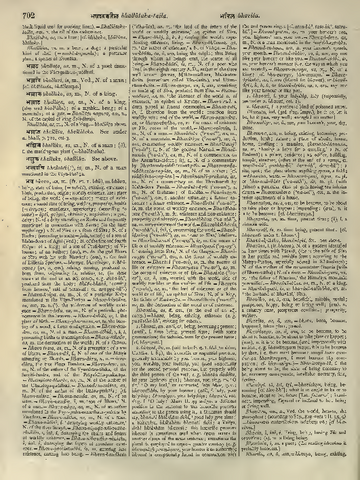
2. bhavat, ān, m. (said to be fr. rt. 1. bhā, to shine, Uṇādi-s. 1. 64), the honorific or respectful pronoun, generally translatable by your honour, your highness, your worship, your lordship, you (used respectfully for the second personal pronoun, but properly with the third person of the verb, e. g. bhavān dadātu, let your highness give); bhavan, voc. sing. m. ‘O sir,’ ‘O my lord,’ or contracted into bhos, q. v.; bhavadbhis, by your honour; (atī), f. lady, your ladyship; bhavatyas, your ladyships; bhavati, voc. sing. f. ‘O lady:’ Manu II. 49 assigns a different position in the sentence to this honorific pronoun according to the person using it; a Brāhman should say, bhavati bhikṣāṃ dehi, ‘good lady give alms;’ a Kṣatriya, bhikṣām bhavati dehi; a Vaiśya, dehi bhikṣām bhavati: this honorific pronoun bhavat is sometimes used when tvam occurs in another clause of the same sentence; sometimes the plural is employed to express greater courtesy (e. g. bhavantaḥ pramāṇam, your honour is an authority); bhavat is exceptionally found in construction with the 2nd person sing.; [cf. atra-bh˚, tato-bh˚, tatra- bh˚.]
Originaltext · Englisch · Worttyp nicht bestimmt
1. bhavat, an, antī, at, being, becoming; present; (antī), f. time being, present time; (with some grammarians) the technical term for the present tense; [cf. bhavanti.]
Apte 1890 Adjektiv · Pronomen
Originaltext · Englisch · Adjektiv · Pronomen
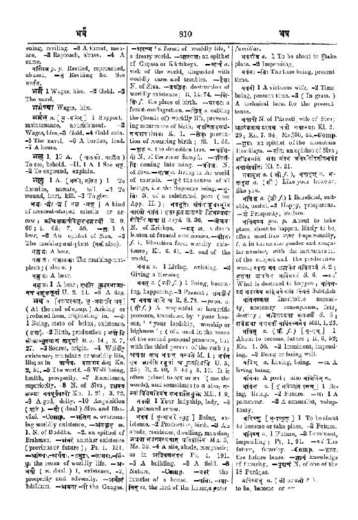
bhavat a. (ntī f.) 1 Being, becoming, happening. 2 Present; samatītaṃ ca bhavacca bhāvi ca R. 8. 78. — pron. a. (tī f.) A respectful or honorific pronoun, translated by ‘your honour,’ ‘your lordship, worship or highness’; (oft. used in the sense of the second personal pronoun, but with the third person of the verb); athavā kathaṃ bhavān manyate M. 1; bhavaṃta eva jānaṃti raghūṇāṃ ca kulasthitiṃ U. 5. 23; R. 2. 40, R. 3. 48; R. 5. 16. It is often joined to atra or tatra (see the words), and sometimes to sa also; yanmāṃ vidheyaviṣaye sabhavānniyuṃkte Māl. 1. 9.
Burnouf 1866 Worttyp nicht bestimmt
Originaltext · Französisch · Worttyp nicht bestimmt
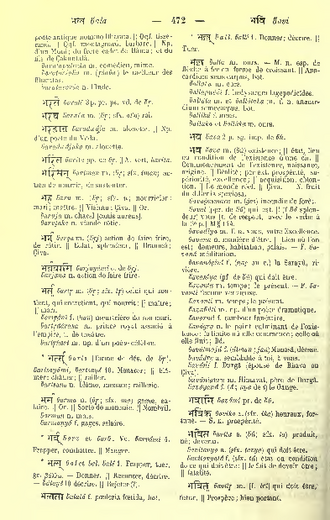
bhavat (ppr. de bhū) qui est. (? bhā splendeur) vous [t. de respect, avec le verbe à la 3ᵉ p.] M§ 114.
Quelltextfundstellen (1)
HP 1 Fundstelle
Mit AYI Free weitermachen
Bildquelle: AYI Archiv.