

gaya गय – Gaya
Substantiv Maskulin · Worttyp nicht bestimmt
Wörterbuchquellen
AYI Wörterbuch Substantiv Maskulin
Gaya
Cappeller 1891 Substantiv Maskulin
Originaltext · Englisch · Substantiv Maskulin
gáya ·m. house, household, family, N. of a Rishi etc., pl. N. of a people. f. gayā N. of a famous place of pilgrimage.
Monier-Williams 1872 Substantiv Maskulin
Originaltext · Englisch · Substantiv Maskulin
gaya gaya, as, m. (said to be fr. rt. gam or gai), a house, household, family, goods and chattels, the contents of a house, property, wealth, a species of ox, the Gayal or Bos Gavæus; N. of a Ṛṣi, son of Plati; also of a Rājarṣi, performer of a celebrated sacrifice, (he was conquered by Māndhātṛ); a son of Amūrta-rajas; also of Āyus; also of a Manu; also of Havirdhāna and Dhiṣaṇā (Havirdhānī); also of Ūru and Āgneyī; of Vitatha; of Sudyumna; of Nakta and Druti; N. of the people living round Gayā and the district inhabited by them; N. of an Asura, who like the Rājarṣi Gaya is connected with the town Gayā; one of the monkey followers of Rāma; N. of a mountain near Gayā; (ās), m. pl., Ved. the vital airs; (ā), f. Gayā, the city in Behār still so called and a place of pilgrimage, the residence of the saint of the same name; it was sanctified by the benediction of Viṣṇu as a tribute to the piety of Gaya, the Rājarṣi, or (according to another legend) to Gaya, the Asura, who was overwhelmed here with rocks by the gods; the Śrāddha should be per- formed once at least in the life of every Hindū to his progenitors at Gayā; N. of a river; [cf. śaṅ-gaya and buddha-gayā.]
Petersburger 1855 Substantiv Maskulin · Worttyp nicht bestimmt
Originaltext · Deutsch · Substantiv Maskulin
gáya gaṇa vṛṣādi zu P. 6,1,203. 1〉 m. a〉 Haus, Hof; Hausstand, Hauswesen, bestehend in der Hausgenossenschaft sowie in dem beweglichen und unbeweglichen Vermögen, familia; daher = gṛha NAIGH. 3,4. = dhana NAIGH. 2,10. = apatya 2. indro̱ vasùbhi̱ḥ parì pātu no̱ gayàm ṚV. 10,66,3. ṚV. 1,74,2. ṚV. 5,44,7. ṚV. 6,2,8. ṚV. 6,71,7. ṚV. 8,45,3. AV. 6,3,3. AV. 7,84,1. sve gayè jāgṛ̱hyapràyucchan VS. 27,3. hi̱tvī gayàmā̱reàvadya̱ āgā̀t ṚV. 10,99,5. gayàṃ pu̱ṣṭiṃ cà vardhaya ṚV. 5,10,3. yaḥ śaśvàto̱ adā̀śuṣo gayàsya praya̱ntāsi̱ suṣvìtarāya̱ vedàḥ ṚV. 7,19,1. ṚV. 7,18,3. ṚV. 8,24,22. mā no̱ gayàmā̱re a̱smatparā̀ sicaḥ ṚV. 9,81,3. amī̀vā̱ yā no̱ gayàmāvi̱veśà ṚV. 6,74,2. Ob das Wort ṚV. 8,41,7 richtig stehe ist zweifelhaft. — b〉 pl. Lebensgeister, nur in einer Ableitung von gāyatrī ŚAT. BR. 14,8,15,7. — c〉 ein best. Thier MED. y. 15. Bos Gavaeus (s. gavaya) WILS. — d〉 N. pr. α〉 eines Ṛṣi, Sohnes des Plati, ṚV. 10,63,17. ṚV. 10,64,16. AIT. BR. 5,2. Ind. St. 3,460. eines Zauberkundigen AV. 1,14,4. Vgl. auch die Einschiebung bei ṚV. 5,51,15. gaya aindraḥ, ātreyaḥ Ind. St. 3,214. Ein Rājarṣi, dessen Opfers öfters Erwähnung geschieht, H. 973. MED. gayasya yajñaḥ MBH. 1,2100. MBH. 3,8518. MBH. 4,1768. MBH. 9,2205. MBH. 13,5661. R. 2,107,11. von Māndhātar besiegt MBH. 7,2281. Sohn des Amūrtarayas MBH. 3,8527. fgg. MBH. 7,2334. fgg. MBH. 12,1004. fgg. des Āyus MBH. 1,3150. eines Manu HARIV. 870. BHĀG. P. 2,7,44. des Havirdhāna und der Dhiṣaṇā (Havirdhānī) HARIV. 83. VP. 106. BHĀG. P. 4,24,8. des Ūru und der Āgneyi HARIV. 73. des Vitatha HARIV. 1732. des Sudyumna HARIV. 631. VP. 350. BHĀG. P. 9,1,41. des Nakta und der Druti BHĀG. P. 5,15,5. VP. 165. — β〉 pl. des um Gayā wohnenden Volksstammes und des von ihm eingenommenen Gebietes MBH. 2,1872. gayasya yajamānasma gayeṣveva mahākratum MBH. 9,2205. R. 2,107,11. — γ〉 eines Asura, der, wie der Rājarṣi gleiches Namens, zu der Stadt Gayā in Beziehung gesetzt wird, VĀYUP._im_ŚKDR. — δ〉 eines Affen im Gefolge von Rāma MBH. 3,16271. R. 4,25,33. R. 6,3,47. R. 6,22,2. — ε〉 eines Berges in der Nähe von Gayā MBH. 3,8304. LALIT. 236. LALIT. 238. LALIT. 378. HIOUEN-THSANG I, 456 (gayā). Vgl. gayaśiras. — 2〉 f. gayā N. pr. gaṇa varaṇādi zu P. 4,2,82. a〉 eines berühmten Wallfahrtsortes, der Residenzstadt des Rājarṣi Gaya, H. 973. MED. y. 15. LIA. I, 136. fg. yaddadāti gayāsthaśca sarvamānantyamaśnute YĀJÑ. 1,260. eṣṭavyā bahavaḥ putrā yadyapyeko gayāṃ vrajet MBH. 3,8075. MBH. 3,8305. MBH. 3,8060. MBH. 13,1728. HARIV. 632. R. 2,107,13. LALIT. 238. RĀJA-TAR. 6,254. gayāmāhātmya (aus dem VĀYU-P.) Verz. d. Pet. H. No. 40. gayākṛtya, ˚paddhati, ˚śrāddhapaddhati Verz. d. B. H. No. 1230. Verz. d. B. H. No. 1233. Verz. d. B. H. No. 1237. gayāsetu Verz. d. B. H. 1403. — b〉 eines Flusses MBH. 1,7818. — Vgl. śaṃgaya, buddhagayā.
Originaltext · Deutsch · Worttyp nicht bestimmt
gaya 1〉d〉α〉 ein Ṛṣi Ind. St. 3,460. Ātreya Verfasser von ṚV. 5,9. ṚV. 5,10. — γ〉 Verz. d. Oxf. H. 68,a,12. — 2〉 gayākalpapaddhati f. Titel einer Schrift HALL 176. — Vgl. mahāgaya.
Böhtlingk 1879 Substantiv Maskulin
Originaltext · Deutsch · Substantiv Maskulin
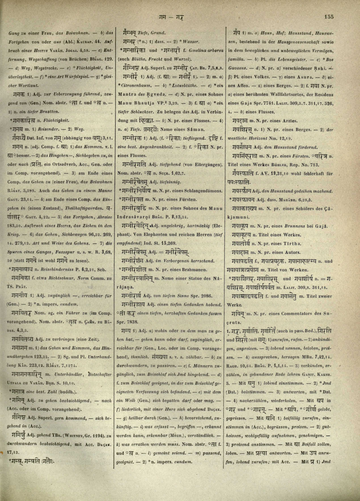
gáya — 1〉 m. — a〉 Haus, Hof; Hausstand, Hauswesen, bestehend in der Hausgenossenschaft sowie in dem beweglichen und unbeweglichen Vermögen, familia. — b〉 Pl. die Lebensgeister. — c〉 *Bos gavaeus. — d〉 N. pr. — α〉 verschiedener Ṛṣi. — β〉 Pl. eines Volkes. — γ〉 eines Asura. — δ〉 eines Affen. — ε〉 eine Berges. — 2〉 f. gayā N. pr. — a〉 eines berühmten Wallfahrtsortes, der Residenz eines Gaya Spr. 7741. LALIT. 309,3. 7. 311,17. 526,4. — b〉 eines Flusses.
Apte 1890 Substantiv Maskulin
Originaltext · Englisch · Substantiv Maskulin
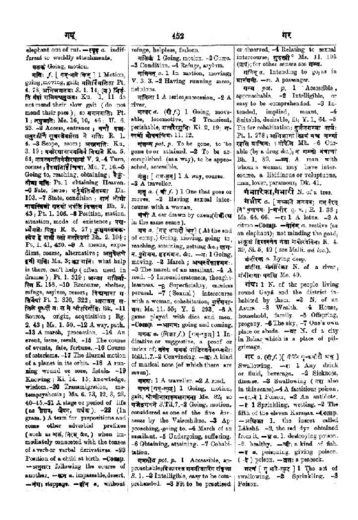
gayaḥ 1 N. of the people living round Gayā and the district inhabited by them. 2 N. of an Asura. 3 Wealth. 4 House, household, family. 5 Offspring, progeny. 6 The sky. 7 One's own place or abode. — yā N. of a city in Behar which is a place of pilgrimage.
Cappeller 1887 Substantiv Maskulin
Originaltext · Deutsch · Substantiv Maskulin
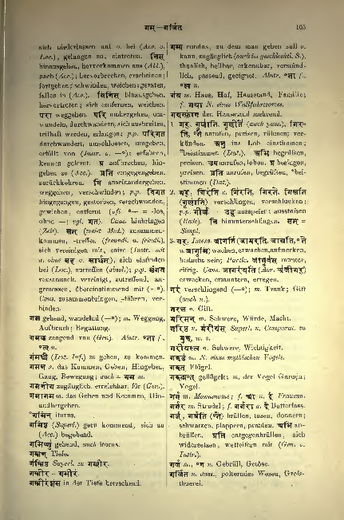
gáya m. Haus. Hof. Hausstand, Familie; f. gayā N. eines Wallfahrtsortes.
Burnouf 1866 Substantiv Maskulin
Originaltext · Französisch · Substantiv Maskulin
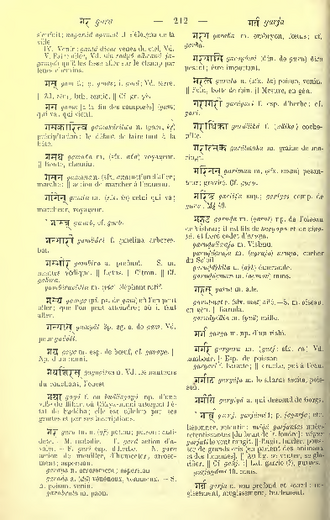
gaya gaya m. esp. de bœuf, cf. gavaya. Np. d'un muni.
Quelltextfundstellen (1)
HP 1 Fundstelle
Mit AYI Free weitermachen
Bildquelle: AYI Archiv.