

vikaraṇa विकरण – organlos; ohne Organ oder Werkzeug
Adjektiv · Substantiv Maskulin · Substantiv Neutrum · Worttyp nicht bestimmt
Wörterbuchquellen
AYI Wörterbuch Adjektiv
organlos; ohne Organ oder Werkzeug
Cappeller 1891 Adjektiv · Substantiv Neutrum
Originaltext · Englisch · Adjektiv · Substantiv Neutrum
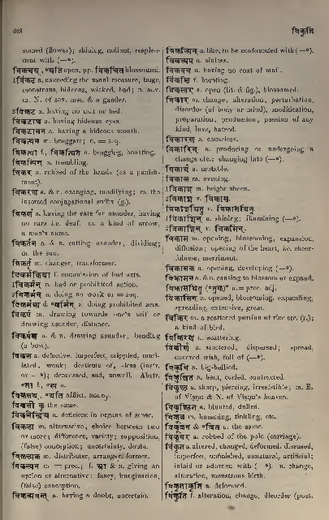
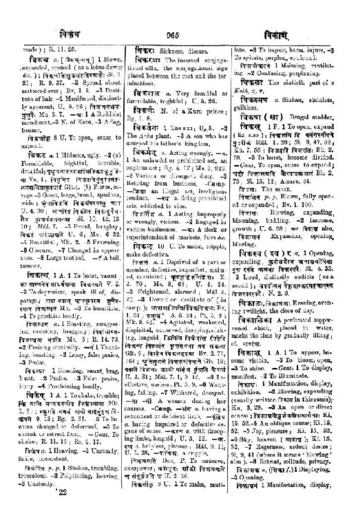
vikaraṇa ·a. & n. changing, modifying; m. the inserted conjugational suffix (g.).
Monier-Williams 1872 Substantiv Maskulin
Originaltext · Englisch · Substantiv Maskulin
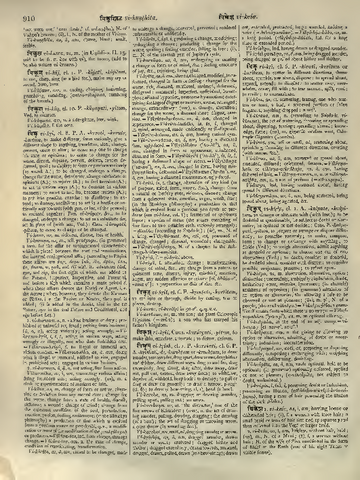
Vi-karaṇa, as, m., scil. pratyaya, (in grammar) a term for the affix or conjugational characteristic which is placed between the root and terminations, the inserted conjugational affix; (according to Pāṇini these affixes are śap, śapo luk, ślu, śyan, śnu, śa, śnam, u, yak, and cli with its substitutes tāsi, sya, and sip, the first eight of which are added in the Present, Imperfect, Imperative, and Potential, and before a Kṛt which contains a mute palatal ś, when these affixes denote the Kartṛ or Agent, i. e. the Active; when, however, they denote the Karman or Bhāva, i. e. the Passive or Neuter, then yak is added; cli is added in the Aorist, tāsi in the Ist Future, sya in the 2nd Future and Conditional, and sip before Leṭ.)
Petersburger 1855 Substantiv Neutrum
Originaltext · Deutsch · Substantiv Neutrum
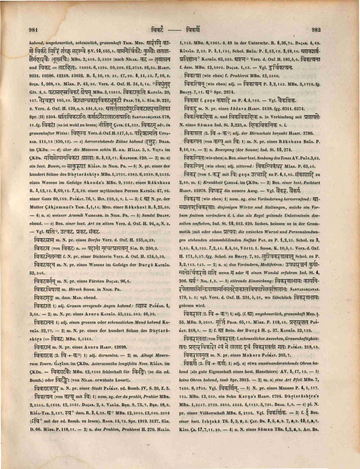
vikaraṇa (wie eben) 1〉 nom. ag. eine Veränderung hervorrufend: ākhyātapadavikaraṇāḥ diejenigen Wörter und Stellungen, welche ein Verbum finitum verändern d. i. das als Regel geltende Unbetontsein desselben aufheben, Ind. St. 10,412. Ind. St. 10,420. Insbes. heissen so in der Grammatik (mit oder ohne pratyaya) die zwischen Wurzel und Personalendungen stehenden stammbildenden Suffixe PAT._zu_P. 1,2,21. Schol. zu P. 3,1,85. 6,1,192. 7,2,44. 8,4,30, Vārtt. 1. SIDDH. K. 10,b,1. Verz. d. Oxf. H. 171,b,27. fgg. Schol. zu BHAṬṬ. 7,93. lugvikaraṇatvāt Schol. zu P. 3,2,142. P. 3,2,145. — 2〉 n. a〉 das Verändern, Modificiren: upadhārañjanaṃ kuryānmanorvikaraṇe sati wenn ma oder na einen Wandel erfahren Ind. St. 4,206. artha˚ NIR. 1,3. — b〉 störende Einwirkung: vikaraṇābhāvaḥ kāyanirapekṣāṇāmindriyāṇāmabhimatadeśakālaviṣayāpekṣavṛttilābhaḥ SARVADARŚANAS. 179,4. SARVADARŚANAS. 179,5; vgl. Verz. d. Oxf. H. 231,b,21, wo fälschlich vikaraṇabhāvaḥ gelesen wird.
Böhtlingk 1879 Adjektiv · Substantiv Neutrum
Originaltext · Deutsch · Adjektiv
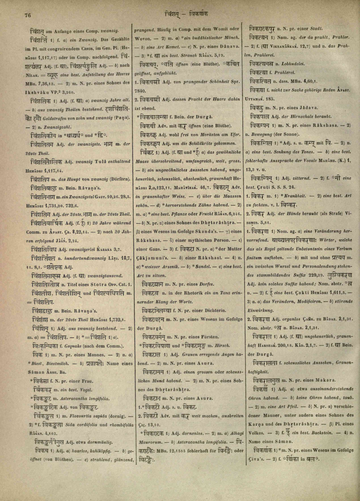
2. vikaraṇa Adj. organlos ŚAṂK. zu BĀDAR. 2,1,31. Nom. abstr. ˚tva n. BĀDAR. 2,1,31.
Originaltext · Deutsch · Substantiv Neutrum
1. vikaraṇa — 1〉 Nom. ag. — a〉 eine Veränderung hervorrufend. ākhyātapadavikaraṇāḥ Wörter, welche das als Regel geltende Unbetontsein eines Verbum finitum aufheben. — b〉 mit und ohne pratyaya m. ein zwischen Wurzel und Personalendung stehendes stammbildendes Suffix Chr. 229,29. lugvikaraṇa Adj. kein solches Suffix habend; Nom. abstr. ˚tva n. — 2〉 f. ī eine best. Śakti HEMĀDRI 1,611,5. — 3〉 n. — a〉 das Verändern, Modificiren. — b〉 störende Einwirkung.
Apte 1890 Substantiv Maskulin
Originaltext · Englisch · Substantiv Maskulin
vikaraṇaḥ The inserted conjugational affix, the conjugational sign placed between the root and the terminations.
Cappeller 1887 Worttyp nicht bestimmt
Originaltext · Deutsch · Worttyp nicht bestimmt
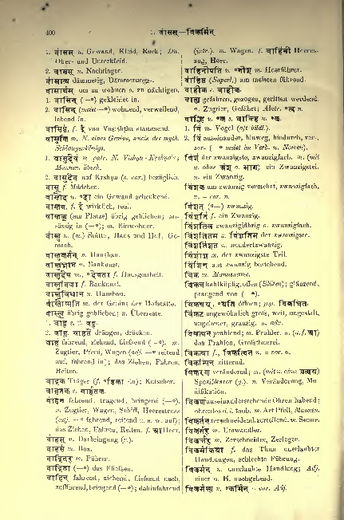
vikaraṇa verädernd; m. (mitu. ohne pratyaya) Spezifikator (g.). n. Veränderung, Modifikation.
Quelltextfundstellen (1)
PYS 1 Fundstelle
Mit AYI Free weitermachen
Bildquelle: AYI Archiv.