

bṛhat बृहत् – mighty; exalted; great
adjective · substantive masculine · substantive neuter · Word type unspecified
Dictionary sources
AYI dictionary adjective
mighty; exalted; great
Monier-Williams 1872 Word type unspecified
Original text · English · Word type unspecified
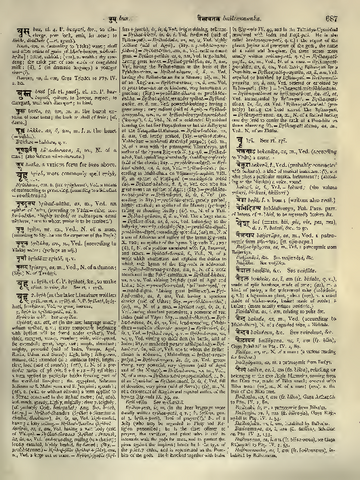
Bṛhat, an, atī, at (in the later language usually written vṛhat, q. v.; many compounds beginning with bṛhat will be found under vṛhat), Ved. thick, compact, massy, massive; wide, wide-spread, far extended; great, large, vast; ample, abundant; mighty, powerful (said of Indra, Varuṇa, Agni, Rudra, Uṣas, and Soma); high, lofty; full-grown, mature, old; extended (as a luminous body), bright; clear, loud (said of sounds); (atī), f., N. of a par- ticular metre of 36 (viz. 8 + 8 + 12 + 8) syllables; a term applied to particular bricks forming part of the sacrificial fire-place; the egg-plant, Solanum Indicum or S. Melongena and S. Jacquini; speech?; (at), n. (with or without sāman) a term applied to a Sāman composed in the Bṛhatī metre; (at, atā), ind. much, greatly, highly, mightily; clearly, brightly; [cf. probably Goth. bairgahei; Angl. Sax. beorh, beorg.]
Apte 1890 adjective · substantive masculine · substantive neuter
Original text · English · adjective · substantive masculine · substantive neuter
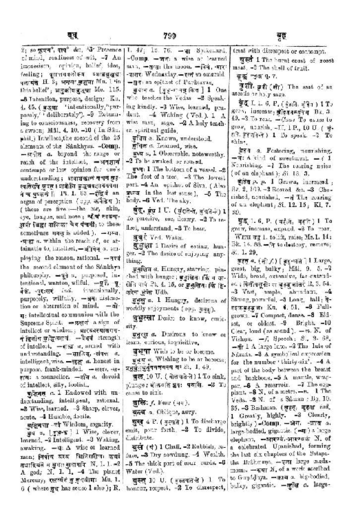
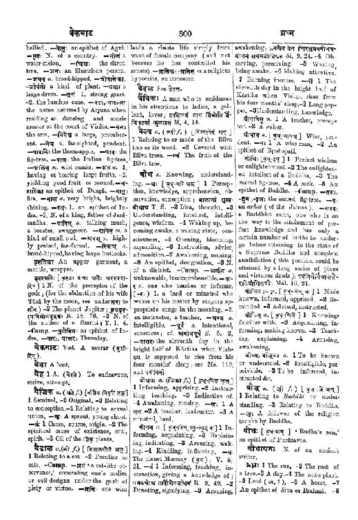
bṛhat a. (tī f.) [bṛh-ati] 1 Large, great, big, bulky; Māl. 9. 5. 2 Wide, broad, extensive, far-extended; dilīpasūnoḥ sa bṛhadbhujāṃtaraṃ R. 3. 54. 3 Vast, ample, abundant. 4 Strong, powerful. 5 Long, tall; devadārubṛhadbhujaḥ Ku. 6. 51. 6 Fullgrown. 7 Compact, dense. 8 Eldest, or oldest. 9 Bright. 10 Clear, loud (as sound). — m. N. of Viṣṇu. — f. Speech; Śi. 2. 68. — tī 1 A large lute. 2 The lute of Nārada. 3 A symbolical expression for the number ‘thirty-six’. 4 A part of the body between the breast and backbone. 5 A mantle, wrapper. 6 A reservoir. 7 The eggplant. 8 N. of a metre. — n. 1 The Veda. 2 N. of a Sāman; Bg. 10. 35. 3 Brahman. (bṛhat, bṛhatā ind. 1 Greatly, highly. 2 Clearly, brightly) Comp. — aṃga, -kāya a. large-bodied, gigantic. — (gaḥ) a large elephant. — āraṇyaṃ, -āraṇyakaṃ N. of a celebrated Upaniṣad, forming the last six chapters of the Satapatha Brāhmaṇa. — elā large cardamoms. — kathā N. of a work ascribed to Guṇāḍhya. — kāya a. big-bodied, bulky, gigantic. — kukṣi a. ([Page 0800-a]) largebellied. — ketuḥ an epithet of Agni. — gṛhaḥ N. of a country. — golaṃ a water-melon. — cittaḥ the citron tree. — janaḥ an illustrious person. — jaghana a. broad-hipped. — jīvaṃtikā, — jīvaṃtī a kind of plant. — ḍhakkā a large drum. — tṛṇaṃ 1 strong grass. 2 the bamboo cane. — naṭaḥ, -nalaḥ-lā the name assumed by Arjuna when residing as dancing and music master at the court of Virāṭa. — nalaḥ the arm. — niveśa a. large, protuberant. — netra a. far-sighted, prudent. — pāṭaliḥ the thorn-apple. — pādaḥ the fig-tree. — pālaḥ the Indian fig-tree. — pālin m. wild cumin. — phala a. 1 having or bearing large fruits. 2 yielding good fruit or reward. — bhaṭṭārikā an epithet of Durgā. — bhānuḥ fire. — bhāsa a. very bright, brightly shining. — rathaḥ 1 an epithet of Indra. 2 N. of a king, father of Jarāsandha. — vādin a. talking much, a boaster, swaggerer. — rāvin m. a kind of small owl. — śravas a. highly praised, far-famed. — sphic a. broad-hipped, having large buttocks.
Burnouf 1866 adjective
Original text · French · adjective
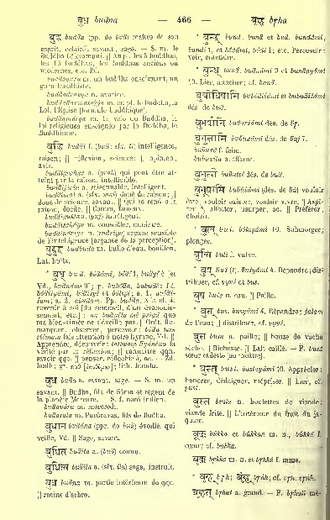
bṛhat bṛhat a. grand. — F. bṛhatī mètre [Page467-1] védique, cf. vṛhati. Zd. berezat; gr. Βερέϰιντος.
Occurrences in source texts (4)
SVU 4 occurrences
Continue with AYI Free
Image source: AYI archive.