

cana चन – at all; any
particle · suffix · Word type unspecified
Dictionary sources
AYI dictionary particle · suffix
Cappeller 1891 Word type unspecified
Original text · English · Word type unspecified
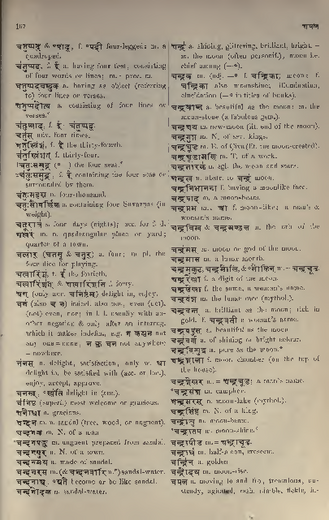
caná ·(also ca ná) indecl. also not, even (not), (not) even, nor; in l. l. usually with another negation & only after an interrog. which it makes indefin., e.g. na kaścana not any one = none, na kva cana not anywhere = nowhere.
Monier-Williams 1872 Word type unspecified
Original text · English · Word type unspecified
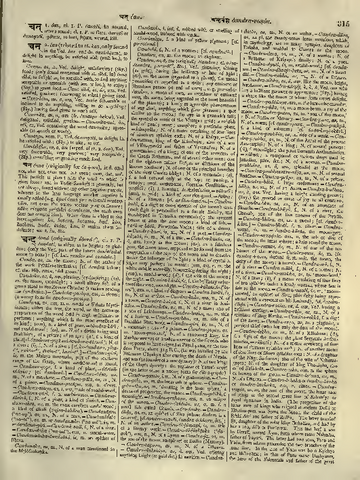
cana cana (originally for ca+na), ind. and not, also not, even not, not even; even, also, and. This particle is placed after the word to which it gives force; and in Vedic Sanskrit is generally, but not always, found without any other negative particle, whereas in the later language another negative is usually added (e. g. āpaś cana pra minanti vrataṃ vām, not even the waters violate your ordinance; nāha vivyāca pṛthivī canainam, the earth even does not contain him). When cana is added to the interrogatives ka, katara, katama, kad, kim, katham, kadā, kutas, kva, it makes them in- definite; see 2. ka, &c.
Petersburger 1855 Word type unspecified
Original text · German · Word type unspecified
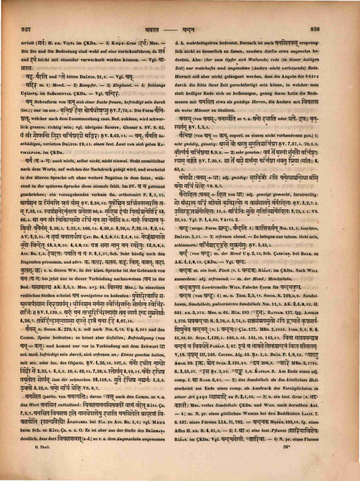
caná (ca + na) auch nicht, selbst nicht, nicht einmal. Steht unmittelbar nach dem Worte, auf welches der Nachdruck gelegt wird, und erscheint in der älteren Sprache oft ohne weitere Negation in dem Satze, während in der späteren Sprache diese niemals fehlt. Im SV. ca na getrennt geschrieben; ein vorangehendes verbum fin. orthotonirt P. 8,1,57. āpàśca̱na pra mìnanti vra̱taṃ vā̀m ṚV. 2,24,12. pū̱rvīśca̱na prasìtayastaranti̱ tam ṚV. 7,32,13. svapnàśca̱nedanṛ̀tasya prayo̱tā ṚV. 7,86,6. ma̱hi̱mna èṣāṃ pi̱taràśca̱neśìre ṚV. 10,56,4. ā ca̱na tvā̀ cikitsā̱mo 'dhì ca̱na tvā̱ nemàsi ṚV. 10,8,3. nāhà vivyāca pṛthi̱vī ca̱nainàm ṚV. 3,36,4. ṚV. 1,55,5. ṚV. 1,166,12. ṚV. 4,30,3. ṚV. 6,59,4. ṚV. 7,32,19. ṚV. 8,2,14. AV. 9,2,24. na tṛṇaṃ canāntardhāya ŚAT. BR. 4,2,4,13. ŚAT. BR. 2,1,1,14. necchaṃścanāto bhūyo vindet ŚAT. BR. 14,4,2,30. ŚAT. BR. 4,4,2,13. yatra samā nānu cana smareyuḥ ŚAT. BR. 13,8,1,2. AIT. BR. 1,6. devadattaḥ pacati ca na P. 8,1,57, Sch. Sehr häufig nach den fragenden pronomm. und advv. ka, katara, katama, kad, kim, katham, kadā, kutas, kva; s. u. diesen Ww. In der klass. Sprache ist der Gebrauch von cana (ca na) bis jetzt nur in dieser Verbindung nachzuweisen (cana in der Bed. asākalya AK. 3,5,3. MED. avy. 44. vismaya MED.). In einzelnen vedischen Stellen scheint cana wenigstens zu bedeuten: yu̱vori̱tthādhi̱ sadma̱svapàśyāma hira̱ṇyayàm . dhī̱bhiśca̱na manàsā̱ svebhìra̱kṣabhi̱ḥ somàsya̱ svebhìra̱kṣabhiḥ .. ṚV. 1,139,2. a̱haṃ ca̱na tatsū̱ribhìrānaśyā̱ṃ tava̱ jyāyà indra su̱mnamojàḥ ṚV. 6,26,7. tavedìndrā̱hamā̱śasā̱ haste̱ dātràṃ ca̱nā dàde ṚV. 8,67,10.
Böhtlingk 1879 particle
Original text · German · particle
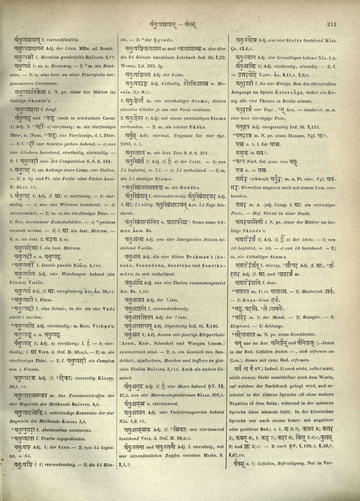
caná (ca ná SV.) indecl. — 1〉 auch nicht, selbst nicht, nicht einmal. Steht unmittelbar nach dem Worte, auf welches der Nachdruck gelegt wird, und erscheint in der älteren Sprache oft ohne weitere Negation in dem Satze, während in der späteren Sprache diese niemals fehlt. In der klassischen Sprache nur nach einem Interr. mit negativer oder positiver Bed.; s. 1. ka 2〉b〉, katama, katara 3〉, katham 8〉, 1. kad 7〉, kadā 6〉, kim 2〉d〉ι〉, kutas 9〉 und kva 5〉c〉. — 2〉 auch ṚV. 1,139,2. 6,26,7. 8,67,10.
Original text · German · particle
caná (ca ná SV.) indecl. — 1〉 auch nicht, selbst nicht, nicht einmal. Steht unmittelbar nach dem Worte, auf welches der Nachdruck gelegt wird, und erscheint in der älteren Sprache oft ohne weitere Negation in dem Satze, während in der späteren Sprache diese niemals fehlt. In der klassischen Sprache nur nach einem Interr. mit negativer oder positiver Bed.; s. 1. ka 2〉b〉, katama, katara 3〉, katham 8〉, 1. kad 7〉, kadā 6〉, kim 2〉d〉ι〉, kutas 9〉 und kva 5〉c〉. — 2〉 auch ṚV. 1,139,2. 6,26,7. 8,67,10.
Apte 1890 particle
Original text · English · particle
cana ind. Not, not also, even not (not used by itself, but found used in combination with the pronoun kim or its derivatives, such as kad, kathaṃ, kva, kadā, kutaḥ to which it imparts an indefinite sense; see ([Page 0484-b]) under kim). Note. Some regard cana to be not a separate word, but a combination of ca and na.
Cappeller 1887 Word type unspecified
Original text · German · Word type unspecified
caná (auch ca ná) und nicht, auch nicht, nicht einmal; sp. nur zur Verallgemeinerung eines (meist mit einer Negation stehenden) Interrogativs = irgend.
Burnouf 1866 Word type unspecified
Original text · French · Word type unspecified
cana cana partic. indéc. qui se trouve à la fin de plusieurs adjectifs interrogatifs ou pronominaux, M§ 113.
Occurrences in source texts (6)
MandUp 2 occurrences
SiSa 3 occurrences
SVU 1 occurrence
Continue with AYI Free
Image source: AYI archive.