
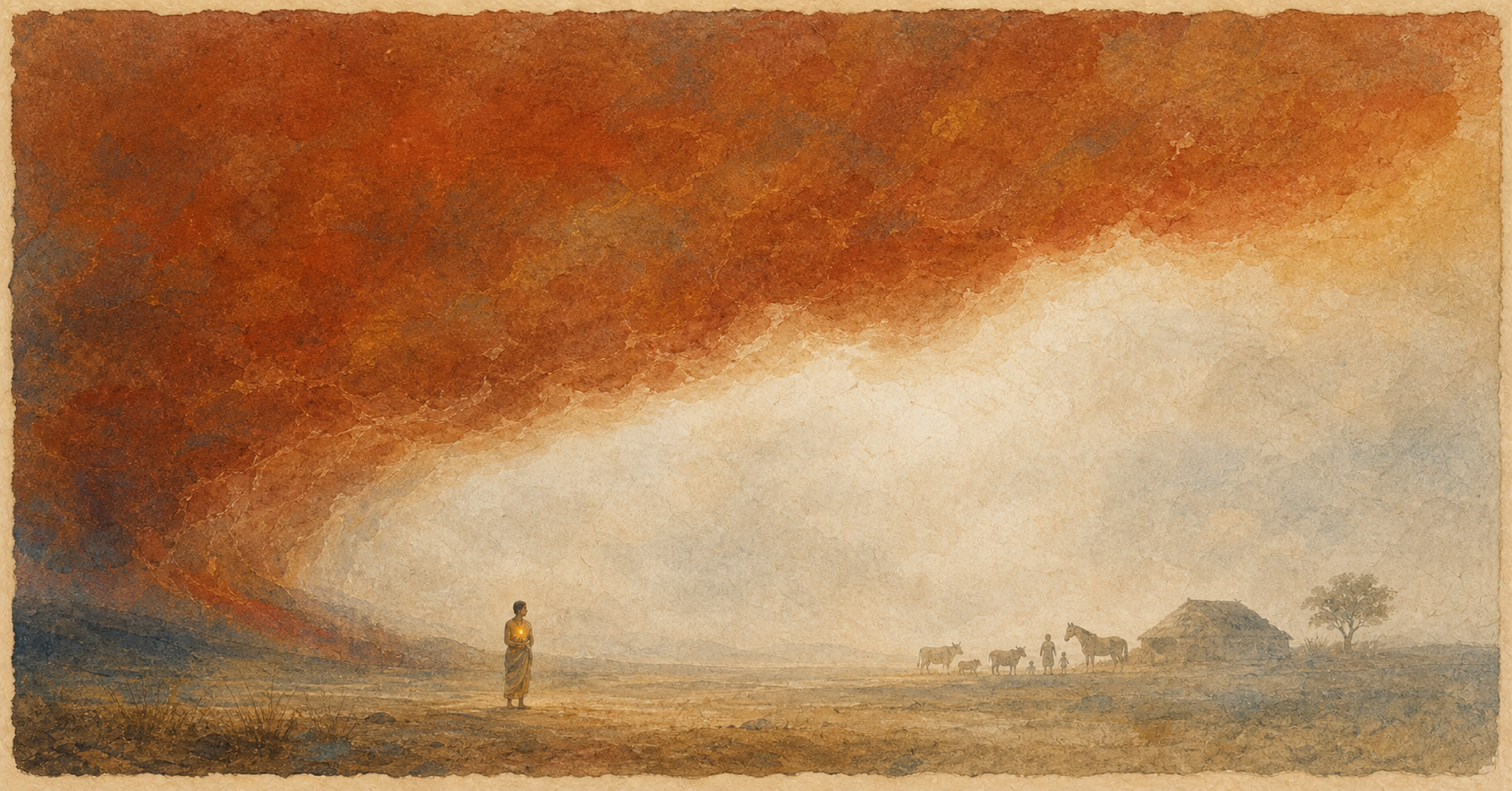
SVU 4.17-4.22: Knowledge and Protection

SVU 4.17-4.22: Transcendent Rudra and the Closing Prayers

Rudra, known in the heart, stands beyond sensory images and all opposites; the closing prayers ask him for knowledge and protection.

Śvetāśvatara Upaniṣad 4.17
एष देवो विश्वकर्मा महात्मा सदा जनानां हृदये संनिविष्टः |
eṣa devo, viśva-karmā mahātmā; sadā janānāṃ, hṛdaye saṃniviṣṭaḥ | Analysis ▾ Analysis ▴
eṣaḥ
nominative singular masculine
pronoun dem
this
devaḥ
nominative singular
substantive masculine
God
viśva
upapada-compound
pronoun quant
all, the whole
karmā
nominative singular masculine upapada-compound
verbal root
suffix
maker
mahā
karmadhāraya-compound
adjective
great
ātmā
nominative singular
substantive masculine
Self
sadā
adverb
always
janānām
genitive plural
substantive masculine
of human beings
hṛdaye
lokative singular
substantive neuter
in the heart
saṃniviṣṭaḥ
nominative singular masculine past participle passive
previx
previx
verbal root
firmly seated
हृदा मनीषा मनसाभिकॢप्तो य एतद्विदुरमृतास्ते भवन्ति ||17||
hṛdā manīṣā, manasābhikḷpto; ya etad vidur, amṛtās te bhavanti ||17|| Analysis ▾ Analysis ▴
hṛdā
instrumental case singular
substantive neuter
through the heart
manīṣā
instrumental case singular
substantive feminine
through insight
manasā
instrumental case singular
substantive neuter
through the mind
abhikḷptaḥ
nominative singular masculine past participle passive
previx
verbal root
apprehended
ye
nominative plural masculine
pronoun rel
those who
etat
accusative singular neuter
pronoun dem
this, him
viduḥ
3rd person plural aktive perfekte
verbal root
they know
amṛtāḥ
nominative plural masculine
adjective
immortal
te
nominative plural masculine
pronoun dem
they
bhavanti
3rd person plural aktive present
verbal root
they become
Metre: Pāda 1: Triṣṭubh with Śālinī ending; Pāda 2: Triṣṭubh with Śālinī ending — 12 syllables; Pāda 3: Triṣṭubh with Vajrā ending; Pāda 4: Triṣṭubh with Śālinī ending — 12 syllables
This (eṣaḥ | nom sg m) God (devaḥ | nom sg), the maker of all (viśva-karmā | nom sg m up), the great Self (mahātmā | nom sg), is always (sadā) firmly seated (saṃniviṣṭaḥ | nom sg m ppp) in the hearts (hṛdaye | loc sg) of human beings (janānām | gen pl). Through the heart (hṛdā | ins sg), through insight (manīṣā | ins sg), through the mind (manasā | ins sg), he is apprehended (abhikḷptaḥ | nom sg m ppp). Those who (ye | nom pl m) know (viduḥ | 3p pl act perf) this (etat | acc sg n) [are] immortal (amṛtāḥ | nom pl m)—they (te | nom pl m) become [so] (bhavanti | 3p pl act pres).
Dr. Ronald Steiner - 2026 - historically literal
This God is the creator of the whole and the great Self; he always dwells in the human heart. Through the heart, insight and mind, he is known. Whoever knows him becomes immortal.
Dr. Ronald Steiner - 2026 - modern transfer

The Bhāṣya attributed to Śaṅkara finds the maker of all in the heart like an image of the sun in water. Through negative instruction, discriminating Buddhi and the resulting knowledge of unity, the ever-present Self becomes manifest; prepared renunciants thereby pass beyond renewed birth.

Śaṅkara's Bhāṣya on the Śvetāśvatara Upaniṣad

Śaṅkarānanda rejects the notion that Śiva must first come into the heart from an external Kailāsa. The great maker of all already dwells within; heart, discriminating insight and mind disclose him, and those who know him become immortal.

Śaṅkarānanda's Śvetāśvataropaniṣaddīpikā

Nārāyaṇa understands the heart as the heart-lotus and inner dwelling-place. Manīṣā is a Buddhi free from wavering resolutions, and the mind appears in its own form; through these inner means the hidden Lord is known.

Nārāyaṇa's Śvetāśvataropaniṣaddīpikā

Vijñānabhagavat interprets the dwelling in the heart as witnessing in the inner organ. “Not this, not this”, discriminating examination and the knowledge “I am Brahman” arising from it reveal the Lord as one's own Self. The knowers do not first become something new but are the ever-existent immortal Īśvara.

Vijñānabhagavat's Śvetāśvataropaniṣadvivaraṇa
Ja, dieser Gott, allschaffend, hohen Sinnes, Ist stets zu finden in der Geschöpfe Herzen; Nur wer an Herz und Sinn und Geist bereitet,—Unsterblich werden, die ihn also kennen.<1>
<1: Bis auf die erste Zeile = Śvet. 3,13, wo man sehe.>
Paul Deussen - 1921
That God, the All-worker, the Great Soul (mahātman), Ever seated in the heart of creatures, Is framed by the heart, by the thought, by the mind—They who know That, become immortal.<1>
<1: Lines b, c, d = 3. 13 b, c, d. Lines c and d also = Kaṭha 6. 9 c, d.>
Robert Hume - 1921
This Luminous Being, whose work is the universe, is the Supreme Soul, and always thoroughly enters the heart of human beings. He is known through (reason), the ruler of the mind, and situated in the heart, and through meditation. Those who know Him become immortal.
Siddhesvar Varma Shastri - 1916
Ja, dieser Gott, allschaffend, hohen Sinnes, Ist stets zu finden in der Geschöpfe Herzen; Nur wer an Herz und Sinn und Geist bereitet,—Unsterblich werden, die ihn also kennen.<1>
<1: Bis auf die erste Zeile = Śvet. 3,13, wo man sehe.>
Paul Deussen - 1897
That god, the maker of all things, the great Self<1>, always dwelling in the heart of man, is perceived by the heart, the soul, the mind<2>;—they who know it become immortal.
<1: Or the high-minded.>
<2: See III, 13.>
F. Max Müller - 1884
That God, whose work is the universe, that supreme soul, who is always dwelling in the hearts of (all) beings, is revealed by the heart, discrimination (manishā), and meditation (manasā). Those who know him, become immortal.<1>
<1: The latter half of this verse is taken from Kāth. 6, 9.>
Edward Röer - 1853
Śvetāśvatara Upaniṣad 4.18
यदातमस्तन्न दिवा न रात्रिर्न सन्न चासच्छिव एव केवलः |
yadātamas, tan na divā na rātrir; na san na cāsac, chiva eva kevalaḥ | Analysis ▾ Analysis ▴
yadā
adverb
when
atamas
nominative singular
previx
substantive neuter
no darkness
tat
nominative singular neuter
pronoun dem
then
na
particle
not
divā
adverb
day
na
particle
not
rātriḥ
nominative singular
substantive feminine
night
na
particle
not
sat
nominative singular neuter present participle active
verbal root
the existent
na
particle
not
ca
particle
and
asat
nominative singular neuter present participle active
previx
verbal root
the non-existent
śivaḥ
nominative singular masculine
adjective
the Auspicious One
eva
particle
alone
kevalaḥ
nominative singular masculine
adjective
sole
तदक्षरं तत्सवितुर्वरेण्यं प्रज्ञा च तस्मात्प्रसृता पुराणी ||18||
tad akṣaraṃ, tat savitur vareṇyaṃ; prajñā ca tasmāt, prasṛtā purāṇī ||18|| Analysis ▾ Analysis ▴
tat
nominative singular neuter
pronoun dem
that
akṣaram
nominative singular
substantive neuter
the Imperishable
tat
nominative singular neuter
pronoun dem
that
savituḥ
genitive singular
substantive masculine
of Savitṛ
vareṇyam
nominative singular neuter future participle passive
verbal root
adorable
prajñā
nominative singular
substantive feminine
insight, wisdom
ca
particle
and
tasmāt
ablative singular neuter
pronoun dem
from it
prasṛtā
nominative singular feminine past participle passive
previx
verbal root
issued
purāṇī
nominative singular feminine
adjective
ancient
Metre: Pāda 1: Triṣṭubh with Vajrā ending; Pāda 2: Jagatī with Vaṃśa ending; Pāda 3: Triṣṭubh with Vajrā ending; Pāda 4: Triṣṭubh with Vajrā ending
When (yadā) there is no darkness (atamas | nom sg), then (tat | nom sg n) [there is] no (na) day (divā), no (na) night (rātriḥ | nom sg), neither (na) the existent (sat | nom sg n pca) nor (na), indeed (ca), the non-existent (asat | nom sg n pca); the Auspicious One (śivaḥ | nom sg m) alone (eva), the sole one (kevalaḥ | nom sg m), [remains]. That (tat | nom sg n) [is] the Imperishable (akṣaram | nom sg); that (tat | nom sg n) [is] the adorable [light] (vareṇyam | nom sg n pfp) of Savitṛ (savituḥ | gen sg). And (ca) from it (tasmāt | abl sg n) has issued (prasṛtā | nom sg f ppp) insight (prajñā | nom sg), the ancient one (purāṇī | nom sg f).
Dr. Ronald Steiner - 2026 - historically literal
Where there is no more darkness, there is neither day nor night, neither being nor non-being; there the Auspicious One alone remains. He is the Imperishable, the adorable light of Savitṛ. From him the ancient wisdom flows.
Dr. Ronald Steiner - 2026 - modern transfer

The Bhāṣya attributed to Śaṅkara relates the verse to dualism cancelled by knowledge. Where Avidyā and its effects have been burnt, neither day and night nor being and non-being remain as opposites; what remains is not emptiness but Śiva as pure, undifferentiated reality.

Śaṅkara's Bhāṣya on the Śvetāśvatara Upaniṣad

Śaṅkarānanda explains darkness as Avidyā with concealing and projecting power. After it is removed, the self-luminous Self of joy remains without a division between knower and known. Alternatively, the verse describes a realm beyond day, night, cause and effect; ancient knowledge proceeds from this Śiva.

Śaṅkarānanda's Śvetāśvataropaniṣaddīpikā

Nārāyaṇa reads the removal of darkness as the cancellation of all pairs of opposites: day and night, cause and effect, being and non-being. Only immutable Śiva remains; even the ancient knowledge originating in scripture proceeds from him.

Nārāyaṇa's Śvetāśvataropaniṣaddīpikā

Vijñānabhagavat offers both an epistemological and a cosmological reading. In knowledge, the opposites sustained by Avidyā disappear; in dissolution, the world exists only as undifferentiated Prakṛti. In both cases Śiva remains non-dual, and the ancient transmission of knowledge or the Veda comes from him.

Vijñānabhagavat's Śvetāśvataropaniṣadvivaraṇa
yadātamas LV1958, ASS1927 ] yad ā tamaḥ Böhtlingk apud LV1958-app
Critical Apparatus
Das Dunkel weicht; nun ist nicht Tag noch Nacht mehr,<1> Nicht seiend noch nichtseiend, selig (śiva) nur ist er; Er ist der Om-Laut, „Savitar’s liebwertes Licht“ (Ṛgv. 3,62,10), Aus ihm erfloß das Wissen uranfänglich.<2>
<1: Vgl. Chānd. 3,11,3. 8,4,1–2 (oben S. 105. 192).>
<2: Vgl. Bṛh. 2,4,10 und Śvet. 6,18.>
Paul Deussen - 1921
When there is no darkness,<1> then there is no day or night, Nor being, nor non-being, only the Kindly One (śiva) alone. That is the Imperishable. “That [is the] desirable [splendor] of Savitri (the Sun).”<2> And from that was primeval Intelligence (prajñā) created.
<1: tamas, perhaps metaphorically as well as literally. That is: when the darkness of ignorance and illusion has been removed, then all fluctuations and distinctions are also overpassed. Undifferenced bliss only remains. Compare the similar descriptions at Chānd. 3. 11. 3 and 8. 4. 1–2.>
<2: The first phrase of the famous Gāyatrī Prayer, RV. 3. 62. 10.>
Robert Hume - 1921
(In that condition) when there is no Avidya, there is neither (the conception of) the day nor night, neither existence nor non-existence; there is only the One (without a second) untainted Being—that Eternal, that Being who has the adorable nature (or form) of a Creator. From him wisdom (handed down) from time immemorial, has proceeded.
Siddhesvar Varma Shastri - 1916
Das Dunkel weicht; nun ist nicht Tag noch Nacht mehr,<1> Nicht seiend noch nichtseiend, selig (śiva) nur ist er; Er ist der Om-Laut, „Savitar’s liebwertes Licht“ (Ṛgv. 3,62,10), Aus ihm erfloß das Wissen uranfänglich.<2>
<1: Vgl. Chānd. 3,11,3. 8,4,1–2 (oben S. 105. 192).>
<2: Vgl. Bṛh. 2,4,10 und Śvet. 6,18.>
Paul Deussen - 1897
When the light has risen<1>, there is no day, no night, neither existence nor non-existence<2>; Śiva (the blessed) alone is there. That is the eternal, the adorable light of Savitṛ<3>,—and the ancient wisdom proceeded thence.
<1: Atamas, no darkness, i. e. light of knowledge.>
<2: See on the difficulty of translating sat and asat, τὸ ὄν and τὸ μὴ ὄν, the remarks in the Preface.>
<3: Referring to the Gāyatrī, Rig-veda III, 62, 10; see also Śvet. Up. V, 4.>
F. Max Müller - 1884
When there is no darkness (when all ignorance has disappeared), then there is neither day nor night, neither existence, nor non-existence (all differences have ceased); (then there is) the all-blessed even alone. He is everlasting, he is to be adored by Savitri (the deity of the sun), from him alone has arisen the ancient knowledge (of Bramha).
Edward Röer - 1853
Śvetāśvatara Upaniṣad 4.19
नैनमूर्ध्वं न तिर्यञ्चं न मध्ये परिजग्रभत् |
nainam ūrdhvaṃ na tiryañcaṃ; na madhye parijagrabhat | Analysis ▾ Analysis ▴
na
particle
not
enam
accusative singular masculine
pronoun dem
him
ūrdhvam
accusative singular masculine
adjective
above
na
particle
not
tiryañcam
accusative singular masculine
adjective
across
na
particle
not
madhye
lokative singular
substantive neuter
in the middle
parijagrabhat
3rd person singular aktive preterite
previx
verbal root
someone encompassed
न तस्य प्रतिमा अस्ति यस्य नाम महद्यशः ||19||
na tasya pratimā asti; yasya nāma mahad yaśaḥ ||19|| Analysis ▾ Analysis ▴
na
particle
not
tasya
genitive singular masculine
pronoun dem
of him
pratimā
nominative singular
substantive feminine
likeness
asti
3rd person singular aktive present
verbal root
exists
yasya
genitive singular masculine
pronoun rel
whose
nāma
nominative singular
substantive neuter
name
mahat
nominative singular neuter
adjective
great
yaśaḥ
nominative singular
substantive neuter
glory
Metre: Anuṣṭubh
No one (na) has encompassed (parijagrabhat | 3p sg act pret) him (enam | acc sg m) above (ūrdhvam | acc sg m), nor (na) across (tiryañcam | acc sg m), nor (na) in the middle (madhye | loc sg). No (na) likeness (pratimā | nom sg) of him (tasya | gen sg m) exists (asti | 3p sg act pres), whose (yasya | gen sg m) name (nāma | nom sg) [is] great (mahat | nom sg n) glory (yaśaḥ | nom sg).
Dr. Ronald Steiner - 2026 - historically literal
No one can grasp him above, across or in the middle. For the one whose name is “Great Glory”, there is no likeness.
Dr. Ronald Steiner - 2026 - modern transfer

The Bhāṣya attributed to Śaṅkara derives the Lord's incomprehensibility in every direction from his limitlessness and absence of parts. Because no second being possesses the same limitless joy, he has no likeness; his glory is limited by neither space nor time.

Śaṅkara's Bhāṣya on the Śvetāśvatara Upaniṣad

Śaṅkarānanda denies any spatial findability or comparability of the Self. No one grasps it above, across or in the middle; “great glory” can denote its universally known splendour or even an expression that names it.

Śaṅkarānanda's Śvetāśvataropaniṣaddīpikā

Nārāyaṇa explains that the ten directions proceed from the Lord and therefore cannot encompass him. No person has grasped him anywhere; here “Pratimā” expressly means a comparable counterpart.

Nārāyaṇa's Śvetāśvataropaniṣaddīpikā

Vijñānabhagavat grounds directionlessness in eternity, non-duality and the absence of parts. The Lord cannot be captured above, across or in a middle. Since there is no second being of equal joy, no comparison exists; his name is glory unlimited by space and time.

Vijñānabhagavat's Śvetāśvataropaniṣadvivaraṇa
„Nicht in der Höhe, noch Breite, Noch Mitte ist umspannbar er. Nicht ist ein Ebenbild dessen, Der da heißt: große Herrlichkeit.“<1>
<1: = Vāj. Saṃh. 32,2–3 (Gesch. d. Phil. I, 292).>
Paul Deussen - 1921
Not above, not across, Nor in the middle has one grasped Him. There is no likeness of Him Whose name is Great Glory (mahad yaśas).<1>
<1: This stanza = VS. 32. 2 c, d + 32. 3 a, b; TA. 10. 1. 2; Mahānār. 1. 10.>
Robert Hume - 1921
None can grasp Him above, in the intermediate directions (obliquely) or in the middle; He, whose name is “great fame,” has no comparison.
Siddhesvar Varma Shastri - 1916
„Nicht in der Höhe, noch Breite, Noch Mitte ist umspannbar er. Nicht ist ein Ebenbild dessen, Der da heißt: große Herrlichkeit.“<1>
<1: = Vāj. Saṃh. 32,2–3 (Gesch. d. Phil. I, 292).>
Paul Deussen - 1897
No one has grasped him above, or across, or in the middle<1>. There is no image of him whose name is Great Glory.
<1: See Muir, Metrical Translations, p. 198; Maitr. Up. VI, 17.>
F. Max Müller - 1884
None is able to comprehend him in the space above, in the space below, or in the space between. For him whose name is the glory of the universe (or infinite glory), there is no likeness.
Edward Röer - 1853
Śvetāśvatara Upaniṣad 4.20
न संदृशे तिष्ठति रूपमस्य न चक्षुषा पश्यति कश्चनैनम् |
na saṃdṛśe, tiṣṭhati rūpam asya; na cakṣuṣā, paśyati kaścanainam | Analysis ▾ Analysis ▴
na
particle
not
saṃdṛśe
dative singular
substantive feminine
within sight
tiṣṭhati
3rd person singular aktive present
verbal root
it lies
rūpam
nominative singular
substantive neuter
form
asya
genitive singular masculine
pronoun dem
of him
na
particle
not
cakṣuṣā
instrumental case singular
substantive neuter
with the eye
paśyati
3rd person singular aktive present
verbal root
one sees
kaścana
nominative singular masculine
pronoun inter
suffix
anyone
enam
accusative singular masculine
pronoun dem
him
हृदा हृदिस्थं मनसा य एनमेवं विदुरमृतास्ते भवन्ति ||20||
hṛdā hṛdi-sthaṃ, manasā ya enam; evaṃ vidur, amṛtās te bhavanti ||20|| Analysis ▾ Analysis ▴
hṛdā
instrumental case singular
substantive neuter
through the heart
hṛdi
upapada-compound
substantive neuter
in the heart
stham
accusative singular masculine
adjective
dwelling
manasā
instrumental case singular
substantive neuter
through the mind
ye
nominative plural masculine
pronoun rel
those who
enam
accusative singular masculine
pronoun dem
him
evam
adverb
thus
viduḥ
3rd person plural aktive perfekte
verbal root
they know
amṛtāḥ
nominative plural masculine
adjective
immortal
te
nominative plural masculine
pronoun dem
they
bhavanti
3rd person plural aktive present
verbal root
they become
Metre: Pāda 1: Triṣṭubh with Vajrā ending; Pāda 2: Triṣṭubh with Vajrā ending; Pāda 3: Triṣṭubh with Vajrā ending; Pāda 4: Triṣṭubh with Śālinī ending
The form (rūpam | nom sg) of him (asya | gen sg m) does not (na) lie (tiṣṭhati | 3p sg act pres) within the range of sight (saṃdṛśe | dat sg); no (na) one at all (kaścana | nom sg m) sees (paśyati | 3p sg act pres) him (enam | acc sg m) with the eye (cakṣuṣā | ins sg). Through the heart (hṛdā | ins sg) [one apprehends] the one dwelling in the heart (hṛdi-stham | acc sg m), through the mind (manasā | ins sg). Those who (ye | nom pl m) know (viduḥ | 3p pl act perf) him (enam | acc sg m) thus (evam) [are] immortal (amṛtāḥ | nom pl m)—they (te | nom pl m) become [so] (bhavanti | 3p pl act pres).
Dr. Ronald Steiner - 2026 - historically literal
His form lies beyond our field of vision; no one can see him with the eyes. Whoever knows him through the heart and mind as the one dwelling in the heart becomes immortal.
Dr. Ronald Steiner - 2026 - modern transfer

The Bhāṣya attributed to Śaṅkara distinguishes sensory perception from knowledge of the Self. No eye or other organ can make formless, self-luminous consciousness its object. In the heart it is directly known through purified Buddhi as one's own Brahman-Self; further embodiment thereby ends.

Śaṅkara's Bhāṣya on the Śvetāśvatara Upaniṣad

Śaṅkarānanda compares the revelation in the pure inner organ with the sun in water or space in a vessel. Although the Self shines by itself, it is known in a completely clear mental activity conformed to the Self; this is what the knowledge of the knowers of Brahman means.

Śaṅkarānanda's Śvetāśvataropaniṣaddīpikā

Vijñānabhagavat stresses the non-objectifiability of the Lord: as qualityless consciousness he is nowhere available to the senses. Negative instruction and purified Buddhi know him in the inner awareness of “I” as one's own Self; no mortal bodily bondage then returns.

Vijñānabhagavat's Śvetāśvataropaniṣadvivaraṇa
Nicht ist zu schauen die Gestalt desselben; Nicht sieht ihn irgendwer mit seinem Auge; Ihn, der im Herzen weilt, mit Herz und Sinnen,—Unsterblich werden, die ihn also kennen.<1>
<1: = Kāṭh. 6,9. Mahānār. 1,11 (verändert); vgl. oben zu 3,13.>
Paul Deussen - 1921
His form is not to be beheld. No one soever sees Him with the eye. They who thus know Him with heart and mind As abiding in the heart, become immortal.<1>
<1: This stanza = Kaṭha 6. 9 and Mahānār. 1. 11 with slight variation.>
Robert Hume - 1921
His Being does not stand in the range of vision; no one can see Him with the eye; those become immortal who know Him present in the heart, by reason and meditation, in this manner.
Siddhesvar Varma Shastri - 1916
Nicht ist zu schauen die Gestalt desselben; Nicht sieht ihn irgendwer mit seinem Auge; Ihn, der im Herzen weilt, mit Herz und Sinnen,—Unsterblich werden, die ihn also kennen.<1>
<1: = Kāṭh. 6,9. Mahānār. 1,11 (verändert); vgl. oben zu 3,13.>
Paul Deussen - 1897
His form cannot be seen, no one perceives him with the eye. Those<1> who through heart and mind know him thus abiding in the heart, become immortal.
<1: B. reads hṛdā manīṣā manasābhikḷpto, yat tad vidur; A. hṛdi hṛdistham manasāya enam evaṃ vidur.>
F. Max Müller - 1884
Not in the sight abides his form, none beholds him by the eye. Those who know him dwelling in the heart (in the ether of the heart) by the heart (pure intellect) and mind, become immortal (vide v. 17).
Edward Röer - 1853
Śvetāśvatara Upaniṣad 4.21
अजात इत्येवं कश्चिद्भीरुः प्रपद्यते |
ajāta ity evaṃ kaścid; bhīruḥ prapadyate | Analysis ▾ Analysis ▴
ajātaḥ
nominative singular masculine past participle passive
previx
verbal root
unborn
iti
particle
thus
evam
adverb
in this way
kaścit
nominative singular masculine
pronoun inter
suffix
someone
bhīruḥ
nominative singular masculine
adjective
fearful
prapadyate
3rd person singular medial present
previx
verbal root
he takes refuge
रुद्र यत्ते दक्षिणं मुखं तेन मां पाहि नित्यम् ||21||
rudra yat te dakṣiṇaṃ mukhaṃ; tena māṃ pāhi nityam ||21|| Analysis ▾ Analysis ▴
rudra
vokative singular
substantive masculine
O Rudra
yat
nominative singular neuter
pronoun rel
which
te
genitive singular
pronoun pers 2p
your
dakṣiṇam
nominative singular neuter
adjective
gracious
mukham
nominative singular
substantive neuter
face
tena
instrumental case singular neuter
pronoun dem
with that
mām
accusative singular
pronoun pers 1p
me
pāhi
2nd person singular aktive imperative
verbal root
protect
nityam
adverb
always
Metre: Pāda 1: Anuṣṭubh; Pāda 2: Anuṣṭubh — 6 rather than 8 syllables; Pāda 3: Anuṣṭubh — 9 rather than 8 syllables; Pāda 4: Anuṣṭubh — 7 rather than 8 syllables
“Unborn” (ajātaḥ | nom sg m ppp)—thus (iti), in this way (evam)—some (kaścit | nom sg m) fearful person (bhīruḥ | nom sg m) takes refuge (prapadyate | 3p sg med pres). O Rudra (rudra | voc sg), that which (yat | nom sg n) [is] your (te | gen sg) gracious (dakṣiṇam | nom sg n) face (mukham | nom sg): with that (tena | ins sg n) protect (pāhi | 2p sg act imp) me (mām | acc sg), always (nityam).
Dr. Ronald Steiner - 2026 - historically literal
With the thought “You are unborn”, a fearful person takes refuge in you. O Rudra, protect me always with your gracious face.
Dr. Ronald Steiner - 2026 - modern transfer

The Bhāṣya attributed to Śaṅkara has the seeker frightened by perishable Saṃsāra take refuge in the unborn Lord. Rudra's right or southern, encouraging and joyful form is to protect the seeker at all times; this remains the interpretation of the transmitted Bhāṣya.

Śaṅkara's Bhāṣya on the Śvetāśvatara Upaniṣad

Śaṅkarānanda connects the right face with the gateway of hearing located on the right side of the heart. It is to turn towards hearing Vedānta and protect the seeker so that the seeker is never separated from the liberating instruction.

Śaṅkarānanda's Śvetāśvataropaniṣaddīpikā

Nārāyaṇa understands the right face as Rudra's side skilled in instruction. The Jīva seized by fear of birth takes refuge in it and asks to be permanently protected and liberated through this teaching presence.

Nārāyaṇa's Śvetāśvataropaniṣaddīpikā

Vijñānabhagavat interprets Rudra's undivided face capable of liberation as the side beyond limited forms. The prepared seeker flees to it from birth, death and delusion; protection means that knowledge of unity arises, burns the root of Saṃsāra and keeps the seeker's own joy manifest.

Vijñānabhagavat's Śvetāśvataropaniṣadvivaraṇa
Er ist der Ew’ge! so denkend Mag man furchtsam ihm nahen wohl;—O Rudra! mit deinem huldreichen Antlitz, Mit dem schütz’ mich allezeit!
Paul Deussen - 1921
With the thought “He is eternal!” A certain one in fear approaches. O Rudra, that face of thine which is propitious—With that do thou protect me ever!
Robert Hume - 1921
As Thou art free from birth, etc., in this way, therefore, some one (like myself) afraid (of birth, etc.) resorts (to Thee). O Rudra! O Destroyer of pain, always protect me by that face of thine which is benevolent.
Siddhesvar Varma Shastri - 1916
Er ist der Ew’ge! so denkend Mag man furchtsam ihm nahen wohl;—O Rudra! mit deinem huldreichen Antlitz, Mit dem schütz’ mich allezeit!
Paul Deussen - 1897
‘Thou art unborn,’ with these words some one comes near to thee, trembling. O Rudra, let thy gracious<1> face protect me for ever!
<1: Dakshiṇa is explained either as invigorating, exhilarating, or turned towards the south.>
F. Max Müller - 1884
“He is unborn;” thus thinking, some one perturbed (by the misery of the world) may be found (to pray): “O Rudra, let thy auspicious (dakshina)<1> face preserve me for ever.”
<1: “Dakshina,” according to Śankara, means either “auspicious,” or “southern” (right), that is, which is turned to the south.>
Edward Röer - 1853
Śvetāśvatara Upaniṣad 4.22
मा नस्तोके तनये मा न आयुषि मा नो गोषु मा नो अश्वेषु रीरिषः |
mā nas toke, tanaye mā na āyuṣi; mā no goṣu, mā no aśveṣu rīriṣaḥ | Analysis ▾ Analysis ▴
mā
particle
do not
naḥ
accusative plural
pronoun pers 1p
us
toke
lokative singular
substantive neuter
in respect of our child
tanaye
lokative singular
substantive masculine
in respect of our descendant
mā
particle
do not
naḥ
accusative plural
pronoun pers 1p
us
āyuṣi
lokative singular
substantive neuter
in respect of life
mā
particle
do not
naḥ
accusative plural
pronoun pers 1p
us
goṣu
lokative plural
substantive feminine
in respect of cattle
mā
particle
do not
naḥ
accusative plural
pronoun pers 1p
us
aśveṣu
lokative plural
substantive masculine
in respect of horses
rīriṣaḥ
2nd person singular aktive injunktive desiderative
verbal root
do not seek to injure
वीरान्मा नो रुद्र भामितो वधीर्हविष्मन्तः सदमित्त्वा हवामहे ||22||
vīrān mā no, rudra bhāmito vadhīr; haviṣmantaḥ, sadam it tvā havāmahe ||22|| Analysis ▾ Analysis ▴
vīrān
accusative plural
substantive masculine
heroes
mā
particle
do not
naḥ
genitive plural
pronoun pers 1p
our
rudra
vokative singular
substantive masculine
O Rudra
bhāmitaḥ
nominative singular masculine
adjective
angered
vadhīḥ
2nd person singular aktive injunktive
verbal root
do not kill
haviṣmantaḥ
nominative plural masculine
adjective
bearing oblations
sadam
adverb
always
it
particle
precisely
tvā
accusative singular
pronoun pers 2p
you
havāmahe
1st person plural medial present
verbal root
we invoke
Metre: Pāda 1: Jagatī; Pāda 2: Jagatī; Pāda 3: Jagatī — 11 syllables; Pāda 4: Jagatī
Do not (mā) [harm] us (naḥ | acc pl) in respect of our child (toke | loc sg), in respect of our descendant (tanaye | loc sg); do not (mā) [harm] us (naḥ | acc pl) in respect of life (āyuṣi | loc sg); do not (mā) [harm] us (naḥ | acc pl) in respect of cattle (goṣu | loc pl); do not (mā) [harm] us (naḥ | acc pl) in respect of horses (aśveṣu | loc pl): do not seek to injure [us] (rīriṣaḥ | 2p sg act inj des). O Rudra (rudra | voc sg), when angered (bhāmitaḥ | nom sg m), do not (mā) kill (vadhīḥ | 2p sg act inj) our (naḥ | gen pl) heroes (vīrān | acc pl). Bearing oblations (haviṣmantaḥ | nom pl m), we invoke (havāmahe | 1p pl med pres) precisely (it) you (tvā | acc sg), continually (sadam).
Dr. Ronald Steiner - 2026 - historically literal
Harm neither our children and descendants nor our life, our cattle or our horses. Do not kill our heroes in your anger, O Rudra. We bring oblations and call upon you always.
Dr. Ronald Steiner - 2026 - modern transfer

The Bhāṣya attributed to Śaṅkara extends the prayer for protection to children, grandchildren, lifespan, cattle, horses, bodies and valiant relatives. Even if Rudra is angered, may he spare them; those offering sacrifice continually call upon him for protection.

Śaṅkara's Bhāṣya on the Śvetāśvatara Upaniṣad

Śaṅkarānanda calls the verse a path of grace for householders. Rudra is to preserve descendants, an unharmed long life, livestock and vigorous helpers. The sacrificers possess domestic and wild plants, milk and other gifts, and perform Homa for him.

Śaṅkarānanda's Śvetāśvataropaniṣaddīpikā

Nārāyaṇa explains the plea to spare relatives through Rudra's grace: one favoured by him need not fight destructive powers personally. The worshippers call him with oblations into the sacrificial hall so that he accepts his share and protects them.

Nārāyaṇa's Śvetāśvataropaniṣaddīpikā

Vijñānabhagavat reads preservation in two ways. Seekers of knowledge ask protection for pupils, grandchildren, vital powers, Vedas and senses until knowledge becomes possible; the worldly ask for family, life, livestock and helpers. In both cases, continuous sacrifice means calling Rudra for protection.

Vijñānabhagavat's Śvetāśvataropaniṣadvivaraṇa
sadam it tvā LV1958, ASS1927 ] sadasi tvā Hauschild apud LV1958-app
Critical Apparatus
„An Kindern und Nachkommen und am Leben auch, An Rindern und an Rossen nicht verletze uns! Erschlage nicht in deinem Grimm die Mannen uns, Mit Opfern rufen wir dich auf der Stätte an.“<1>
<1: = Ṛgv. 1,114,8. Taitt. Saṃh. 4,5,10,3. Vāj. Saṃh. 16,16 (mit Varianten).>
Paul Deussen - 1921
Injure us not in child or grandchild, nor in life! Injure us not in cattle! Injure us not in horses! Slay not our strong men in anger, O Rudra! With oblations ever we call upon thee.<1>
<1: This stanza = RV. 1. 114. 8; TS. 4. 5. 10. 3; and VS. 16. 16 with variations.>
Robert Hume - 1921
Do not bring destruction on our children, on our sons, on our life, on our cows, and on our horses. Being full of anger, O Rudra, O Destroyer of pain, do not kill our brave (servants), (as) we always invoke Thee with oblations.
Siddhesvar Varma Shastri - 1916
„An Kindern und Nachkommen und am Leben auch, An Rindern und an Rossen nicht verletze uns! Erschlage nicht in deinem Grimm die Mannen uns, Mit Opfern rufen wir dich auf der Stätte an.“<1>
<1: = Ṛgv. 1,114,8. Taitt. Saṃh. 4,5,10,3. Vāj. Saṃh. 16,16 (mit Varianten).>
Paul Deussen - 1897
O Rudra! hurt us not in our offspring and descendants, hurt us not in our own lives, nor in our cows, nor in our horses! Do not slay our men in thy wrath, for, holding oblations, we call on thee always.<1>
<1: See Colebrooke, Miscellaneous Essays, I, p. 141; Rig-veda I, 114, 8; Taitt. Saṃh. IV, 5, 10, 3; Vāg. Saṃh. XVI, 16. The various readings are curious. Āyuṣi in the Śvet. Up., instead of āyau in the Rig-veda, is supported by the Taitt. Saṃh. and the Vāg. Saṃh.; but Vijñānātman reads āyau. As to bhāmito, it seems the right reading, being supported by the Rig-veda, the Taitt. Saṃh., and the Śvet. Up., while bhāvito in Roer’s edition is a misprint. The Vāg. Saṃh. alone reads bhāmino, which Mahīdhara refers to vīrān. The last verse in the Rig-veda and Vāg. Saṃh. is haviṣmantaḥ sadam it tvā havāmahe; in the Taitt. Saṃh. haviṣmanto namasā vidhema te. In the Śvet. Up. haviṣmantaḥ sadasi tvā havāmahe, as printed by Roer, seems to rest on Śaṅkara’s authority only. The other commentators, Śaṅkarānanda and Vijñānātman, read and interpret sadam it.>
F. Max Müller - 1884
Injure not our children, nor our grandchildren, nor our lives, nor our cows, nor our horses, nor slay in anger our valiant men; for with offerings we always invoke thee.<1>
<1: This verse, according to Weber, occurs in the Vāj. Sanh. xvi, 16., in the Taitt. S. v, 10, 11, and in the Rig. V. S. i, 114–18.>
Edward Röer - 1853

Continue with AYI Free

Illustrations: AI-generated.

Messages and ratings
0 messages

Please log in to write a message. Go to login

No messages yet.