

daiva दैव – of or belonging to a deity or divinity, coming from the gods, divine, celestial
adjective · substantive masculine · substantive neuter · Word type unspecified
Dictionary sources
Cappeller 1891 Word type unspecified
Original text · English · Word type unspecified
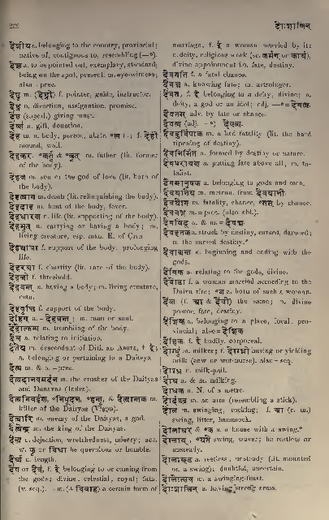
daíva ·belonging to or coming from the gods; divine, celestial, royal; fatal (v. seq.) --m. (±vivāha) a certain form of marriage, f. ī a woman married by it; n. deity, religious work (sc. karman or kārya), divine appointment i.e. fate, destiny.
Original text · English · Word type unspecified
daivá, f. ·belonging to or coming from the gods; divine, celestial, royal; fatal (v. seq.) --m. (±vivāha) a certain form of marriage, f. ī a woman married by it; n. deity, religious work (sc. karman or kārya), divine appointment i.e. fate, destiny.
Monier-Williams 1872 adjective
Original text · English · adjective
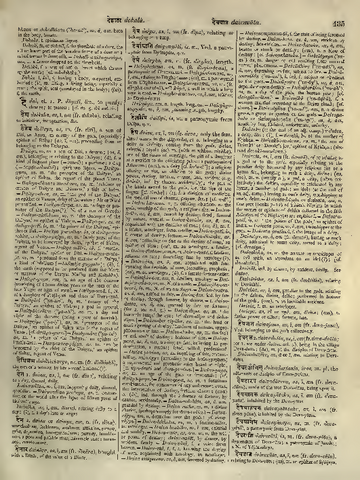
daiva daiva, as, ī, am (fr. deva; only the fem. daivī occurs in the Ṛg-veda), of or belonging to a deity or divinity, coming from the gods, divine, celestial; royal; (as), m. (with or without vivāha), one of the forms of marriage, the gift of a daughter at a sacrifice to the officiating priest; a patronymic of Atharvan; (am), n. a deity [cf. kula-d˚]; a religious offering or rite, an oblation to the gods; divine power, destiny, fortune, chance, fate, accident (e. g. daivāt, ind. by chance, accidentally); the part of the hands sacred to the gods, i. e. the tips of the fingers [cf. tīrtha]; (ī), f. a division of medicine, the medical use of charms, prayers, &c.; [cf. a-d˚.]
Petersburger 1855 adjective · substantive masculine · substantive neuter · Word type unspecified
Original text · German · adjective · substantive masculine · substantive neuter
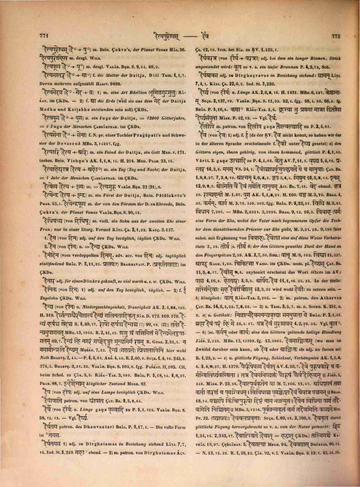
daíva (von deva) 1〉 adj. f. ī (da der ṚV. daiva nicht kennt, so haben wir das in der älteren Sprache erscheinende f. daivī unter daivya gesetzt) a〉 den Göttern eigen, ihnen gehörig, von ihnen kommend, göttlich P. 4,1,85, Vārtt. 3. gaṇa utsādi zu P. 4,1,86. ketu AV. 7,11,1. vṛṣṇya AV. 5,4,10. prastara AV. 16,2,6. manas VS. 34,1. daivāṃścādhvaryūnupahvayate ye ca mānuṣāḥ ŚAT. BR. 1,8,1,27. ŚAT. BR. 7,3,1,10. ātman ŚAT. BR. 6,6,4,5. rūpa ŚAT. BR. 6,8,1,4. mithuna ŚAT. BR. 10,5,2,11. enas ŚAT. BR. 12,9,2,3. omiti vai daivaṃ tatheti mānuṣam AIT. BR. 7,18. veda ebend. kṣatra AIT. BR. 7,20. rātryahanī M. 1,67. yuga AK. 1,1,3,21. H. 160. yajña M. 3,70. BHAG. 4,25. karman, kārya M. 3,75. M. 3,149. M. 3,203. fgg. BHĀG. P. 8,23,31. vidhi M. 5,31. vidhāna M. 7,205. — MBH. 2,2321. MBH. 5,2996. BHAG. 9,13. BHAG. 16,3. vivāha (dharma) eine Form der Ehe, wobei der Vater nach begonnenem Opfer die Tochter dem dienstthuenden Priester zur Ehe giebt, M. 3,21. M. 3,28. M. 9,196 (hier subst. mit Ergänzung von vivāha). daivoḍhā eine auf diese Weise Verheirathete M. 3,38. tīrtha (s. tīrtha 6) der den Göttern geweihte Theil der Hand an den Fingerspitzen M. 2,59. AK. 2,7,50. fem.: vāc M. 8,103. vidyā M. 11,237. āpad RAGH. 1,60. cikitsā VAIDY._im_ŚKDR. nom. pl. daivyas ŚAT. BR. 11,5,4,17. daivīs ŚAT. BR. 11,5,9,8. oxytonirt erscheint das Wort öfters im AV.: pāśa AV. 4,16,8. hotāraḥ AV. 5,3,5. ārṣeya, daiva AV. 11,1,16. AV. 11,1,23. AV. 11,1,25. In der Stelle: tasmìnde̱vāḥ sa̱ha dai̱vīrvìśantu AV. 12,3,32 wird wohl devīḥ zu setzen sein. — b〉 königlich: vāc RĀJA-TAR. 5,205. — 2〉 m. patron. des Atharvan ŚAT. BR. 14,5,5,22. ŚAT. BR. 14,7,3,28. — 3〉 n. TRIK. 3,5,7. m.n. SIDDH. K. 251,a,9. a〉 n. Gottheit: nijātmadaivamananyavṛttyā samanuvratā ye BHĀG. P. 3,1,35. brahma daivaṃ paraṃ hi me BHĀG. P. 16,4. BHĀG. P. 16,17. yatra daivaṃ surāsavam BHĀG. P. 4,2,29. BHĀG. P. 4,2,32. Vgl. kula˚. — b〉 (sc. karman oder kārya) eine den Göttern geltende heilige Handlung YĀJÑ. 2,235. MBH. 12,13399. fg. MBH. 13,5065. daivamāhnikam (wo man im Zweifel darüber sein kann, ob daiva oder āhnika als adj. zu fassen sei) R. 1,25,2. — c〉 n. göttliche Fügung, Schicksal, Verhängniss AK. 1,1,4,6. AK. 3,4,9,37. H. 1379. paurùṣeyā̱nna daivā̀t AV. 4,26,7. daive puruṣakāre ca karmasthitirvyavasthitā . tatra daivamabhivyaktaṃ pauruṣaṃ paurvadaihikam .. YĀJÑ. 1,348. MĀRK. P. 23,26. daivātpūrvakṛtena vā M. 7,166. M. 11,47. adhiṣṭhānaṃ tathā kartā karaṇaṃ ca pṛthagvidham . vividhāśca pṛthakceṣṭā daivaṃ caivātra pañcamam .. BHAG. 18,14. yaccāpi kiṃcitpuruṣo diṣṭaṃ nāma bhajatyuta . daivena vidhinā pārtha taddaivamiti niścitam .. MBH. 3,1218. pūrvajanmakṛtaṃ karma taddaivamiti kathyate HIT. Pr. 32. (vyādhayaḥ) daivabalapravṛttāḥ SUŚR. 1,89,18. SUŚR. 2,396,9. daivakṛta durch göttliche Fügung hervorgebracht so v. a. von der Natur gemacht: chidra SUŚR. 1,54,16. SUŚR. 2,343,17. daivātsthite (daivāt = haṭhāt ŚKDR.) tasminnaśve KATHĀS. 18,97. ŚṚṄGĀRAT. 5. daivagatyā MEGH. 94. daivavaśāt DHŪRTAS. 90,13. — N. 13,13. N. 13,32. R. 1,58,22. ŚĀK. 92, v. l. VARĀH. BṚH. S. 19,1. VARĀH. BṚH. S. 45,28. VARĀH. BṚH. S. 45,39. BHĀG. P. 3,23,4. apratighāta BHĀG. P. 1,12,16. anukūla KATHĀS. 18,406. pratikūla ŚĀK. 7,16. aśubha AK. 3,4,24,151. yukte ca daive yudhyeta so v. a. unter günstigen Adspecten M. 7,197. pratikūladaivatā f. nom. abstr. PAÑCAT. 192,21. Das m. CHĀND. UP. 7,1,4. CHĀND. UP. 7,1,2 erklärt ŚAṂK. durch utpātajñāna, aber das Wort ist wohl hier als adj. zu fassen. — Vgl. a˚.
Original text · German · Word type unspecified
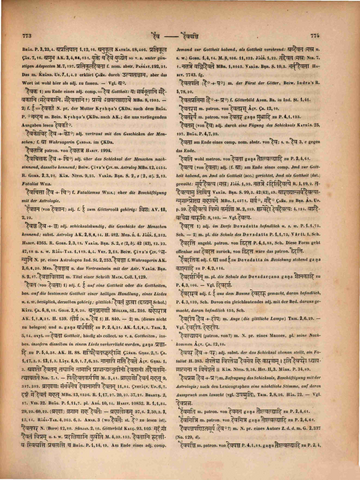
daiva 1〉a〉 vivāha ĀŚV. GṚHY. 1,6,2. mit den Göttern beschäftigt: paricarandaivaḥ sadā devalaḥ Spr. 4723. — c〉 dem Schicksal (daiva) eigen u. s. w.: daivī vicitrā gatiḥ Spr. 632. Spr. 1973. — 3〉b〉 M. 3,18. — c〉 daive samarpya cirasaṃcitaduḥkhajālam Spr. 1256. ˚vaśāt zufällig SARVADARŚANAS. 153,9. daiva so v. a. śubhadaiva in daivayuta, daivahīna, daivānvita Ind. St. 10,166 (vgl. śubhadaivayukta ebend.).
Böhtlingk 1879 adjective · substantive masculine · substantive neuter
Original text · German · adjective · substantive masculine · substantive neuter
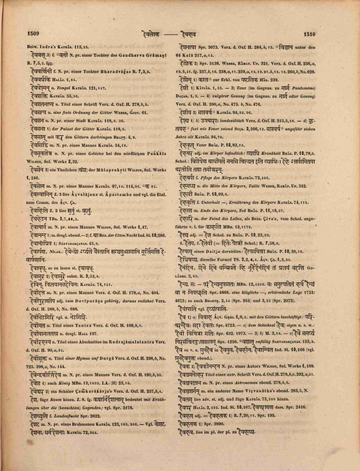
daiva — 1〉 Adj. paroxyt. und oxyt. (f. ī) — a〉 den Göttern eigen, ihnen gehörig, zu ihnen kommend, göttlich, es mit Göttern zu thun habend Spr. 4873. vivāha m. oder dharma m. = 2〉a〉. tīrtha n. der den Göttern geweihte Theil der Hand an den Fingerspitzen [Page3-122-b] VP.² 3,99. 148. daivī dik Norden RĀJAN. 11,23. — b〉 königlich. — c〉 dem Schicksal eigen, vom Schicksal verhängt u. s. w. — 2〉 m. — a〉 eine Form der Ehe, wobei der Vater nach begonnenem Opfer seine Tochter dem dienstthuenden Priester zur Ehe giebt. — b〉 nach ŚAṂK. die Kenntniss der Portenta. — c〉 Parox. Patron. des Atharvan. — d〉 Pl. das Gefolge der Götter TĀṆḌYA-BR. 17,1. 1. — 3〉 f. ī eine nach der Daiva-Weise Verheirathete VIṢṆUS. 24,30. — 4〉 n. — a〉 Gottheit (concret). — b〉 eine den Göttern geltende heilige Handlung. — c〉 göttliche Fügung, Schicksal, Verhängniss. yukte daive so v. a. unter günstigen Adspecten. daivaṃ śikṣayati das Schicksal lehrt, so v. a. Noth lehrt beten BĀLAR. 165,5. — d〉 glückliche Fügung.
Apte 1890 adjective · substantive masculine · substantive neuter
Original text · English · adjective · substantive masculine · substantive neuter
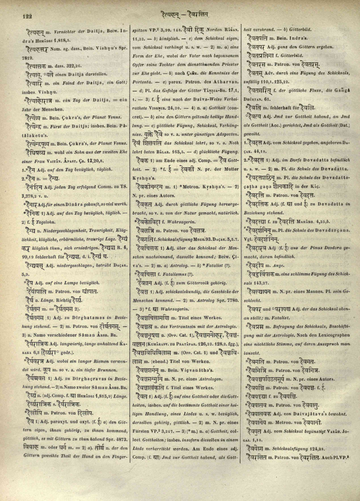
daiva a. (vī f.) [devādāgataḥ aṇ] Relating to gods, caused by or coming from gods, divine, celestial; saṃskṛtaṃ nāma daivī vāganvākhyātā maharṣibhiḥ Kāv. 1. 33; daivīnāṃ mānuṣīṇāṃ ca pratihartā tvamāpadāṃ R. 1. 60; Y. 2. 235; Bg. 4. 25, Bg. 9. 13, Bg. 16. 3; Ms. 3. 75. — vaḥ (i. e. vivāhaḥ) One of the eight forms of marriage, that in which the daughter is given away at a sacrifice to the officiating priest; yajñasya ṛtvije daivaḥ Y. 1. 59; (for the eight forms of marriage see udvāha or Ms. 3. 21). — vaṃ 1 Fate, destiny, luck, fortune; daivamavidvāṃsaḥ pramāṇayaṃti Mu. 3; vinā puruṣakāreṇa daivamatra na sidhyati ‘God helps those who help ([Page 0581-c]) themselves’; daivaṃ nihatya kuru pauruṣama tmaśaktyā Pt. 1. 361. (daivāt by chance, luckily, accidentally). 2 A god, deity. 3 A religious rite or offering, an oblation to gods. 4 A kind of Śrāddha ceremony. 5 Parts of the hands sacred to the gods, i. e. the tips of the fingers; cf. Ms. 2. 59. — vī A woman married according to the form of marriage called daiva q. v. above. Comp. — atyayaḥ evil resulting from unusual natural phenomena. — adhīna — āyatta a. dependent on fate; daivāyattaṃ kule janma madāyattaṃ tu pauruṣaṃ Ve. 3. 33. — ahorātraḥ a day of the gods. i. e. the human year. — upahata a. illfated, unfortunate; Mu. 6. 8. — karnan n. offering oblations to gods. — kṛta a. 1 fated. 2 natural. — kovid, -ciṃtakaḥ, -jñaḥ an astrologer, a fortune-teller; Y. 1. 313; Kām. 9. 25. — gatiḥ f. turn or course of fate; muktājālaṃ ciraparicitaṃ tyājito daivagatyā Me. 96; Pt. 3. 174. — taṃtra a. dependent on fate. — dīpaḥ the eye. — durvipākaḥ hardness of fortune, adverseness or unpropitiousness of fate, an evil turn of fate; U. 1. 40 — doṣaḥ badness of fate. — para a. 1 trusting to fate, a fatalist. 2 fated, predestined. — praśnaḥ 1 fortune-telling, astrology. 2 a voice from heaven. — yugaṃ ‘a Yuga of the gods’, said to consist of 12000 divine years, but see Kull. on Ms. 1. 71. — yogaḥ a lucky coincidence, fortuitous combination, fortune, chance; (daivayogena, daivayogāt fortunately, accidentally). — lekhakaḥ a fortune-teller, an astrologer. — vaśaḥ, -śaṃ the power of destiny, subjection to fate. — vāṇī 1 a voice from heaven. 2 the Sanskrit language; cf. Kāv. 1. 33 quoted above. — hīna a. ill-fated, unfortunate, unlucky.
Cappeller 1887 Word type unspecified
Original text · German · Word type unspecified
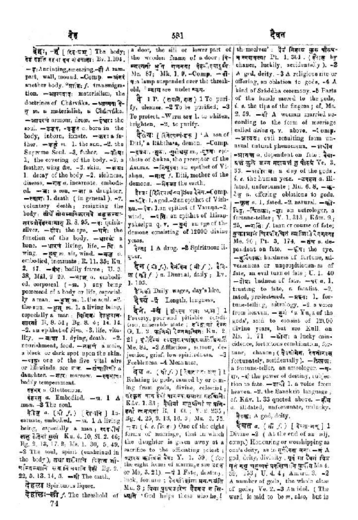
daíva u. daivá, f. ī göttlich, köttlich, Schicksals.- m. eine Form der Eheschließung (r.); f. ī eine danach Verheiratete; n. Gottheit, heilige Handlung, göttliche Fügung, Schicksal.
Burnouf 1866 adjective
Original text · French · adjective
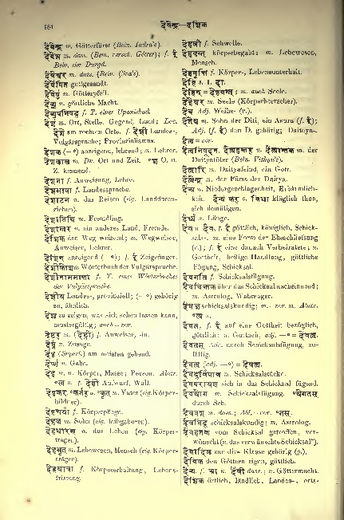
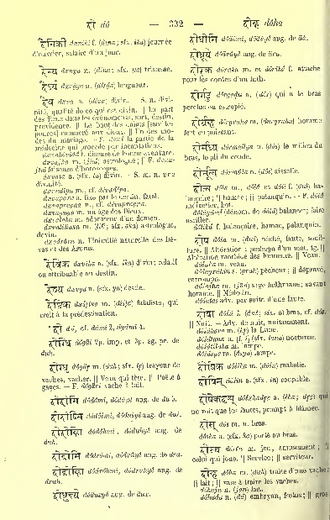
daiva daiva a. (deva) divin. — S. n. divinité, qualité de ce qui est divin. La part des dieux dans les évènements, sort, destin, providence. Le bout des doigts [sauf les pouces] consacré aux dieux. Un des modes du mariage. — F. daivī la partie de la médecine qui procède par incantations. daivakovidā f. diseuse de bonne aventure. daivajña m. (jñā) astrologue; F. daivajñā faiseuse d'horoscopes. daivata a. (sfx. ta) divin. — S. m. n. une divinité. daivadīpa m., cf. devadīpa. daivapara a. fixé par le destin, fatal. daivapraśna n., cf. devapraśna. daivayuga m. un âge des Dieux. daivalaka m. adorateur d'un démon. daivalekhaka m. (likh; sfx. aka) astrologue, devin. daivāsūra n. l'inimitié naturelle des Devas et des Asuras.
Occurrences in source texts (4)
HTK 1 occurrence
HTK 10.42–43: Meru: Three stages of breath retention 1 occurrence
Direct occurrences
-
HTK 10.42 Segment 14
SiSa 3 occurrences
Continue with AYI Free
Image source: AYI archive.