

ghana घन – dense; solid; gross
adjective · substantive masculine · substantive neuter · Word type unspecified
Dictionary sources
AYI dictionary adjective · substantive masculine
adjective
dense; solid; gross
substantive masculine
dense mass; compact fullness
Cappeller 1891 adjective
Original text · English · adjective
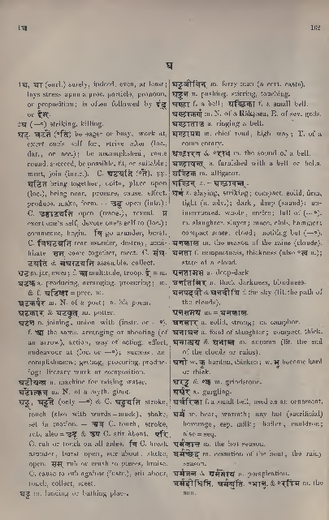
ghaná ·a. slaying, striking; compact, solid, firm, tight (n. adv.); dark, deep (sound); uninterrupted, whole, entire; full of (--°). m. slaughter, slayer; mace, club, hammer; compact mass, cloud; nothing but (--°).
Monier-Williams 1872 adjective
Original text · English · adjective
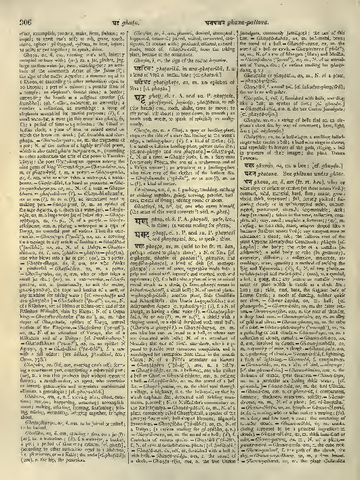
ghana ghana, as, ā, am (fr. rt. han), who or what slays or strikes or crushes (in these senses Ved.); compact, solid, material, hard, firm; coarse, gross; viscid, thick, inspissated; full, densely packed; fol- lowing closely or in uninterrupted series, uninter- rupted, permanent, eternal; impenetrable; dark; deep (as sound); taken in the mass, collective, com- plete, all; very, much; auspicious, fortunate; (as), m. slaying; an iron club, mace, weapon shaped like a hammer (in these senses Ved.); any compact mass or substance; a cloud; talc; the bulbous root of the plant Cyperus Hexastychus Communis; phlegm [cf. kapha]; the body; the cube of a number (in arithmetic), a solid body or cube (in geometry); extension, diffusion; a collection, multitude, as- semblage, mass, quantity; a method of reciting the Ṛg and Yajur-veda; (ā), f., N. of two plants, = māṣa-parṇī and rudra-jaṭā; (am), n. a cymbal, a bell, a gong, &c.; any brazen or metallic instru- ment or plate which is struck as a clock &c.; iron; tin; skin, rind, bark, the fragrant bark of Laurus Cassia; a mode of dancing, neither quick nor slow.
Petersburger 1855 adjective · substantive masculine · substantive neuter · Word type unspecified
Original text · German · adjective · substantive masculine · substantive neuter
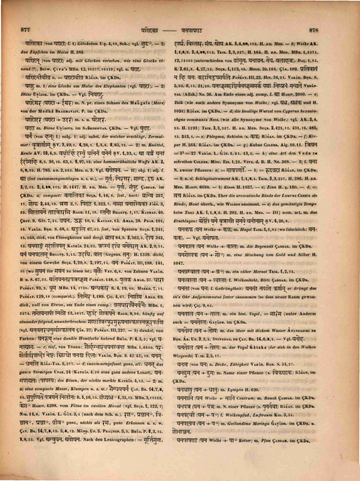
ghaná (von han) I〉 subj. 1〉 adj. subst. der welcher erschlägt, Zermalmer: vṛ̱trāṇā̀m ṚV. 3,49,1. ṚV. 4,38,1. ṚV. 1,4,8. ṚV. 8,85,12. — 2〉 m. Knüttel, Keule AV. 10,4,9. vadhī̱rhi dasyùṃ dha̱ninàṃ gha̱nenà ṚV. 1,33,4. ā vajràṃ gha̱nā dàdīmahi ṚV. 8,3. ṚV. 36,16. ṚV. 63,5. ṚV. 9,97,16. eine hammerähnliche Waffe AK. 2,8,2,59. H. 785. H. an. 2,262. MED. n. 3. Vgl. ayoghana. — II〉 obj. 1〉 adj. f. ā (fest zusammengeschlagen u. s. w.), = mūrta, nirantara, sāndra, dṛḍha AK. 3,2,15. AK. 3,4,18,113. H. 1447. H. an. MED. = pūrṇa, saṃpuṭa ŚABDAR._im_ŚKDR. a〉 compact: kavalikā SUŚR. 1,16,8. fest, hart: granthi SUŚR. 257,17. śopha SUŚR. 2,44,19. vraṇa SUŚR. 2,7. piṇḍa SUŚR. 1,322,7. nāsā ghanāsthikā YĀJÑ. 3,89. śilāghane tāḍakorasi RAGH. 11,18. stanau BHARTṚ. 1,17. CAURAP. 40. ŚRUT. 8. GĪT. 7,24. jaghana, ūru GĪT. 10,6. CAURAP. 15. AMAR. 28. PRAB. 101,16. VARĀH. BṚH. S. 68,3. aṅguli VARĀH. BṚH. S. 67,43. fest, von Speisen SUŚR. 1,241,15. zäh, dick, von Flüssigkeiten und dergl. srāva SUŚR. 84,9. SUŚR. 2,363,5. doṣa SUŚR. 345,15. ghanayāṅgaṃ mṛdālipat KATHĀS. 24,93. trapsyaṃ dadhi ghanetarat AK. 2,9,51. ghanaṃ ghanapaṭalam BHARTṚ. 1,43. udadhi, vāta (Gegens. tanu) H. 1359. dicht, von einem Gewebe SUŚR. 1,29,8. SUŚR. 2,197,14. vana PAÑCAT. III, 188. PAÑCAT. III,141,16 (wo sughana für saghana zu lesen ist). vṛkṣaiḥ VET. 6,8. von Zähnen VARĀH. BṚH. S. 67,52. atighanatarapatracchanna PAÑCAT. 148,5. pulaka AMAR. 57. dhārā PAÑCAT. 93,2. dhūma MBH. 14,1738. andhakāra R. 6,19,60. MṚCCH. 7,11. PAÑCAT. 129,18 (comparat.). timira PAÑCAT. I, 189. ŚIŚ. 4,67. niśītha AMAR. 69. dick, voll von Etwas, am Ende eines comp.: jaladhārāghainarghanaiḥ MBH. 1,5374. tamoghanāyāṃ niśi MBH. 13,4047. hṛdi śokaghane RAGH. 8,90. häufig auf einander folgend, ununterbrochen: gāṇḍīvasphuragurughanāsphālanakrūrapāṇi (vgl. anavataradhanurjyāsphālana ŚĀK. 37) PAÑCAT. III, 237. — b〉 dunkel, von Farben: ghanaruc eine dunkle Hautfarbe habend BHĀG. P. 4,5,3; vgl. ghanaśyāma. — c〉 tief, von Tönen: gaurhambhāravaghanasvanā MBH. 1,6680. paraśorjarjaraśabdo neṣṭaḥ snigdho ghanaśca hitaḥ VARĀH. BṚH. S. 42 (43), 19. ghanam — dhvananti RĀJA-TAR. 5,377. — d〉 zusammengefasst, ganz, all: dhanam das ganze Vermögen UPAK. 24 (KATHĀS. 4,26 eine ganz andere Lesart). ghanamapaśyataḥ (pāpasya) des Bösen, der nichts merkte KATHĀS. 4,53. — 2〉 m. a〉 eine compacte Masse, Klumpen u. s. w.: saindhavaghaná ŚAT. BR. 14,7,3,13. supuṣpite patraghane nilānaḥ R. 5,16,55. saṃdhyābhra˚ R. 6,35,12. MBH. 3,11555. keśa˚ HARIV. 4298. vom Fötus im zweiten Monat (vgl. SUŚR. 1,322,7) NIR. 14,6. VARĀH. L. JĀT. 3,4 (nach dem Sch. n.). rasa˚, prajñāna˚, vijñāna˚, prajñā˚, jīva˚ ganz, nichts als rasa, ganz Erkennen u. s. w. ŚAT. BR. 14,7,3,13. ŚAT. BR. 14,5,4,12. MĀṆḌ. UP. 5. PRAŚNOP. 5,5. BHĀG. P. 8,3,12. BHĀG. P. 9,8,23. Vgl. ambughana, ayoghana. Nach den Lexicographen: = mūrtiguṇa, dārḍhya, vistāra, saṃgha, ogha AK. 3,4,18,113. H. an. MED. — b〉 Wolke AK. 1,1,2,9. AK. 3,4,18,113. TRIK. 3,3,237. H. 164. H. an. MED. MBH. 1,5374. MBH. 12,12405 (unterschieden von jīmūta, ghanāghana, megha, balāhaka). DAŚ. 1,15. R. 3,61,8. R. 4,27,23. SUŚR. 1,113,19. MEGH. 20. MEGH. 104. ŚĀK. 109. prativātaṃ na hi ghanaḥ kadācidupasarpati PAÑCAT. III, 22. HIT. 34,21. VARĀH. BṚH. S. 5,93. VARĀH. BṚH. S. 6,11. VARĀH. BṚH. S. 21,20. ghanacchannadṛṣṭirghanacchannamarkaṃ yathā niṣprabhaṃ manyate VEDĀNTAS. (Allah.) No. 36. Am Ende eines adj. comp. f. ā HARIV. 2660. — c〉 Talk (wie auch andere Synonyme von Wolke; vgl. abhra, abhraka und H. 1051) RĀJAN._im_ŚKDR. — d〉 die knollige Wurzel von Cyperus hexastachyus communis Nees. (wie alle Synonyme von Wolke; vgl. AK. 2,4,25. H. 1193) TRIK. 3,3,237. H. an. MED. SUŚR. 2,421,11. SUŚR. 2,431,16. SUŚR. 2,485,13. SUŚR. 2,515,1. — e〉 Phlegma, Schleim (s. kapha) RĀJAN._im_ŚKDR. — f〉 Körper H. 564. RĀJAN._im_ŚKDR. — g〉 Kubus COLEBR. Alg. 10. COLEBR. Alg. 11. trighana = 3×3×3 = 27 VARĀH. L. JĀT. 1,21. VARĀH. L. JĀT. 13,2. — h〉 eine Art den Veda zu schreiben COLEBR. Misc. Ess. I, 21. Verz. d. B. H. No. 368. — 3〉 f. ghanā N. zweier Pflanzen: a〉 = māṣaparṇī. — b〉 = rudrajaṭā RĀJAN._im_ŚKDR. — 4〉 n. a〉 Schlaginstrument AK. 1,1,7,4. TRIK. 3,3,237. H. 286. H. an. MED. HARIV. 8688. — b〉 Eisen H. 1037. — c〉 Zinn H. ś. 160. — d〉 = tvaca RĀJAN._im_ŚKDR. Eher die aromatische Rinde der Laurus Cassia als Rinde, Haut überh., wie WILSON annimmt. — e〉 das gemässigte Tempo beim Tanz AK. 1,1,7,9. H. 292. H. an. MED. — III〉 nom. act. m. das Erschlagen: śreṣṭhò gha̱ne vṛ̱trāṇā̀ṃ sa̱naye̱ dhanā̀nām ṚV. 6,26,8.
Original text · German · Word type unspecified
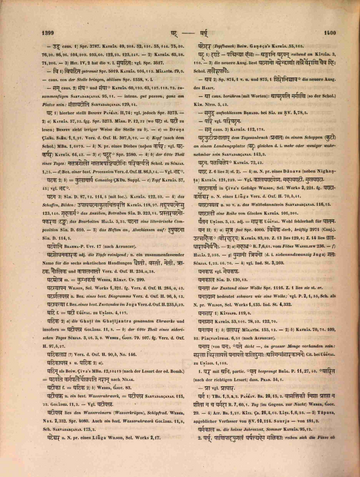
ghana II〉1〉a〉 sūtra fest Spr. 4000. viveka derb, kräftig Spr. 2971 (Conj.). utsāhaika˚ (vīrahṛdaya) KATHĀS. 83,39. Z. 13 lies 129,8; Z. 14 lies jaladhārāghanairghanaiḥ. — 2〉a〉 mahābhra˚ R. 7,6,61. vom Fötus WASSILJEW 236. — f〉 HALĀY. 2,355. — g〉 yugānāṃ trighano (d. i. siebenundzwanzig Yuga) gataḥ SŪRYAS. 1,22. SŪRYAS. 1,46. SŪRYAS. 1,70. — h〉 vgl. Ind. St. 3,269.
Original text · German · Word type unspecified
ghana I〉 2〉 Hammer Spr. (II) 4074. — II〉 2〉a〉 und b〉 pl. von Menschen so v. a. Pack und zugleich Wolken Spr. (II) 6919. — h〉 Ind. Antiq. 1874, S. 133.
Böhtlingk 1879 adjective · substantive neuter · Word type unspecified
Original text · German · adjective · substantive neuter
ghaná — 1〉 Adj. (f. ā) — a〉 erschlagend, Tödter, Vernichter. — b〉 compact, fest (Strick, Speisen), hart; zäh, dick; dicht. ṚV. 1,8,3 ist ghanā́ = ghanámā. Am Ende eines Comp. voll von Chr. 319,9. ghanam Adv. fest Chr. 312,15. — c〉 häufig auf einander folgend, ununterbrochen. — d〉 dunkel, schwarz. — e〉 tief (Ton). — f〉 tüchtig (Verstand) Spr. 6432 (Conj.) — g〉 ganz, all. — 2〉 — a〉 das Erschlagen. — b〉 Knüttel, Keule; Hammer. — c〉 eine compacte Masse, Klumpen (auch vom Fötus im zweiten Monat). vijñānaghaná so v. a. Nichts als —, ganz Erkennen Chr. 34,24. — d〉 Pl. von Menschen so v. a. Pack. — e〉 Wolke. Am Ende eines adj. Comp. f. ā. — f〉 *Talk. — g〉 die Wurzel von Cyperus hexastachyus communis. — h〉 eine best. [Page2-197-b] Tempelform HEMĀDRI 2,58,10. — i〉 eine best. Art den Veda zu schreiben Ind. Antiq. 1874,133. — k〉 Cubus. — l〉 *Phlegma, Schleim RĀJAN. 21,5. — m〉 *Körper. — 3〉 f. ghanā — a〉 ein best. Saiteninstrument S. S. S. 185. — b〉 *Glycine debilis. — c〉 *eine best. Schlingpflanze. — 4〉 n. — a〉 Schlaginstrument. — b〉 *Eisen. — c〉 *Zinn. — d〉 *das gemässigte Tempo beim Tanz. — e〉 *Dunkel RĀJAN. 21,48.
Original text · German · Word type unspecified
ghana II. 1〉c〉 ghanam oft RUDRAṬA, ŚṚṄGĀRAT. 2,76. [Nachtrag, Band 7]
Apte 1890 adjective · substantive masculine · substantive neuter
Original text · English · adjective · substantive masculine · substantive neuter
ghana a. [han mūrtau ap ghanadeśaśca Tv]. 1 Compact, firm, hard, solid: saṃjāta śca ghanāghanaḥ Māl. 9. 39; nāsā ghanāsthikā Y. 3. 89; R. 11. 18. 2 Thick, close, dense; ghanāviralabhāvaḥ U. 2. 27; R. 8. 91; Amaru. 57. 3 Thick-set, full, fully developed (as breasts); ghaṭayati sughane kucayugagagane mṛgamadarucirūṣite Gīt. 7; agurucatuṣkraṃ bhavati gurū dvau ghanakucayugme śaśivadanā'sau Śrut. 8; Bh. 1. 8; Amaru. 28. 4 Deep (as sound); Māl. 2. 12; Mu. 1. 21. 5 Uninterrupted, permanent. 6 Impenetrable. 7 Great, excessive, violent. 8 Complete. 9 Auspicious, fortunate. 10 Coarse, gross. 11 Engrossed by, full or replete with; Māl. 1. 32; nirvṛti˚ U. 6. 11. — naḥ 1 A cloud; ghanodayaḥ prāk tadanantaraṃ payaḥ Ś. 7. 30; ghanarucirakalāpo niḥsapatno'sya jātaḥ V. 4. 10. 2 An iron club, a mace. 3 The body. 4 The cube of a number (in math.). 5 Extension, diffusion. 6 A collection, multitude, quantity, mass, assemblage. 7 Talc 8 Phlegm. 9 Any compact mass or substance. 10 Hardness, firmness. 11 A particular manner of reciting Vedic texts; thus the padas namaḥ rudrebhyaḥ ye repeated in this manner would stand thus: -namo rudrebhyo rudrebhyo namo namo rudrebhyo ye ye rudrebhyo namo namo rudrebhyo ye. — naṃ 1 A cymbal, a bell, a gong. 2 Iron. 3 Tin. 4 Skin, rind, bark. 5 A mode of dancing. Comp. — atyayaḥ, — aṃtaḥ ‘disappearance of the clouds’, the season succeeding the rains, autumn; (śarad); R. 3. 37. — ajñānī N. of Durgā. — aṃbu n. rain. — ākaraḥ the rainy season. — āgamaḥ, — udayaḥ ‘the approach of clouds’, the rainy season; ghanāgamaḥ kāmijanapriyaḥ priye Rs. 2. 1. — āmayaḥ the date-tree. — āśrayaḥ the ([Page 0476-c]) atmosphere, firmament. — uttamaḥ the face. — upalaḥ hail. — oghaḥ gathering of clouds. — kaphaḥ hail. — kālaḥ the rainy season. — garjitaṃ 1 thunder, peal or thundering noise of clouds, roar of thunder. 2 a deep loud roar. — golakaḥ alloy of gold and silver. — ghataḥ the cube of a cube. — jaṃbāla, thick mire. — jvālā lightning. — tālaḥ a kind of bird (sāraṃga). — tolaḥ the Cātaka bird. — dhātuḥ lymph. — dhvani a. roaring. — (niḥ) 1 a deep or low tone. 2 the muttering of thunder clouds; Śi. 16. 25. — nābhiḥ smoke (being supposed to be a principal ingredient in clouds; Me. 5). — nīhāraḥ thick hoar-frost or mist. — padaṃ the cube root. — padavī ‘the path of clouds’, firmament, sky; krāmadbhirghanapadavīmanekasaṃkhyaiḥ Ki. 5. 34. — pāṣaṃḍaḥ a peacock. — phalaṃ (in geom.) the solid or cubical contents of a body or of an excavation. — mūlaṃ cube root (in math.). — rasaḥ 1 a thick juice. 2 extract, decoction. 3 camphor. 4 water (m. or n.). — varaṃ the face. — vargaḥ the square of a cube, the sixth power (in math.). — vartman n. the sky; ghanavartma sahasradheva kurvan Ki. 5. 17. — vallikā, -vallī lightning. — vātaḥ a thick oppressive breeze or air. — vīthiḥ the sky. — śabdaḥ thunder, peal of thunder. — vāsaḥ a kind of pumpkin gourd. — vāhanaḥ 1 Śiva. 2 Indra. — śyāma a. ‘dark like a cloud’, deep-black, dark. — (maḥ) an epithet (1) of Rāma, (2) of Kṛṣṇa. — samayaḥ the rainy season. — sāraḥ 1 camphor; ghanasāranīhārahāra &c. Dk. 1 (mentioned among white substances). 2 mercury. 3 water. — svanaḥ, -śabdaḥ, -svaḥ the roaring of clouds. — hastasaṃkhyā the contents of an excavation or of a solid (in math).
Cappeller 1887 Word type unspecified
Original text · German · Word type unspecified
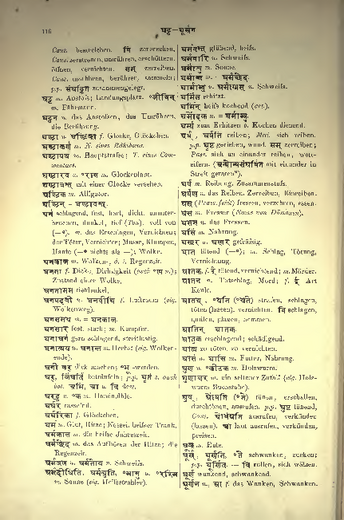
ghaná schlagend, fest, hart, dicht, ununterbrochen, dunkel, tief (Ton), voll von (—˚) m. das Erschlagen, Vernichten; der Töter, Vernichter; Masse, Klumpen, Haufe (—˚ nichts als —); Wolke.
Burnouf 1866 adjective
Original text · French · adjective
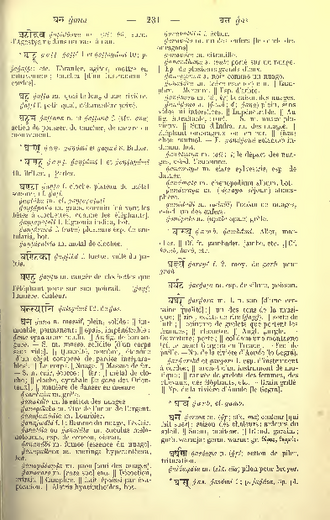
ghana ghana a. massif, plein, solide; immuable, permanent; épais, impénétrable: ghana vṛkṣa arbre touffu. Au fig. de bon augure. — S. m. masse, solidité [d'un corps sans vide]. Quantité, nombre, étendue [d'un objet composé de parties inséparables]. Le corps. Nuage. Massue de fer. — S. n. cuir, écorce; fer; métal de cloche; cloche, cymbale [le gong des Orientaux]; manière de danser en mesure. ghanakapha m. grêle. ghanakāla m. la saison des nuages. ghanagolaka m. titre de l'or ou de l'argent. ghanajambāla m. bourbier. ghanajvālā f. la flamme du nuage, l'éclair. ghanatola ou ghanatāla m. cuculus melanoleucus, esp. de coucou, oiseau. ghananābhi m. fumée [essence du nuage]. ghanapallava m. moringa hyperanthera, bot. ghanapāṣaṇḍa m. paon [ami des nuages]. ghanarasa m. [rasa suc] eau. Décoction, extrait. Camphre. Lait épaissi par évaporation. Aletris hyacinthoïdes, bot. [Page231-2] ghanavallikā f. éclair. ghanavāta m. un des enfers [le cercle des ouragans]. ghanavāsa m. citrouille. ghanavāhana a. (vah) porté sur un nuage. Ép. de plusieurs grands dieux. ghanaśyāma a. noir comme un nuage. ghanasāra m. (sāra essence) eau. Camphre. Mercure. Esp. d'arbre. ghanākara m. (ā; kṛ) la saison des nuages. ghanāghana a. (ghana; ā; ghanā) plein, sans vides ni interstices. Impénétrable. Au fig. intraitable, cruel. — S. m. nuage pluvieux. Surn. d'Indra, roi des nuages. Eléphant ombrageux ou en rut. (han) choc mutuel. — F. ghanāghanā solanum indicum, bot. ghanātyaya m. (ati; i) le départ des nuages, c-à-d. l'automne. ghanāmaya m. elate sylvestris, esp. de dattier. ghanāmala m. chenopodium album, bot. ghanāśraya m. (āśraya séjour) atmosphère. ghanodadhi m. (udadhi) l'océan de nuages, c-à-d. un des enfers. ghanopala m. (upala opale) grêle.
Occurrences in source texts (6)
HP 2 occurrences
MandUp 2 occurrences
Continue with AYI Free
Image source: AYI archive.