

parokṣa परोक्ष – paro-'kṣa, as, ā, am, (fr. paras + 4. akṣa, opposed to praty-akṣa, q. v.), beyond the range of sight, out of sight…
adjective · substantive feminine · substantive masculine · substantive neuter · Word type unspecified
Dictionary sources
Cappeller 1891 adjective
Original text · English · adjective
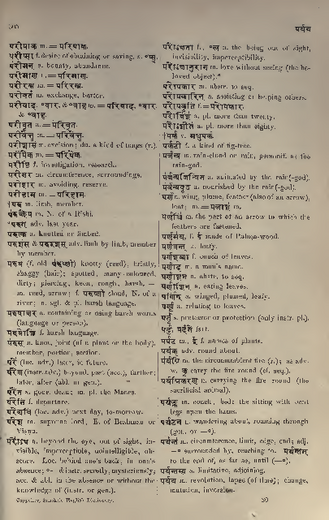
paró'kṣa ·a. beyond the eye, out of sight, invisible, imperceptible, unintelligible, obscure. Loc. behind one's back, in one's absence; °-- & instr. secretly, mysteriously; acc. & abl. in the absence or without the knowledge of (instr. or gen.).
Monier-Williams 1872 adjective
Original text · English · adjective
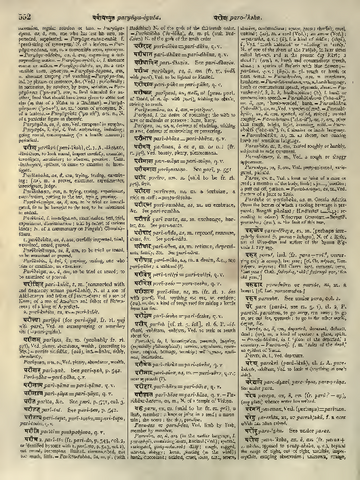
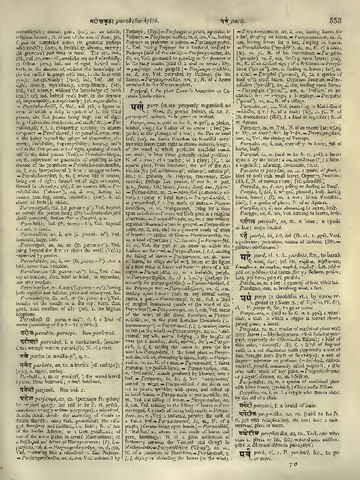
parokṣa paro-'kṣa, as, ā, am, (fr. paras + 4. akṣa, opposed to praty-akṣa, q. v.), beyond the range of sight, out of sight, invisible, imper- ceptible, escaping observation; unknown, strange, unintelligible; absent, past; (as), m. an ascetic, religious hermit; N. of one of the sons of Anu; (ā), f. past or completed action (in grammar perhaps with vṛtti); (am), n. invisibility, absence, secrecy; (in grammar) past time or tense. The acc., inst., abl., and loc. cases of parokṣa are used adverbially, as follow: (am), ind. out of sight, behind one's back, in the absence of, without the knowledge of (in the earlier language with inst., in the later with gen.); surreptitiously; (eṇa), ind., Ved. out of sight, secretly, mysteriously, surreptitiously; (āt), ind., Ved. secretly, without the knowledge of (with inst.); (e), ind. behind one's back, in the absence of, imperceptibly, surreptitiously; [cf. a-parokṣa.]
Petersburger 1855 adjective · substantive feminine · substantive masculine
Original text · German · adjective · substantive masculine
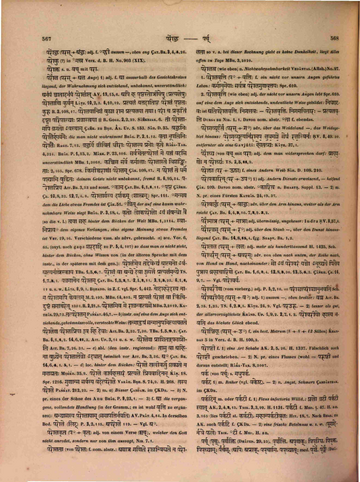
parókṣa (paras + akṣa Auge) 1〉 adj. f. ā ausserhalb des Gesichtskreises liegend, der Wahrnehmung sich entziehend, unbekannt, unverständlich: abhàyaṃ jñā̱tādabhàyaṃ pa̱rokṣā̀t AV. 19,15,6. api ha pṛṣṭhastotrīyeṣu (pratyakṣeṣu) parokṣāṇi kurvan LĀṬY. 10,2,3. LĀṬY. 6,10,19. pratyakṣaṃ yattadātiṣṭha parokṣaṃ pṛṣṭhataḥ kuru R. 2,108,17. parokṣayāniśaṃ buddhyā rāma pratyakṣayā tathā . parāṃ ca prakṛtiṃ dṛṣṭvā paripālyāḥ prajāstvayā .. R. GORR. 2,2,29. SĀṂKHYAK. 6. tāṃ parokṣāmapi jagato 'vasthām ŚAṂK._zu_BṚH. ĀR. UP. S. 153. SĀH. D. 55. bahubhiḥ parokṣairhāyanaiḥ die man nicht wahrnimmt BHĀG. P. 2,1,12. vṛtā bhūpatibhiḥ parokṣaiḥ RAGH. 7,13. jahurye jīvitaṃ dhīrāḥ parokṣasya prabhoḥ kṛte RĀJA-TAR. 4,324. BHĀG. P. 1,15,3. MĀRK. P. 23,106. sarvametatparokṣaṃ me yattvaṃ vadasi unverständlich MBH. 1,3068. kaccinna sarve karmāntāḥ parokṣāste viśaṅkitāḥ MBH. 2,165. Spr. 678. kimīśvarāṇāṃ parokṣam ŚĀK. 108,17. na parokṣaṃ te dharmaṃ paśyāmi buddhitaḥ deinem Geiste nicht unbekannt, fremd R. 6,95,54. parokṣapriya AIT. BR. 3,33 und sonst. ˚kāma ŚAT. BR. 6,1,1,11. ˚pṛṣṇa ŚĀṄKH. ŚR. 10,8,33. ŚĀṄKH. ŚR. 12,7,4. ŚĀṄKH. ŚR. 12,7,8. parokṣārthasya darśakam (śāstram) Spr. 111. ˚manmatha dem die Liebe etwas Fremdes ist ŚĀK. 51. ˚jit der auf eine kaum wahrnehmbare Weise siegt BHĀG. P. 3,18,4. kṛto lokaparokṣo 'yaṃ saṃbandho vai (so die v. l.) tvayā saha hinter dem Rücken der Welt MBH. 1,3114. svābhiprāya˚ dem eigenes Verlangen, eine eigene Meinung etwas Fremdes ist VET. 19,16. Verschiedene cass. als advv. gebraucht. a〉 acc. VOP. 6,65. (oxyt. nach gaṇa śaradādi zu P. 5,4,107) so dass man es nicht sieht, hinter dem Rücken, ohne Wissen von (in der älteren Sprache mit dem instr., in der späteren mit dem gen.): pa̱rokṣàme̱va tadde̱vebhyà ā̱tmano 'vàdya̱tyanā̀vraskāya TBR. 1,5,6,7. pa̱rokṣa̱ṃ vā a̱nye de̱vā i̱jyantè pra̱tyakṣàma̱nye TS. 1,7,3,1. yajamānena parokṣam ŚAT. BR. 1,5,2,7. ŚAT. BR. 2,1,2,11. ŚAT. BR. 3,1,3,25. ŚAT. BR. 6,1,1,11 u. s. w. LĀTY. 8,9,1. BṚHADD._in_Z. f. vgl. Spr. 1,442. nodāharedasya nāma parokṣamapi kevalam M. 2,199. MBH. 14,805. na pratyakṣaṃ parokṣaṃ vā kiṃcidduṣṭaṃ samācaret MBH. 14,1301. R. 2,21,5. parokṣamiva me rājankatthase MBH. 3,2819. KATHĀS. 29,73. tatparokṣam PAÑCAT. 46,7. — b〉 instr. auf eine dem Auge sich entziehende, geheimnissvolle, versteckte Weise: tanmāduṣaṃ sanmānuṣamityācakṣate parokṣeṇa parokṣapriyā iva hi devāḥ AIT. BR. 3,33. AIT. BR. 7,30. TBR. 1,5,9,2. ŚAT. BR. 6,1,1,2. ŚAT. BR. 14,6,11,2. AIT. UP. 3,14 u. s. w. parokṣeṇa prāśitarūpamāpnoti AIT. BR. 7,26. AIT. BR. 7,31. — c〉 abl. (den instr. regierend): tāsu vā ahinā budhnyena parokṣāttejo 'dadhāt heimlich vor AIT. BR. 3,36. a˚ ŚAT. BR. 14,6,4,1. ŚAT. BR. 14,6,5,1. — d〉 loc. hinter dem Rücken: parokṣe khalīkartuṃ śakyate na mamāgrataḥ MṚCCH. 35,9. parokṣe kāryahantāraṃ pratyakṣe priyavādinam CĀṆ. 18. Spr. 1216. guṇānsa sarvasya vadetparokṣe VARĀH. BṚH. S. 74,9. H. 268. tasya parokṣe PAÑCAT. 212,22. — 2〉 m. a〉 Büsser ŚABDAM._im_ŚKDR. — b〉 N. pr. eines der Söhne des Anu BHĀG. P. 9,23,1. — 3〉 f. ā die vergangene, vollendete Handlung (in der Gramm.; es ist wohl vṛtti zu ergänzen): abhyāsasya parokṣāyām (samāpattirbhavati) AV. PRĀT. 4,84. In derselben Bed. parokṣe (liṭ) P. 3,2,115. aparokṣe P. 3,2,119. — Vgl. a˚.
Original text · German · substantive feminine
parokṣa 3〉 f. (sc. vibhakti) eine Personalendung des Perfects ebend. 1,186,b. KĀTANTRA 3,1,13. KĀTANTRA 3,1,29.
Böhtlingk 1879 adjective · substantive masculine
Original text · German · adjective · substantive masculine
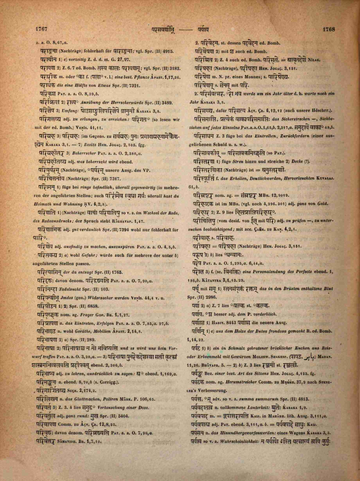
paró'kṣa — 1〉 Adj. (f. ā) ausserhalb des Gesichtskreises liegend, der Wahrnehmung sich entziehend, unbekannt, unverständlich; nur durch den innern Sinn (manas) erkennbar, — vermittelt. Definition des Wortes bei den Grammatikern Chr. 241,25. fgg. — a〉 Acc. so dass man es nicht sieht, hinter dem Rücken, ohne Wissen von (Instr. später Gen. oder im Comp. Vorangehend). — b〉 Instr. auf eine dem Auge sich entziehende, geheimnissvolle, versteckte Weise. — c〉 Abl. — α〉 heimlich vor (Instr.). — β〉 hinter dem Rücken, — von (Gen.), wenn man nicht zugegen ist oder war Chr. 241,24 — d〉 paro'kṣa˚ auf nicht wahrnehmbare Weise. — 2〉 m. — a〉 *Büsser. — b〉 N. pr. eines Sohnes des Anu. — 3〉 f. paro'kṣā — a〉 eine vergangene, vollendete Handlung. — b〉 eine Personalendung des Perfects. — c〉 N. pr. eines Flusses VP. 2,2,151.
Apte 1890 adjective · substantive masculine · substantive neuter
Original text · English · adjective · substantive masculine · substantive neuter
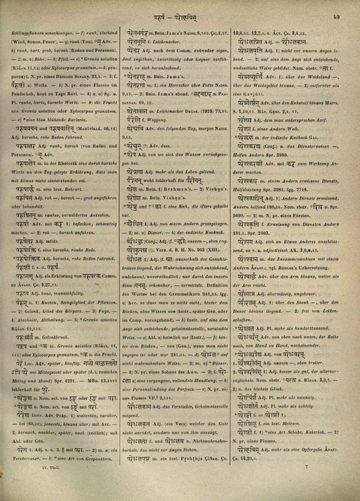
parokṣa a. 1 Out of or beyond the range of sight, invisible, escaping observation. 2 Absent; sthāne vṛtā bhūpatibhiḥ parokṣaiḥ R. 7. 13. 3 Secret, unknown, stranger; parokṣamanmatho janaḥ Ś. 2. 18 ‘a stranger to the influence of love’; H. Pr. 10. — kṣaḥ An ascetic. — kṣaṃ 1 Absence, invisibility. 2 (In gram.) Past time or tense (not witnessed by the speaker); parokṣe liṭ P. III. 2. 115. Note. The acc. and loc. singulars of parokṣa (i. e. parokṣaṃ, parokṣe) are used adverbially in the sense of ‘in one's absence’, ‘out of sight’, ‘behind one's back’, with or without a gen.; parokṣe khalīkartuṃ śakyate na mamāgrataḥ Mk. 2; parokṣe kāryahatāraṃ pratyakṣe priyavādinaṃ Chāṇ. 18; nodāharedasya nāma parokṣamapi kevalaṃ Ms. 2. 119. Comp. — artha a. having a secret meaning. — kṛtā a hymn in which a deity is spoken of in the third person. — bhogaḥ enjoyment of anything in the absence of the owner. — vṛtti a. living out of sight. ( — ttiḥ f.) an unseen or obscure life.
Cappeller 1887 Word type unspecified
Original text · German · Word type unspecified
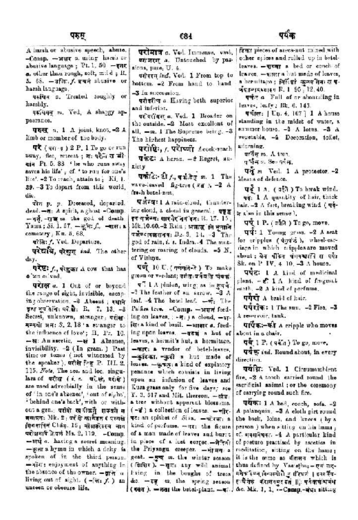
paró'kṣa aus den Augen liegend, nicht vorhanden, nicht gegenwärtig o. wahrnehmbar. Loc. hinter dem Rücken, heimlich; wo man nicht selbst dabei gewesen ist (g.). Instr. auf heimliche Weise. Acc. u. Abl. heimlich, clam (Instr. o. Gen.).
Burnouf 1866 adjective
Original text · French · adjective
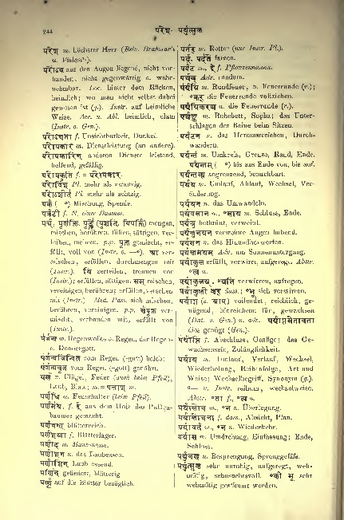
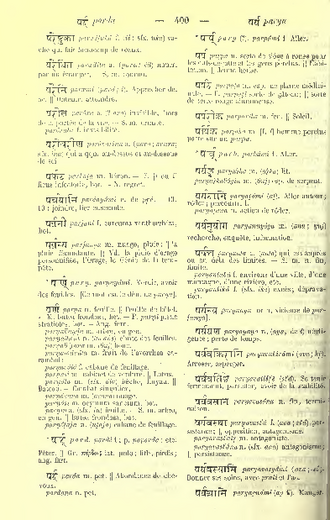
parokṣa parokṣa a. (? akṣa) invisible, hors de la portée de la vue. — S. m. ermite. parokṣatā f. invisibilité.
Occurrences in source texts (2)
SiSa 2 occurrences
SiSa 5.208-5.222: Rājayoga 2 occurrences
Direct occurrences
-
SiSa 5.216 Segment 9
-
SiSa 5.217 Segment 4
Continue with AYI Free
Image source: AYI archive.