

saindhava सैन्धव – salt
adjective · substantive masculine · substantive neuter · Word type unspecified
Dictionary sources
AYI dictionary substantive neuter
Cappeller 1891 Word type unspecified
Original text · English · Word type unspecified
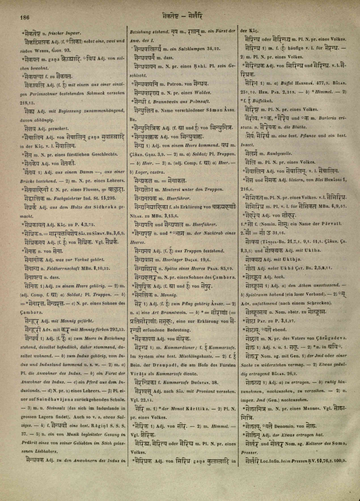
saindhavá ·f. ī́ belonging to the sea or to the Indus; m. pl. the inhabitants of the country near the Indus, m. n. a kind of rock-salt (found in this country).
Monier-Williams 1872 adjective
Original text · English · adjective
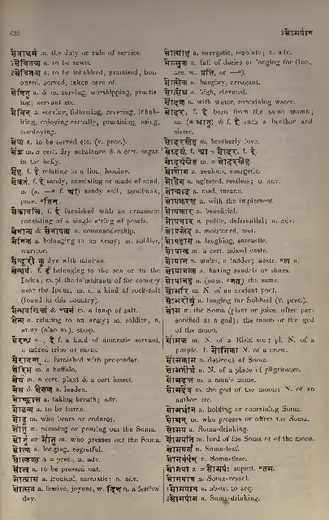
saindhava saindhava, as, ī, am (fr. sindhu), pro- duced or born in Sindh or in the country near the Indus; belonging to the Indus; river-born; belong- ing to the sea, oceanic, marine, aquatic; (as), m. a horse (particular one bred in Sindh); N. of a Muni; of a family; of a country; (as, am), m. n. a kind of rock-salt (found in the country near the Indus); (ī), f., N. of one of the Rāgiṇīs or personified musical scales; (am), n. (in dramatic literature) a kind of song in Prākṛt words accompanied with music expressive of disappointment in the keeping of an assignation; (ās), m. pl. the people inhabit- ing Sindh or the country near the Indus.
Petersburger 1855 adjective · substantive masculine · substantive neuter
Original text · German · adjective · substantive masculine · substantive neuter
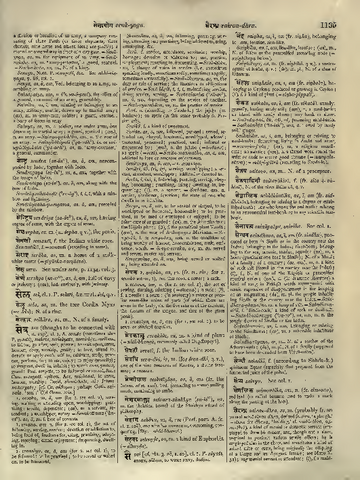
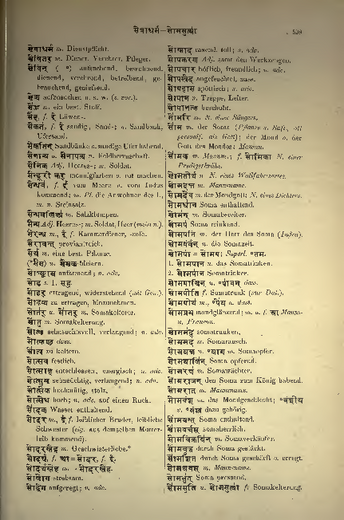
saindhavá (von sindhu) 1〉 adj. (f. ī) a〉 zum Meere in Beziehung stehend: bindavaḥ Tropfen aus dem Meere Verz. d. Oxf. H. 129,a,10. vom Meere stammend, daselbst wohnend: śrāvakāḥ TĀRAN. 221. TĀRAN. 230. TĀRAN. 241. TĀRAN. 255. TĀRAN. 274. TĀRAN. 303. — b〉 zum Indus gehörig, vom Indus und Indusland kommend u. s. w. P. 4,3,33. P. 4,3,93. gaṇa kacchādi zu P. 4,2,133. H. an. 3,715. MED. v. 55. guggulu AV. 19,38,2. Wasser TS. 7,4,13,1. Pferde (auch m. mit Ergänzung eines Wortes für Pferd) AK. 2,8,2,12. TRIK. 3,3,423. H. 1234. H. an. MED. HALĀY. 2,284. RĀJAN. 19. ŚAT. BR. 11,5,5,12. ŚAT. BR. 14,9,2,13. MBH. 3,15672. MBH. 7,276. MBH. 7,3898. BHĀG. P. 9,1,23. BHĀG. P. 10,69,35. P. 1,3,35, Schol. — 2〉 m. a〉 pl. die Anwohner des Indus (vgl. sindhu) AV. PARIŚ._in_Ind. St. 10,317. MBH. 3,1991. MBH. 14,2221. VARĀH. BṚH. S. 5,71. VP. 2,3,17. Verz. d. Oxf. H. 217,b,24. wohl sg. Bez. des Landes Verz. d. Oxf. H. 338,b,25. fg. Bez. eines Geschlechts Verz. d. Oxf. H. 352,b,3. — b〉 ein Fürst der Anwohner des Indus MBH. 1,7001. MBH. 2,1267. MBH. 3,15850. MBH. 4,526. MBH. 6,1723. MBH. 14,2229. MUDRĀR. 18,17. VARĀH. YOGAYĀTRĀ 3,18. BHĀG. P. 1,15,16. — c〉 ein Pferd aus dem Induslande s. u. 1〉b〉. — d〉 N. pr. eines Lehrers Verz. d. Oxf. H. 55,b,37. — e〉 pl. N. einer auf Saindhavāyana zurückgehenden Schule VP. 3,6,12. — 3〉 m.n. gaṇa ardharcādi zu P. 2,4,31. SIDDH. K. 251,b,1. Steinsalz, das sich im Induslande in grossen Lagern findet, AK. 2,9,42. TRIK. H. 941. H. an. MED. HALĀY. 2,459. RATNAM. 85. RĀJAN. 6,90. ˚ghana ŚAT. BR. 14,7,3,13. ˚khilya ŚAT. BR. 14,5,4,12. MAITRYUP. 6,35 (m.). SUŚR. 1,134,10. SUŚR. 1,134,148. SUŚR. 1,134,14. SUŚR. 1,226,15. ˚cūrṇa SUŚR. 42,10. ˚sarpis SUŚR. 368,21. SUŚR. 2,330,7. VARĀH. BṚH. S. 16,25. VARĀH. BṚH. S. 51,32 (so v. a. etwas Salziges). Verz. d. Oxf. H. 103,b,2. Verz. d. Oxf. H. 235,b,3. Verz. d. Oxf. H. 237,a,14. ˚śilāśakala RAGH. 5,73. Accent eines darauf auslautenden comp. P. 6,2,72. śúkla˚ Steinsalz an Weisse, weiss wie St. Schol. — 4〉 f. ī N. einer Rāgiṇī WILSON angeblich nach HALĀY. — 5〉 n. ein von Musik begleiteter Gesang in Prākrit eines von seiner Geliebten im Stich gelassenen Liebhabers SĀH. D. 504. SĀH. D. 508. — Vgl. susaindhavī.
Böhtlingk 1879 adjective · substantive masculine · substantive neuter
Original text · German · adjective · substantive masculine · substantive neuter
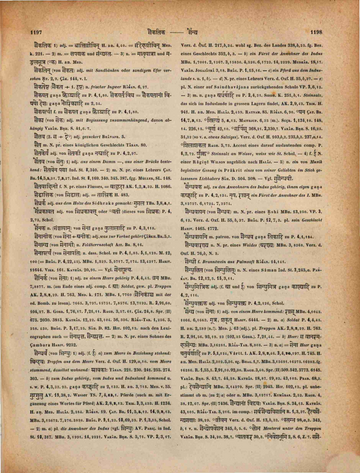
saindhavá — 1〉 Adj. (f. ī́) — a〉 zum Meere in Beziehung stehend, daselbst befindlich, daher stammend, daselbst wohnend. — b〉 zum Indus gehörig, vom Indus und Indusland kommend u. s. w. — 2〉 m. — a〉 Pl. die Anwohner Indus. — b〉 ein Fürst der Anwohner des Indus. — c〉 ein Pferd aus dem Induslande. — d〉 N. pr. — α〉 eines Lehrers. — β〉 Pl. eines auf Saindhavāyana zurückgehenden Schule. — 3〉 m. n. Steinsalz (das sich im Induslande in grossen Lagern findet). Auch so v. a. etwas Salziges. — 4〉 saindhavī eine best. Rāgiṇī S. S. S. 37. — 5〉 n. ein von Musik begleiteter Gesang in Prākrit eines von seiner Geliebten im Stich gelassenen Liebhabers.
Cappeller 1887 Word type unspecified
Original text · German · Word type unspecified
saindhavá, f. ī́ vom Meere o. vom Indus kommend; m. Pl. die Anwohner des I., m. n. Steinsalz.
Burnouf 1866 adjective
Original text · French · adjective
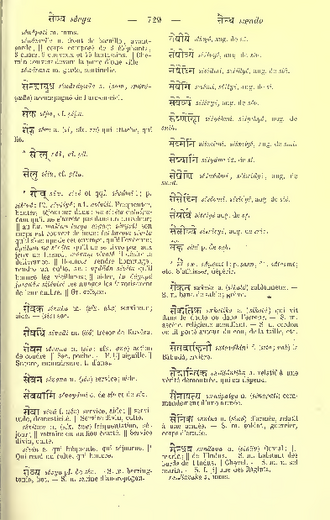
saindhava saindhava a. (sindhu) fluvial; marin; de l'Indus. de l'Indus. — S. m. habitant des bords de l'Indus. Cheval. — S. m. n. sel marin. — S. f. [ī] une des Rāgiṇīs. saindhavaka a. mms.
Occurrences in source texts (2)
HP 2 occurrences
Continue with AYI Free
Image source: AYI archive.