
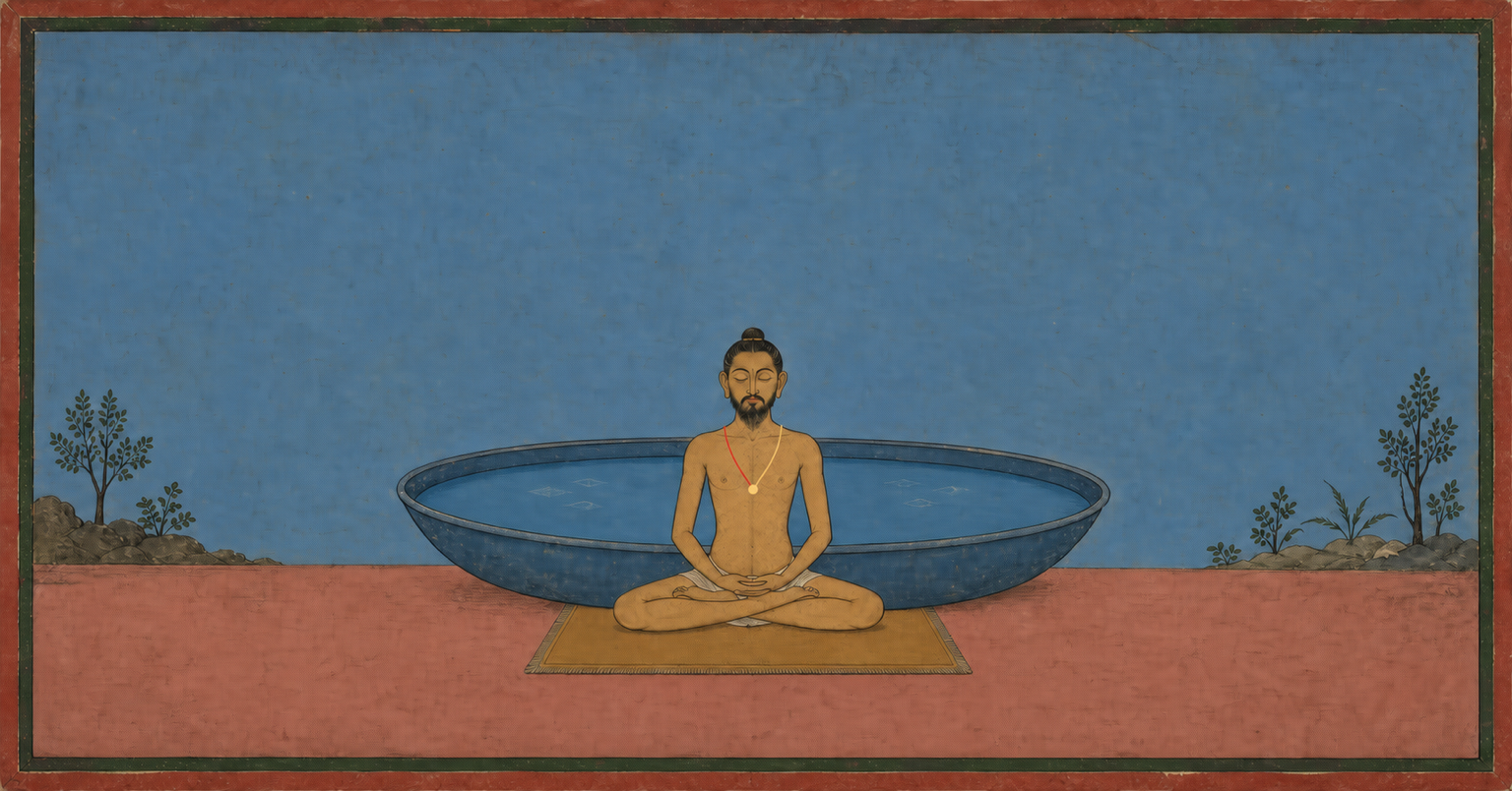
HP 4.0*1-4.0*14: Samādhi and Laya

Haṭha Pradīpikā 4.0*1-4.0*14: Prelude to Samādhi

The prelude gathers definitions and conditions of Samādhi, Rājayoga, Laya, the awakening of Śakti, and the binding of mind and breath.

Dr. Ronald Steiner Dr. Ronald Steiner
Haṭha Pradīpikā 4.0*1
नमः शिवाय गुरवे नादबिन्दुकलात्मने |
namaḥ śivāya gurave; nāda-bindu-kalātmane | Analysis ▾ Analysis ▴
namas
substantive neuter
worship, homage
śivāya
dative singular
substantive masculine
Śiva
guru
dative singular
substantive masculine
to the guru
nāda
dvandva-compound
substantive masculine
nāda
bindu
dvandva-compound
substantive masculine
bindu
kalā
dvandva-compound
substantive feminine
kalā
ātmane
dative singular
substantive masculine
whose nature
निरञ्जनपदं यान्ति नित्यं यत्रपरायणाः ||0*1||
nirañjana-padaṃ yānti; nityaṃ yatra-parāyaṇāḥ ||0*1|| Analysis ▾ Analysis ▴
nirañjana
karmadhāraya-compound
adjective
stainless
padam
accusative singular
substantive neuter
state
yānti
3rd person plural aktive present
verbal root
go, reach
nityam
adverb
constantly, regularly
yatra
avyayībhāva-compund
adverb
upon which
parāyaṇāḥ
nominative plural masculine
adjective
supremely intent
Metre: Anuṣṭubh
Homage (namas) to Śiva (śivāya | dat sg), the guru (gurave | dat sg), whose nature consists of Nāda, Bindu, and Kalā (nāda-bindu-kalātmane | dat sg). [Those] constantly (nityam) devoted to that (yatra-parāyaṇāḥ | nom pl m) reach (yānti | 3p pl act pres) the stainless state (nirañjana-padam | acc sg).
Dr. Ronald Steiner - 2026 - historically literal
Homage to the guru Śiva, whose nature is Nāda, Bindu, and Kalā. One who is continually devoted to him reaches the stainless state.
Dr. Ronald Steiner - 2026 - modern transfer

Brahmānanda understands Śiva and the guru as non-different. Nāda denotes the continuing inner tone, which he compares to the resonance of a metal bell; Bindu is its subtler fading sound, and Kalā a part or unfolding of Nāda. Devotion to the guru therefore leads consistently, in his account, to absorption in the inner sound and finally to Brahman free from Māyā.

Brahmānanda's Jyotsnā - 19th c.
yānti … yatraparāyaṇāḥ MBHDL2026 ] yāti … yatraparāyaṇaḥ MBHDL2024
Critical Apparatus
Salutation to the Gurû, the dispenser of happiness to all, appearing as Nâda, Vindû and Kalâ. One who is devoted to Him, obtains the highest bliss.
Pancham Sinh - 1915
Verehrung dem Siva, dem Lehrer, der in sich einen Theil des Nâdabindu enthält, und in welchen vertieft man immer zum Brahma gelangt.
Hermann Walter - 1893
Haṭha Pradīpikā 4.0*2
अथेदानीं प्रवक्ष्यामि समाधिक्रममुत्तमम् |
athedānīṃ pravakṣyāmi; samādhi-kramam uttamam | Analysis ▾ Analysis ▴
athedānīm
particle
adverb
now
pravakṣyāmi
1st person singular aktive future
previx
verbal root
I shall teach
samādhi
tatpuruṣa-compound genitive
substantive masculine
of samādhi
kramam
accusative singular
substantive masculine
the progression, path
uttamam
accusative singular masculine
adjective
highest
मृत्युघ्नं तु सुखोपायं ब्रह्मानन्दकरं परम् ||0*2||
mṛtyu-ghnaṃ tu sukhopāyaṃ; brahmānanda-karaṃ param ||0*2|| Analysis ▾ Analysis ▴
mṛtyu
tatpuruṣa-compound accusative
substantive masculine
death
ghnam
accusative singular masculine
adjective
destroying
tu
particle
but
sukha
karmadhāraya-compound
adjective
easy
upāyam
accusative singular
substantive masculine
means, access
brahma
tatpuruṣa-compound genitive
substantive neuter
Brahman
ānanda
tatpuruṣa-compound accusative
substantive masculine
bliss
karam
accusative singular masculine
adjective
producing
param
accusative singular masculine
adjective
supreme
Metre: Anuṣṭubh
Now, at this point (atha idānīm), I shall teach (pravakṣyāmi | 1p sg act fut) the supreme path of Samādhi (samādhi-kramam uttamam | acc sg): it destroys death (mṛtyu-ghnam | acc sg m), yet (tu) is an easy means (sukhopāyam | acc sg), produces the bliss of Brahman (brahma-ānanda-karam | acc sg m), and is supreme (param | acc sg m).
Dr. Ronald Steiner - 2026 - historically literal
Now I teach the supreme path of Samādhi. It conquers death, provides an easy approach, and bestows the supreme bliss of Brahman.
Dr. Ronald Steiner - 2026 - modern transfer

For Brahmānanda, Samādhi is the fruit of the means taught in the first three chapters. He initially interprets “overcoming death” as the ability to leave the body voluntarily. At the same time, he distinguishes Jīvanmukti, liberation while the body remains, from Videhamukti after the end of karma that has already become active. Insight, stilling of the mind, and exhaustion of conditioning belong together for him.

Brahmānanda's Jyotsnā - 19th c.
mṛtyughnaṃ tu MBHDL2026 ] mṛtyughnaṃ ca NS1882
Critical Apparatus
Now I will describe a regular method of attaining to Samâdhi, which destroys death, is the means for obtaining happiness, and gives the Brahmânanda.
Pancham Sinh - 1915
Nun werde ich die erhabene Methode des Samadhi auseinandersetzen, die den Tod besiegt, Glück verschafft und die höchste Seligkeit erlangen lässt.
Hermann Walter - 1893
Haṭha Pradīpikā 4.0*3
सलिले सैन्धवं यद्वत् साम्यं भजति योगतः |
salile saindhavaṃ yadvat; sāmyaṃ bhajati yogataḥ | Analysis ▾ Analysis ▴
salile
lokative singular
substantive neuter
in water
saindhavam
nominative accusative singular
substantive neuter
salt
yadvat
adverb
like
sāmyam
accusative singular
substantive neuter
sameness
bhajati
3rd person singular aktive present
verbal root
attains, assumes
yogataḥ
adverb
through union
तथात्ममनसोरैक्यं समाधिः सो ऽभिधीयते ||0*3||
tathātma-manasor aikyaṃ; samādhiḥ so 'bhidhīyate ||0*3|| Analysis ▾ Analysis ▴
tathā
adverb
thus
ātman
dvandva-compound
substantive masculine
Self
manasoḥ
genitive lokative dual
substantive neuter
and mind
aikyam
nominative accusative singular
substantive neuter
unity
samādhiḥ
nominative singular
substantive masculine
samādhi
saḥ
nominative singular masculine
pronoun dem
it
abhidhīyate
3rd person singular passive present
previx
verbal root
is called
Metre: Anuṣṭubh
Just as (yadvat) salt (saindhavam | nom acc sg) assumes (bhajati | 3p sg act pres) sameness (sāmyaṃ | acc sg) with water (salile | loc sg) through union (yogataḥ), so (tathā) the unity (aikyam | nom acc sg) of self and mind (ātma-manasoḥ | gen loc du) is called (abhidhīyate | 3p sg pas pres) Samādhi (samādhiḥ | nom sg).
Dr. Ronald Steiner - 2026 - historically literal
Just as salt becomes one with water through union, the unity of self and mind is called Samādhi.
Dr. Ronald Steiner - 2026 - modern transfer

Just as salt loses its own form in water and wholly assumes the character of water, the mind held in the self, according to Brahmānanda, assumes the form of the self. The image describes the end of the perceptible separation of consciousness from the object of absorption.

Brahmānanda's Jyotsnā - 19th c.
samādhiḥ so’bhidhīyate MBHDL2026 ] samādhir abhidhīyate NS1882
Critical Apparatus
As salt being dissolved in water becomes one with it, so when Âtmâ and mind become one, it is called Samâdhi.
Pancham Sinh - 1915
Gerade wie im Wasser das Salz durch Vereinigung (yogatas) demselben gleich wird, so wird die Vereinigung der Seele mit der Allseele durch den Yoga (yogatas) Samadhi genannt.
Hermann Walter - 1893
Haṭha Pradīpikā 4.0*4
यत्समत्वं द्वयोरत्र जीवात्मपरमात्मनोः |
yat samatvaṃ dvayor atra; jīvātma-paramātmanoḥ | Analysis ▾ Analysis ▴
yat
nominative accusative singular neuter
pronoun
which
samatvam
nominative accusative singular
substantive neuter
sameness
dvayoḥ
genitive lokative dual
numeral
of the two
atra
adverb
here
jīva
dvandva-compound
substantive masculine
individual self
ātman
dvandva-compound
substantive masculine
Self
parama
karmadhāraya-compound
adjective
supreme
ātmanoḥ
genitive dual
substantive masculine
of the two selves
समस्तनष्टसंकल्पः समाधिः सो ऽभिधीयते ||0*4||
samasta-naṣṭa-saṃkalpaḥ; samādhiḥ so 'bhidhīyate ||0*4|| Analysis ▾ Analysis ▴
samasta
karmadhāraya-compound
adjective
all, completely
naṣṭa
karmadhāraya-compound past participle passive
verbal root
vanished
saṃkalpaḥ
nominative singular masculine bahuvrīhi-compund
substantive masculine
whose conceptions
samādhiḥ
nominative singular
substantive masculine
samādhi
saḥ
nominative singular masculine
pronoun
this
abhidhīyate
3rd person singular passive present
previx
verbal root
is called
Metre: Anuṣṭubh
That equality (yat samatvam | nom acc sg) which exists here (atra) between the two (dvayoḥ | gen loc du), the individual self and the supreme self (jīvātma-paramātmanoḥ | gen du), and in which all conceptions have vanished (samasta-naṣṭa-saṃkalpaḥ | nom sg m), that is called (saḥ abhidhīyate | 3p sg pas pres) Samādhi (samādhiḥ | nom sg).
Dr. Ronald Steiner - 2026 - historically literal
Samādhi is the equality of the individual and supreme self, in which every conception has vanished.
Dr. Ronald Steiner - 2026 - modern transfer
yat samatvaṃ dvayor atra MBHDL2026 ] tatsamaṃ ca dvayor aikyaṃ NS1882

samastanaṣṭasaṃkalpaḥ MBHDL2026 ] pranaṣṭasarvasaṅkalpaḥ NS1882
Critical Apparatus
This equality and oneness of the self and the ultra self, when all Saṃkalpas cease to exist, is called Samâdhi.
Pancham Sinh - 1915
Diese vollkommene Identität des Individuums (jîvâtman) mit der Allseele (paramatman) ist der alles Verlangen vernichtende Samadhi.
Hermann Walter - 1893
Haṭha Pradīpikā 4.0*5
राजयोगस्य माहात्म्यं को वा जानाति तत्त्वतः |
rāja-yogasya māhātmyaṃ; ko vā jānāti tattvataḥ | Analysis ▾ Analysis ▴
rāja
tatpuruṣa-compound genitive
substantive masculine
of the king
yogasya
genitive singular
substantive masculine
of yoga
māhātmyam
accusative singular
substantive neuter
greatness, glory
ka
nominative singular masculine
pronoun
whoever
vā
particle
then, or
jānāti
3rd person singular aktive present
verbal root
knows
tattvataḥ
adverb
according to reality
ज्ञानान्मुक्तिः स्थिरा सिद्धिर् गुरुवाक्येन लभ्यते ||0*5||
jñānān muktiḥ sthirā siddhir; guru-vākyena labhyate ||0*5|| Analysis ▾ Analysis ▴
jñānāt
ablative singular
substantive neuter
through knowledge
muktiḥ
nominative singular
substantive feminine
liberation
sthirā
nominative singular feminine
adjective
constantly
siddhiḥ
nominative singular
substantive feminine
perfection
guru
tatpuruṣa-compound genitive
substantive masculine
of the guru
vākyena
instrumental case singular
substantive neuter
through the word
labhyate
3rd person singular passive present
verbal root
is attained
Metre: Anuṣṭubh
Who (kaḥ | nom sg m), indeed (vā), truly (tattvataḥ) knows (jānāti | 3p sg act pres) the greatness (māhātmyam | acc sg) of Rājayoga (rāja-yogasya | gen sg)? Through knowledge (jñānāt | abl sg), liberation (muktiḥ | nom sg) becomes firm (sthirā | nom sg f); accomplishment (siddhiḥ | nom sg) is attained (labhyate | 3p sg pas pres) through the word of the guru (guru-vākyena | ins sg).
Dr. Ronald Steiner - 2026 - historically literal
Who truly knows the greatness of Rājayoga? Through knowledge, liberation becomes firm; Siddhi is attained through the word of the guru.
Dr. Ronald Steiner - 2026 - modern transfer

The four results are carefully distinguished. Jñāna is direct experience of the self, Mukti is disembodied liberation, Sthiti is liberation while still alive, and Siddhi is the unfolding of extraordinary abilities such as Aṇimā. The statement that all four arise “through the guru” identifies instruction as the sustaining prerequisite of the entire path.

Brahmānanda's Jyotsnā - 19th c.
jñānān muktiḥ sthirā siddhir MBHDL2026 ] jñānaṃ muktiḥ sthitiḥ siddhir NS1882
Critical Apparatus
Or, who can know the true greatness of the Raja Yoga. Knowledge, mukti, condition, and Siddhîs can be learnt by instructions from a gurû alone.
Pancham Sinh - 1915
Wer kennt wirklich die erhabene Natur des Rajayoga? Erkenntniss, Erlösung, Unveränderlichkeit und Siddhi sind durch die Unterweisung des Lehrers zu erlangen.
Hermann Walter - 1893
Haṭha Pradīpikā 4.0*6
दुर्लभो विषयत्यागो दुर्लभं तत्त्वदर्शनम् |
durlabho viṣaya-tyāgo; durlabhaṃ tattva-darśanam | Analysis ▾ Analysis ▴
durlabhaḥ
nominative singular masculine
adjective
difficult to attain
viṣaya
tatpuruṣa-compound genitive
substantive masculine
of sense objects
tyāgaḥ
nominative singular
substantive masculine
relinquishment
durlabham
nominative accusative singular neuter
adjective
difficult to attain
tattva
tatpuruṣa-compound genitive
substantive neuter
of reality
darśanam
nominative accusative singular
substantive neuter
vision
दुर्लभा सहजावस्था सद्गुरोः करुणां विना ||0*6||
durlabhā sahajāvasthā; sad-guroḥ karuṇāṃ vinā ||0*6|| Analysis ▾ Analysis ▴
durlabhā
nominative singular feminine
adjective
difficult to attain
sahaja
karmadhāraya-compound
adjective
natural, innate
avasthā
nominative singular
substantive feminine
state
sat
karmadhāraya-compound
adjective
indeed
guroḥ
genitive singular
substantive masculine
of the guru
karuṇām
accusative singular
substantive feminine
compassion, grace
vinā
particle
without
Metre: Anuṣṭubh
Difficult to attain (durlabhaḥ | nom sg m) is the abandonment of sense objects (viṣaya-tyāgaḥ | nom sg); difficult to attain (durlabham | nom acc sg n) is the vision of reality (tattva-darśanam | nom acc sg). Difficult to attain (durlabhā | nom sg f) is the natural state (sahaja-avasthā | nom sg) without (vinā) the grace (karuṇām | acc sg) of the true guru (sad-guroḥ | gen sg).
Dr. Ronald Steiner - 2026 - historically literal
Renunciation of the senses, vision of reality, and the natural state are difficult to attain without the grace of a true guru.
Dr. Ronald Steiner - 2026 - modern transfer

Brahmānanda includes both worldly and heavenly pleasures among the objects of the senses. Sahaja, the “natural state,” is for him the fourth state of consciousness, Turīya, which transcends waking, dreaming, and deep sleep. The commentary explicitly traces its attainment as well to the grace of the guru.

Brahmānanda's Jyotsnā - 19th c.
Indifference to worldly enjoyments is very difficult to obtain, and equally difficult is the knowledge of the Realities to obtain. It is very difficult to get the condition of Samâdhi, without the favour of a true guru.
Pancham Sinh - 1915
Schwer ist es der Sinnenwelt zu entsagen, schwer die Erkenntniss der Allseele (tattva), schwer die Sahaja (IV. 4) zu erreichen ohne das Erbarmen eines guten Lehrers.
Hermann Walter - 1893
Haṭha Pradīpikā 4.0*7
विविधैरासनैः कुम्भैर् विचित्रैः करणैरपि |
vividhair āsanaiḥ kumbhair; vicitraiḥ karaṇair api | Analysis ▾ Analysis ▴
vividhaiḥ
instrumental case plural
adjective
through various
āsanaiḥ
instrumental case plural
substantive neuter
postures
kumbhaiḥ
instrumental case plural
substantive masculine
breath retentions
vicitraiḥ
instrumental case plural
adjective
manifold
karaṇaiḥ
instrumental case plural
substantive neuter
techniques
api
particle
also
प्रबुद्धायामादिशक्तौ प्राणः शून्ये विलीयते ||0*7||
prabuddhāyām, ādi-śaktau; prāṇaḥ śūnye vilīyate ||0*7|| Analysis ▾ Analysis ▴
prabuddhāyām
lokative singular feminine past participle passive
previx
verbal root
when awakened
ādi
karmadhāraya-compound
adjective
primordial
śaktau
lokative singular
substantive feminine
in śakti, power
prāṇaḥ
nominative singular
substantive masculine
prāṇa
śūnye
lokative singular neuter
adjective
in the void
vilīyate
3rd person singular medial present
previx
verbal root
dissolves
Metre: Anuṣṭubh
Through various (vividhaiḥ | ins pl) Āsanas (āsanaiḥ | ins pl), Kumbhakas (kumbhaiḥ | ins pl), and also (api) manifold (vicitraiḥ | ins pl) techniques (karaṇaiḥ | ins pl), when the primordial Śakti (ādi-śaktau | loc sg) has awakened (prabuddhāyām | loc sg f ppp), Prāṇa (prāṇaḥ | nom sg) dissolves (vilīyate | 3p sg med pres) into the void (śūnye | loc sg n).
Dr. Ronald Steiner - 2026 - historically literal
When the primordial Śakti has awakened through Āsanas, Kumbhakas, and special techniques, Prāṇa dissolves into the void.
Dr. Ronald Steiner - 2026 - modern transfer
ādiśaktau MBHDL2026 ] mahāśaktau NS1882
Critical Apparatus
By means of various postures and different Kumbhakas, when the great power (Kuṇḍalî) awakens, then the Prâṇa becomes absorbed in Sûnya (Samâdhi).
Pancham Sinh - 1915
Durch die verschiedenen Asana und Kumbhaka und die mannigfaltigen Uebungen (wie Mudra) und nach dem Aufwecken der Mahasakti (Kundali) wird der Athem im Brahmarandhra (Sunya) vernichtet.
Hermann Walter - 1893
Haṭha Pradīpikā 4.0*8
उत्पन्नशक्तिबोधस्य त्यक्तनिःशेषकर्मणः |
utpanna-śakti-bodhasya; tyakta-niḥśeṣa-karmaṇaḥ | Analysis ▾ Analysis ▴
utpanna
karmadhāraya-compound past participle passive
previx
verbal root
arisen
śakti
tatpuruṣa-compound genitive
substantive feminine
of śakti
bodhasya
genitive singular
substantive masculine
awakening
tyakta
karmadhāraya-compound past participle passive
verbal root
relinquished
niḥśeṣa
karmadhāraya-compound
adjective
entirely
karmaṇaḥ
genitive singular
substantive neuter
whose karma
योगिनः सहजावस्था स्वयमेव प्रकाशते ||0*8||
yoginaḥ sahajāvasthā; svayam eva prakāśate ||0*8|| Analysis ▾ Analysis ▴
yoginaḥ
genitive singular
substantive masculine
of the yogin
sahaja
karmadhāraya-compound
adjective
natural, innate
avasthā
nominative singular
substantive feminine
state
svayam
adverb
by itself
eva
particle
alone, indeed
prakāśate
3rd person singular medial present
previx
verbal root
shines forth, reveals itself
Metre: Anuṣṭubh
For the yogi (yoginaḥ | gen sg) whose awareness of Śakti has arisen (utpanna-śakti-bodhasya | gen sg) and who has abandoned every action without remainder (tyakta-niḥśeṣa-karmaṇaḥ | gen sg), the natural state (sahajāvasthā | nom sg) shines forth (prakāśate | 3p sg med pres) entirely of itself (svayam eva).
Dr. Ronald Steiner - 2026 - historically literal
For the yogi whose Śakti has awakened and who has abandoned all actions, the natural state shines forth by itself.
Dr. Ronald Steiner - 2026 - modern transfer

Brahmānanda outlines a sequence of progressive stilling. Āsana first ends coarse bodily activity; Pratyāhāra, Dhāraṇā, Dhyāna, and object-oriented Samādhi increasingly calm the movements of the mind. Only long practice and the highest non-attachment bring even the activity of discriminative knowledge to an end. He calls this final state, which is no longer produced intentionally, Sahaja, Turīya, and Jīvanmukti.

Brahmānanda's Jyotsnā - 19th c.
prakāśate MBHDL2026 ] prajāyate NS1882
Critical Apparatus
The Yogî whose śakti has awakened, and who has renounced all actions, attains to the condition of Samâdhi, without any effort.
Pancham Sinh - 1915
Dem Yogin, der die Şakti geweckt hat und sich aller Thätigkeit (physischer und geistiger) enthält, entsteht die Sahaja von selbst.
Hermann Walter - 1893
Haṭha Pradīpikā 4.0*9
सुषुम्णावाहिनि प्राणे शून्यं विशति मानसे |
suṣumṇā-vāhini prāṇe; śūnyaṃ viśati mānase | Analysis ▾ Analysis ▴
suṣumṇā
tatpuruṣa-compound lokative
substantive feminine
in Suṣumṇā
vāhini
lokative singular masculine
adjective
flowing
prāṇe
lokative singular
substantive masculine
when the breath
śūnyam
nominative accusative singular
substantive neuter
void, empty space
viśati
3rd person singular aktive present
verbal root
enters
mānase
lokative singular
substantive neuter
when the mind
तथा समस्तकर्माणि निर्मूलयति मर्मवित् ||0*9||
tathā samasta-karmāṇi; nirmūlayati marma-vit ||0*9|| Analysis ▾ Analysis ▴
tathā
adverb
likewise
samasta
karmadhāraya-compound
adjective
all
karmāṇi
accusative plural
substantive neuter
actions
nirmūlayati
3rd person singular aktive present
previx
verbal root
uproots
marma
tatpuruṣa-compound genitive
substantive neuter
of the innermost secret
vit
nominative singular
adjective
knower
Metre: Anuṣṭubh
When Prāṇa flows through Suṣumṇā (suṣumṇā-vāhini prāṇe | loc sg), the void (śūnyam | nom acc sg) enters (viśati | 3p sg act pres) the mind (mānase | loc sg). In this way (tathā), the knower of the innermost secret (marmavit | nom sg) uproots (nirmūlayati | 3p sg act pres) all actions (samasta-karmāṇi | acc pl).
Dr. Ronald Steiner - 2026 - historically literal
When Prāṇa flows through Suṣumṇā and the void enters the mind, the knower of the innermost secret uproots every karmic action.
Dr. Ronald Steiner - 2026 - modern transfer

When Prāṇa rests in Suṣumṇā and the mind dissolves into Brahman, which is unlimited by time, place, or object, all karmic bonds are, according to Brahmānanda, released at the root. His far-reaching statement explicitly includes karma that has already become active. It expresses the goal of liberation in the commentary's teaching.

Brahmānanda's Jyotsnā - 19th c.
śūnyaṃ viśati mānase MBHDL2026 ] śūnye viśati mānase NS1882
Critical Apparatus
When the Prâṇa flows in the Suṣumnâ, and the mind has entered śûnya, then the Yogî is free from the effects of Karmas.
Pancham Sinh - 1915
Wenn der Athem sich in der Sushumna bewegt und der Geist in's Leere (sûnya) tritt, dann entwurzelt der Yogakundige alles Karma.
Hermann Walter - 1893
Haṭha Pradīpikā 4.0*10
अमरौघ नमस्तुभ्यं सो ऽपि कालस्त्वया हतः |
amaraugha namas tubhyaṃ; so 'pi kālas tvayā hataḥ | Analysis ▾ Analysis ▴
amaraugha
vokative singular
substantive masculine
O Amaraugha
namas
substantive neuter
worship, homage
tubhyam
dative singular
pronoun pers 2p
to you
saḥ
nominative singular masculine
pronoun
by whom
api
particle
even
kālaḥ
nominative singular
substantive masculine
time, death
tvayā
instrumental case singular
pronoun pers 2p
by you
hataḥ
nominative singular masculine past participle passive
verbal root
slain
पतितं वदने यस्य जगदेतच्चराचरम् ||0*10||
patitaṃ vadane yasya; jagad etac carācaram ||0*10|| Analysis ▾ Analysis ▴
patitam
nominative accusative singular neuter past participle passive
verbal root
fallen
vadane
lokative singular
substantive neuter
into the mouth
yasya
genitive singular masculine
pronoun
of whom
jagat
nominative accusative singular
substantive neuter
world
etat
nominative accusative singular neuter
pronoun
this
cara
dvandva-compound
adjective
moving
acara
nominative accusative singular neuter
adjective
unmoving
Metre: Anuṣṭubh
O Amaraugha (amaraugha | voc sg), homage (namas) to you (tubhyam | dat sg). Even (api) death itself (saḥ kālaḥ | nom sg) has been slain (hataḥ | nom sg m ppp) by you (tvayā | ins sg), into whose (yasya | gen sg) mouth (vadane | loc sg) this world (etaj jagat | nom acc sg n), with all that moves and does not move (carācaram | nom acc sg n), has fallen (patitam | nom acc sg n ppp).
Dr. Ronald Steiner - 2026 - historically literal
O Amaraugha, homage to you. Even time, into whose mouth the moving and unmoving world falls, has been slain by you.
Dr. Ronald Steiner - 2026 - modern transfer
amaraugha MBHDL2026 ] amarāya NS1882
Critical Apparatus
O Immortal one (that is, the yogi who has attained to the condition of Samâdhi), I salute thee! Even death itself, into whose mouth the whole of this movable and immovable world has fallen, has been conquered by thee.
Pancham Sinh - 1915
Verehrung sei dir, dem Unsterblichen, der den Tod besiegt hat; ihn, dem doch die ganze bewegliche und unbewegliche Welt in den Rachen gerathen ist.
Hermann Walter - 1893
Haṭha Pradīpikā 4.0*11
चित्ते समत्वमापन्ने वायौ व्रजति मध्यमे |
citte samatvam āpanne; vāyau vrajati madhyame | Analysis ▾ Analysis ▴
citta
lokative singular
substantive neuter
when mind
samatvam
nominative accusative singular
substantive neuter
into sameness
āpanne
lokative singular neuter past participle passive
previx
verbal root
has entered
vāyau
lokative singular
substantive masculine
when the breath
vraj
3rd person singular aktive present
verbal root
goes, enters
madhyama
lokative singular
adjective
into the middle
तदामरौघवज्रोली तदाशा जीविते ऽपि च ||0*11||
tadāmaraugha-vajrolī; tadāśā jīvite 'pi ca ||0*11|| Analysis ▾ Analysis ▴
tadā
adverb
then
amaraugha
tatpuruṣa-compound genitive
substantive masculine
of the Amaraugha lineage
vajrolī
nominative singular
substantive feminine
Vajrolī
tadā
adverb
thereafter
āśā
nominative singular
substantive feminine
hope
jīvite
lokative singular
substantive neuter
in life
api
particle
also
ca
particle
and
Metre: Anuṣṭubh
When equality (samatvam | nom acc sg) has arisen (āpanne | loc sg) in the mind (citte | loc sg) and the breath-wind (vāyau | loc sg) moves (vrajati | 3p sg act pres) into the middle channel (madhyame | loc sg), then (tadā) [there arises] the Vajrolī of the Amaraugha lineage (amaraugha-vajrolī | nom sg); †then (tadā) there is also (api ca) hope (āśā | nom sg) of life (jīvite | loc sg)†.
Dr. Ronald Steiner - 2026 - historically literal
When the mind reaches equanimity and the breath enters the center, Amaraugha Vajrolī arises. The explicitly uncertain conclusion associates this with the hope of continued life.
Dr. Ronald Steiner - 2026 - modern transfer

Brahmānanda regards Amarolī, Vajrolī, and Sahajolī as successful only when the mind flows without interruption toward its object of meditation and Prāṇa has entered Suṣumṇā. The commentary thus subordinates these body-oriented Mudrās to an already advanced state of concentration, while not simply explaining them away as mere symbols.

Brahmānanda's Jyotsnā - 19th c.
tadāmaraughavajrolī †tadāśā jīvite’pi ca† MBHDL2026 ] tadāmarolī vajrolī sahajolī prajāyate NS1882
Critical Apparatus
Amarolî, Vajrolî and Sahajolî are accomplished when the mind becomes calm and Prâṇa has entered the middle channel.
Pancham Sinh - 1915
Wenn der Geist gleichmässig geworden ist und der Athem sich in der Mitte bewegt, dann erst kommen Amarolî, Vajrolî und Sahajolî zu Stande.
Hermann Walter - 1893
Haṭha Pradīpikā 4.0*12
ज्ञानं कुतो मनसि जीवति देवि यावत् प्राणो ऽपि जीवति मनो म्रियते न तावत् |
jñānaṃ kuto manasi jīvati devi yāvat prāṇo 'pi jīvati mano mriyate na tāvat | Analysis ▾ Analysis ▴
jñānam
nominative accusative singular
substantive neuter
knowledge
kutas
adverb
whence
manas
lokative singular
substantive neuter
while the mind
jīvati
3rd person singular aktive present
verbal root
lives
devī
vokative singular
substantive feminine
O Goddess
yāvat
particle
as long as
prāṇaḥ
nominative singular
substantive masculine
prāṇa
api
particle
also
jīvati
3rd person singular aktive present
verbal root
lives
manas
nominative accusative singular
substantive neuter
mind
mriyate
3rd person singular medial present
verbal root
dies
na
particle
not
tāvat
particle
so long
प्राणो मनो द्वयमिदं विलयं प्रयाति मोक्षं स गच्छति नरो न कथंचिदन्यः ||0*12||
prāṇo mano dvayam idaṃ vilayaṃ prayāti mokṣaṃ sa gacchati naro na kathaṃcid anyaḥ ||0*12|| Analysis ▾ Analysis ▴
prāṇaḥ
nominative singular
substantive masculine
prāṇa
manas
nominative accusative singular
substantive neuter
mind
dvayam
nominative accusative singular
substantive neuter
the pair, both
idam
nominative accusative singular neuter
pronoun
this
vilayam
accusative singular
substantive masculine
into dissolution
prayāti
3rd person singular aktive present
previx
verbal root
goes, reaches
mokṣam
accusative singular
substantive masculine
liberation
saḥ
nominative singular masculine
pronoun
he
gacchati
3rd person singular aktive present
verbal root
goes, reaches
naraḥ
nominative singular
substantive masculine
the person
na
particle
not
kathaṃcit
adverb
in any way
anyaḥ
nominative singular masculine
adjective
another
Metre: Vasantatilakā
Whence (kutaḥ) can knowledge (jñānam | nom acc sg) arise as long as (yāvat) the mind (manasi | loc sg) lives (jīvati | 3p sg act pres), O Goddess (devi | voc sg)? For as long (tāvat) as Prāṇa (prāṇaḥ | nom sg) also (api) lives (jīvati | 3p sg act pres), the mind (manaḥ | nom acc sg) does not (na) die (mriyate | 3p sg med pres). Prāṇa and mind (prāṇo manaḥ), this pair (dvayam idam | nom acc sg n), proceeds (prayāti | 3p sg act pres) to dissolution (vilayam | acc sg). That person (sa naraḥ | nom sg) reaches (gacchati | 3p sg act pres) liberation (mokṣam | acc sg), and in no way (na kathaṃcit) does another (anyaḥ | nom sg m).
Dr. Ronald Steiner - 2026 - historically literal
As long as mind and breath live, knowledge cannot arise. When the two dissolve together, a person reaches liberation; no one else arrives there.
Dr. Ronald Steiner - 2026 - modern transfer

For Brahmānanda, breath, senses, and mind are “alive” as long as Prāṇa moves through Iḍā and Piṅgalā, the senses grasp their objects, and the mind assumes their forms. Their “death” means the end of each of these activities. In an extended defense, he declares yoga a necessary prerequisite for direct knowledge and liberation; even sages who appear to have been liberated without yoga must have practised it in earlier lives.

Noteworthy is his explicit statement that yoga is open to Brāhmaṇas, Kṣatriyas, Vaiśyas, Śūdras, and women. This considerably widens the circle of practitioners, while remaining formulated within Brahmānanda's historical, hierarchical social order.

Brahmānanda's Jyotsnā - 19th c.
jīvati devi yāvat MBHDL2026 ] sambhavatīha tāvat NS1882
Critical Apparatus
How can it he possible to get knowledge, so long as the Prâṇa is living and the mind has not died? No one else can get mokṣa, except one who can make one's Prâṇa and mind latent.
Pancham Sinh - 1915
Woher sollte die Erkenntniss kommen, so lange das Bewusstsein hier weilt? So lange lebt der Athem, als das Bewusstsein nicht erstirbt. Wer diese zwei, Athem und Bewusstsein zur Vernichtung bringt, der Mann gelangt zur Erlösung, kein Anderer.
Hermann Walter - 1893
Haṭha Pradīpikā 4.0*13
रसस्य मनसश्चैव चञ्चलत्वं स्वभावतः |
rasasya manasaś caiva; cañcalatvaṃ svabhāvataḥ | Analysis ▾ Analysis ▴
rasa
genitive singular
substantive masculine
of mercury
manas
genitive singular
substantive neuter
of the mind
ca
particle
and
eva
particle
indeed
cañcalatvam
nominative accusative singular
substantive neuter
mobility, restlessness
svabhāvataḥ
by nature
रसबन्धे मनोबन्धे किं न सिध्यति भूतले ||0*13||
rasa-bandhe mano-bandhe; kiṃ na sidhyati bhūtale ||0*13|| Analysis ▾ Analysis ▴
rasa
tatpuruṣa-compound lokative
substantive masculine
when mercury
bandhe
lokative singular
substantive masculine
is bound
manas
tatpuruṣa-compound lokative
substantive neuter
when mind
bandhe
lokative singular
substantive masculine
is bound
kim
nominative accusative singular neuter
pronoun
what
na
particle
not
sidhyati
3rd person singular aktive present
verbal root
succeeds
bhūtale
lokative singular
substantive neuter
on earth
Metre: Anuṣṭubh
Restlessness (cañcalatvam | nom acc sg) belongs by nature (svabhāvataḥ) to mercury (rasasya | gen sg) and likewise (caiva) to the mind (manasaḥ | gen sg). When mercury is bound (rasa-bandhe | loc sg) and the mind is bound (mano-bandhe | loc sg), what (kim | nom acc sg n) on earth (bhūtale | loc sg) does not (na) succeed (sidhyati | 3p sg act pres)?
Dr. Ronald Steiner - 2026 - historically literal
Mercury and the mind are restless by nature. Once both are bound, what could remain impossible on earth?
Dr. Ronald Steiner - 2026 - modern transfer

Rasa here means mercury. In premodern alchemy, mind and mercury are both regarded as naturally mobile; their “binding” accordingly promises extraordinary efficacy. Brahmānanda uses this analogy to explain the stabilization of the mind through an alchemical model familiar in his time, not to assert a chemical identity.

Brahmānanda's Jyotsnā - 19th c.
rasasya manasaś caiva cañcalatvaṃ svabhāvataḥ … dhatte raso vāyuś ca bhairavi MBHDL2026 ] transp. NS1882 post HP 4.71

rasabandhe manobandhe MBHDL2026 ] raso baddho mano baddhaṃ NS1882
Critical Apparatus
By nature, Mercury and mind are unsteady: there is nothing in the world which cannot be accomplished when these are made steady.
Pancham Sinh - 1915
Quecksilber und Bewusstsein sind von Natur sehr beweglich. Wenn nun Quecksilber und Bewusstsein gefesselt werden, was kann dann auf dieser Erde nicht erreicht werden?
Hermann Walter - 1893
Haṭha Pradīpikā 4.0*14
मूर्छितो हरते व्याधिं मृतो जीवयति स्वयम् |
mūrchito harate vyādhiṃ; mṛto jīvayati svayam | Analysis ▾ Analysis ▴
mūrchitaḥ
nominative singular masculine past participle passive
verbal root
fixed, stupefied
harate
3rd person singular aktive present
verbal root
removes, eliminates
vyādhim
accusative singular
substantive masculine
disease
mṛtaḥ
nominative singular masculine past participle passive
verbal root
dead, immobilized
jīvayati
3rd person singular aktive present causative
verbal root
revives
svayam
adverb
by itself
बद्धः खेचरतां धत्ते रसो वायुश्च भैरवि ||0*14||
baddhaḥ khecaratāṃ dhatte; raso vāyuś ca bhairavi ||0*14|| Analysis ▾ Analysis ▴
baddhaḥ
nominative singular masculine past participle passive
verbal root
bound
khecaratām
accusative singular
substantive feminine
Khecarī state
dhatte
3rd person singular medial present
verbal root
bestows
rasaḥ
nominative singular
substantive masculine
mercury
vāyuḥ
nominative singular
substantive masculine
breath, wind
ca
particle
and
bhairavī
vokative singular
substantive feminine
O Bhairavī
Metre: Anuṣṭubh
Stupefied (mūrchitaḥ | nom sg m ppp), [mercury or the breath-wind] removes disease (vyādhim | acc sg); stilled (mṛtaḥ | nom sg m ppp), it revives (jīvayati | 3p sg act pres caus) by itself (svayam). Bound (baddhaḥ | nom sg m ppp), mercury (rasaḥ | nom sg) and (ca) the breath-wind (vāyuḥ | nom sg) confer (dhatte | 3p sg med pres) the state of Khecarī (khecaratām | acc sg), O Bhairavī (bhairavi | voc sg).
Dr. Ronald Steiner - 2026 - historically literal
Stabilized, Rasa and Vāyu remove disease; stilled, they revive; bound, they bestow Khecaratā, O Bhairavī.
Dr. Ronald Steiner - 2026 - modern transfer
vyādhiṃ MBHDL2026 ] vyādhīn NS1882

bhairavi MBHDL2026 ] pārvati NS1882
Critical Apparatus
O Pârvati! Mercury and breathing, when made steady, destroy diseases and the dead himself comes to life (by their means). By their (proper) control, moving in the air is attained.
Pancham Sinh - 1915
„Erstarrt " (mûrcchita) befreien Quecksilber und Athem von Krankheiten, „todt" (mrita) verleihen sie langes Leben,. und „gebunden" (baddha) gelangen sie in den leeren Raum (khecaratâm dhatte), oh Pârvatî!
Hermann Walter - 1893

Continue with AYI Free

Illustrations: AI-generated.

Editor

Dr. Ronald Steiner

From Ulm

The "Yoga Doc" - Dr. Ronald Steiner is the founder of the AYI method. This method links traditional Ashtanga Yoga with innovative Yogatherapy and living Philosophy. This forms a practice that is personal for each and... more ›

Messages and ratings
0 messages

Please log in to write a message. Go to login

No messages yet.