

tvac त्वच् – skin
verbal root · substantive feminine · Word type unspecified · verb
Dictionary sources
AYI dictionary substantive feminine
Cappeller 1891 substantive feminine
Original text · English · substantive feminine
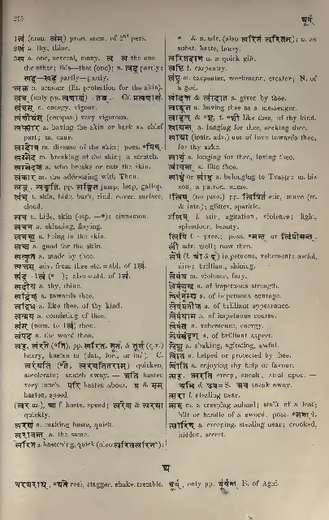
tvác ·f. skin, hide, bark, rind, cover, surface, cloud.
Monier-Williams 1872 substantive feminine · verb
Original text · English · substantive feminine
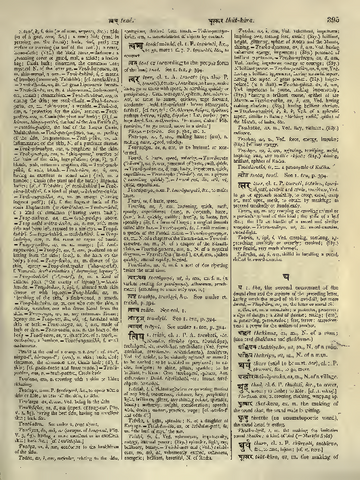
2. tvac, k, f. skin (as of men, serpents, &c.); hide (as of a goat, cow, &c.); a cow's hide (used in pressing out the Soma); bark, rind, peel; any surface or covering (as turf of the earth); a cover, horse-cloth; (Ved.) the black cover, = darkness; a protecting cover or guard, mail, a shield; a leather bag; Cassia bark; cinnamon, the cinnamon tree; mystical N. of the letter ya.
Original text · English · verb
tvac 1 . tvac, cl. 6. P. tvacati, &c., to cover, (a root artificially formed to furnish an etymology for 2. tvac); [cf. Lat. tego; Old Germ. dekiu, ‘to cover;’ Lith. dengiù.]
Petersburger 1855 substantive feminine · Word type unspecified
Original text · German · substantive feminine
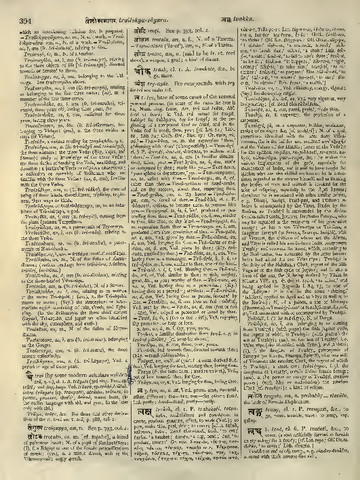
1. √tvac f. UṆĀDIS. 2,63. 1〉 Haut (des Menschen, der Schlange u. s. w.), Fell (der Ziege, Kuh u. s. w.). AK. 2,6,2,13. TRIK. 3,3,76. H. 619. H. 630. H. an. 1,17. MED. c. 6. AV. 1,24,2. tva̱ce rū̱pāyà sa̱ṃdṛśè pratī̱cīnā̀ya te̱ namàḥ AV. 11,2,5. ṚV. 10,87,5. māsya̱ tvacàṃ cikṣipo̱ mā śarī̀ram ṚV. 10,16,1. ahi̱rna jū̱rṇāmatì sarpati̱ tvacàm ṚV. 9,86,44. ŚAT. BR. 2,3,1,6. AV. 9,4,14. AV. 9,5,4. VS. 13,50. yā ha vā iyaṃ gostvakpuruṣe haiṣāgra āsa ŚAT. BR. 3,1,2,13. ŚAT. BR. 4,3,4,26. ŚAT. BR. 12,9,1,2. sarveṣāṃ sparśānāṃ tvagekāyanam ŚAT. BR. 14,5,4,11. ŚAT. BR. 14,6,7,26. ŚAT. BR. 14,9,30,31. indriyaṃ sparśagrāhakaṃ tvaksarvaśarīravarti TARKAS. 9. tvagindriyamātragrāhyo guṇaḥ sparśaḥ TARKAS. 14. SĀṂKHYAK. 26. M. 2,90. ekadhāsya tvacamācchyatāt AIT. BR. 2,6. KĀTY. ŚR. 21,2,5. PĀR. GṚHY. 1,11. M. 4,189. M. 4,221. RAGH. 3,26. āma˚ BHĀG. P. 3,31,27. tvacevāhirvimucyate M. 2,79. M. 11,228. ŚĀK. 170. tvakkeśabālaromāṇi (aśvasya) Cit. beim Schol. zu ŚĀK. 6,5. mṛgasya R. 3,49,9. gardabha˚ Verz. d. Oxf. H. 98,a,1. tvacaṃ sa medhyāṃ paridhāya rauravīm RAGH. 3,31. die Rindshaut, auf welcher der Soma ausgeschlagen wird: adràyastvā bapsati̱ goradhì tva̱ci ṚV. 9,79,4. ṚV. 9,65,25. ṚV. 9,66,29. ṚV. 9,70,7. ṚV. 3,21,5. VS. 19,82. manàve̱ śāsàdavra̱tāntvacàṃ kṛ̱ṣṇāmàrandhayat die schwarze Haut so v. a. den schwarzen Mann ṚV. 1,130,8. Haut so v. als Schlauch, von der Wolke: da̱smo hi ṣmā̱ vṛṣàṇa̱ṃ pinvàsi̱ tvacàm ṚV. 129,3. ṚV. 9,74,5. die sieben Häute des Embryo SUŚR. 1,326,2. tanutvakka SUŚR. 264,2. — 2〉 Decke überh. z. B. Pferdedecke; Oberfläche (der Erde, der sie bedeckende Graswuchs); Rinde VS. 7,47. ya ṛ̱jrā mahyàṃ māma̱he sa̱ha tva̱cā hìra̱ṇyayā̀ ṚV. 8,1,32. sa ī̀ṃ mṛ̱go apyò vana̱rgurupà tva̱cyùpa̱masyā̱ṃ ni dhā̀yi ṚV. 1,145,5. bhūmyā̀ u̱ḥneva̱ vi tvacàṃ bibheda ṚV. 10,68,4. AV. 6,21,1. yo a̱syāḥ pṛ̀thi̱vyāstva̱ci nìva̱rtaya̱tyoṣàdhīḥ TBR. 1,5,5,4; vgl. VS. 1,14. VS. 4,30. Rinde von Pflanzen AK. 2,4,1,12. H. 668. H. 1121. H. an. MED. SUŚR. 1,4,21. SUŚR. 1,133,13. SUŚR. 1,160,16. SUŚR. 2,97,19. RAGH. 2,37. RAGH. 17,12. KUMĀRAS. 1,7. VARĀH. BṚH. S. 45,41. VARĀH. BṚH. S. 80 (79), 2. dhānya˚ AK. 2,9,22. des Puroḍāśa VS. 1,22. schwarze Decke so v. a. Finsterniss, Dunkel: indràdviṣṭā̱mapà dhamanti mā̱yayā̱ tvaca̱masìknī̱ṃ bhūmàno di̱vasparì ṚV. 9,73,5. ṚV. 9,41,1. schützende Bedeckung, Schild u. s. w.: u̱ta tvaca̱ṃ dadàto̱ vājàsātau piprīhi madhva̱ḥ suṣùtasya̱ cāròḥ ṚV. 5,33,7. — 3〉 Cassia-Rinde TRIK. MED. zur Bereitung von Wohlgerüchen verwendet VARĀH. BṚH. S. 76,12. VARĀH. BṚH. S. 76,18. VARĀH. BṚH. S. 76,30. VARĀH. BṚH. S. 76,38. — 4〉 Zimmet VYUTP. 135. Zimmetbaum RĀJAN._im_ŚKDR. — 5〉 myst. Bez. des Buchstabens ya Ind. St. 2,316. — Vgl. sūrya˚.
Original text · German · Word type unspecified
2. tvac , tvacáti bedecken DHĀTUP. 28,18. — Wohl nur eine zur Erklärung von tvac Haut gebildete Wurzel.
Original text · German · Word type unspecified
1. tvac 1〉 pl. Haut Verz. d. Oxf. H. 311,a,1 v. u. — 3〉 AK. 2,4,4,22, wenn man tvak pattram trennt.

Böhtlingk 1879 verbal root · substantive feminine
Original text · German · verbal root
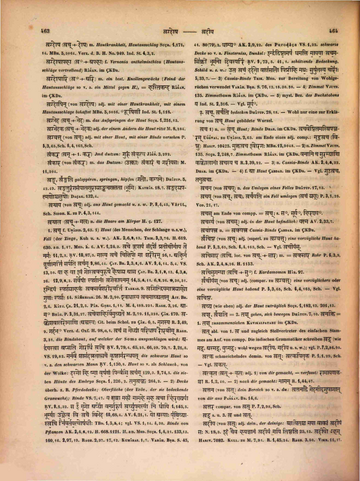
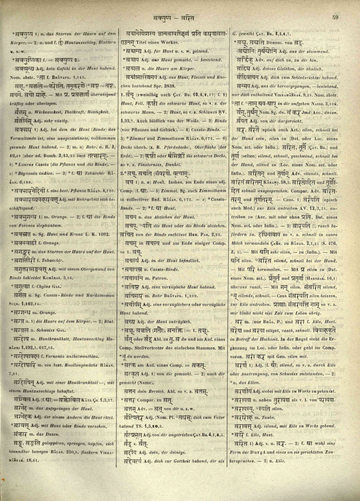
2. *√tvac , tvacati (saṃvaraṇe, vṛtyām).
Original text · German · substantive feminine
1. tvác (zweisilbig nach ŚAT. BR. 10,4,1,17) f. — 1〉 Haut, Fell. kṛṣṇā́ die schwarze Haut So v. a. der schwarze Mann. — 2〉 Haut, so v. a. Schlauch ṚV. 5,33,7. Auch bildlich von der Wolke. — 3〉 Rinde (von Pflanzen und Gebäck). — 4〉 Cassia-Rinde. — 5〉 *Zimmet und Zimmetbaum RĀJAN. 6,172. — 6〉 Decke überh. (z. B. Pferdedecke), Oberfläche (der Erde). — 7〉 kṛṣṇā́ oder ásiknī die schwarze Decke, so v. a. Finsterniss, Dunkel.
Whitney Roots 1885 verbal root
Original text · English · verbal root
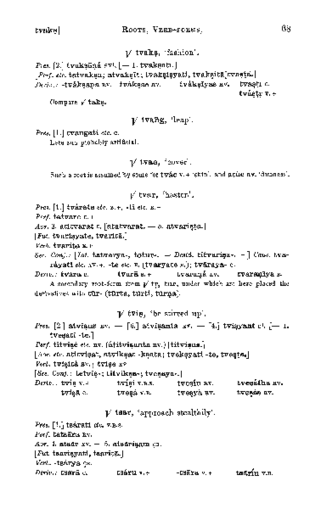
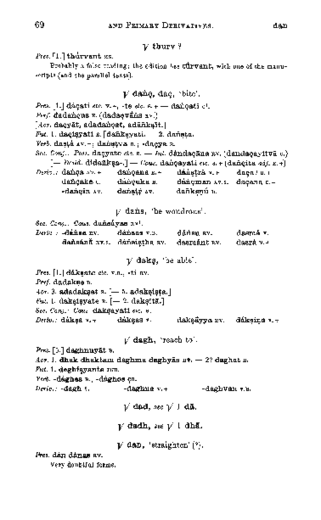
tvac — cover
Apte 1890 verbal root · substantive feminine
Original text · English · verbal root
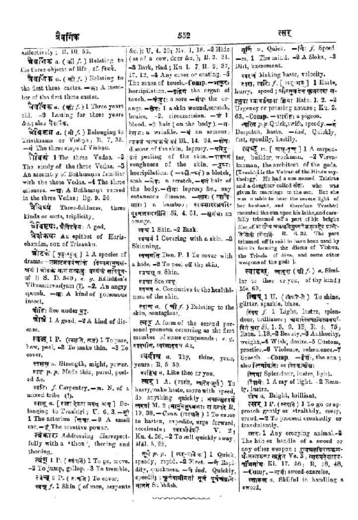
tvac 6 P. (tvacati) To cover.
Original text · English · substantive feminine
tvac f. 1 Skin(of men, serpents ([Page 0552-b]) &c.); U. 4. 20; Mv. 1. 18. 2 Hide (as of a cow, deer &c.); R. 3. 31. 3 Bark, rind; Ku. 1. 7; R. 2, R. 37, R. 17. 12. 4 Any cover or coating. 5 The sense of touch. Comp. — aṃkuraḥ horripilation. — iṃdriyaṃ the organ of touch. — kaṃḍuraḥ a sore — gaṃdhaḥ the orange. — chedaḥ 1 a skin wound, scratch, bruise. 2 circumcision. — jaṃ 1 blood. 2 hair (on the body). — taraṃgakaḥ a wrinkle. — traṃ an armour; tvaktraṃ cācakace varaṃ Bk. 14. 94. — doṣaḥ disease of the skin, leprosy. — paripuṭanaṃ peeling of the skin. — pāruṣyaṃ roughness of the skin. — puṣpaḥ horripilation. — (ṣpī, -ṣpaṃ) a blotch, scab. — bhedaḥ a scratch. — malaṃ hair of the body. — rogaḥ leprosy &c., any cutaneous disease. — sāraḥ ( tvacisāraḥ) a bamboo; tvaksāraraṃdhraparipūraṇalabdhagītiḥ Śi. 4. 61. — sugaṃdhaḥ an orange.
Cappeller 1887 substantive feminine
Original text · German · substantive feminine
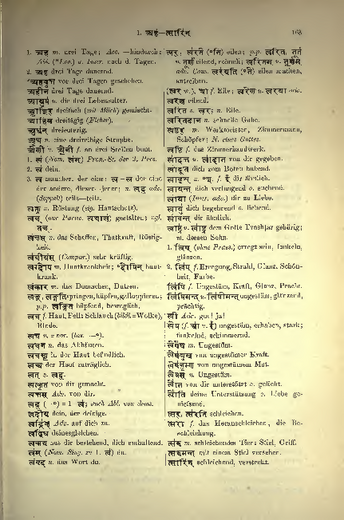
tvac f. Haut, Fell; Schlauch (bildl. = Wolke), Rinde.
Burnouf 1866 verbal root · substantive feminine
Original text · French · verbal root
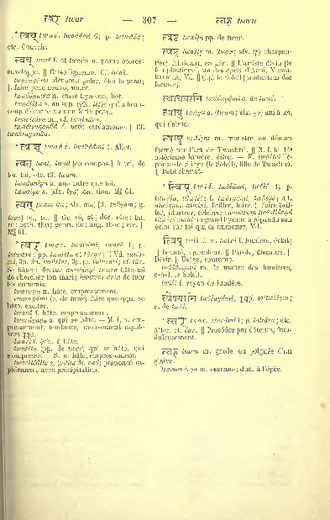
*tvac tvac. tvacāmi 6; p. tatvāca; etc. Couvrir.
Original text · French · substantive feminine
tvac tvac f. et tvaca n. peau; écorce; enveloppe. Casse ligneuse. Cf. tvak. tvacayāmi (dénom.) peler, ôter la peau; faire peau neuve, muer. tvacāpatra n. casse ligneuse, bot. tvaciṣṭha a. au sup. (sfx. iṣṭha) qui a beaucoup d'écorce ou une forte peau. tvacisāra m., cf. tvaksāra. tvacisugandhā f. petit cardamome. Cf. tvaksugandha.
Occurrences in source texts (3)
DYS 1 occurrence
SiSa 1 occurrence
VBT 1 occurrence
Continue with AYI Free
Image source: AYI archive.