
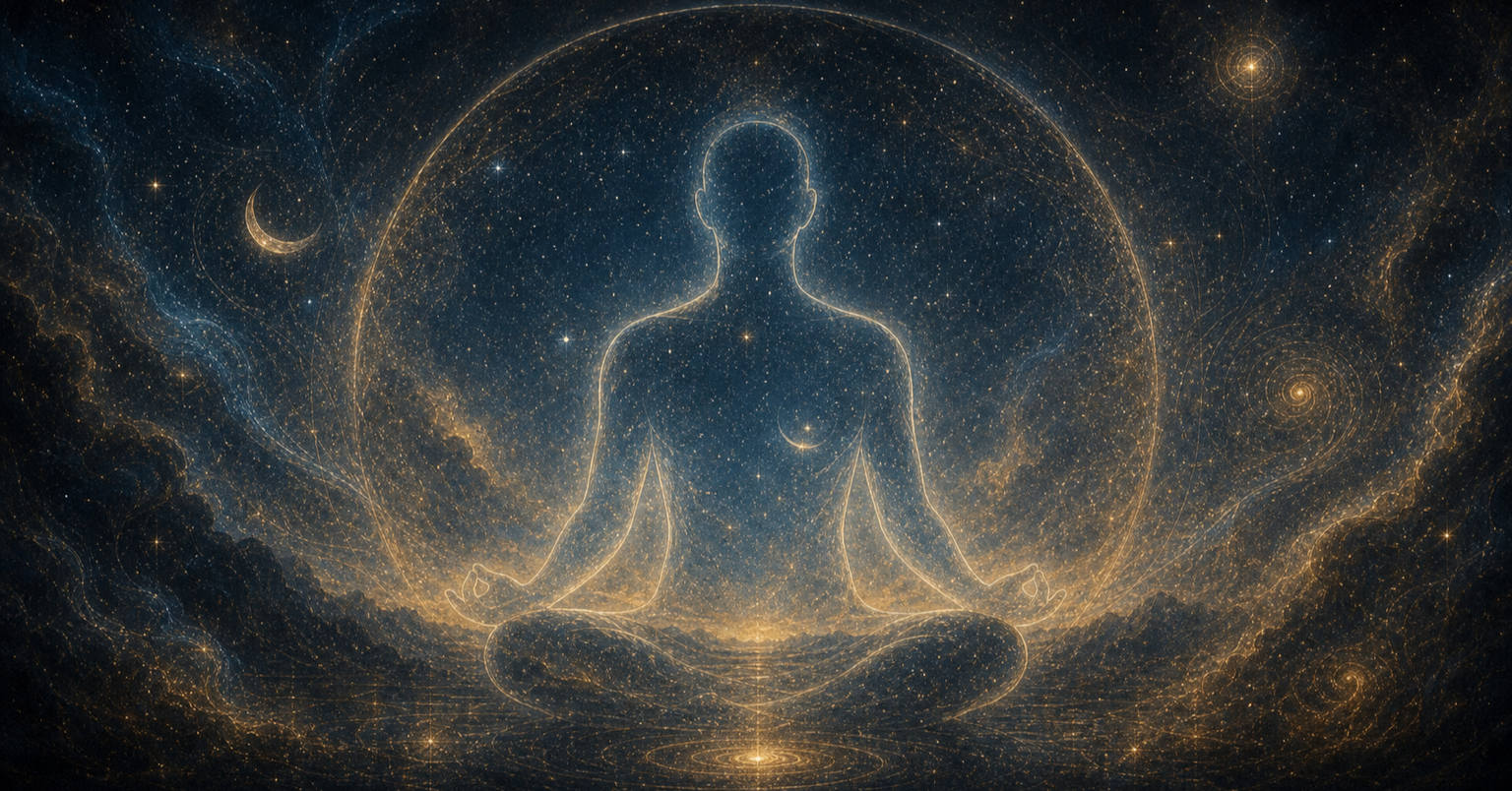
VBT 43-48: Body as Space

Vijñāna Bhairava Tantra 43–48: Body as Space and Boundless Void

The body is viewed as empty inner space pervaded by space; part, substance, and sheath dissolve into vastness.

Dr. Ronald Steiner Dr. Ronald Steiner
Vijñāna Bhairava Tantra 43
निजदेहे सर्वदिक्कं युगपद्भावयेद्वियत् |
nija-dehe sarva-dikkaṃ; yugapad bhāvayed viyat | Analysis ▾ Analysis ▴
nija
karmadhāraya-compound
adjective
own, belonging to the self
dehe
lokative singular
substantive masculine
in the body
sarva
karmadhāraya-compound
adjective
all, every
dikkam
accusative singular
substantive feminine
direction, spatial direction
yugapat
adverb
simultaneously, at the same time
bhāvayet
3rd person singular causative optative
verbal root
should contemplate, meditate
viyat
accusative singular
substantive neuter
space, sky-space
निर्विकल्पमनास्तस्य वियत्सर्वम्प्रवर्तते ||43||
nirvikalpa-manās tasya; viyat sarvam pravartate ||43|| Analysis ▾ Analysis ▴
nirvikalpa
bahuvrīhi-compund nominative
adjective
free of conceptions, without construction
manāḥ
nominative singular masculine
substantive neuter
having mind
tasya
genitive singular masculine
pronoun dem
from this, for him
viyat
nominative singular
substantive neuter
space, sky-space
sarvam
nominative singular neuter
adjective
all, the whole
pravartate
3rd person singular medial present
previx
verbal root
unfolds, appears
Metre: Anuṣṭubh
In one's own body (nija-dehe | loc sg), one should bring to awareness (bhāvayet | 3p sg caus opt) space (viyat | acc sg) simultaneously (yugapat) in all directions (sarva-dikkam | acc sg).
For this one (tasya | gen sg m), whose mind is free of conceptions (nirvikalpa-manāḥ | nom sg m), everything (sarvam | nom sg n) unfolds (pravartate | 3p sg med pres) as space (viyat | nom sg).
Dr. Ronald Steiner - 2026 - historically literal
Feel your own body in all directions at once as space. When the mind no longer grasps at concepts, everything begins to appear as space.
Dr. Ronald Steiner - 2026 - modern transfer
Vijñāna Bhairava Tantra 44
पृष्टशून्यं मूलशून्यं युगपद्भावयेच्च यः |
pṛṣṭa-śūnyaṃ mūla-śūnyaṃ; yugapad bhāvayec ca yaḥ | Analysis ▾ Analysis ▴
pṛṣṭha
tatpuruṣa-compound accusative
substantive neuter
back, upper region
śūnyam
accusative singular neuter
adjective
empty, emptiness
mūla
tatpuruṣa-compound accusative
substantive neuter
root, basis
śūnyam
accusative singular neuter
adjective
empty, emptiness
yugapat
adverb
simultaneously, at the same time
bhāvayet
3rd person singular causative optative
verbal root
should contemplate, meditate
ca
particle
and
yaḥ
nominative singular masculine
pronoun rel
who
शरीरनिरपेक्षिण्या शक्त्या शून्यमना भवेत् ||44||
śarīra-nirapekṣiṇyā; śaktyā śūnya-manā bhavet ||44|| Analysis ▾ Analysis ▴
śarīra
tatpuruṣa-compound instrumental case
substantive neuter
body
nirapekṣiṇyā
instrumental case singular feminine
adjective
independent, not dependent
śaktyā
instrumental case singular
substantive feminine
through the power, energy
śūnya
karmadhāraya-compound
adjective
empty, emptiness
manāḥ
nominative singular masculine
substantive neuter
having mind
bhavet
3rd person singular aktive optative
verbal root
becomes, may become
Metre: Anuṣṭubh
Whoever (yaḥ | nom sg m) simultaneously (yugapat) brings to awareness (bhāvayet | 3p sg caus opt) the upper emptiness (pṛṣṭha-śūnyam | acc sg n) and the root emptiness (mūla-śūnyam | acc sg n), becomes (bhavet | 3p sg act opt), through the power independent of the body (śarīra-nirapekṣiṇyā śaktyā | ins sg), of empty mind (śūnya-manāḥ | nom sg m).
Dr. Ronald Steiner - 2026 - historically literal
Hold at the same time the emptiness above and the emptiness at the root. Then a power no longer dependent on the body carries the mind into emptiness.
Dr. Ronald Steiner - 2026 - modern transfer
Vijñāna Bhairava Tantra 45
पृष्टशून्यं मूलशून्यं हृच्छून्यम्भावयेत्स्थिरम् |
pṛṣṭa-śūnyaṃ mūla-śūnyaṃ; hṛc-chūnyam bhāvayet sthiram | Analysis ▾ Analysis ▴
pṛṣṭha
tatpuruṣa-compound accusative
substantive neuter
back, upper region
śūnyam
accusative singular neuter
adjective
empty, emptiness
mūla
tatpuruṣa-compound accusative
substantive neuter
root, basis
śūnyam
accusative singular neuter
adjective
empty, emptiness
hṛd
tatpuruṣa-compound accusative
substantive neuter
heart
śūnyam
accusative singular neuter
adjective
empty, emptiness
bhāvayet
3rd person singular causative optative
verbal root
should contemplate, meditate
sthiram
accusative singular neuter
adjective
firm, constant
युगपन्निर्विकल्पत्वान्निर्विकल्पोदयस्ततः ||45||
yugapan nirvikalpatvān; nirvikalpodayas tataḥ ||45|| Analysis ▾ Analysis ▴
yugapat
adverb
simultaneously, at the same time
nirvikalpatvāt
ablative singular
substantive neuter
because of freedom from conception
nirvikalpa
karmadhāraya-compound
adjective
free of conception, free of construction
udayaḥ
nominative singular
substantive masculine
arising, emergence
tataḥ
adverb
from that, then, therefore
Metre: Anuṣṭubh
One should bring to awareness (bhāvayet | 3p sg caus opt) the upper emptiness (pṛṣṭha-śūnyam | acc sg n), the root emptiness (mūla-śūnyam | acc sg n), and the heart-emptiness (hṛc-chūnyam | acc sg n) firmly (sthiram | acc sg n).
Then (tataḥ), from freedom from conception (nirvikalpatvāt | abl sg), the arising of the conception-free state (nirvikalpa-udayaḥ | nom sg) [occurs] at the same time (yugapat).
Dr. Ronald Steiner - 2026 - historically literal
Abide in the emptiness above, the emptiness at the root, and the emptiness of the heart. When this becomes steady, freedom from concepts gives rise, at the same time, to the thought-free state.
Dr. Ronald Steiner - 2026 - modern transfer
Vijñāna Bhairava Tantra 46
तनूदेशे शून्यतैव क्षणमात्रं विभावयेत् |
tanū-deśe śūnyataiva; kṣaṇa-mātraṃ vibhāvayet | Analysis ▾ Analysis ▴
tanū
tatpuruṣa-compound lokative
substantive feminine
body, body
deśe
lokative singular
substantive masculine
at one place, in one area
śūnyatā
nominative singular
substantive feminine
voidness, emptiness
eva
particle
precisely, exactly, truly
kṣaṇa
tatpuruṣa-compound accusative
substantive masculine
instant, moment
mātram
accusative singular neuter
adjective
only, merely
vibhāvayet
3rd person singular causative optative
previx
verbal root
should contemplate, bring to awareness
निर्विकल्पं निर्विकल्पो निर्विकल्पस्वरूपभाक् ||46||
nirvikalpaṃ nirvikalpo; nirvikalpa-svarūpa-bhāk ||46|| Analysis ▾ Analysis ▴
nirvikalpam
accusative singular neuter
adjective
free of conception, free of construction
nirvikalpaḥ
nominative singular masculine
adjective
free of conception, free of construction
nirvikalpa
karmadhāraya-compound
adjective
of conceptionless
svarūpa
tatpuruṣa-compound genitive
substantive neuter
own form, true essence
bhāk
nominative singular masculine
adjective
participating, possessing
Metre: Anuṣṭubh
At one place of the body (tanū-deśe | loc sg), one should bring to awareness (vibhāvayet | 3p sg caus opt), even for just a moment (kṣaṇa-mātram | acc sg n), emptiness itself (śūnyatā eva).
Conception-free (nirvikalpam | acc sg n), the conception-free one (nirvikalpaḥ | nom sg m) becomes a participant in the own form of freedom from conception (nirvikalpa-svarūpa-bhāk | nom sg m).
Dr. Ronald Steiner - 2026 - historically literal
For just a moment, perceive any place in the body as pure emptiness. When this perception happens without inner construction, the mind itself comes to share in thought-free reality.
Dr. Ronald Steiner - 2026 - modern transfer
Vijñāna Bhairava Tantra 47
सर्वं देहगतं द्रव्यं वियद्व्याप्तं मृगेक्षणे |
sarvaṃ deha-gataṃ dravyaṃ; viyad-vyāptaṃ mṛgekṣaṇe | Analysis ▾ Analysis ▴
sarvam
accusative singular neuter
adjective
all, whole
deha
tatpuruṣa-compound accusative
substantive masculine
body
gatam
accusative singular neuter past participle passive
verbal root
gone, situated
dravyam
accusative singular neuter
substantive neuter
substance, material, component
viyat
tatpuruṣa-compound accusative
substantive neuter
space, sky-space
vyāptam
accusative singular neuter past participle passive
previx
verbal root
pervaded, filled
mṛga
bahuvrīhi-compund vokative
substantive masculine
gazelle, deer
īkṣaṇe
vokative singular feminine
īkṣaṇa
adjective
gazing, eyed
विभावयेत्ततस्तस्य भावना सा स्थिरा भवेत् ||47||
vibhāvayet tatas tasya; bhāvanā sā sthirā bhavet ||47|| Analysis ▾ Analysis ▴
vibhāvayet
3rd person singular causative optative
previx
verbal root
should contemplate, bring to awareness
tataḥ
adverb
thereby, then, from that
tasya
genitive singular masculine
pronoun dem
from this, for him
bhāvanā
nominative singular
substantive feminine
meditation, contemplation
sā
nominative singular feminine
pronoun dem
these
sthirā
nominative singular feminine
adjective
firm, constant
bhavet
3rd person singular aktive optative
verbal root
becomes, may become
Metre: Anuṣṭubh
Everything (sarvam | acc sg n) that is substance located in the body (deha-gataṃ dravyam | acc sg), O gazelle-eyed one (mṛgekṣaṇe | voc sg f), one should bring to awareness (vibhāvayet | 3p sg caus opt) as pervaded by space (viyad-vyāptam | acc sg n ppp).
Thereby (tataḥ), for this one (tasya | gen sg m), that meditation (sā bhāvanā | nom sg) becomes (bhavet | 3p sg act opt) firm (sthirā | nom sg f).
Dr. Ronald Steiner - 2026 - historically literal
Contemplate every tissue and substance of the body as pervaded by space. In this way, meditation on space and emptiness becomes stable.
Dr. Ronald Steiner - 2026 - modern transfer
Vijñāna Bhairava Tantra 48
देहान्तरे त्वग्विभागम्भित्तिभूतं विचिन्तयेत् |
dehāntare tvag-vibhāgam; bhitti-bhūtaṃ vicintayet | Analysis ▾ Analysis ▴
deha
tatpuruṣa-compound lokative
substantive masculine
body
antare
lokative singular
substantive neuter
inside, in the interior
tvac
tatpuruṣa-compound accusative
substantive feminine
skin
vibhāgam
accusative singular
substantive masculine
separation, division, limitation
bhitti
tatpuruṣa-compound accusative
substantive feminine
wall
bhūtam
accusative singular neuter past participle passive
verbal root
become, being
vicintayet
3rd person singular aktive optative
previx
verbal root
should contemplate, imagine
न किंचिदन्तरे तस्य ध्यायन्नध्येयभाग्भवेत् ||48||
na kiṃcid antare tasya; dhyāyann adhyeya-bhāg bhavet ||48|| Analysis ▾ Analysis ▴
na
particle
not
kiṃcit
accusative singular neuter
pronoun inter
suffix
something, anything
antare
lokative singular
substantive neuter
inside, within
tasya
genitive singular masculine
pronoun dem
from that, from it
dhyāyan
nominative singular masculine present participle active
verbal root
meditating
adhyeya
tatpuruṣa-compound genitive future participle passive
previx
verbal root
of what is to be meditated upon, of the meditation object
bhāk
nominative singular masculine
adjective
participating, possessing
bhavet
3rd person singular aktive optative
verbal root
becomes, may become
Metre: Anuṣṭubh
Inside the body (deha-antare | loc sg), one should contemplate (vicintayet | 3p sg act opt) the skin-boundary (tvag-vibhāgam | acc sg) as having become wall-like (bhitti-bhūtam | acc sg n ppp).
Meditating (dhyāyan | nom sg m pca) that nothing (na kiṃcit | acc sg n) [is] inside it (tasya | gen sg m; antare | loc sg), [the practitioner] becomes (bhavet | 3p sg act opt) a participant in what is not to be meditated on (adhyeya-bhāk | nom sg m).
Dr. Ronald Steiner - 2026 - historically literal
Imagine the body as a space whose skin is only a wall. Inside, there is nothing graspable. Whoever meditates in this way comes into contact with what is no longer an ordinary object of meditation.
Dr. Ronald Steiner - 2026 - modern transfer

Continue with AYI Free

Illustrations: AI-generated.

Editor

Dr. Ronald Steiner

From Ulm

The "Yoga Doc" - Dr. Ronald Steiner is the founder of the AYI method. This method links traditional Ashtanga Yoga with innovative Yogatherapy and living Philosophy. This forms a practice that is personal for each and... more ›

Messages and ratings
0 messages

Please log in to write a message. Go to login

No messages yet.