

brāhmaṇa ब्राह्मण – Brahmane; Brahmin
Adjektiv · Substantiv Maskulin · Substantiv Neutrum · Worttyp nicht bestimmt
Wörterbuchquellen
AYI Wörterbuch Substantiv Maskulin
Brahmane; Brahmin
Cappeller 1891 Substantiv Maskulin · Worttyp nicht bestimmt
Originaltext · Englisch · Substantiv Maskulin
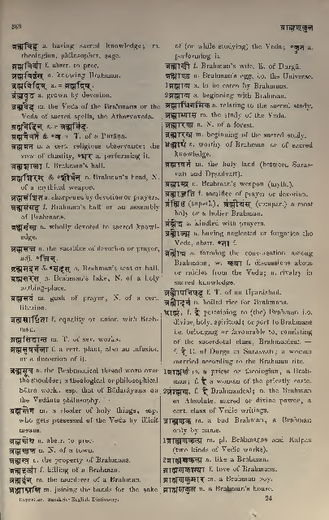
brāhmaṇá1 ·m. a priest or theologian, a Brahman; f. ī a woman of the priestly caste.
Originaltext · Englisch · Worttyp nicht bestimmt
brā́hmaṇa ·f. ī2 Brahmanical; n. the Brahman or Absolute, sacred or divine power, a cert. class of Vedic writings.
Monier-Williams 1872 Adjektiv
Originaltext · Englisch · Adjektiv
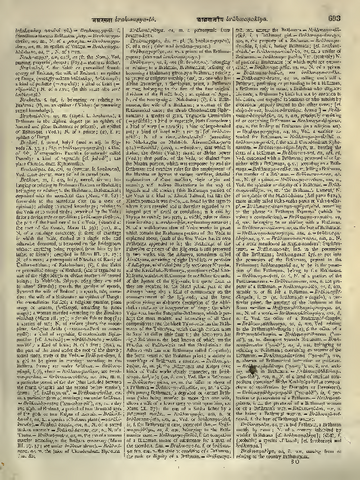
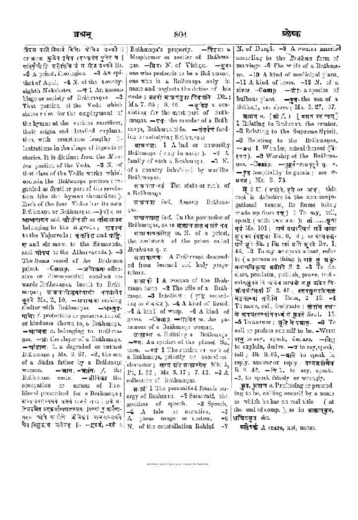
Brāhmaṇa, as, ī, am (fr. brahman), belonging or relating to a Brāhman, Brāhmanical, befitting or becoming a Brāhman; given by a Brāhman; relating to prayer or religious worship; (as), m. one who has divine knowledge, a theologian, priest, a Brāhman or man belonging to the first of the four original divisions of the Hindū body; an epithet of Agni; N. of the twenty-eighth Nakṣatra; (ī), f. a Brāh- maness, the wife of a Brāhman; a woman of the Brāhmanical caste; the shrub Clerodendrum Sipho- nanthus; a species of grass, Trigonella Corniculata (= pṛkkā); a kind of vegetable, Ruta Graveolens; a kind of wasp (= varaṭī); a kind of large-headed ant; a kind of lizard with a red tail [cf. brāhma- ṇikā]; N. of a river, = brahmāṇī; (according to Nīla-kaṇṭha on Mahā-bh. Āśvamedhika-parva 924) = buddhi; (am), n. = brahma, that which is divine, the divine (Ved.); sacred or divine power (Ved.); that portion of the Veda, as distinct from the Mantra portion, which was composed by and for Brāhmans and contains rules for the employment of the Mantras or hymns at various sacrifices, detailed explanations of these sacrifices, their origin and meaning, with tedious illustrations in the way of legends and old stories; (this Brāhmaṇa portion of the Veda is a kind of Hindū Talmud, but like the Mantra portion it was śruta, i. e. heard by the sages to whom it was revealed and is therefore regarded as an integral part of śruti or revelation; it is said by Sāyaṇa to contain two parts, 1. vidhi, rules or direc- tions for rites; 2. artha-vāda, explanatory remarks); N. of a well-known class of Vedic works in prose which contain the Brāhmaṇa portion of the Veda as explained above, (each of the four Vedas has its own Brāhmaṇa appended to it; the Brāhmaṇa of the Bahvṛcas or priests of the Ṛg-veda is still preserved in two works, viz. the Aitareya, sometimes called Āśvalāyana, consisting of eight Pañcikās or pentads of Adhyāyas, subdivided into 285 sections or Khaṇḍas, and the Kauṣītaki-Brāhmaṇa, sometimes called Śāṅ- khāyana, which two Brāhmaṇas do not follow the order of the hymns of the Ṛg-veda, but quote them as they are required for the Hotṛ priest, part of the Aitareya being also a kind of commentary on the commencement of the Ṛg-veda, and the latter portion giving an elaborate description of the Abhi- sheka ceremony or inauguration of kings; the white Yajur-veda has the Śatapatha-Brāhmaṇa, which is per- haps the most modern and interesting of all these compositions; and the black Yajur-veda has the Brāh- maṇa of the Taittirīyas, which though distinct from its Saṃhitā differs little from it; the Sāma-veda has eight Brāhmaṇas, the best known of which are the Prauḍha or Pañca-viṃśa and the Ṣaḍ-viṃśa; the Atharva-veda has one Brāhmaṇa called Go-patha); the Soma vessel of the Brahman priest; a society or assemblage of Brāhmans, a conclave.
Petersburger 1855 Adjektiv · Substantiv Maskulin · Substantiv Neutrum · Worttyp nicht bestimmt
Originaltext · Deutsch · Adjektiv · Substantiv Maskulin · Substantiv Neutrum
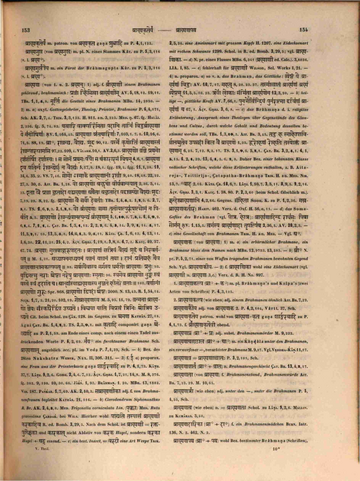
brāhmaṇa (von 1. u. 2. brahman) 1〉 adj. f. brā́hmaṇī einem Brahmanen gehörend, brahmanisch: pra̱jāṃ hìṃsi̱tvā brāhmàṇīm AV. 5,18,12. AV. 5,19,11. TBR. 1,1,4,8. mūrti die Gestalt eines Brahmanen MBH. 14,2890. — 2〉 m. a〉 oxyt. Gottesgelehrter, Theolog, Priester, Brahmane P. 6,4,171, Sch. AK. 2,7,4. TRIK. 3,3,135. H. 811. H. an. 3,225. MED. ṇ. 67. fg. HALĀY. 2,236. fg. HALĀY. 5,74. fg. HALĀY. 5,82. ca̱tvāri̱ vākparìmitā pa̱dāni̱ tānì vidurbrāhma̱ṇā ye mànī̱ṣiṇàḥ ṚV. 1,164,45. brā̱hma̱ṇā vràtacā̱riṇàḥ ṚV. 7,103,1. ṚV. 7,103,7. ṚV. 7,103,8. ṚV. 10,16,6. ṚV. 10,71,9. ṚV. 10,88,19. brā˚, rājanya, vaiśya, śūdra ṚV. 10,90,12. yasmaì kṛ̱ṇotì brāhma̱ṇastaṃ rā̀janpārayāmasi ṚV. 97,22. ṚV. 109,4. VĀLAKH. 10,1. AV. 2,6,3. brā̱hma̱ṇo jàjñe pratha̱mo daśàśīrṣo̱ daśā̀syaḥ . sa somàṃ pratha̱maḥ pàpau̱ sa càkārāra̱saṃ vi̱ṣam AV. 4,6,1. brā̱hma̱ṇa e̱va pati̱rna rā̀ja̱nyo̱3̱̀ na vaiśyàḥ AV. 5,17,9. AV. 5,18,1. fgg. AV. 5,19,2. fgg. AV. 11,1,28. AV. 19,34,6. AV. 19,35,2. VS. 7,46. somo̱ 'smākàṃ brāhma̱ṇānā̱ṃ rājā̀ VS. 9,40. VS. 18,48. VS. 22,22. VS. 27,3. VS. 30,5. AIT. BR. 1,28. yo brāhmaṇo bahvṛco vīryavānsyāt AIT. BR. 2,36. AIT. BR. 5,14. AIT. BR. 5,23. etā vai prajā hutādo yadbrāhmaṇā athaitā ahutādo yadrājanyo vaiśyaḥ śūdraḥ AIT. BR. 7,19. AIT. BR. 7,29. AIT. BR. 8,22. fg. brā̱hma̱ṇo vai sarvā̀ de̱vatā̀ḥ TBR. 1,4,4,2. TBR. 1,1,2,5. TBR. 1,4,4,6. TBR. 2,7,3,1. TS. 1,6,7,2. TS. 2,1,2,8. yo brā̀hma̱ṇaḥ sannā tṛ̱tīyā̱tpurùṣā̱tsoma̱ṃ na pibàti TS. 5,5. brā̱hma̱ṇo rā̀ja̱nyàvā̱natya̱nyaṃ brā̀hma̱ṇam TS. 5,1,10,3. TS. 5,7,3,4. TS. 6,4,9,2. TS. 6,6,1,4. TS. 7,1,1,4. ŚAT. BR. 1,5,1,12. ŚAT. BR. 2,2,2,6. ŚAT. BR. 2,4,3,14. ŚAT. BR. 3,9,1,14. ŚAT. BR. 3,9,4,17. ŚAT. BR. 11,5,7,1. ŚAT. BR. 11,5,7,10. ŚAT. BR. 13,5,4,8. ŚAT. BR. 14,6,1,3. ŚAT. BR. 14,9,4,11. KĀTY. ŚR. 1,6,13. KĀTY. ŚR. 4,13,11. KĀTY. ŚR. 5,6,30. KĀTY. ŚR. 22,11,21. KĀTY. ŚR. 25,4,2. ĀŚV. GṚHY. 1,19,1. ĀŚV. GṚHY. 3,8,6. ĀŚV. GṚHY. 4,7,2. KAUŚ. 49. KAUŚ. 57. KAUŚ. 67. KAUŚ. 74. (brahmā) mukhabāhūrupādataḥ . brāhmaṇaṃ kṣatriyaṃ vaiśyaṃ śūdraṃ ca niravartayat .. M. 1,31. adhyāpanamadhyayanaṃ yājanaṃ tathā . dānaṃ pratigrahaṃ caiva brāhmaṇānāmakalpayat .. M. 88. sarvasyaivāsya sargasya dharmato brāhmaṇaḥ prabhuḥ M. 93. buddhimatsu narāḥ śreṣṭhā nareṣu brāhmaṇāḥ smṛtāḥ M. 96. svameva brāhmaṇo bhuṅkte svaṃ vaste svaṃ dadāti ca . ānṛśaṃsyādbrāhmaṇasya bhuñjate hītare janāḥ .. M. 101. varṇānāṃ brāhmaṇo guruḥ Spr. 868. brāhmaṇo dvipadāṃ śreṣṭhaḥ Spr. 2000. N. 13,43. R. 1,54,14. SUŚR. 1,7,2. SUŚR. 1,21,20. SUŚR. 1,102,19. gobrāhmaṇasya M. 5,95. M. 11,79. janmanā brāhmaṇo jñeyaḥ saṃskārairdvija ucyate . vidyayā yāti vipratvaṃ tribhiḥ śrotriya ucyate Cit. beim Schol. zu ŚĀK. 128. im Gegens. zu śramaṇa KATHĀS. 27,18. Agni ŚAT. BR. 1,4,2,2. TS. 2,5,9,1. mit kṛtādi componirt gaṇa śreṇyādi zu P. 2,1,59. am Ende eines comp. nach einem einen Tadel ausdrückenden Worte P. 6,2,69. bháya˚ ein furchtsamer Brahmane Sch. brāhmaṇāt angeblich acc. pl. im Veda P. 7,1,39, Sch. — b〉 Bez. des 28ten Nakṣatra WEBER, Nax. II, 306. WEBER, Nax. II,311. — 3〉 f. ī a〉 proparox. eine Frau aus der Priesterkaste gaṇa śārṅgaravādi zu P. 4,1,73. KĀṬH. 37,7. LĀṬY. 9,2,6. GOBH. 2,4,6. GOBH. 2,7,12. ĀŚV. GṚHY. 1,7,21. ĀŚV. GṚHY. 1,14,8. M. 8,376. fg. M. 8,382. M. 9,198. fg. M. 10,30. fg. M. 10,66. YĀJÑ. 1,93. BRĀHMAṆ. 1,20. MBH. 13,1882. VID. 187. PAÑCAR. 1,7,69. AK. 2,10,3. sabrāhmaṇīkā adj. f. von Brahmanenfrauen begleitet KATHĀS. 21,116. — b〉 Clerodendrum Siphonanthus R. Br. AK. 2,4,3,8. MED. Trigonella corniculata Lin. (pṛkkā) MED. Ruta graveolens ŚABDAC._bei_WILS. Hierher wohl paśyati tasyāntaṃ brāhmaṇī karakādiva R. ed. Bomb. 3,29,5. Nach dem Schol. ist brāhmaṇī = raktapucchikā und kārakāt nicht Ablativ von karaka Hagel, sondern karakā Hagel + ad essend. — c〉 ein best. Insect, = varaṭī eine Art Wespe TRIK. 2,5,34. eine Ameisenart mit grossem Kopfe H. 1207. eine Eidechsenart mit rothem Schwanze H. 1299. Schol. in R. ed. Bomb. 3,29,5; vgl. brāhmaṇikā. — d〉 N. pr. eines Flusses MBH. 6,341 (brahmāṇī ed. Calc.) 3,8036. LIA. I, 85. — e〉 fehlerhaft für brahmāṇī WILSON, Sel. Works I, 21. — 4〉 n. proparox. a〉 so v. a. das Brahman, das Göttliche: jye̱ṣṭhaṃ ye brāhmàṇaṃ vi̱duḥ AV. 10,7,17. mahat AV. 8,20. AV. 10,23. AV. 10,37. tasmā̀jjā̱taṃ brāhmàṇa̱ṃ brahmà jye̱ṣṭham AV. 11,5,5. AV. 11,5,10. AV. 11,5,23. trayò lo̱kāḥ saṃmìtā̱ brāhmàṇena AV. 12,3,20. — b〉 heilige —, göttliche Kraft AV. 7,66,1. puna̱rmaitvìndri̱yaṃ punàrā̱tmā dravìṇa̱ṃ brāhmàṇaṃ ca AV. 7,67,1. ĀŚV. GṚHY. 3,6,8. — c〉 das Brāhmaṇa d. i. religiöse Erläuterung, Ausspruch eines Theologen über Gegenstände des Glaubens und Cultus, durch welche Gehalt und Bedeutung desselben bestimmt werden soll, TBR. 1,3,10,3. AIT. BR. 3,45. tadu ha smāhopāvirjānaśruteya upasadāṃ kila vai brāhmaṇe AIT. BR. 1,25. dūrohaṇaṃ rohati tasyoktaṃ brāhmaṇam AIT. BR. 6,25. AIT. BR. 7,12. AIT. BR. 8,2. AIT. BR. 8,17. TS. 3,1,9,5. TS. 3,5,2,1. ŚAT. BR. 3,2,4,1. ŚAT. BR. 3,2,4,1. ŚAT. BR. 3,2,5,15. ŚAT. BR. 3,2,4,6. ŚAT. BR. 3,2,4,2. ŚAT. BR. 3,2,1,39. ŚAT. BR. 13,4,1,5. ŚAT. BR. 13,4,1,6. ŚAT. BR. 13,4,2,8. Daher Bez. einer bekannten Klasse vedischer Schriften, welche diese Erläuterungen enthalten, z. B. Aitareya-, Taittirīya-, Śatapatha-Brāhmaṇa TRIK. H. an. MED. NIR. 13,7. ˚vāda NIR. 2,16. KĀTY. ŚR. 18,6,7. LĀṬY. 1,10,7. LĀṬY. 3,5,11. LĀṬY. 8,9,5. LĀṬY. 9,2,16. ĀŚV. GṚHY. 3,3. ĀŚV. GṚHY. 3,1. KAUŚ. 1,58. KAUŚ. 1,80. P. 2,3,60 (beim Schol. fälschlich m.). chandobrāhmaṇāni P. 4,2,66. Gegens. saṃhitā SIDDH. K._zu_P. 1,2,36. mantrabrāhmaṇakartāraḥ HARIV. 462. Verz. d. Oxf. H. 56,a,11. — b〉 das Soma- Gefäss des Brahman (vgl. potra. hotra): brāhmàṇādindra̱ rādhàsa̱ḥ pibā̱ somàm ṚV. 1,15,5. tvamàsya̱ brāhmàṇā̱dā tṛ̱patpìba ṚV. 2,36,5. AV. 20,2,3. — e〉 eine Gesellschaft von Brahmanen TRIK. H. an. MED. — Vgl. a˚.
Originaltext · Deutsch · Worttyp nicht bestimmt
brāhmaṇa 2〉a〉 Z. 26 füge hinzu brāhmaṇaśramaṇanyāyāt so v. a. nach der Art, wie man unter brāhmaṇaśramaṇa einen brahmanischen Asketen versteht, obgleich diese Verbindung einen Widerspruch enthält und einen brahmanischen Buddhisten bezeichnet, SĀH. D. 103,12. just as we use the word «Brahman-mendicant» which, though it etymologically means an absurdity viz. a mendicant, or one not a Brāhman, who is a Brāhman, tropically signifies one who was a Brāhman, BALLANT. — 3〉f〉 araṇīṃ brāhmaṇīṃ viddhi gururasyottarāraṇiḥ . tapaḥśrute 'bhimathnīto jñānāgnirjāyate tataḥ .. MBH. 14,924. nach NĪLAK. = buddhi.
Böhtlingk 1879 Adjektiv · Substantiv Maskulin · Substantiv Neutrum
Originaltext · Deutsch · Adjektiv · Substantiv Neutrum
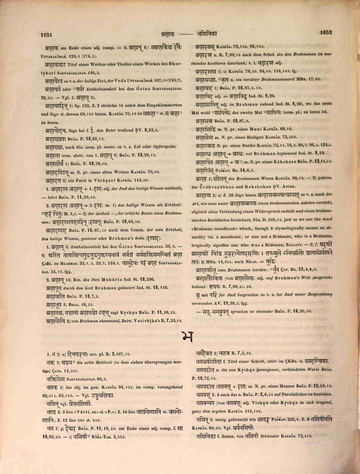
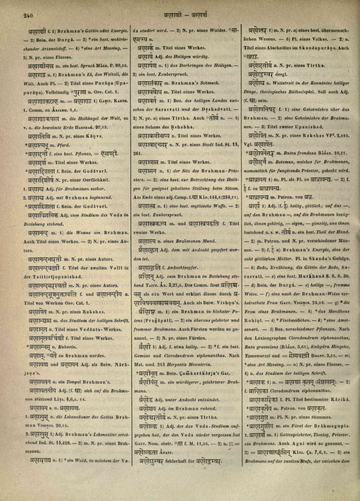
2. brā́hmaṇa — 1〉 Adj. (f. ī) einem Brahmanen gehörig, brahmanisch. — 2〉 f. ī (nach den Grammatikern brā́hmaṇī) — a〉 eine Frau aus der Priesterkaste. — b〉 eine Eidechsenart mit rothem Schwanze. — c〉 eine Ameisenart mit grossem Kopfe. — d〉 eine Wespenart. — e〉 Clerodendrum siphonanthus. — f〉 Trigonella corniculata BHĀVAPR. 1,194. — g〉 Ruta graveolens. — h〉 eine Art Messing RĀJAN. 13,29. — i〉 angeblich = buddhi Verstand. — k〉 N. pr. eines Flusses MBH. 6,9,33. — l〉 fehlerhaft für brahmāṇī — 3〉 n. — a〉 das Brahman, das Göttliche. — b〉 heilige —, göttliche Kraft. — c〉 religiöse Erläuterung, Ausspruch eines Theologen über Gegenstände des Glaubens und Cultus, durch welche Gehalt und Bedeutung derselben bestimmt werden soll. — d〉 eine Klasse vedischer Werke, welche diese Erläuterungen enthalten. — e〉 das Soma-Gefäss des Brahman-Priesters. — f〉 eine Gesellschaft von Brahmanen.
Originaltext · Deutsch · Substantiv Maskulin
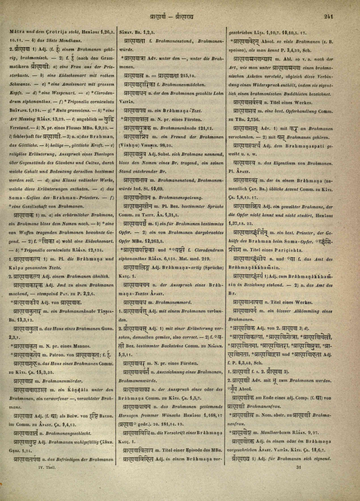
1. brāhmaṇá m. — 1〉 Gottesgelehrter, Theolog, Priester, ein Brahmane. Auch Agni wird so genannt. — 2〉 = brāhmaṇācchaṃsin KĀTY. ŚR. 7,6,5. — 3〉 ein Brahmane auf der zweiten Stufe, der zwischen dem [Page4-241-a] Mātra und dem Śrotriya steht, HEMĀDRI 1,26,3. 10. 11. — 4〉 das 28ste Mondhaus.
Apte 1890 Adjektiv · Substantiv Maskulin · Substantiv Neutrum
Originaltext · Englisch · Adjektiv · Substantiv Maskulin · Substantiv Neutrum
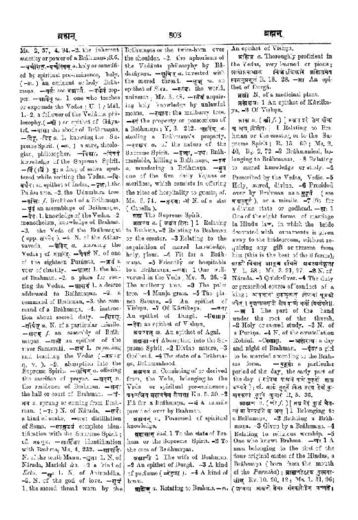
brāhmaṇa a. (ṇī f.) [brahma vedaṃ śuddhaṃ caitanyaṃ vā vettyadhīte vā aṇ] 1 Belonging to a Brāhmaṇa. 2 Befitting a Brāhmaṇa. 3 Given by a Brāhmaṇa. 4 Relating to religious worship. 5 One who knows Brahma. — ṇaḥ 1 A man belonging to the first of the four original castes of the Hindus, a Brāhmaṇa (born from the mouth of the Puruṣa); brāhmaṇo'sya mukhamāsīt Rv. 10. 90. 12; Ms. 1. 31, Ms. 1. 96; (janmanā brāhmaṇo jñeyaḥ saṃskāraidvija ucyate . ([Page 0804-a]) vidyayā yāti vipratvaṃ tribhiḥ śrotriya ucyate .. or jātyā kulena vṛttena svādhyāyena śrutena ca . ebhiryukto hi yastiṣṭhennityaṃ sa dvija ucyate ..). 2 A priest, theologian. 3 An epithet of Agni. 4 N. of the twentyeighth Nakṣatra. — ṇaṃ 1 An assemblage or society of Brāhmaṇas. 2 That portion of the Veda which states rules for the employment of the hymns at the various sacrifices, their origin and detailed explanation, with sometimes lengthy illustrations in the shape of legends or stories. It is distinct from the Mantra portion of the Veda. 3 N. of that class of the Vedic works which contain the Brāhmaṇa portion (regarded as Śruti or part of the revelation like the hymns themselves). Each of the four Vedas has its own Brāhmaṇa or Brāhmaṇas: — aitareya or āśvalāyana and kauśītakī or sāṃkhyāyana belonging to the Ṛgveda; śatapatha to the Yajurveda; paṃvaviṃśa and ṣaḍviṃśa and six more, to the Sāmaveda, and gopatha to the Atharvaveda. 4 The Soma vessel of the Brahman priest. Comp. — atikramaḥ offensive or disrespectful conduct towards Brāhmaṇas, insult to Brāhmaṇas; brāhmaṇātikramatyāgo bhavatāmeva bhūtaye Mv. 2. 10. — apāśrayaḥ seeking shelter with Brāhmaṇas. — abhyupapāttiḥ f. protection or preservation of, or kindness shown to, a Brāhmaṇa. — ātmaka a. belonging to Brāhmaṇas. — ghnaḥ the slayer of a Brāhmaṇa. — cāṃḍālaḥ 1 a degraded or outcast Brāhmaṇa; Ms. 9. 87. 2 the son of a Śūdra father by a Brāhmaṇī woman. — jātaṃ, -jātiḥ f. the Brāhmaṇa caste. — jīvikā the occupation or means of livelihood prescribed for a Brāhmaṇa; adhyāpanamadhyayanaṃ yajanaṃ yājanaṃ tathā . dānaṃ pratigrahaścaiva ṣaṭkarmāṇyagrajanmanaḥ .. ṣaṇṇāṃ tu karmaṇāmasya trīṇi karmāṇi jīvikā . yājanādhyāpane caiva viśuddhācca pratigrahaḥ ... — dravyaṃ, -svaṃ a ([Page 0804-b]) Brāhmaṇa's property. — niṃdakaḥ a blasphemer or reviler of Brāhmaṇas. — priyaḥ N. of Viṣṇu. — bruvaḥ one who pretends to be a Brāhmaṇa, one who is a Brāhmaṇa only in name and neglects the duties of his caste; bahavo brāhmaṇabruvā nivasaṃti Dk.; Ms. 7. 85; Ms. 8. 20. — bhūyiṣṭha a. consisting for the most part of Brāhmaṇas. — vadhaḥ the murder of a Brāhmaṇa, Brāhmanicide. — saṃtarpaṇaṃ feeding or satisfying Brāhmaṇas.
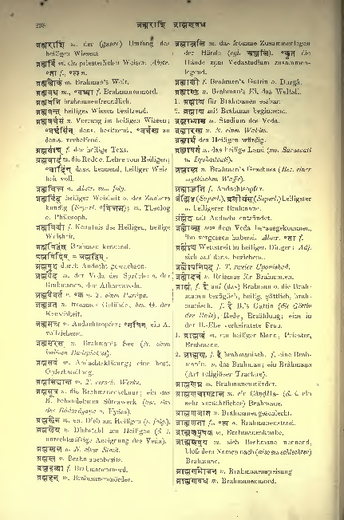
Cappeller 1887 Worttyp nicht bestimmt
Originaltext · Deutsch · Worttyp nicht bestimmt
2. brā́hmaṇa f. ī brahmanisch. f. eine Brahmanin. n. das Brahman; ein Brāhmaṇa (Art religiöser Trachtate).
Burnouf 1866 Worttyp nicht bestimmt
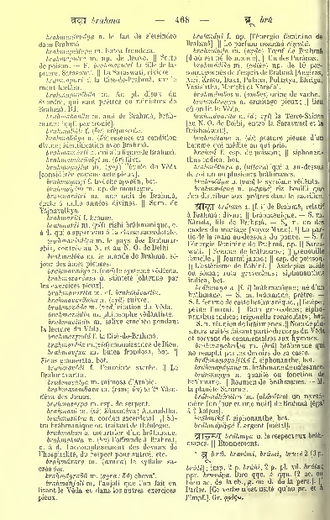
Originaltext · Französisch · Worttyp nicht bestimmt
brāhmaṇa a [f. ī] brâhmanique; né d'un brâhmane. — S. m. brâhmane, prêtre. — S. f. femme de caste brâhmanique. Guêpe; petite fourmi. Ruta graveolens; siphonanthus indica; trigonella corniculata; bot. — S. n. réunion de brâhmanes. Nom de plusieurs traités faisant partie du corps du Veda et servant de commentaires aux hymnes.
Quelltextfundstellen (2)
DYS 1 Fundstelle
MAN 1 Fundstelle
Mit AYI Free weitermachen
Bildquelle: AYI Archiv.