

buddha बुद्ध – Buddha
Adjektiv · Substantiv Maskulin · Substantiv Neutrum · Worttyp nicht bestimmt
Wörterbuchquellen
AYI Wörterbuch Substantiv Maskulin
Buddha
Cappeller 1891 Adjektiv
Originaltext · Englisch · Adjektiv
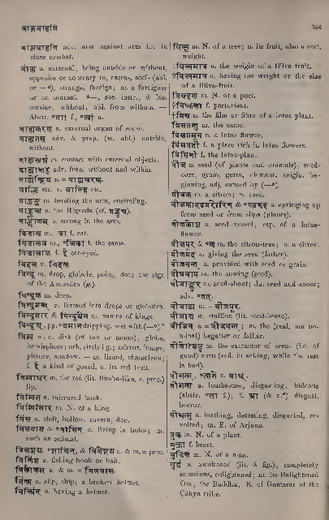
buddhá ·a. awakened (lit. & fig.), completely conscious, enlightened; m. the Enlightened One, the Buddha, E. of Gautama of the Cakya tribe.
Monier-Williams 1872 Adjektiv · Worttyp nicht bestimmt
Originaltext · Englisch · Adjektiv
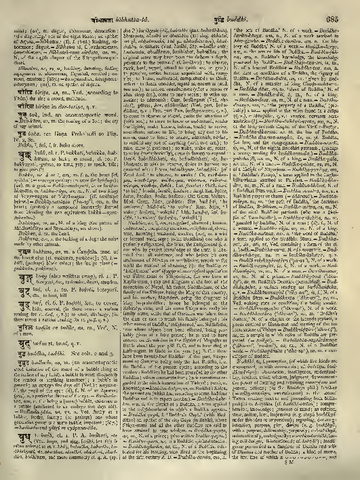
Buddha, as, ā, am, recognised, observed; known, understood; completely conscious, enlightened, clever, wise, knowing; wakened, awake; (as), m. a wise or learned man, sage; (with Buddhists) one who is perfectly enlightened, the Wise, the Enlightened (i. e. one who by perfect knowledge of the truth is libe- rated from all existence, and who before his own attainment of Nirvāṇa or annihilation reveals to the world the method of obtaining it); the Buddha or ‘Enlightened’ κατ’ ἐξοχήν whose original appellation was Śākya-muni or Śākya-siṃha, (he was born at Kapila-vastu, a city and kingdom at the foot of the mountains of Nepal, his father, Śuddhodana, of the family of the Śākyas, being the king of that country, and his mother, Māyādevī, being the daughter of king Su-prabuddha; hence he belonged to the Kṣatriya caste, and his name Śākya was really his family name, while that of Gautama was taken from the class or race to which his family belonged; his other names of Buddha, ‘enlightened,’ and Siddhārtha, ‘one whose objects have been effected,’ being pro- bably given at a later period; he is said to have entered on his mission in the district of Magadha or Behār about the year 588 B. C. and to have died at Kuśi-nagara in Oude in the year 543 B. C.; there have been twenty-four Buddhas of the past, Śākya- muni or Gautama being only the last Buddha, i. e. the Buddha of the present cycle; according to the northern Buddhists he had been preceded by six other Buddhas; others enumerate four; he is sometimes re- garded as the ninth incarnation of Viṣṇu); (am), n. knowledge.
Originaltext · Englisch · Worttyp nicht bestimmt
buddha buddha, buddhi. See cols. 2 and 3.
Petersburger 1855 Adjektiv · Substantiv Maskulin · Worttyp nicht bestimmt
Originaltext · Deutsch · Adjektiv · Substantiv Maskulin
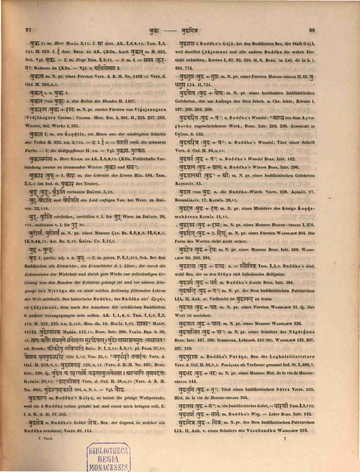
buddha 1〉 partic. adj. s. u. budh. — 2〉 m. parox. P. 6,1,205, Sch. Bei den Buddhisten ein Erwachter, ein Erleuchteter d. i. Einer, der durch die Erkenntniss der Wahrheit und durch gute Werke zur vollständigen Erlösung von den Banden der Existenz gelangt ist und vor seinem Eingange inʼs Nirvāṇa die zu einer solchen Erlösung führenden Lehren der Welt mittheilt. Der historische Buddha, der Buddha ϰατ᾽ ἐξοχήν, ist Śākyamuni, dem nach der Annahme der nördlichen Buddhisten 6 andere vorangegangen sein sollen. AK. 1,1,1,8. TRIK. 1,1,8. TRIK. 3,3,219. H. 232. H. 235. H. an. 2,243. MED. dh. 10. HALĀY. 1,85. śākya˚ HARIV. 11142. buddhopāsaka MṚCCH. 113,11. BURN. Intr. 280. VARĀH. BṚH. S. 58,44. tataḥ kalau saṃpravṛtte saṃmohāya suradviṣām . buddho nāmnāñjanasutaḥ (nāmnājana˚ ed. Bomb.) kīkaṭeṣu bhaviṣyati BHĀG. P. 1,3,24. BHĀG. P. 6,8,17. pl. PRAB. 57,10. keśava dhṛtabuddhaśarīra GĪT. 1,13. VOP. 25,1. ˚vapurdhārī janārdanaḥ Verz. d. Oxf. H. 253,b,7. buddhāvatāra Verz. d. Oxf. H. 129,a,22 (Verz. d. B. H. No. 495). BURN. Intr. 338. fg. buddhena ca parasyārthe karuṇākulacetasā . ātmāpi tṛṇavaddattaḥ KATHĀS. 28,10. ˚dvādaśīvrata Verz. d. Oxf. H. 58,a,31 (Verz. d. B. H. No. 485). buddhotpādakāle Verz. d. Oxf. H. 304,a, N. 1. — Vgl. bauddha.
Originaltext · Deutsch · Worttyp nicht bestimmt
buddha 2〉 eine Incarnation Viṣṇuʼs MĀTSYA-P._bei_MUIR, ST. (2te Aufl.) 4,156.
Böhtlingk 1879 Adjektiv · Substantiv Maskulin · Substantiv Neutrum
Originaltext · Deutsch · Adjektiv · Substantiv Maskulin · Substantiv Neutrum
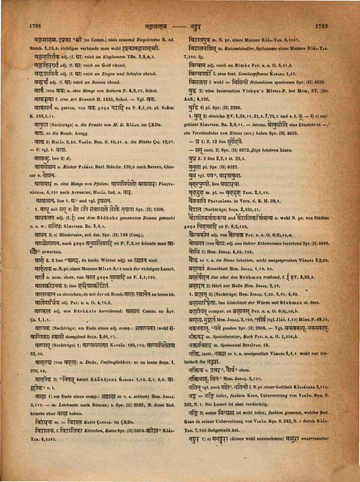
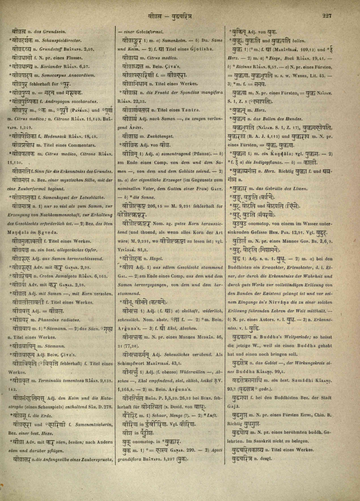
buddha — 1〉 Adj. s. u. 1. budh. — 2〉 m. — a〉 bei den Buddhisten ein Erwachter, Erleuchteter, d. i. Einer, der durch die Erkenntniss der Wahrheit und durch gute Werke zur vollständigen Erlösung von den Banden der Existenz gelangt ist und vor seinem Eingange inʼs Nirvāṇa die zu einer solchen Erlösung führenden Lehren der Welt mittheilt. — b〉 N. pr. eines Autors. v. l. budha. — 3〉 n. Erkenntniss. v. l. buddhi.
Apte 1890 Adjektiv · Substantiv Maskulin · Substantiv Neutrum
Originaltext · Englisch · Adjektiv · Substantiv Maskulin · Substantiv Neutrum
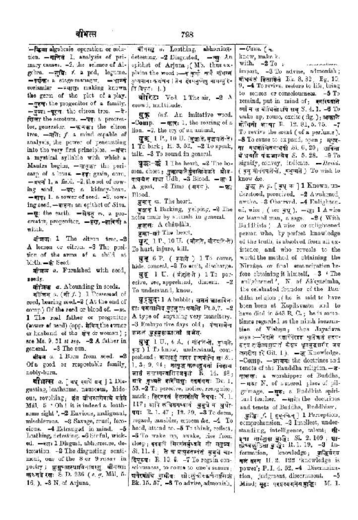
buddha p. p. [budh-kta] 1 Known, understood, perceived. 2 Awakened, awake. 3 Observed. 4 Enlightened, wise; (see budh). — ddhaḥ 1 A wise or learned man, a sage. 2 (With Buddhists) A wise or enlightened person who, by perfect knowledge of the truth, is absolved from all existence, and who reveals to the world the method of obtaining the Nirvāṇa or final emancipation before obtaining it himself. 3 ‘The enlightened’, N. of Śākyasiṃha, the celebrated founder of the Bauddha religion; (he is said to have been born at Kapilavastu and to have died in 543 B. c.; he is sometimes regarded as the ninth incarnation of Viṣṇu; thus Jayadeva says: -niṃdasi yajñavidherahaha śrutijātaṃ sadayahṛdaya dārśitapaśughātaṃ keśava dhṛtabuddhaśarīra jaya jagadīśa hare Gīt. 1). — ddhaṃ Knowledge. Comp. — āgamaḥ the doctrines and tenets of the Bauddha religion. — upāsakaḥ a worshipper of Buddha. — gayā N. of a sacred place of pilgrimage. — guruḥ a Buddhist spiritual teacher. — mārgaḥ the doctrines and tenets of Buddha, Buddhism.
Cappeller 1887 Worttyp nicht bestimmt
Originaltext · Deutsch · Worttyp nicht bestimmt
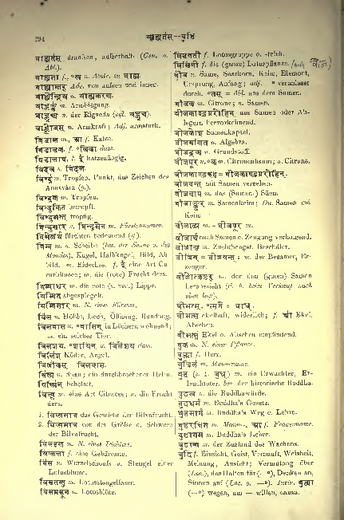
buddha (s. 1. budh) m. ein Erwachter, Erleuchteter, bes der historische Buddha.
Burnouf 1866 Worttyp nicht bestimmt
Originaltext · Französisch · Worttyp nicht bestimmt
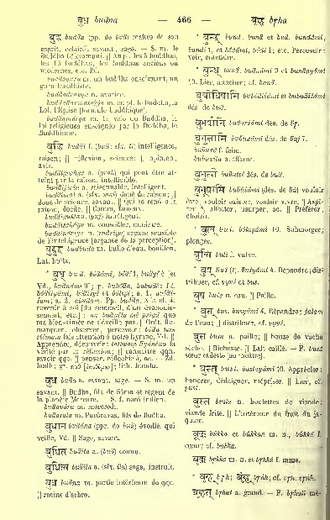
buddha buddha (pp. de budh) maître de son esprit, éclairé, savant, sage. — S. m. le Buddha Śākyamuni. Au pl. les 5 buddhas, les 16 buddhas, les buddhas anciens ou modernes, etc. Bd. buddhaguru m. un buddha enseignant, un guru buddhiste. buddhadravya n. avarice. buddhadharmasaṅgha m. au pl. le Buddha, la Loi, l'Eglise [formule buddhique]. buddhamārga m. la voie du Buddha, la loi religieuse enseignée par le Buddha, le Buddhisme.
Quelltextfundstellen (1)
HP 1 Fundstelle
Mit AYI Free weitermachen
Bildquelle: AYI Archiv.