

rākṣasa राक्षस – den Rakṣas eigen, rakshasisch.
Adjektiv · Substantiv Maskulin · Substantiv Neutrum · Worttyp nicht bestimmt
Wörterbuchquellen
Cappeller 1891 Worttyp nicht bestimmt
Originaltext · Englisch · Worttyp nicht bestimmt
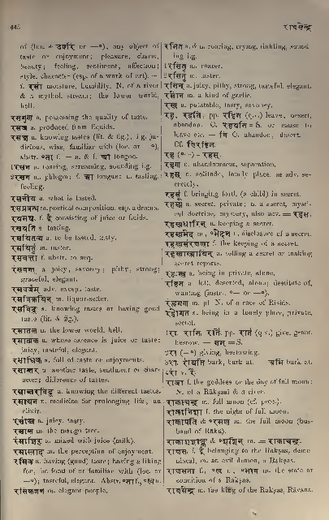
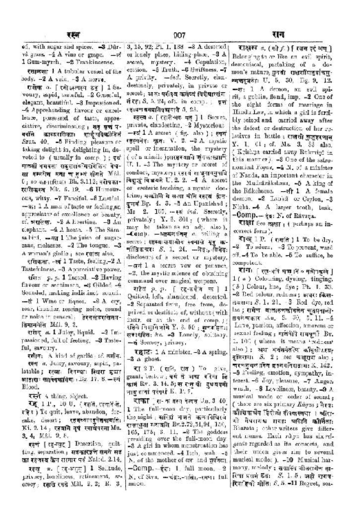
rākṣasa ·f. ī belonging to the Rakṣas, demoniacal, m. an evil demon, a Rakṣas.
Monier-Williams 1872 Adjektiv
Originaltext · Englisch · Adjektiv
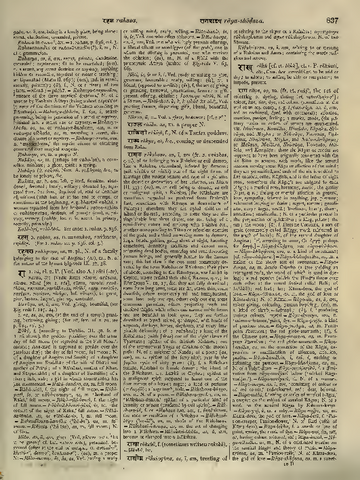
rākṣasa rākṣasa, as, ī, am (fr. 2. rakṣas, q. v.), of or belonging to a Rakṣas or evil demon, like a Rakṣas, demoniacal, infested by demons; (scil. vivāha or vidhi) one of the eight forms of marriage (the violent seizure and rape of a girl after the defeat or destruction of her relatives, see Manu III. 33); (as), m. an evil being or demon, an evil or malignant spirit, a Rakṣas, (the Rākṣasas are sometimes regarded as produced from Brahmā's foot, sometimes with Rāvaṇa as descendants of Pulastya; elsewhere they are styled children of Khasā or Su-rasā; according to some they are dis- tinguishable into three classes, one sort being of a semi-divine nature and ranking with Yakṣas &c., another corresponding to Titans or relentless enemies of the gods, and a third answering more to demons, imps, fiends, goblins, going about at night, haunting cemeteries, disturbing sacrifices and devout men, animating dead bodies, ensnaring and even devouring human beings, and generally hostile to the human race; this last class is the one most commonly de- noted by the term Rakṣas or Rākṣasa; their place of abode, according to the Rāmāyaṇa, was Laṅkā in Ceylon, where resided their chief, Rāvaṇa, q. v.; in Rāmāyaṇa V. 10, 17, &c. they are fully described; some have long arms, some are fat, others thin, some dwarfish, others enormously tall and humpbacked, some have only one eye, others only one ear, some enormous paunches, others projecting teeth and crooked thighs, while others can assume noble forms and are beautiful to look upon; they are further described as biped, triped, quadruped, with heads of serpents, donkeys, horses, elephants, and every ima- ginable deformity; cf. 2. rakṣas); a king of the Rākṣasas; (with Jainas) one of the eight classes of Vyantaras; epithet of the thirtieth Muhūrtha; one of the astronomical Yogas or divisions of the moon's path; N. of a minister of Nanda; of a poet; (as, am), m. n. epithet of the forty-ninth year in the Jupiter cycle of sixty years; (ī), f. a Rākṣasa female, Rākṣasī or female demon; the island of the Rākṣasas, i. e. Laṅkā or Ceylon; epithet of a malignant spirit supposed to haunt one of the four corners of a house; night; a kind of perfume (= caṇḍā); a large tooth, tusk.
Petersburger 1855 Adjektiv · Substantiv Maskulin · Substantiv Neutrum
Originaltext · Deutsch · Adjektiv · Substantiv Maskulin · Substantiv Neutrum
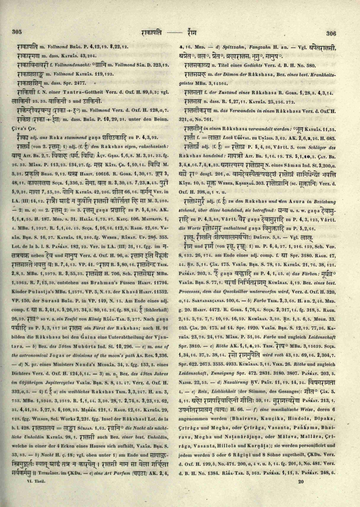
rākṣasá (von 2. rakṣas) 1〉 adj. (f. ī) den Rakṣas eigen, rakshasisch: vāc AIT. BR. 2,7. vivāha (dharma, vidhi) ĀŚV. GṚHY. 1,6,8. M. 3,21. fg. M. 3,23. M. 3,26. fg. M. 3,33. MĀRK. P. 113,23. MĀRK. P. 134,27. fg. mantra KĀTY. ŚR. 1,10,14. vidhi M. 5,31. prakṛti BHAG. 9,12. astra HARIV. 10616. R. GORR. 1,30,17. rūpa R. GORR. 3,48,11. kāyalakṣaṇa SUŚR. 1,336,2. senā, bala R. 3,30,45. R. 7,23,3,45. purī R. 5,9,31. māyā R. 7,15,30. yoni KATHĀS. 42,206. śīla KATHĀS. 66,16. karman VET. in LA. (III) 14,12. rātrau śrāddhaṃ na kurvīta rākṣasī kīrtitā hi sā M. 3,280. — 2〉 m. a〉 = 2. rakṣas 2〉 = 3. rakṣas gaṇa prajñādi zu P. 5,4,38. AK. 1,1,1,55. H. 187. MED. s. 31. HALĀY. 1,73. HALĀY. 1,87. KAUŚ. 106. MAITRYUP. 1,4. MBH. 1,5927. R. 1,1,40. R. 1,1,45 SUŚR. 1,16,16. SUŚR. 1,112,3. RAGH. 12,68. VARĀH. BṚH. S. 16,37. KATHĀS. 18,280. fg. WEBER, RĀMAT. UP. 286. WEBER, RĀMAT. UP. 355. Lot. de la b. l. 8. PAÑCAT. 182,22. VET. in LA. (III) 31,11. fgg. im nakṣatracakra neben deva und mānuṣa Verz. d. Oxf. H. 96,a. rakṣāma iti yairuktaṃ rākṣasāste bhavantu vaḥ R. 7,4,13. VP. 41. ˚rājya R. 5,80,16. rākṣasendra TRIK. 2,8,5. MBH. 1,5979. R. 3,55,35. rākṣaseśa H. 706, Sch. rākṣaseśvara MBH. 1,5962. R. 7,15,30. entstehen aus Brahmanʼs Füssen HARIV. 11794. Kinder Pulastyaʼs MBH. 1,2571. VP. 5, N. 13. der Khasā HARIV. 11552. VP. 150. der Surasā BHĀG. P._in_VP. 149, N. 15. Am Ende eines adj. comp. f. ā R. 3,41,8. fg. R. 5,26,37. R. 5,34,3. fg. R. 5,80,16. R. 5,26,28. fg. R. 5,88,24. ī (fehlerhaft) R. 3,26,39. rāja˚ so v. a. ein Teufel von König RĀJA-TAR. 5,277. Nach gaṇa parśvādi zu P. 5,3,117 ist rākṣasa ein Fürst der Rakṣas; nach H. 91 bilden die Rākṣasa bei den Jaina eine Unterabtheilung der Vyantara. — b〉 Bez. des 30ten Muhūrta Ind. St. 10,296. — c〉 m. one of the astronomical Yogas or divisions of the moonʼs path As. Res. 9,336. — d〉 N. pr. eines Ministers Nandaʼs MUDRĀR. 34,2. fgg. MUDRĀR. 153,5. eines Dichters Verz. d. Oxf. H. 124,b,14. — 3〉 m.n. Bez. des 49ten Jahres im 60jährigen Jupitercyclus VARĀH. BṚH. S. 8,45. VARĀH. BṚH. S. 8,47. Verz. d. Oxf. H. 332,a,5. — 4〉 f. ī a〉 ein weibliches Rakṣas TRIK. 3,3,247. H. an. 3,753. MBH. 1,5940. MBH. 3,2519. R. 1,1,44. R. 1,3,30. R. 1,28,7. R. 2,74,8. R. 3,23,12. R. 3,62,34. R. 4,41,38. R. 5,27,9. R. 6,108,35. MṚCCH. 121,1. RAGH. 12,61. KATHĀS. 29,128. fgg. WILSON, Sel. Works 2,231. fgg. Insel der Rākṣasī Lot. de la b. l. 428. rākṣasālaya = laṅkā SŪRYAS. 1,62. rajani˚ die Nacht als nächtliche Unholdin KATHĀS. 98,1. rākṣasī auch Bez. einer best. Unholdin, welche in einer der KATHĀS. 4 Ecken eines Hauses sich aufhält, VARĀH. BṚH. S. 53,83. — b〉 Nacht H. ś. 18; vgl. oben unter 1〉 am Ende und sāyāhnastrimuhūrtaḥ syāt śrāddhaṃ tatra na kārayet . rākṣasī nāma sā velā garhitā sarvakarmasu .. TITHYĀDIT._im_ŚKDR. — c〉 eine Art Parfum (caṇḍā) AK. 2,4,4,16. MED. — d〉 Spitzzahn, Fangzahn H. an. — Vgl. apetarākṣasī, apreta˚, jala˚, preta˚, brahmarākṣasa, bhṛgu˚, mānuṣa˚.
Böhtlingk 1879 Adjektiv · Substantiv Maskulin · Substantiv Neutrum
Originaltext · Deutsch · Adjektiv · Substantiv Maskulin · Substantiv Neutrum
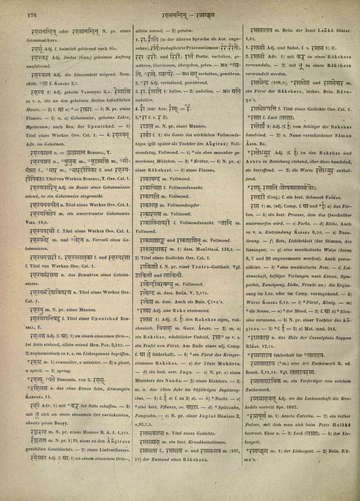
rākṣasa — 1〉 Adj. (f. ī) den Rakṣas eigen, rakshasisch. vivāha m. GAUT. ĀPAST. — 2〉 m. — a〉 ein Rakṣas, nächtlicher Unhold. rāja˚ so v. a. ein Teufel von Fürst. Am Ende eines adj. Comp. f. ā (ī fehlerhaft). — b〉 *ein Fürst des Kriegerstammes Rakṣas — c〉 der 30ste Muhūrta. — d〉 ein best. astr. Yoga. — e〉 N. pr. — α〉 eines Ministers des Nanda. — β〉 eines Dichters. — 3〉 m. n. das 49ste Jahr im 60jährigen Jupitercyclus. — 4〉 f. ī — a〉 f. zu 2〉a〉. — b〉 *Nacht. — c〉 *eine best. Pflanze, = caṇḍā. — d〉 *Spitzzahn, Fangzahn. — e〉 N. pr. einer Yoginī HEMĀDRI 2,1,93,7. 9.
Apte 1890 Adjektiv · Substantiv Maskulin
Originaltext · Englisch · Adjektiv · Substantiv Maskulin
rākṣasa a. (sī f.) [rakṣasa idaṃ aṇ] Belonging to or like an evil spirit, demoniacal, partaking of a demon's nature; munayo rākṣasīmāhurvācamunmattadṛptayoḥ U. 5. 30, Bg. 9. 12. — saḥ 1 A demon, an evil spirit, a goblin, fiend, imp. 2 One of the eight forms of marriage in Hindu Law, in which a girl is forcibly seized and carried away after the defeat or destruction of her relatives in battle; rākṣaso yuddhaharaṇāt Y. 1. 61; cf. Ms. 3. 33 also. (Kṛṣṇa carried away Rukmiṇī in this manner). 3 One of the astronomical Yogas. 4 N. of a minister of Nanda, an important character in the Mudrārākṣasa. 5 A king of the Rākṣasas. — sī 1 A female demon. 2 Laṅkā or Ceylon. 3 Night. 4 A larger tooth, tusk. Comp. — iṃdraḥ N. of Rāvaṇa.
Cappeller 1887 Worttyp nicht bestimmt
Originaltext · Deutsch · Worttyp nicht bestimmt
rākṣasa, f. ī den Rakshas eigen. m. ein Raskṣas (adj.) —˚ f. ā; N. eines Ministers.
Burnouf 1866 Adjektiv
Originaltext · Französisch · Adjektiv
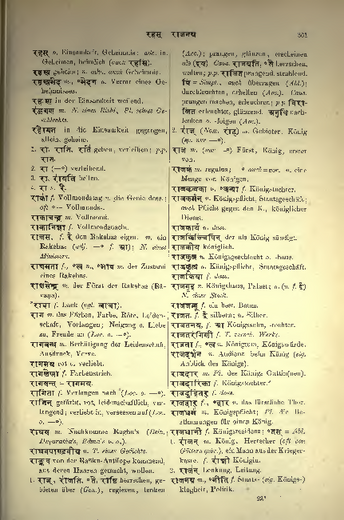
rākṣasa rākṣasa a. (rakṣas) de rakṣas; diabolique. — S. m. un rakṣas. — F. [ī] femelle de rākṣasa. Grande dent, défense. — N. mode de mariage [cf. Manu III, 33]. Chirurgie. rākṣasendra m. (indra) Kuvera Rāvaṇa.
Quelltextfundstellen (1)
SiSa 1 Fundstelle
Mit AYI Free weitermachen
Bildquelle: AYI Archiv.