

sthāvara स्थावर – Feststehenden; Unbeweglichen
Adjektiv · Substantiv Maskulin · Substantiv Neutrum · Worttyp nicht bestimmt
Wörterbuchquellen
AYI Wörterbuch Adjektiv
Feststehenden; Unbeweglichen
Cappeller 1891 Adjektiv
Originaltext · Englisch · Adjektiv
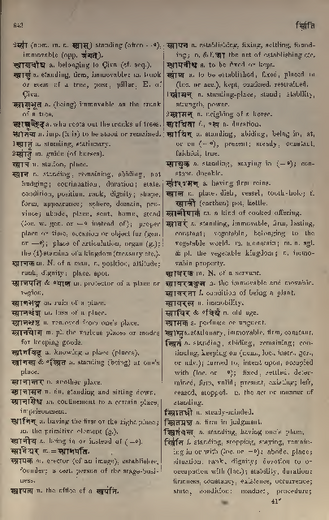
sthāvará ·a. standing, immovable, firm, lasting, constant; vegetable, belonging to the vegetable world. m. mountain; m. n. sgl. & pl. the vegetable kingdom; n. immovable property.
Monier-Williams 1872 Adjektiv · Worttyp nicht bestimmt
Originaltext · Englisch · Adjektiv
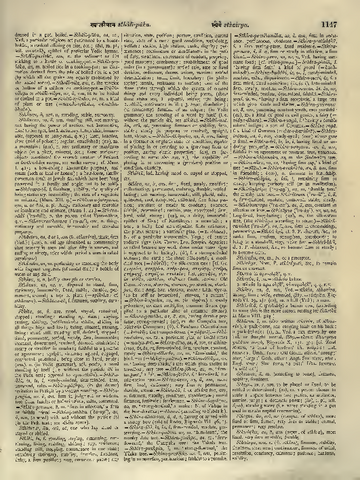
Sthāvara, as, ā, am, standing still, not moving, not having the power of motion, not locomotive, fixed to one spot, fixed, stationary, firm, stable, immov- able, (opposed to jaṅgama, q. v.); inert, inactive, slow (said of poison); regular, established; (as), m. a mountain; (am), n. any stationary or inanimate object (as a plant, mineral, &c.; these stationary objects constituted the seventh creation of Brahmā or tasthuṣāṃ sarga, see under sarga; cf. Manu I. 41); a bow-string; immovable property, real estate (such as land or houses); a heir-loom, family possession (such as jewels &c. which have been long preserved in a family and ought not to be sold).
Originaltext · Englisch · Worttyp nicht bestimmt
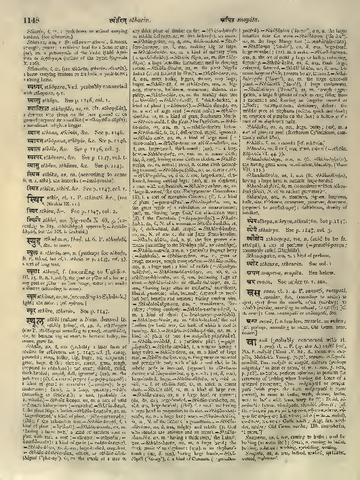
sthāvara sthāvara, &c. See p. 1147, col. 1.
Petersburger 1855 Adjektiv · Substantiv Maskulin · Substantiv Neutrum · Worttyp nicht bestimmt
Originaltext · Deutsch · Adjektiv · Substantiv Maskulin · Substantiv Neutrum
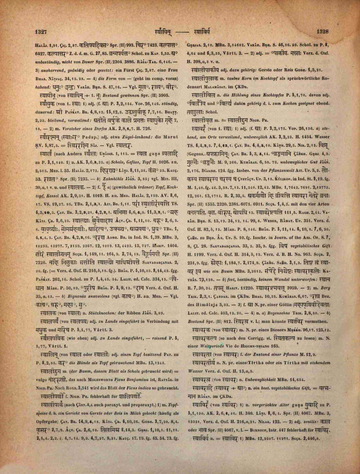
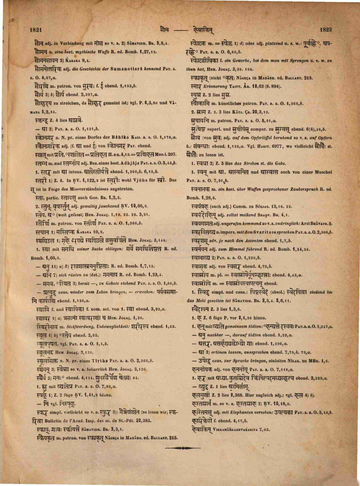
sthāvará (von 1. sthā) 1〉 adj. (f. ā) P. 3,2,175. VOP. 26,156. a〉 stehend, am Orte verweilend, unbeweglich AK. 3,2,23. H. 1454. Wasser TS. 6,4,2,3. TS. 7,4,13,1. ŚAT. BR. 4,4,5,10. KĀṬH. 29,3. NIR. 2,15. viś (Gegens. apakrāmin) ŚAT. BR. 5,3,4,14. ˚jaṅgamāni ŚĀṄKH. GṚHY. 4,9. gulmaiḥ ˚jaṅgamaiḥ M. 9,266. KUMĀRAS. 6,58. KUMĀRAS. 6,73. unbewegliches Gut YĀJÑ. 2,176. DĀYABH. 124. fgg. Insbes. von der Pflanzenwelt AIT. UP. 5,3. lokasya sthāvarasya carasya ca ŚVETĀŚV. UP. 3,18. CŪLIKOP._in_Ind. St. 9,19. fg. M. 1,40. fg. M. 1,46. M. 5,28. fg. M. 7,15. M. 11,240. fg. M. 12,42. MBH. 1,7642. MBH. 1,7691. MBH. 2,12773. MBH. 12,261. MBH. 13,1713. R. 2,35,5. akarmāṇo hi jīvanti sthāvarā netare janāḥ Spr. (II) 1555. Spr. (II) 2320. Spr. (II) 2381. Spr. (II) 6071. Spr. (II) 6911. SUŚR. 1,4,3. mit den vier Arten vanaspati, vṛkṣa, vīrudh, oṣadhi 15. sthāvarotpatti SUŚR. 111,5. RAGH. 2,44. VARĀH. BṚH. S. 15,19. VARĀH. BṚH. S. 34,12. VARĀH. BṚH. S. 34,14. VARĀH. BṚH. S. 99,8. WEBER, RĀMAT. UP. 351. Verz. d. Oxf. H. 82,b,15. MĀRK. P. 8,146. BHĀG. P. 5,11,14. BHĀG. P. 6,10,8. BHĀG. P. 7,6,20. ŚAṂK._zu_BṚH. ĀR. UP. S. 10. fg. Inschr. in Journ. of the Am. Or. S. 7,8, Śl. 28. SARVADARŚANAS. 33,2. SARVADARŚANAS. 35,9. fgg. viṣa vegetabilisches Gift H. 1199. Verz. d. Oxf. H. 314,b,12. Verz. d. B. H. No. 963. SUŚR. 2,251,9. fgg. snehāḥ SUŚR. 1,184,7. SUŚR. 2,174,9. ŚĀRṄG. SAṂH. 3,1,2. tiṣṭha tvaṃ sthāvara iva wie ein Baum MBH. 3,2613. saṃpede niśceṣṭaḥ sthāvarākṛtiḥ KATHĀS. 73,128. — b〉 fest, beständig, keinem Wandel unterworfen: sthāna R. 7,30,34. tapas HARIV. 11220. sthāvarātmavant HARIV. 3959. — 2〉 m. Berg TRIK. 2,3,1. ŚABDAR._im_ŚKDR. BHAG. 10,25. KUMĀRAS. 6. KUMĀRAS. 67. ˚rāja Bez. des Himālaya KUMĀRAS. 3,52. — 3〉 f. ā N. pr. einer Göttin (mahāpṛthivīdevatā) LALIT. ed. Calc. 403,13. LALIT. ed. Calc. 403,20. — 4〉 n. a〉 Bogensehne TRIK. 2,8,50. — b〉 Bestand Spr. (II) 812. sthiratva v. l.; man könnte sthāvira vermuthen.
Originaltext · Deutsch · Worttyp nicht bestimmt
sthāvara 1〉a〉 trasānāṃ sthāvarāṇāṃ ca HEM. YOGAŚ. 1,20.
Böhtlingk 1879 Adjektiv · Substantiv Maskulin · Substantiv Neutrum
Originaltext · Deutsch · Adjektiv · Substantiv Maskulin · Substantiv Neutrum
sthāvará — 1〉 Adj. (f. ā́) — a〉 stehend, am Orte verweilend, unbeweglich. — b〉 fest, beständig, keinem Wandel unterworfen, dauernd ĀPAST. 1,19,6. ŚIŚ. 18,15 (Ruhm). — c〉 vegetabilisch, zur Pflanzen Welt gehörig. ˚krayāṇaka Holzwaaren CAMPAKA. 9. — d〉 um liegende Güter sich handelnd Chr. 215,4. Chr. 215,8. Vgl. 5〉a〉. — 2〉 m. Berg. — 3〉 m. n. Sg. und Pl. die Pflanzenwelt Chr. 84,14. tiṣṭha tvaṃ sthāvara iva steht unbeweglich wie ein Baum. — 4〉 f. sthāvarā N. pr. einer buddh. Göttin. — 5〉 n. — a〉 unbewegliches Gut. — b〉 Bogensehne. — c〉 Bestand. v. l. sthiratva.
Apte 1890 Adjektiv · Substantiv Maskulin · Substantiv Neutrum
Originaltext · Englisch · Adjektiv · Substantiv Maskulin · Substantiv Neutrum
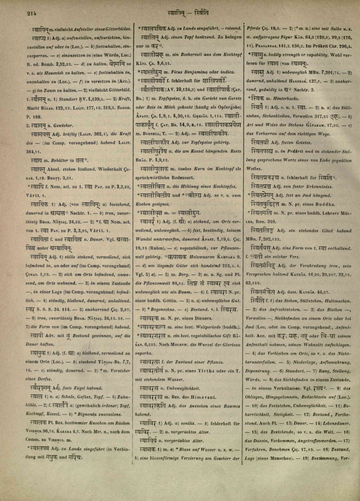
sthāvara a. [sthā-varac] 1 Fixed to one spot, stable, stationary, immovable, inanimate (opp. jaṃgama); śarīriṇāṃ sthāvarajaṃgamānāṃ sukhāya tajjanmadinaṃ babhūva Ku. 1. 23, Ku. 6. 67, Ku. 6. 73. 2 Inert, inactive, slow. 3 Regular, established. — raḥ A mountain; sthāvarāṇāṃ himālayaḥ Bg. 10. 25. — raṃ 1 Any stationary or inanimate object (such as clay, stones, trees &c. which formed the seventh creation of Brahman; cf. Ms. 1. 41); mānyaḥ sa me sthāvarajaṃgamānāṃ sargasthitipratyavahārahetuḥ R. 2. 44; Ku. 6. 58. 2 A bow-string. 3 immovable property, real estate. 4 A heir-loom. Comp. — asthāvaraṃ, -jaṃgamaṃ 1 moveable and immovable property. 2 animate ([Page 1149-b]) and inanimate things. — ātman a. of immovable form; Ku. 6. 67.

Cappeller 1887 Worttyp nicht bestimmt
Originaltext · Deutsch · Worttyp nicht bestimmt
sthāvará stehend, unbeweglich (bes. von Pflanzen), fest, beständig.

Burnouf 1866 Adjektiv
Originaltext · Französisch · Adjektiv
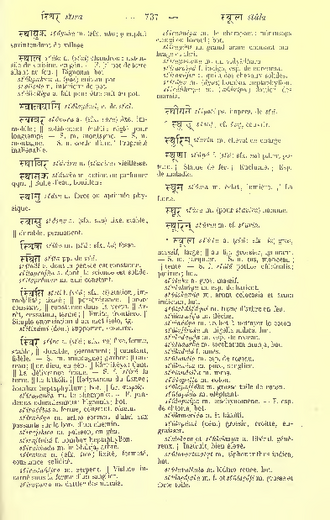
sthāvara sthāvara a. (sfx. vara) fixe, immobile; solidement établi, réglé pour longtemps. — S. m. montagne. — S. n. montagne. — S. n. corde d'arc. Propriété inaliénable.
Quelltextfundstellen (1)
SVU 1 Fundstelle
Mit AYI Free weitermachen
Bildquelle: AYI Archiv.