

tripura त्रिपुर – oxyt. dreifache Wehr, — Burg. Im Epos (vgl.
Substantiv Maskulin · Substantiv Neutrum · Worttyp nicht bestimmt
Wörterbuchquellen
Cappeller 1891 Substantiv Neutrum
Originaltext · Englisch · Substantiv Neutrum
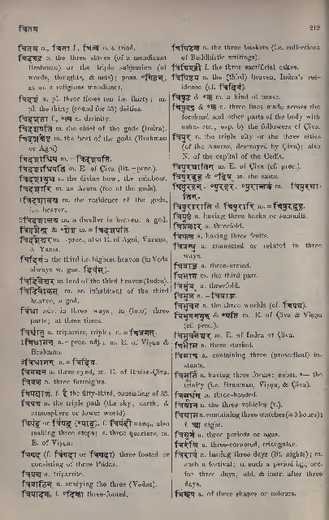
tripura ·n. the triple city or the three cities (of the Asuras, destroyed by Śiva); also N. of the capital of the Cedis.
Monier-Williams 1872 Substantiv Neutrum
Originaltext · Englisch · Substantiv Neutrum
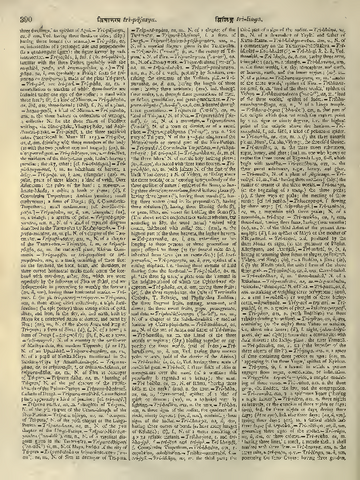
—Tri-pura, am, n. three strong cities collectively, a triple forti- fication; (in epic poetry) three strong cities of gold, silver, and iron, in the sky, air, and earth, built by Maya for a celebrated Asura or demon, and burnt by Śiva; (as), m., N. of the above Asura and king of Tri-pura; a form of Śiva; (ā), f., N. of a town; a form of Durgā (= tri-puṭā ?); (ī), f., N. of a town, = cedi-nagarī; N. of a country to the south-east of Madhya-deśa, the modern Tipparah; (ā or ī?), N. of an Upaniṣad.
Petersburger 1855 Substantiv Maskulin · Substantiv Neutrum · Worttyp nicht bestimmt
Originaltext · Deutsch · Substantiv Maskulin · Substantiv Neutrum
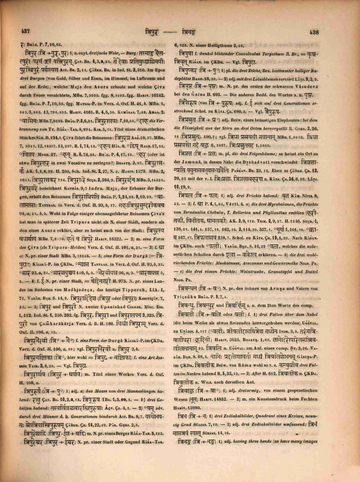
tripura (tri + pur, pura) 1〉 n. oxyt. dreifache Wehr, — Burg: tasmādu haitatpurāṃ paramaṃ rūpaṃ yattripuram ŚAT. BR. 6,3,3,25. te devāḥ pratibudhyāgnimayīḥ purastripuraṃ paryāsyanta AIT. BR. 2,11. ŚĀṄKH. BR._in_Ind. St. 2,310. Im Epos drei Burgen (von Gold, Silber und Eisen, im Himmel, im Luftraum und auf der Erde), welche Maya den Asura erbaute und welche Śiva durch Feuer vernichtete, MBH. 7,9555. fgg. MBH. 8,1402. fgg. HARIV. 16242. fgg. BHĀG. P. 7,10,53. fgg. MATSYA-P._in_Verz. d. Oxf. H. 41,b. MBH. 1,543. MBH. 3,883. MBH. 13,798. MBH. 13,855. HARIV. 4161. R. 4,5,30. KUMĀRAS. 7,48. AMAR. 2. ˚vāsinaḥ MBH. 7,9559. BHĀG. P. 8,6,31. tripurālayāḥ BHĀG. P. 7,10,55. ˚dāha die Verbrennung von Tr. RĀJA-TAR. 8,994. KIR. 5,14. Titel eines dramatischen Stückes SĀH. D. 194,1. Śiva führt die Beinamen: tripuraghna ARJ. 10,57. MBH. 7,3941. MBH. 12,10357. MBH. 14,207. R. 1,74,18. ˚dahana HĀR. 8. ˚dviṣ RAGH. 17,14. ˚vijaya MEGH. 57. ˚han R. 6,74,38. BHĀG. P. 4,17,13. ˚hara (oder ist etwa tripurahara in zwei Vocative zu zerlegen?) BHARTṚ. 3,87. tripurāntaká AK. 1,1,1,29. H. 200, Sch. Ind. St. 2,27, N. 2. HARIV. 1579. MBH. 2,1641. tripurāntakara MBH. 2,754. tripurāri SUŚR. 2,394,9. tripurārdana MBH. 3,14521. tripurāri bezeichnet KATHĀS. 9,7 Indra. Maya, der Erbauer der Burgen, erhält den Beinamen tripurādhipati BHĀG. P. 5,24,28. BHĀG. P. 8,10,22. ˚bālāmantrāḥ TANTRAS._in_Verz. d. Oxf. H. 93,b,17. mahātripurasundarīkavaca Verz. d. Oxf. H. 94,a,41. Verz. d. Oxf. H. 94,b,5. Wohl in Folge einiger obenangeführter Beinamen Śivaʼs hat man in späterer Zeit Tripura nicht als N. einer Stadt, sondern als den eines Asura erklärt, aber es heisst auch von der Stadt: tripurasya badhārthāya MBH. 7,9570. hate ca tripure HARIV. 16322. — 2〉 m. eine Form des Śiva (als Tripura-Helden) Verz. d. Oxf. H. 101,a,31. — 3〉 f. ā a〉 N. pr. einer Stadt MBH. 3,15246. — b〉 eine Form der Durgā (= tripuṭā?) KĀLIKĀ-P._im_ŚKDR. ˚nyāsa TANTRAS._in_Verz. d. Oxf. H. 93,b,25. ˚sāra Verz. d. Oxf. H. 95,a,34. ˚sārasamuccaya Verz. d. Oxf. H. 110,b,5. ˚bhairavīyantra Verz. d. Oxf. H. 96,a,2. ˚dhāraṇayantra Verz. d. Oxf. H. 96,b,2. — 4〉 f. ī N. pr. einer Stadt, = cedinagarī H. 975. N. pr. eines Landes im Südosten von Madhyadeśa, das heutige Tipperah, LIA. I, 71. VARĀH. BṚH. S. 14,9. tripurādideśa (tripura oder tripurā) KṢITĪŚĀV. 7,21. — 5〉 tripura und tripurī N. zweier Upaniṣad COLEBR. Misc. Ess. I, 112. Ind. St. 1,230. Ind. St. 1,252. fg. tripura, tripurā und tripurātapana Ind. St. 3,325. tripurī von Śaṃkarākārya Verz. d. B. H. 180. vidyāṃ tripurām Verz. d. Oxf. H. 106,a,13.
Originaltext · Deutsch · Worttyp nicht bestimmt
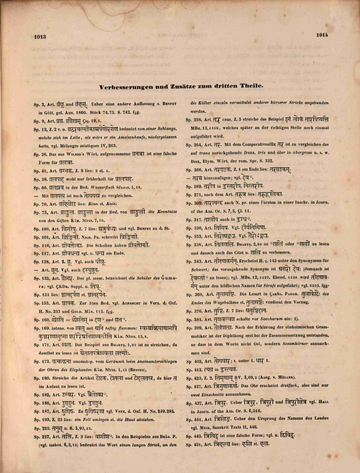
tripura [vgl. [3:437]] Ueber tripura, tripurī und tripurīkṣetra vgl. HALL in Journ. of the Am. Or. S. 6,516. (revision)
Originaltext · Deutsch · Worttyp nicht bestimmt
tripura 1〉 ˚ghātin Śiva KATHĀS. 115,108. tripurāntaka desgl. KATHĀS. 103,236. tripurārāti desgl. KATHĀS. 56,239. tripurāri desgl. KATHĀS. 52,389. ˚sundarī eine Form der Durgā Verz. d. Oxf. H. 88,a,10. Verz. d. Oxf. H. 94,b,5. — 3〉b〉 KATHĀS. 53,170. — Ueber die Lage der Orte tripura, tripurī und tripurīkṣetra vgl. HALL_in_Journ. of the Am. Or. S. 6,516. fg.
Böhtlingk 1879 Substantiv Maskulin · Substantiv Neutrum
Originaltext · Deutsch · Substantiv Maskulin · Substantiv Neutrum
tripura — 1〉 n. — a〉 oxyt. dreifache Wehr, — Burg. Im Epos (vgl. TS. 6,2,3,1) drei von Maya für die Asura erbaute Burgen aus Gold, Silber und Eisen, die Śiva verbrannte. — b〉 Titel einer Upaniṣad. — c〉 N. pr. einer Stadt. — 2〉 m. — a〉 eine Form Śivaʼs. — b〉 Bein. des Asura Bāṇa VP.² 5,118. — 3〉 f. ā — a〉 *eine Art Kardamomen GAL. Vgl. tripuṭā und ˚ṭī. — b〉 *eine Reisart GAL. — c〉 eine best. Zauberkunst. — d〉 Titel einer Upaniṣad. — e〉 eine Form der Durgā PAÑCAD. — f〉 N. pr. einer Stadt. ˚purī v. l. — 4〉 f. ī — a〉 Titel einer Upaniṣad. — b〉 N. pr. der Hauptstadt der Cedi MBH. 3,254,10 BĀLAR. 68,7.
Apte 1890 Worttyp nicht bestimmt
Originaltext · Englisch · Worttyp nicht bestimmt
tripura-rī N. of the capital of the Cedis, ‘made noisy by the waves of the Moon's daughter’, i. e. the Narmadā, and, therefore, situated on that river. It is identified with the modern Tevur 6 miles from Jabbalpur.
Cappeller 1887 Substantiv Neutrum
Originaltext · Deutsch · Substantiv Neutrum
tripura n. die Dreiburg o. die drei (mythischen) Burgen (der Götterfeinde); auch N. der Hauptstadt der Cedi.
Burnouf 1866 Substantiv Neutrum
Originaltext · Französisch · Substantiv Neutrum
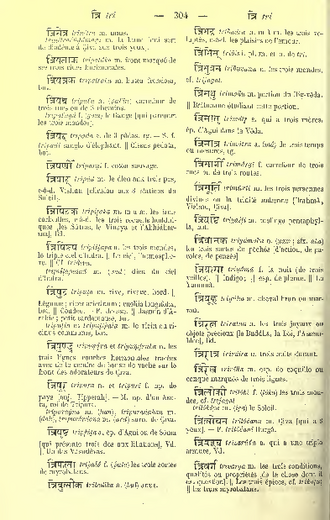
tripura tripura n. et tripurī f. np. de pays [auj. Tipperah]. — M. np. d'un Asura, roi de Tripura. tripuraghna m. (han), tripuradahan m. (dah), tripurārdana m. (ard) surn. de Śiva.
Quelltextfundstellen (3)
SiSa 3 Fundstellen
SiSa 5.234-5.252: Tripurā-Mantra 2 Fundstellen
Direkt belegt
-
SiSa 5.240 Segment 15
-
SiSa 5.252 Segment 2
Mit AYI Free weitermachen
Bildquelle: AYI Archiv.