

anyonya अन्योन्य – mutual; reciprocal
adjective · pronoun · substantive neuter · Word type unspecified
Dictionary sources
AYI dictionary adjective · pronoun
Cappeller 1891 Word type unspecified
Original text · English · Word type unspecified
anyó'nyá ·(only sgl. m. f.) one another, mutual. anyonya (°--) & n. anyonyam mutually.
Monier-Williams 1872 Word type unspecified
Original text · English · Word type unspecified
Anyonya or anyo-'nya, as, ā, am, one another, mutual [this word is said to be fr. anyas, nom. sing. m., and anya; cf. paraspara. In most cases, ac- cordingly, it will be found that the first anya may be regarded as the subject of the sentence, while the latter assumes the acc., inst., gen., or loc. cases as re- quired by the verb; there are many instances, however, in which the first anya, originally a nominative, must be regarded as equivalent to an oblique case]; anyo- nyam or anyonya-tas, ind. mutually.
Petersburger 1855 adjective · substantive neuter
Original text · German · adjective
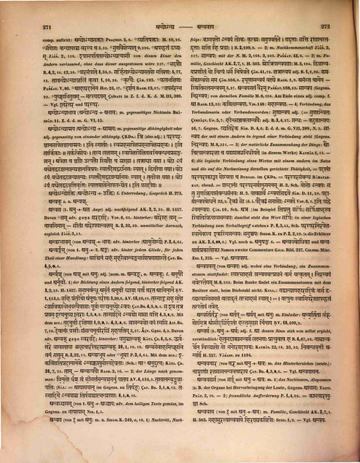
anyo'nya (anyas, nom. sg. m. von anya, + anya) pron. adj. Einer den Andern u. s. w. Das erste anya bewahrt, auch auf ein fem. bezogen, die Endung des masc.; das zweite anya dagegen wird movirt und nimmt ausnahmsweise auch die Endung des pl. an. Das in Verbindung mit anyo'nya erscheinende Verbum weist nach P. 1,3,16. die mediale Form zurück (vgl. jedoch ŚAT. BR. 1,1,4,5.) Folgende casus obliqui können von uns belegt werden: 1〉 acc.: ne̱da̱nyo'nya̱ṃ hina̱sāte ŚAT. BR. 1,1,4,5. mitho 'nyo'nyaṃ jighāṃsanto mahīkṣitaḥ M. 7,89. jīvantyanyo'nyamāśritya drumā kānanajā iva HIḌ. 1,42. tathānyo'nyaṃ (so ist mit der ed. Calc. des MBH. zu lesen) samāśliṣya vikarṣantau punaḥ punaḥ MBH. 4,39. vinānyo'nyaṃ na bhuñjāte vinānyo'nyaṃ na gacchataḥ SUND. 1,5. R. 4,4,19. R. 6,25,7. anyo'nyamime brāhmaṇā bhojayanti P. 8,1,12, Vārtt. 9, Sch. anyo'nyāmime brāhmaṇyau kule (also auch beim neutr. das fem.!) vā bhojayataḥ ebend. Vārtt. 10, Sch. Sehr häufig adv. gegenseitig AK. 3,4,32,17. (COL. 3,4,28,17). H. 1499. anyo'nyaṃ saṃvidaṃ kṛtvā R. 1,17,9. anyo'nyaṃ kalahaṃ kurutaḥ DHŪRTAS. 86,7. anyo'nyamaparājitau R. 6,79,54. anyo'nyamasahiṣṇavaḥ VID. 66. anyo'nyamavitṛptau vilokane VID. 303.⫽print_change — 2〉 instr.: tāni sṛṣṭānyanyo'nyenāspardhanta ŚAT. BR. 14,4,3,30. (= BṚH. ĀR. UP. 1,5,21.) na cābhidyanta te sarve tadānyo'nyena MBH. 1,7742. anyo'nyairāhatāḥ santaḥ sasvanurbhīmanisvanāḥ R. 5,74,36. — 3〉 gen.: anyo'nyasya pṛṣṭhe pradhāvataḥ ŚAT. BR. 4,4,5,23. anyo'nyasyā (fem.) evaitacchriyā atiṣṭhamānā uttarādharā iva bhavantyo yanti (āpaḥ) ŚAT. BR. 5,3,4,21. āpayato vai tāvanyo'nyasya kāmam CHĀND. UP. 1,1,6. anyo'nyasya priyakarāvanyo'nyasya priyaṃvadau SUND. 1,5. jijñāsantāvubhau vīryamanyo'nyasyāntaraiṣiṇau R. 4,60,10. anyo'nyasya vyatilunanti P. 1,3,16, Sch. — 4〉 loc.: atha devā anyo'nyasminneva juhvataśceruḥ ŚAT. BR. 5,1,1,2. tāvetāvanyo'nyasminpratiṣṭhitau BṚH. ĀR. UP. 5,5,2. — In allen bis jetzt aufgeführten Beispielen ist das erste anyaḥ nach der Construction des Satzes als nom. aufzufassen; nicht selten aber vertritt der erstarrte nom. auch die Stelle eines casus obl.: tayoradṛṣṭakāmo 'bhūt — anyo'nyaṃ prati N. 1,16. teṣāṃ saṃbhāṣamāṇānāmanyo'nyam R. 5,89,52. bhītānāṃ bhṛśamārttānāmanyo'nyaṃ hi vanaukasām R. 4,18,16. mayānyo'nyaṃ tābhyāṃ mithyāprajalpanena bhedastathā vihito yathā u. s. w. PAÑCAT. 85,21. virodhaḥ syādyathā tābhyāmanyo'nyena tathā kuru SUND. 3,21. bhinnaṃ ye mantriṇo mantramanyo'nyenābhisaṃhitam (GORR. ˚nye nābhi˚) R. 5,82,5. anyo'nyasyāvyabhicāraḥ gegenseitige Treue M. 9,101. anyo'nyasya hṛdi sthite 'pyanunaye AMAR. 19. Nach diesem darf es nicht Wunder nehmen, wenn anyo'nya auch am Anfange eines comp. auftritt: anyo'nyasaktāḥ PRAŚNOP. 5,6. ˚vyatiṣaktāḥ M. 10,25. ˚saṃyogaḥ kanyāyāśca varasya ca M. 3,32. ˚guṇavaiśeṣyāt M. 9,296. ˚apahṛtaṃ dravyam YĀJÑ. 2,126. eṣāmapatitānyo'nyatyāgī von diesen Einer den Andern verlassend, ohne dass dieser ausgestossen wäre YĀJÑ. 2,237. ˚sadṛśau R. 4,2,10. R. 4,12,28. ˚śarasaṃpāte R. 3,34,9. garhitānyo'nyamatayo mantriṇaḥ R. 5,77,15. tāvanyo'nyāñjaliṃ kṛtvā R. 1,10,28. ˚kṛtyaiḥ ŚĀK. 193. ˚phalabhakṣiṇaḥ PAÑCAT. V, 86. ˚āhāradānena HIT. 25,17. ˚darśana RAGH. 12,87. ˚jayasaṃrambha RAGH. 12,92. ˚pucchābhimukham — matsyadvayam ŚRĪPATI_in_Z. f. d. K. d. M. III, 389. — Vgl. itaretara und paraspara.
Original text · German · adjective · substantive neuter
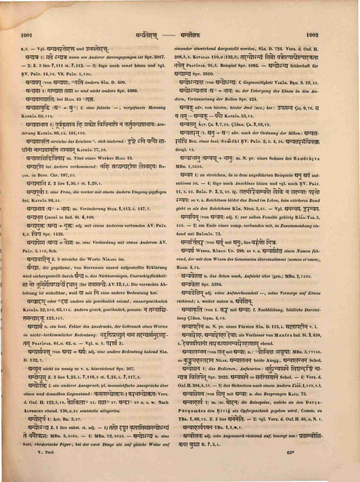
anyo'nya *Z. 1 lies subst. st. adj. — 1〉 tato dṛṣṭvā kṛtātithyamanyo'nyaṃ te vanaukasaḥ MBH. 5,6060. — 4〉 MBH. 12,9023. — anyo'nya n. eine best. rhetorische Figur, bei der zwei Dinge als auf gleiche Weise auf einander einwirkend dargestellt werden, SĀH. D. 724. Verz. d. Oxf. H. 208,b,5. KUVALAY. 110,a (KUVALAY. 132,b). tadanyo'nyaṃ mitho yatrotpādyotpādakatā bhavet PRATĀPAR. 91,b. Beispiel Spr. 1085. — anyo'nya fehlerhaft für anyānya Spr. 3810.
Böhtlingk 1879 substantive neuter
Original text · German · substantive neuter
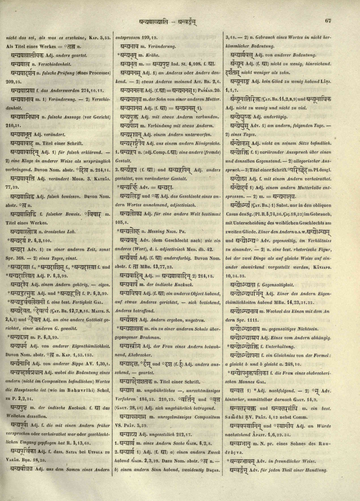
anyò'nyá (ŚAT. BR.) — 1〉 Subst. nur in den obliquen Casus des Sg. (Pl. R. 5,74,36. ŚIŚ. 18,32) im Gebrauch, mit Unterscheidung des weiblichen Geschlechts am zweiten Gliede. Einer den Andern u. s. w. anyo'nyam und anyo'nya˚ Adv. gegenseitig, im Verhältniss zu einander. — 2〉 n. eine best. rhetorische Figur, bei der zwei Dinge als auf gleiche Weise auf einander einwirkend vorgestellt werden, KĀVYAPR. 10,34. 35.
Apte 1890 adjective · substantive neuter · Word type unspecified
Original text · English · adjective · substantive neuter
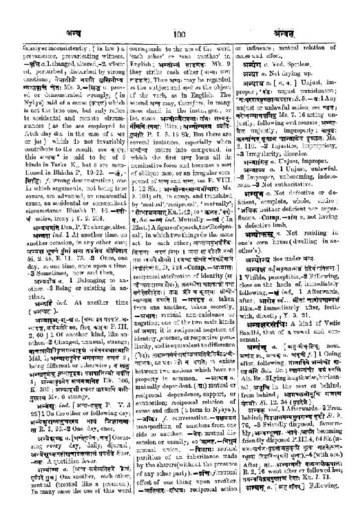
anyonya a. [anya-karmavyatihāre dvitvaṃ, pūrvapade suśca] One another, each other, mutual (treated like a pronoun). In many cases the use of this word ([Page 0100-b]) corresponds to the use of the word ‘each other’ or ‘one another’ in English; anyonyaṃ tāḍayataḥ Mk. 9 they strike each other (anyaḥ anyaṃ tāḍayati). Thus anyaḥ may be regarded as the subject and anyaṃ as the object of the verb, as in English. The second anya may, therefore, in many cases stand in the instr., gen., or loc. cases; anyonyairāhatāḥ saṃtaḥ sasvanurbhīmaniḥsvanāḥ Rām.; anyonyasya vyatilunaṃti P. I. 3. 16 Sk. But there are several instances, especially when anyonya enters into compound, in which the first anya loses all its nominative force and becomes a sort of oblique case, or an irregular com pound of anya and anya, see P. VIII. 1. 12 Sk.; anyonyasyāvyabhīcāraḥ Ms. 9. 101; oft. in comp. and translated by ‘mutual’, ‘reciprocal’, ‘mutually’; ˚śobhājananāt Ku. 1. 42; so ˚kalaha, ˚darśana, &c. — nyaṃ ind. Mutually. — nyaṃ (In Rhet.) A figure of speech, the ‘Reciprocal’, in which two things do the same act to each other; anyonyamubhayorekakriyāyāḥ karaṇaṃ mithaḥ . tvayā sā śobhate tanvī tayā tvamapi śobhase . rajanyā śobhate caṃdraścaṃdreṇāpi niśīthinī S. D. 724. Comp. — adhyāsaḥ reciprocal attribution of identity ( anyonyatādātmyāropaḥ); jalavyomnā ghaṭākāśo yathā sarvastirohitaḥ . tathā jīve ca kūṭasthaḥ sonyonyādhyāsa ucyate .. — apahṛta a. taken from one another, taken secretly. — abhāvaḥ mutual non-existence or negation; one of the two main kinds of abhāva; it is reciprocal negation of identity, essence, or respective peculiarity, and is equivalent to difference (bheda); tādātmyasaṃbaṃdhāvacchinnapratiyogiko' nyonyābhāvaḥ, as ghaṭaḥ paṭo na bhavati; it exists between two notions which have no property in common. — āśraya a. mutually dependent. — (yaḥ) mutual or reciprocal dependence, support, or connection; reciprocal relation of cause and effect (a term in Nyāya). — uktiḥ f. conversation. — pakṣanayanaṃ transposition of numbers from one side to another. — bhedaḥ mutual dissension or enmity; so ˚kalaha. — mithunaṃ mutual union. — vibhāgaḥ mutual partition of an inheritance made by the sharers (without the presence of any other party). — vṛttiḥ f. mutual effect of one thing upon another. — vyatikaraḥ -saṃśrayaḥ reciprocal action ([Page 0100-c]) or influence; mutual relation of cause and effect.
Original text · English · Word type unspecified
anyonya See under anya.
Cappeller 1887 Word type unspecified
Original text · German · Word type unspecified
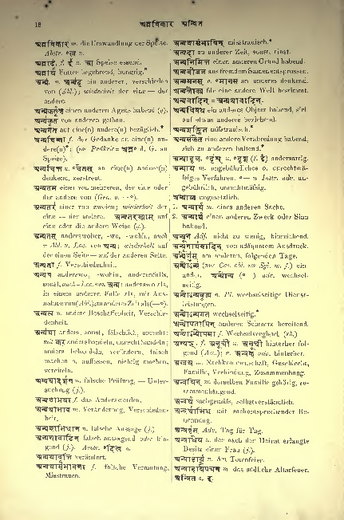
anyo'nyá (nur Cas. obl. im Sgl. m. f. einander. anyonya (˚—) adv. wechselseitig.
Burnouf 1866 adjective
Original text · French · adjective
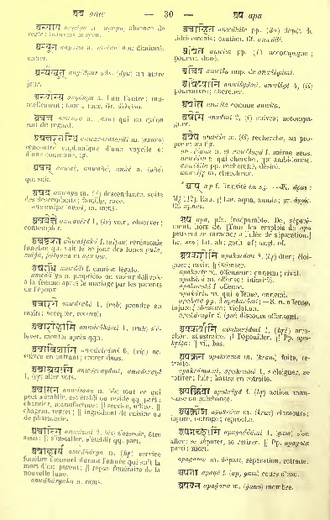
anyonya anyonya a. l'un l'autre; mutuellement; tour à tour. Gr. ἀλλήλων.
Occurrences in source texts (3)
Continue with AYI Free
Image source: AYI archive.