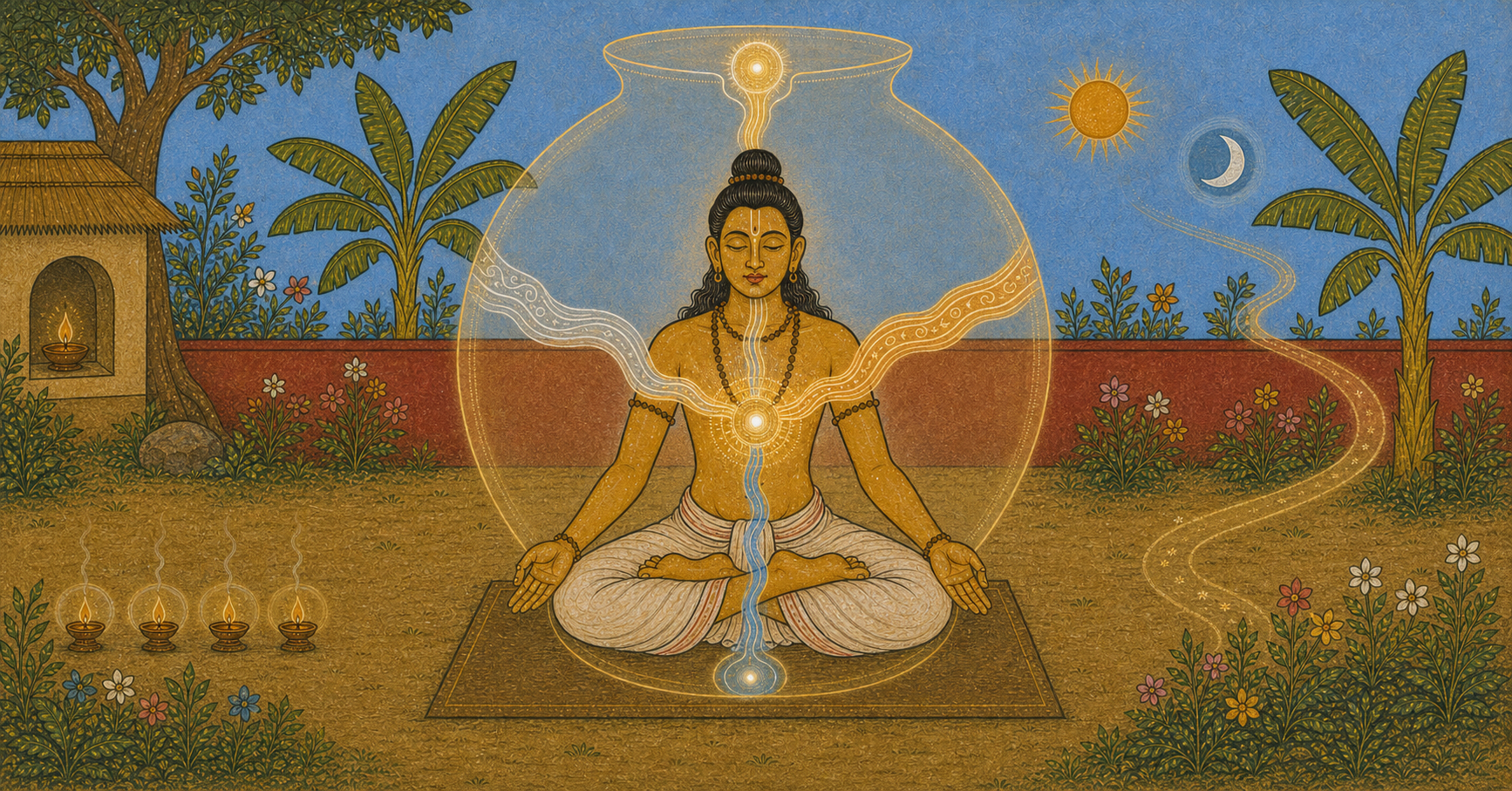
DYS 89–93: Stages of Development

Dattātreyayogaśāstra 89–93: From Inception to the Ghaṭa Stage

Practice leads from Inception to Union: Prāṇa and Apāna, mind and breath, and the individual and supreme selves each become one. The earlier fourfold daily rhythm is then replaced by about three hours of practice by day or night and a single daily Kevala Kumbhaka.

Dr. Ronald Steiner Dr. Ronald Steiner Nils Jacob Liersch Nils Jacob Liersch
Dattātreyayogaśāstra 89
एवमभ्यासयोगेन सिद्धिरारम्भसंभवा |
evam-abhyāsa-yogena; siddhir ārambha-saṃbhavā | Analysis ▾ Analysis ▴
evam
adverb
thus
abhyāsa
tatpuruṣa-compound genitive
substantive masculine
practice
yogena
instrumental case singular
substantive masculine
through practice
siddhiḥ
nominative singular
substantive feminine
accomplishment
ārambha
tatpuruṣa-compound ablative
substantive masculine
commencement
saṃbhavā
nominative singular feminine
adjective
arising from
ततो भवेद्घटावस्था प्रणवाभ्यासतस्तथा ||89||
tato bhaved ghaṭāvasthā; praṇavābhyāsatas tathā ||89|| Analysis ▾ Analysis ▴
tataḥ
adverb
then
bhavet
3rd person singular aktive optative
verbal root
becomes
ghaṭa
tatpuruṣa-compound genitive
substantive masculine
union, joining
avasthā
nominative singular
substantive feminine
state
praṇava
tatpuruṣa-compound genitive
substantive masculine
Oṃ, Praṇava
abhyāsatas
adverb
through practice
tathā
adverb
likewise
Metre: Anuṣṭubh
By engaging in practice (abhyāsayogena | ins sg) in this way (evam), mastery (siddhiḥ | nom sg) of the Commencement [Stage] arises (ārambhasaṃbhavā | nom sg f). Then (tataḥ), through practice of Oṃ (praṇavābhyāsataḥ), the Union Stage (ghaṭāvasthā | nom sg) likewise (tathā) arises (bhavet | 3p sg act opt).
Dr. Ronald Steiner - 2026 - historically literal
Steady practice completes the Commencement Stage. Continued practice of Oṃ then gives rise to the Union Stage, Ghaṭa.
Dr. Ronald Steiner - 2026 - modern transfer
ārambhasaṃbhavā JM2024 ] ārambhasambhavā DYŚ

praṇavābhyāsatas tathā JM2024 ] pavanābhyāsinaḥ sadā DYŚ
Critical Apparatus
Dattātreyayogaśāstra 90
प्राणापानौ मनोवायू जीवात्मपरमात्मनौ |
prāṇāpānau mano-vāyū; jīvātma-paramātmanau | Analysis ▾ Analysis ▴
prāṇa
dvandva-compound
substantive masculine
Prāṇa
apānau
nominative dual
substantive masculine
Apāna
manas
dvandva-compound
substantive neuter
mind
vāyū
nominative dual
substantive masculine
breath
jīva
karmadhāraya-compound
substantive masculine
individual self
ātman
dvandva-compound
substantive masculine
self
parama
karmadhāraya-compound
adjective
supreme
ātmanau
nominative dual
substantive masculine
the two selves
अन्योन्यस्याविरोधेन एकधा घटतो यदा ||90||
anyonyasyāvirodhena; ekadhā ghaṭato yadā ||90|| Analysis ▾ Analysis ▴
anyonyasya
genitive singular masculine
adjective
of one another
avirodhena
instrumental case singular
substantive masculine
without discomfort, without resistance
ekadhā
adverb
as one
ghaṭataḥ
3rd person dual medial present
verbal root
the two join
yadā
adverb
when
Metre: Anuṣṭubh
When (yadā) Prāṇa and Apāna (prāṇāpānau | nom du), mind and breath (manovāyū | nom du), and the individual and supreme selves (jīvātmaparamātmanau | nom du) join in pairs (ghaṭataḥ | 3p du med pres) as one (ekadhā), without obstruction (avirodhena | ins sg) of one another (anyonyasya | gen sg m), [the Union Stage begins].
Dr. Ronald Steiner - 2026 - historically literal
In the Union Stage, Prāṇa and Apāna, mind and breath, and the individual and supreme selves each unite as one without obstructing one another.
Dr. Ronald Steiner - 2026 - modern transfer
ekadhā ghaṭato JM2024 ] ekatā ghaṭate DYŚ
Critical Apparatus
Dattātreyayogaśāstra 91
तदा घटाह्वयावस्था प्रसिद्धा योगिनां स्मृता |
tadā ghaṭāhvayāvasthā; prasiddhā yogināṃ smṛtā | Analysis ▾ Analysis ▴
tadā
adverb
then
ghaṭa
karmadhāraya-compound
substantive masculine
union, joining
āhvayā
karmadhāraya-compound
adjective
called, named
avasthā
nominative singular
substantive feminine
state
prasiddhā
nominative singular feminine
adjective
well known
yoginām
genitive plural
substantive masculine
among yogis
smṛtā
nominative singular feminine past participle passive
verbal root
taught, said
तत्र चिह्नानि यानि स्युस्तानि वक्ष्यामि कानि चित् ||91||
tatra cihnāni yāni syus; tāni vakṣyāmi kāni cit ||91|| Analysis ▾ Analysis ▴
tatra
adverb
there
cihnāni
nominative plural
substantive neuter
signs, characteristics
yāni
nominative plural neuter
pronoun
which
syuḥ
3rd person plural aktive optative
verbal root
may arise
tāni
nominative plural neuter
pronoun
those
vakṣyāmi
1st person singular aktive future
verbal root
I shall teach
kāni
nominative plural neuter
pronoun inter
which
cit
suffix
indefinite marker: some
Metre: Anuṣṭubh
Then (tadā), the state called Union (ghaṭāhvayāvasthā | nom sg), famous (prasiddhā | nom sg f) among yogis (yoginām | gen pl), is said [to occur] (smṛtā | nom sg f ppp). In it (tatra), I shall describe (vakṣyāmi | 1p sg act fut) some (kāni cit | nom pl n) of the signs (cihnāni | nom pl) that (yāni | nom pl n) may arise (syuḥ | 3p pl act opt).
Dr. Ronald Steiner - 2026 - historically literal
Yogis know this as the Union Stage, Ghaṭa. The text now describes some signs that can arise within it.
Dr. Ronald Steiner - 2026 - modern transfer
ghaṭāhvayāvasthā JM2024 ] ghaṭādvayāvasthā DYŚ
Critical Apparatus
Dattātreyayogaśāstra 92
पूर्वं यः कथितो ऽभ्यासश्चतुर्धा तं परित्यजेत् |
pūrvaṃ yaḥ kathito 'bhyāsaś; caturdhā taṃ parityajet | Analysis ▾ Analysis ▴
pūrvam
adverb
previously
yaḥ
nominative singular masculine
pronoun
which
kathitaḥ
nominative singular masculine past participle passive
verbal root
taught
abhyāsaḥ
nominative singular
substantive masculine
practice
caturdhā
adverb
fourfold
tam
accusative singular masculine
pronoun
it
parityajet
3rd person singular aktive optative
previx
verbal root
he should abandon
दिवा वा यदि वा रात्रौ याममात्रं समभ्यसेत् ||92||
divā vā yadi vā rātrau; yāma-mātraṃ samabhyaset ||92|| Analysis ▾ Analysis ▴
divā
adverb
by day
vā
particle
or
yadi
particle
whether
vā
particle
or
rātrau
lokative singular
substantive feminine
by night
yāma
tatpuruṣa-compound genitive
substantive masculine
of a yāma (a three-hour period)
mātram
accusative singular neuter
adjective
only that long; for one yāma
samabhyaset
3rd person singular aktive optative
previx
previx
verbal root
should practise
Metre: Anuṣṭubh
He should abandon (parityajet | 3p sg act opt) that (tam | acc sg m) practice (abhyāsaḥ | nom sg), which (yaḥ | nom sg m) was previously (pūrvam) taught (kathitaḥ | nom sg m ppp) as fourfold (caturdhā). He should practise (samabhyaset | 3p sg act opt) for three hours (yāmamātram | acc sg), either by day (divā) or (vā) by night (rātrau | loc sg).
Dr. Ronald Steiner - 2026 - historically literal
The earlier four-times-daily schedule is abandoned. Instead, the yogi practises for about three hours, either by day or by night.
Dr. Ronald Steiner - 2026 - modern transfer
Dattātreyayogaśāstra 93
एकवारं प्रतिदिनं कुर्यात्केवलकुम्भकम् |
eka-vāraṃ prati-dinaṃ; kuryāt kevala-kumbhakam | Analysis ▾ Analysis ▴
eka
karmadhāraya-compound
numeral
one
vāram
accusative singular
substantive masculine
time
prati
avyayībhāva-compund
previx
each
dinam
accusative singular
substantive neuter
day
kuryāt
3rd person singular aktive optative
verbal root
should perform
kevala
karmadhāraya-compound
adjective
unaccompanied, pure
kumbhakam
accusative singular
substantive masculine
breath retention
प्रत्याहारो ऽयमेव स्यादेवं कर्तुर्हि योगिनः ||93||
pratyāhāro 'yam eva syād; evaṃ kartur hi yoginaḥ ||93|| Analysis ▾ Analysis ▴
pratyāhāraḥ
nominative singular
substantive masculine
withdrawal of the senses
ayam
nominative singular masculine
pronoun
this
eva
particle
precisely
syāt
3rd person singular aktive optative
verbal root
would be
evam
adverb
thus
kartuḥ
genitive singular
substantive masculine
of one acting
hi
particle
indeed
yoginaḥ
genitive singular
substantive masculine
of the yogi
Metre: Anuṣṭubh
Once (ekavāram | acc sg) every day (pratidinam), he should perform (kuryāt | 3p sg act opt) unaccompanied breath retention (kevalakumbhakam | acc sg). The withdrawal of the senses (pratyāhāraḥ | nom sg) of this (ayam | nom sg m) yogi (yoginaḥ | gen sg), acting (kartuḥ | gen sg) in this way (evam), should be (syāt | 3p sg act opt) precisely (eva) the following.
Dr. Ronald Steiner - 2026 - historically literal
Once a day the yogi practises unaccompanied retention. The text now explains withdrawal of the senses.
Dr. Ronald Steiner - 2026 - modern transfer
ekavāraṃ JM2024 ] ekabāraṃ DYŚ

’yam eva JM2024 ] hi [sic] evaṃ DYŚ
Critical Apparatus

Continue with AYI Free

Illustrations: AI-generated.

Editor

Dr. Ronald Steiner

From Ulm

The "Yoga Doc" - Dr. Ronald Steiner is the founder of the AYI method. This method links traditional Ashtanga Yoga with innovative Yogatherapy and living Philosophy. This forms a practice that is personal for each and... more ›

Nils Jacob Liersch

Meine Begeisterung für Yoga, indische Philosophie und Sanskrit führte mich zum Studium der Indologie und Religionswissenschaft an der Universität Heidelberg. Seit 2004 befinde ich mich auf meinem persönlichen Yogaweg... more ›

Messages and ratings
1 messages Ø

Please log in to write a message. Go to login