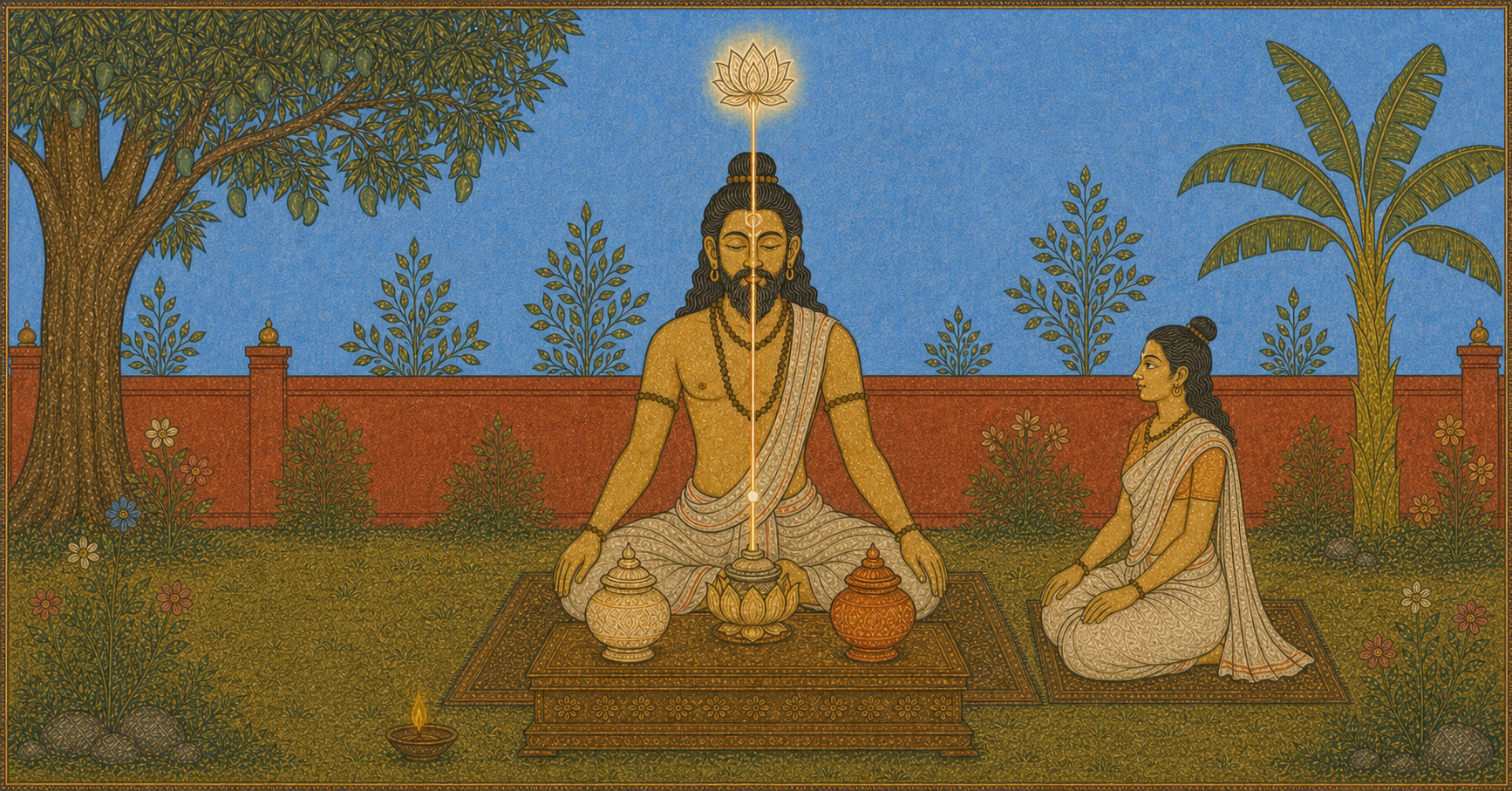
DYS 154–167: Vajrolī for the Male Yogi

Dattātreyayogaśāstra 154–167: Sexual Ritual, Bindu, and the Preservation of Life

The expanded critical text describes prerequisites and a ritualised sexual practice whose aim is to retain or draw back bindu.

Dr. Ronald Steiner Dr. Ronald Steiner Nils Jacob Liersch Nils Jacob Liersch
Dattātreyayogaśāstra 154
क्षीरं चैकं द्वितीयं तु नारी च वशवर्तिनी |
kṣīraṃ caikaṃ dvitīyaṃ tu; nārī ca vaśa-vartinī | Analysis ▾ Analysis ▴
kṣīram
nominative singular
substantive neuter
semen (literally: milk)
ca
particle
and
ekam
nominative singular neuter
numeral
the one
dvitīyam
nominative singular neuter
adjective
the second
tu
particle
but
nārī
nominative singular
substantive feminine
a woman
ca
particle
and
vaśa
tatpuruṣa-compound lokative
substantive masculine
under control
vartinī
nominative singular feminine
adjective
remaining
न संभवेद्यदि क्षीरं तत्तुल्यं कथयामि ते ||154||
na saṃbhaved yadi kṣīraṃ; tat-tulyaṃ kathayāmi te ||154|| Analysis ▾ Analysis ▴
na
particle
not
saṃbhavet
3rd person singular aktive optative
previx
verbal root
might be obtained
yadi
particle
if
kṣīram
nominative singular
substantive neuter
semen (literally: milk)
tat
karmadhāraya-compound
pronoun dem
to that
tulyam
nominative singular neuter
adjective
comparable
kathayāmi
1st person singular aktive present
verbal root
I shall teach
te
dative singular
pronoun pers 2p
to you
Metre: Anuṣṭubh
The one (ekam | nom sg n) is semen (kṣīram | nom sg), while (tu) the second (dvitīyam | nom sg n) is a woman (nārī | nom sg) who remains under control (vaśa-vartinī | nom sg f). If (yadi) semen (kṣīram | nom sg) should not (na) be obtainable (saṃbhavet | 3p sg act opt), I shall explain (kathayāmi | 1p sg act pres) to you (te | dat sg) something comparable to it (tat-tulyam | nom sg n).
Dr. Ronald Steiner - 2026 - historically literal
This practice requires two things: semen and a willing female partner. If semen is unavailable, the text now describes a substitute.
Dr. Ronald Steiner - 2026 - modern transfer
kṣīraṃ caikaṃ dvitīyaṃ tu nārī ca vaśavartinī JM2024 ] om. DYŚ

na saṃbhaved yadi kṣīraṃ tattulyaṃ kathayāmi te JM2024 ] om. DYŚ
Critical Apparatus
Dattātreyayogaśāstra 155
पिबेदाङ्गीरसं किं चिद्यदि क्षीरं न लभ्यते |
pibed āṅgīrasaṃ kiṃ cid; yadi kṣīraṃ na labhyate | Analysis ▾ Analysis ▴
pibet
3rd person singular aktive optative
verbal root
should drink
āṅgīrasam
accusative singular
substantive neuter
Āṅgīrasa, female generative fluid
kim
accusative singular neuter
pronoun inter
some
cit
particle
(indefinite particle)
yadi
particle
if
kṣīram
nominative singular
substantive neuter
semen (literally: milk)
na
particle
not
labhyate
3rd person singular passive present
verbal root
is available
सांकृतिरुवाच |
sāṃkṛtir uvāca | Analysis ▾ Analysis ▴
sāṃkṛtiḥ
nominative singular
substantive masculine
Sāṃkṛti
uvāca
3rd person singular aktive perfekte
verbal root
said
आङ्गीरसाख्यं किं वस्तु भगवन्कथयस्व मे ||155||
āṅgīrasākhyaṃ kiṃ vastu; bhagavan kathayasva me ||155|| Analysis ▾ Analysis ▴
āṅgīrasa
karmadhāraya-compound
substantive neuter
Āṅgīrasa
ākhyam
nominative singular neuter
adjective
called
kim
nominative singular neuter
pronoun inter
what?
vastu
nominative singular
substantive neuter
substance
bhagavan
vokative singular
substantive masculine
O Lord
kathayasva
2nd person singular medial imperative
verbal root
tell
me
dative singular
pronoun pers 1p
me
Metre: Anuṣṭubh; speaker and title lines: prose
[The yogi] should drink (pibet | 3p sg act opt) a little (kiṃ cit) Āṅgīrasa (āṅgīrasam | acc sg) if (yadi) semen (kṣīram | nom sg) is not (na) available (labhyate | 3p sg pas pres). Sāṃkṛti (sāṃkṛtiḥ | nom sg) said (uvāca | 3p sg act perf): “What (kim | nom sg n), O Lord (bhagavan | voc sg), is the substance (vastu | nom sg) called Āṅgīrasa (āṅgīrasākhyam | nom sg n)? Tell (kathayasva | 2p sg med imp) me (me | dat sg).”
Dr. Ronald Steiner - 2026 - historically literal
The yogi is told to drink a little Āṅgīrasa as the substitute. Sāṃkṛti asks Dattātreya what this substance is.
Dr. Ronald Steiner - 2026 - modern transfer
pibed āṅgīrasaṃ kiṃ cid yadi kṣīraṃ na labhyate JM2024 ] om. DYŚ

sāṃkṛtir uvāca JM2024 ] om. DYŚ

āṅgīrasākhyaṃ kiṃ vastu bhagavan kathayasva me JM2024 ] om. DYŚ
Critical Apparatus
Dattātreyayogaśāstra 156
दत्तात्रेयः |
dattātreyaḥ | Analysis ▾ Analysis ▴
dattātreyaḥ
nominative singular
substantive masculine
Dattātreya
स्त्रीणामाङ्गीरसं योनौ इडापानात्तु जायते |
strīṇām āṅgīrasaṃ yonau; iḍāpānāt tu jāyate | Analysis ▾ Analysis ▴
strīṇām
genitive plural
substantive feminine
of women
āṅgīrasam
nominative singular
substantive neuter
Āṅgīrasa, female generative fluid
yonau
lokative singular
substantive feminine
in the vagina
iḍā
tatpuruṣa-compound lokative
substantive feminine
in the Iḍā
apānāt
ablative singular
substantive masculine
as a result of Apāna
tu
particle
but
jāyate
3rd person singular medial present
verbal root
arises
तत्पिबेत्पुरुषो ऽभ्यासी यदि क्षीरं न लभ्यते ||156||
tat pibet puruṣo 'bhyāsī; yadi kṣīraṃ na labhyate ||156|| Analysis ▾ Analysis ▴
tat
accusative singular neuter
pronoun dem
it
pibet
3rd person singular aktive optative
verbal root
should drink
puruṣaḥ
nominative singular
substantive masculine
the man
abhyāsī
nominative singular masculine
adjective
the practitioner
yadi
particle
if
kṣīram
nominative singular
substantive neuter
semen (literally: milk)
na
particle
not
labhyate
3rd person singular passive present
verbal root
is available
Metre: Anuṣṭubh; speaker and title lines: prose
Dattātreya (dattātreyaḥ | nom sg) [said]: “Women’s generative fluid (strīṇām āṅgīrasam | nom sg) arises (jāyate | 3p sg med pres) in the vagina (yonau | loc sg) through Apāna in the Iḍā (iḍā-apānāt | abl sg). The man (puruṣaḥ | nom sg) who practises [Vajrolī] (abhyāsī | nom sg m) should drink (pibet | 3p sg act opt) it (tat | acc sg n) if (yadi) semen (kṣīram | nom sg) is not (na) available (labhyate | 3p sg pas pres).”
Dr. Ronald Steiner - 2026 - historically literal
Dattātreya identifies Āṅgīrasa as female generative fluid produced in the vagina through Apāna in the Iḍā. A Vajrolī practitioner should drink it when semen is not available.
Dr. Ronald Steiner - 2026 - modern transfer
dattātreyaḥ JM2024 ] om. DYŚ

strīṇām āṅgīrasaṃ yonau iḍāpānāt tu jāyate JM2024 ] om. DYŚ

tat pibet puruṣo ’bhyāsī yadi kṣīraṃ na labhyate JM2024 ] om. DYŚ
Critical Apparatus
Dattātreyayogaśāstra 157
तथापि तत्क्षीरगुणं किं चिन्मात्रमपि ध्रुवम् |
tathāpi tat-kṣīra-guṇaṃ; kiṃ cin mātram api dhruvam | Analysis ▾ Analysis ▴
tathā
adverb
moreover
api
particle
even
tat
karmadhāraya-compound
pronoun dem
that
kṣīra
tatpuruṣa-compound genitive
substantive neuter
semen (literally: milk)
guṇam
nominative singular
substantive masculine
quality
kim
accusative singular neuter
pronoun inter
some
cit
particle
(indefinite particle)
mātram
nominative singular neuter
adjective
mere measure
api
particle
even
dhruvam
adverb
certainly
नारीधातुं पुनः कोशे पिबेदादरतो भृशम् ||157||
nārī-dhātuṃ punaḥ kośe; pibed ādarato bhṛśam ||157|| Analysis ▾ Analysis ▴
nārī
tatpuruṣa-compound genitive
substantive feminine
woman's
dhātum
accusative singular
substantive masculine
essence
punar
adverb
however
kośe
lokative singular
substantive masculine
in the receptacle, in the vagina
pibet
3rd person singular aktive optative
verbal root
should drink
ādaratas
adverb
respectfully
bhṛśam
adverb
without hesitation
Metre: Anuṣṭubh
Even so (tathā api), at least a small measure (kiṃ cin mātram | acc sg n) of the quality of semen (tat-kṣīra-guṇam | acc sg) is certainly (dhruvam) present. The yogi, however (punar), should drink (pibet | 3p sg act opt) the woman’s essence (nārī-dhātum | acc sg) in the receptacle, the vagina (kośe | loc sg), respectfully (ādaratas) and without hesitation (bhṛśam).
Dr. Ronald Steiner - 2026 - historically literal
The woman’s essence is said to share, however slightly, the quality of semen. The yogi is therefore instructed to take it respectfully and without hesitation directly from the vagina.
Dr. Ronald Steiner - 2026 - modern transfer
tathāpi tatkṣīraguṇaṃ kiṃ cin mātram api dhruvam JM2024 ] om. DYŚ

nārīdhātuṃ punaḥ kośe pibed ādarato bhṛśam JM2024 ] om. DYŚ
Critical Apparatus
Dattātreyayogaśāstra 158
क्षीराभावे तद्रसं तु क्षीरतुल्यं भवेद्ध्रुवम् |
kṣīrābhāve tad rasaṃ tu; kṣīra-tulyaṃ bhaved dhruvam | Analysis ▾ Analysis ▴
kṣīra
tatpuruṣa-compound genitive
substantive neuter
semen (literally: milk)
abhāve
lokative singular
substantive masculine
in the absence
tat
nominative singular neuter
pronoun dem
that
rasam
nominative singular
substantive masculine
liquid
tu
particle
but
kṣīra
tatpuruṣa-compound instrumental case
substantive neuter
semen (literally: milk)
tulyam
nominative singular neuter
adjective
comparable
bhavet
3rd person singular aktive optative
verbal root
would be
dhruvam
adverb
certainly
अभ्यासं शृणु वज्रोल्या वक्ष्याम्यतिरहस्यकम् ||158||
abhyāsaṃ śṛṇu vajrolyā; vakṣyāmy ati-rahasyakam ||158|| Analysis ▾ Analysis ▴
abhyāsam
accusative singular
substantive masculine
the practice
śṛṇu
2nd person singular aktive imperative
verbal root
listen
vajrolyāḥ
genitive singular
substantive feminine
of Vajrolī
vakṣyāmi
1st person singular aktive future
verbal root
I shall teach
ati
karmadhāraya-compound
previx
exceedingly
rahasyakam
accusative singular neuter
adjective
secret
Metre: Anuṣṭubh
When semen is absent (kṣīra-abhāve | loc sg), that liquid (tad rasam | nom sg) would (bhavet | 3p sg act opt) certainly (dhruvam) be comparable to semen (kṣīra-tulyam | nom sg n). Listen (śṛṇu | 2p sg act imp) to the practice (abhyāsam | acc sg) of Vajrolī (vajrolyāḥ | gen sg); I shall teach (vakṣyāmi | 1p sg act fut) this most secret [method] (ati-rahasyakam | acc sg n).
Dr. Ronald Steiner - 2026 - historically literal
This fluid serves as a substitute when semen is unavailable. The text now begins its closely guarded teaching on Vajrolī.
Dr. Ronald Steiner - 2026 - modern transfer
kṣīrābhāve tad rasaṃ tu kṣīratulyaṃ bhaved dhruvam JM2024 ] om. DYŚ

abhyāsaṃ śṛṇu vajrolyā vakṣyāmy atirahasyakam JM2024 ] om. DYŚ
Critical Apparatus
Dattātreyayogaśāstra 159
सुखानि लभते नारी सिद्धिं च पुरुषो यथा |
sukhāni labhate nārī; siddhiṃ ca puruṣo yathā | Analysis ▾ Analysis ▴
sukhāni
accusative plural
substantive neuter
pleasures
labhate
3rd person singular medial present
verbal root
obtains
nārī
nominative singular
substantive feminine
a woman
siddhim
accusative singular
substantive feminine
success in yoga
ca
particle
and
puruṣaḥ
nominative singular
substantive masculine
a man
yathā
adverb
as
नारीं रम्यामधःस्थाप्य रहस्ये तु दिगंबराम् ||159||
nārīṃ ramyām adhaḥsthāpya; rahasye tu dig-aṃbarām ||159|| Analysis ▾ Analysis ▴
nārīm
accusative singular
substantive feminine
a woman
ramyām
accusative singular feminine
adjective
attractive
adhaḥsthāpya
absolutus
adverb
verbal root
having placed beneath
rahasye
lokative singular
substantive neuter
in a private place
tu
particle
now
diś
bahuvrīhi-compund
substantive feminine
the directions
ambarām
accusative singular feminine
substantive neuter
having the directions as her garment; naked
Metre: Anuṣṭubh
A woman (nārī | nom sg) obtains (labhate | 3p sg med pres) pleasures (sukhāni | acc pl), just as (yathā) a man (puruṣaḥ | nom sg) [obtains] success in yoga (siddhim | acc sg). In a secluded place (rahasye | loc sg), [the yogi] should now (tu) position below [him] (adhaḥ sthāpya | abs) an attractive (ramyām | acc sg f), naked woman (digambarāṃ nārīm | acc sg).
Dr. Ronald Steiner - 2026 - historically literal
Vajrolī is said to give pleasure to the woman and yogic success to the man. In a private place, a naked female partner lies beneath the yogi.
Dr. Ronald Steiner - 2026 - modern transfer
sukhāni labhate nārī siddhiṃ ca puruṣo yathā JM2024 ] om. DYŚ

nārīṃ ramyām adhaḥsthāpya rahasye tu digaṃbarām JM2024 ] om. DYŚ
Critical Apparatus
Dattātreyayogaśāstra 160
स्वयं दिगम्बरो भूत्वा उत्तानायास्तथोपरि |
svayaṃ dig-ambaro bhūtvā; uttānāyās tathopari | Analysis ▾ Analysis ▴
svayam
adverb
himself
diś
bahuvrīhi-compund
substantive feminine
the directions
ambaraḥ
nominative singular masculine
substantive neuter
having the directions as his garment; naked
bhūtvā
absolutus
verbal root
having become
uttānāyāḥ
genitive singular feminine
adjective
of her lying on her back
tathā
adverb
so
upari
adverb
on top
शयानः कुंभकं कुर्यात्किंचिन्नम्रः स्वयं बहिः ||160||
śayānaḥ kuṃbhakaṃ kuryāt; kiṃcin namraḥ svayaṃ bahiḥ ||160|| Analysis ▾ Analysis ▴
śayānaḥ
nominative singular masculine present participle active
verbal root
lying
kuṃbhakam
accusative singular
substantive masculine
breath retention
kuryāt
3rd person singular aktive optative
verbal root
should perform
kiṃcit
adverb
a little
namraḥ
nominative singular masculine
adjective
hunched up
svayam
adverb
himself
bahis
adverb
externally
Metre: Anuṣṭubh
Having become naked himself (svayaṃ digambaro bhūtvā | abs) and lying (śayānaḥ | nom sg m pca) in this way (tathā) on top (upari) of her as she lies on her back (uttānāyāḥ | gen sg f), he should perform (kuryāt | 3p sg act opt) breath retention (kumbhakam | acc sg) and remain outside [her] (bahiḥ), himself (svayam) slightly hunched (kiṃcin namraḥ | nom sg m).
Dr. Ronald Steiner - 2026 - historically literal
The naked yogi lies above the woman as she rests on her back, holds his breath, and bends slightly forward. At first, he remains outside her body.
Dr. Ronald Steiner - 2026 - modern transfer
svayaṃ digambaro bhūtvā uttānāyās tathopari JM2024 ] om. DYŚ

śayānaḥ kuṃbhakaṃ kuryāt kiṃcinnamraḥ svayaṃ bahiḥ JM2024 ] om. DYŚ
Critical Apparatus
Dattātreyayogaśāstra 161
अन्योन्यं दृढमालिंग्य योनौ शिश्नं न चार्पयेत् |
anyonyaṃ dṛḍham āliṃgya; yonau śiśnaṃ na cārpayet | Analysis ▾ Analysis ▴
anyonyam
accusative singular masculine
pronoun
one another
dṛḍham
adverb
tightly
āliṃgya
absolutus
previx
verbal root
having embraced
yonau
lokative singular
substantive feminine
in the vagina
śiśnam
accusative singular
substantive neuter
the penis
na
particle
not
ca
particle
and
arpayet
3rd person singular aktive optative
verbal root
should insert
मिथश्चाधरपानं च कुर्याद्गलरवादिकम् ||161||
mithaś cādhara-pānaṃ ca; kuryād gala-ravādikam ||161|| Analysis ▾ Analysis ▴
mithas
adverb
mutually
ca
particle
and
adhara
tatpuruṣa-compound genitive
substantive masculine
the lips
pānam
accusative singular
substantive neuter
kissing
ca
particle
and
kuryāt
3rd person singular aktive optative
verbal root
should make
gala
tatpuruṣa-compound genitive
substantive masculine
the throat
rava
karmadhāraya-compound
substantive masculine
sounds
ādikam
accusative singular neuter
adjective
and so forth
Metre: Anuṣṭubh
Having tightly (dṛḍham) embraced (āliṅgya | abs) one another (anyonyam | acc sg m), he should not (na) insert (arpayet | 3p sg act opt) his penis (śiśnam | acc sg) into her vagina (yonau | loc sg). They should mutually (mithas) kiss each other’s lips (adhara-pānam | acc sg) and (ca) make (kuryāt | 3p sg act opt) throaty moans and the like (gala-ravādikam | acc sg n).
Dr. Ronald Steiner - 2026 - historically literal
The partners embrace and kiss tightly and make sounds of pleasure, but the penis is not yet inserted into the vagina.
Dr. Ronald Steiner - 2026 - modern transfer
anyonyaṃ dṛḍham āliṃgya yonau śiśnaṃ na cārpayet JM2024 ] om. DYŚ

mithaś cādharapānaṃ ca kuryād galaravādikam JM2024 ] om. DYŚ
Critical Apparatus
Dattātreyayogaśāstra 162
विलुठेच्च सुखेनैव यावत्प्रस्वेदसंभवः |
viluṭhec ca sukhenaiva; yāvat prasveda-saṃbhavaḥ | Analysis ▾ Analysis ▴
viluṭhet
3rd person singular aktive optative
previx
verbal root
he should roll around
ca
particle
and
sukhena
instrumental case singular
substantive neuter
with pleasure
eva
particle
indeed
yāvat
adverb
until
prasveda
tatpuruṣa-compound genitive
substantive masculine
sweat
saṃbhavaḥ
nominative singular
substantive masculine
arises
यदि स्खलेद्बहिर्वीर्यं ततः स्वेदेन मर्दयेत् ||162||
yadi skhaled bahir vīryaṃ; tataḥ svedena mardayet ||162|| Analysis ▾ Analysis ▴
yadi
particle
if
skhalet
3rd person singular aktive optative
verbal root
should be emitted
bahis
adverb
externally
vīryam
nominative singular
substantive neuter
semen
tatas
adverb
then
svedena
instrumental case singular
substantive masculine
with sweat
mardayet
3rd person singular aktive optative
verbal root
he should rub
Metre: Anuṣṭubh
And (ca) he should roll around (viluṭhet | 3p sg act opt) with pleasure (sukhenaiva | ins sg) until (yāvat) sweat is produced (prasveda-saṃbhavaḥ | nom sg). If (yadi) semen (vīryam | nom sg) should be emitted (skhalet | 3p sg act opt) outside (bahiḥ), he should then (tataḥ) rub (mardayet | 3p sg act opt) it [into his body] with sweat (svedena | ins sg).
Dr. Ronald Steiner - 2026 - historically literal
The yogi moves pleasurably with his partner until they sweat. If he ejaculates, he is instructed to rub the semen into his body together with the sweat.
Dr. Ronald Steiner - 2026 - modern transfer
viluṭhec ca sukhenaiva yāvat prasvedasaṃbhavaḥ JM2024 ] om. DYŚ

yadi skhaled bahir vīryaṃ tataḥ svedena mardayet JM2024 ] om. DYŚ
Critical Apparatus
Dattātreyayogaśāstra 163
जीर्णवस्त्रेण संमार्ज्य तद्वस्त्रं रक्षयेद्बुधः |
jīrṇa-vastreṇa saṃmārjya; tad vastraṃ rakṣayed budhaḥ | Analysis ▾ Analysis ▴
jīrṇa
karmadhāraya-compound past participle passive
verbal root
worn out
vastreṇa
instrumental case singular
substantive neuter
with a cloth
saṃmārjya
absolutus
previx
verbal root
having wiped up
tat
accusative singular neuter
pronoun dem
that
vastram
accusative singular
substantive neuter
cloth
rakṣayet
3rd person singular aktive optative
verbal root
should preserve
budhaḥ
nominative singular
substantive masculine
the wise practitioner
यदि बिन्दुर्न स्खलति निष्ठुरं तु यभेद्बहिः ||163||
yadi bindur na skhalati; niṣṭhuraṃ tu yabhed bahiḥ ||163|| Analysis ▾ Analysis ▴
yadi
particle
if
binduḥ
nominative singular
substantive masculine
semen
na
particle
not
skhalati
3rd person singular aktive present
verbal root
is emitted
niṣṭhuram
adverb
roughly
tu
particle
but
yabhet
3rd person singular aktive optative
verbal root
he should copulate
bahis
adverb
externally
Metre: Anuṣṭubh
The wise practitioner (budhaḥ | nom sg) should wipe up (saṃmārjya | abs) that [mixture] (tat | acc sg n) with an old cloth (jīrṇa-vastreṇa | ins sg) and preserve (rakṣayet | 3p sg act opt) the cloth (vastram | acc sg). If (yadi) the semen (binduḥ | nom sg) is not (na) emitted (skhalati | 3p sg act pres), he should instead (tu) copulate (yabhet | 3p sg act opt) roughly (niṣṭhuram) outside [the vagina] (bahiḥ).
Dr. Ronald Steiner - 2026 - historically literal
The mixture is collected on an old cloth and kept for later. If ejaculation does not occur, the yogi intensifies the external stimulation while still avoiding penetration.
Dr. Ronald Steiner - 2026 - modern transfer
jīrṇavastreṇa saṃmārjya tad vastraṃ rakṣayed budhaḥ JM2024 ] om. DYŚ

yadi bindur na skhalati niṣṭhuraṃ tu yabhed bahiḥ JM2024 ] om. DYŚ
Critical Apparatus
Dattātreyayogaśāstra 164
योनौ शिश्नं तु नार्प्येत यावद्बिन्दुर्बहिः पतेत् |
yonau śiśnaṃ tu nārpyeta; yāvad bindur bahiḥ patet | Analysis ▾ Analysis ▴
yonau
lokative singular
substantive feminine
in the vagina
śiśnam
accusative singular
substantive neuter
the penis
tu
particle
but
na
particle
not
arpyeta
3rd person singular passive optative
verbal root
should be inserted
yāvat
adverb
as long as
binduḥ
nominative singular
substantive masculine
semen
bahis
adverb
externally
patet
3rd person singular aktive optative
verbal root
falls
एवं तु त्रिदिनं कुर्यादेकैकं वारमेव च ||164||
evaṃ tu tri-dinaṃ kuryād; ekaikaṃ vāram eva ca ||164|| Analysis ▾ Analysis ▴
evam
adverb
thus
tu
particle
now
tri
karmadhāraya-compound
numeral
three
dinam
accusative singular
substantive neuter
days
kuryāt
3rd person singular aktive optative
verbal root
should practise
eka
karmadhāraya-compound
numeral
one
ekam
accusative singular neuter
numeral
each
vāram
accusative singular
substantive masculine
time
eva
particle
only
ca
particle
and
Metre: Anuṣṭubh
The penis (śiśnam | acc sg) should not (na) be inserted (arpyeta | 3p sg pas opt) into the vagina (yonau | loc sg) as long as (yāvat) semen (binduḥ | nom sg) is emitted outside (bahiḥ patet | 3p sg act opt). He should practise (kuryāt | 3p sg act opt) in this way (evam) for three days (tri-dinam | acc sg), only (eva) once (vāram | acc sg) on each [day] (ekaikam | acc sg n).
Dr. Ronald Steiner - 2026 - historically literal
As long as semen is released externally during this preliminary training, penetration is avoided. The exercise is performed once a day for three days.
Dr. Ronald Steiner - 2026 - modern transfer
yonau śiśnaṃ tu nārpyeta yāvad bindur bahiḥ patet JM2024 ] om. DYŚ

evaṃ tu tridinaṃ kuryād ekaikaṃ vāram eva ca JM2024 ] om. DYŚ
Critical Apparatus
Dattātreyayogaśāstra 165
ततस्तु शरनालेन फूत्कारं वज्रकन्दरे |
tatas tu śara-nālena; phūt-kāraṃ vajra-kandare | Analysis ▾ Analysis ▴
tatas
adverb
then
tu
particle
now
śara
tatpuruṣa-compound genitive
substantive masculine
of the reed
nālena
instrumental case singular
substantive masculine
with the tube
phūt
karmadhāraya-compound
adverb
blowing
kāram
accusative singular
substantive masculine
the act
vajra
tatpuruṣa-compound genitive
substantive masculine
of the penis
kandare
lokative singular
substantive neuter
in the cavity, at the glans
शनैः शनैः प्रकुर्वीत वायुसंचारकारणात् ||165||
śanaiḥ śanaiḥ prakurvīta; vāyu-saṃcāra-kāraṇāt ||165|| Analysis ▾ Analysis ▴
śanaiḥ
adverb
gently
śanaiḥ
adverb
gently
prakurvīta
3rd person singular medial optative
previx
verbal root
should perform
vāyu
tatpuruṣa-compound genitive
substantive masculine
air
saṃcāra
tatpuruṣa-compound genitive
substantive masculine
movement
kāraṇāt
ablative singular
substantive neuter
in order to cause
Metre: Anuṣṭubh
Then (tatas), using a reed tube (śara-nālena | ins sg), he should very gently (śanaiḥ śanaiḥ) perform (prakurvīta | 3p sg med opt) a blowing action (phūt-kāram | acc sg) at the cavity of the glans (vajra-kandare | loc sg) in order to make the air move (vāyu-saṃcāra-kāraṇāt | abl sg).
Dr. Ronald Steiner - 2026 - historically literal
The yogi then blows very gently into the opening at the glans through a reed tube. This is meant to set the air inside the penis in motion.
Dr. Ronald Steiner - 2026 - modern transfer
tatas tu śaranālena phūtkāraṃ vajrakandare JM2024 ] om. DYŚ

śanaiḥ śanaiḥ prakurvīta vāyusaṃcārakāraṇāt JM2024 ] om. DYŚ
Critical Apparatus
Dattātreyayogaśāstra 166
तद्भगे पतितं बिन्दुमभ्यासेनोर्ध्वमाहरेत् |
tad-bhage patitaṃ bindum; abhyāsenordhvam āharet | Analysis ▾ Analysis ▴
tad
karmadhāraya-compound
pronoun dem
that
bhage
lokative singular
substantive masculine
in the vagina
patitam
accusative singular masculine past participle passive
verbal root
fallen
bindum
accusative singular
substantive masculine
semen
abhyāsena
instrumental case singular
substantive masculine
through practice
ūrdhvam
adverb
upward
āharet
3rd person singular aktive optative
previx
verbal root
should draw up
चलितं च तथा बिन्दुमूर्ध्वमाकृष्य रक्षयेत् ||166||
calitaṃ ca tathā bindum; ūrdhvam ākṛṣya rakṣayet ||166|| Analysis ▾ Analysis ▴
calitam
accusative singular masculine past participle passive
verbal root
moved
ca
particle
and
tathā
adverb
likewise
bindum
accusative singular
substantive masculine
semen
ūrdhvam
adverb
upward
ākṛṣya
absolutus
previx
verbal root
having drawn up
rakṣayet
3rd person singular aktive optative
verbal root
should retain
Metre: Anuṣṭubh
Through practice (abhyāsena | ins sg), he should draw upward (ūrdhvam āharet | 3p sg act opt) the semen (bindum | acc sg) that has fallen into her vagina (tad-bhage patitam | acc sg m ppp). And (ca), once that semen (bindum | acc sg) has moved (calitam | acc sg m ppp), he should likewise (tathā) draw it upward (ūrdhvam ākṛṣya | abs) and retain it (rakṣayet | 3p sg act opt).
Dr. Ronald Steiner - 2026 - historically literal
He now trains himself to draw semen that has entered the vagina back up into the penis. Once the fluid starts to move, he draws it in and retains it.
Dr. Ronald Steiner - 2026 - modern transfer
tadbhage patitaṃ bindum abhyāsenordhvam āharet JM2024 ] om. DYŚ

calitaṃ ca tathā bindum ūrdhvam ākṛṣya rakṣayet JM2024 ] om. DYŚ
Critical Apparatus
Dattātreyayogaśāstra 167
एवं च रक्षितो बिन्दुर्मृत्युं जयति तत्त्वतः |
evaṃ ca rakṣito bindur; mṛtyuṃ jayati tattvataḥ | Analysis ▾ Analysis ▴
evam
adverb
thus
ca
particle
and
rakṣitaḥ
nominative singular masculine past participle passive
verbal root
preserved
binduḥ
nominative singular
substantive masculine
semen
mṛtyum
accusative singular
substantive masculine
death
jayati
3rd person singular aktive present
verbal root
conquers
tattvataḥ
substantive neuter
suffix
truly
मरणं बिन्दुपातेन जीवनं बिन्दुधारणात् ||167||
maraṇaṃ bindu-pātena; jīvanaṃ bindu-dhāraṇāt ||167|| Analysis ▾ Analysis ▴
maraṇam
nominative singular
substantive neuter
death
bindu
tatpuruṣa-compound ablative
substantive masculine
semen
pātena
instrumental case singular
substantive masculine
through its fall
jīvanam
nominative singular
substantive neuter
life
bindu
tatpuruṣa-compound ablative
substantive masculine
semen
dhāraṇāt
ablative singular
substantive neuter
through its retention
Metre: Anuṣṭubh
Semen preserved in this way (evaṃ ca rakṣito binduḥ | nom sg) truly (tattvataḥ) conquers (jayati | 3p sg act pres) death (mṛtyum | acc sg). Death (maraṇam | nom sg) [arises] from the fall of semen (bindu-pātena | ins sg), life (jīvanam | nom sg) from its retention (bindu-dhāraṇāt | abl sg).
Dr. Ronald Steiner - 2026 - historically literal
Semen preserved in this way is said to conquer death: its loss means death, while its retention means life.
Dr. Ronald Steiner - 2026 - modern transfer

Continue with AYI Free

Illustrations: AI-generated.

Editor

Dr. Ronald Steiner

From Ulm

The "Yoga Doc" - Dr. Ronald Steiner is the founder of the AYI method. This method links traditional Ashtanga Yoga with innovative Yogatherapy and living Philosophy. This forms a practice that is personal for each and... more ›

Nils Jacob Liersch

Meine Begeisterung für Yoga, indische Philosophie und Sanskrit führte mich zum Studium der Indologie und Religionswissenschaft an der Universität Heidelberg. Seit 2004 befinde ich mich auf meinem persönlichen Yogaweg... more ›

Messages and ratings
0 messages

Please log in to write a message. Go to login

No messages yet.