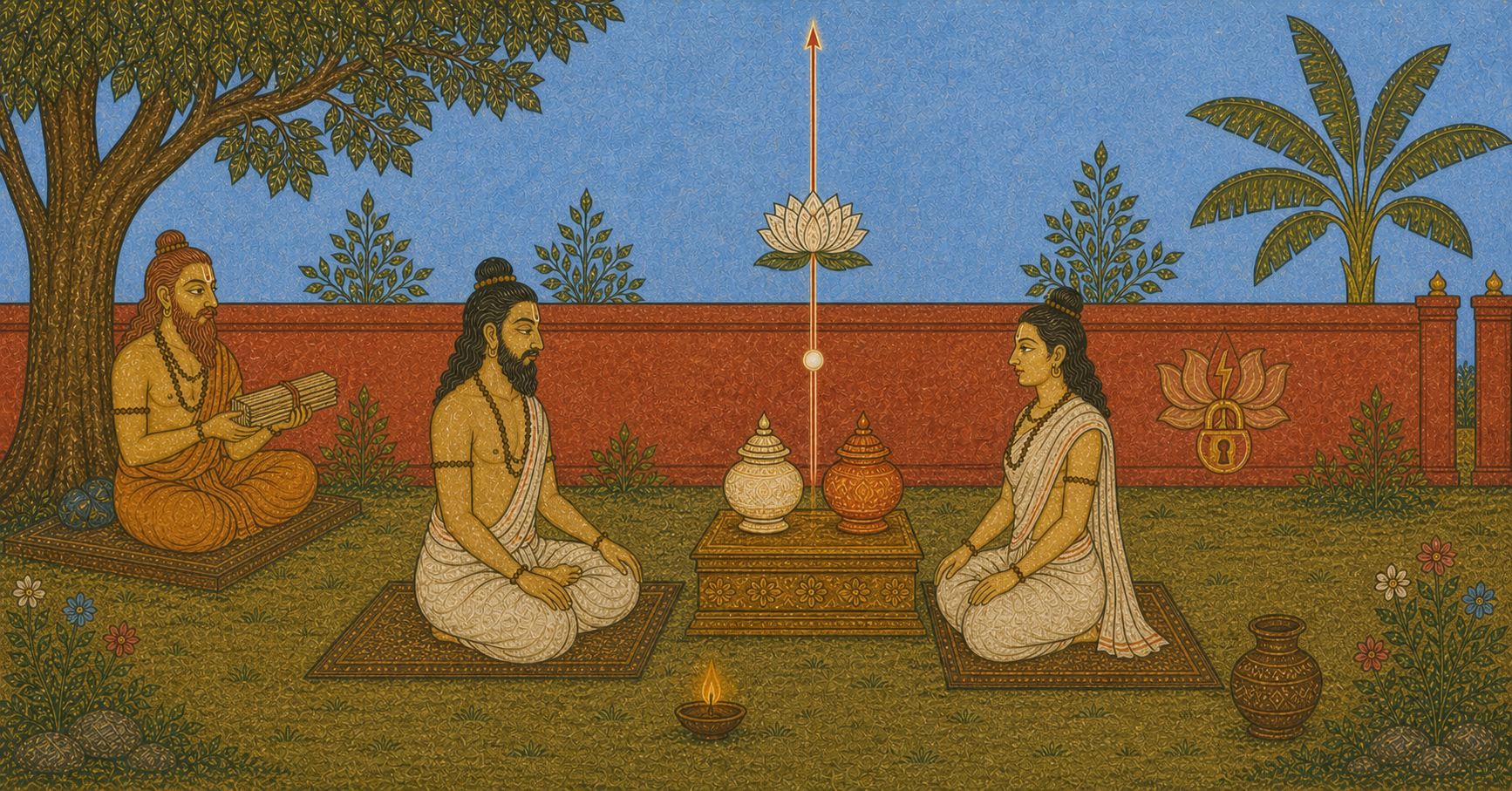
DYS 150–153*3: Vajrolī: Secret Teaching

Dattātreyayogaśāstra 150–153*3: Requirements and the Alternative DYŚ Transmission

Vajrolī is introduced as a closely guarded practice; three star verses from Avasthī’s DYŚ preserve its much shorter account beside Mallinson’s main text.

Dr. Ronald Steiner Dr. Ronald Steiner Nils Jacob Liersch Nils Jacob Liersch
Dattātreyayogaśāstra 150
याममात्रं हि यो नित्यमभ्यसेत्स तु कालजित् |
yāma-mātraṃ hi yo nityam; abhyaset sa tu kāla-jit | Analysis ▾ Analysis ▴
yāma
tatpuruṣa-compound genitive
substantive masculine
of a yāma (a three-hour period)
mātram
accusative singular neuter
adjective
only that long; for one yāma
hi
particle
indeed
yaḥ
nominative singular masculine
pronoun
whoever
nityam
adverb
regularly
abhyaset
3rd person singular aktive optative
previx
verbal root
should practise
saḥ
nominative singular masculine
pronoun
he
tu
particle
indeed
kāla
upapada-compound
substantive masculine
Time, death
jit
nominative singular masculine
adjective
conqueror
अथ वज्रोलीलक्षणम् |
atha vajrolī-lakṣaṇam | Analysis ▾ Analysis ▴
atha
adverb
now
vajrolī
tatpuruṣa-compound genitive
substantive feminine
Vajrolī
lakṣaṇam
nominative singular
substantive neuter
characteristic
वज्रोलीं कथयिष्यामि गोपितां सर्वयोगिभिः ||150||
vajrolīṃ kathayiṣyāmi; gopitāṃ sarva-yogibhiḥ ||150|| Analysis ▾ Analysis ▴
vajrolīm
accusative singular
substantive feminine
Vajrolī
kathayiṣyāmi
1st person singular aktive future
verbal root
I shall teach
gopitām
accusative singular feminine
adjective
kept hidden
sarva
karmadhāraya-compound
adjective
all
yogibhiḥ
instrumental case plural
substantive masculine
by yogis
Metre: Anuṣṭubh; speaker and title lines: prose
One who (yaḥ | nom sg) regularly (nityam) practises (abhyaset | 3p sg act opt) for three hours (yāmamātram | acc sg) is indeed (tu) a conqueror of Time (kāla-jit | nom sg). Now (atha) come the characteristics of Vajrolī (vajrolī-lakṣaṇam | nom sg n). I shall teach (kathayiṣyāmi | 1p sg act fut) Vajrolī (vajrolīm | acc sg), kept hidden (gopitām | acc sg f) by all yogis (sarva-yogibhiḥ | ins pl).
Dr. Ronald Steiner - 2026 - historically literal
One who maintains the inversion for three hours is said to conquer Time. Dattātreya then introduces the closely guarded practice of Vajrolī.
Dr. Ronald Steiner - 2026 - modern transfer
hi yo nityam abhyaset sa tu kālajit JM2024 ] tu yo nityam abhyaset sa tu yogavit DYŚ
Critical Apparatus
Dattātreyayogaśāstra 151
अतीवैतद्रहस्यं हि न देयं यस्य कस्य चित् |
atīvaitad rahasyaṃ hi; na deyaṃ yasya kasya cit | Analysis ▾ Analysis ▴
atīva
previx
particle
exceedingly
etat
nominative singular neuter
pronoun
this
rahasyam
nominative singular
substantive neuter
secret teaching
hi
particle
indeed
na
particle
not
deyam
nominative singular neuter
adjective
to be given
yasya
genitive singular masculine
pronoun
to
kasya
genitive singular masculine
pronoun
anyone
cit
suffix
at all
स्वप्राणैस्तु समो यः स्यात्तस्यैव कथयेद्ध्रुवम् ||151||
sva-prāṇais tu samo yaḥ syāt; tasyaiva kathayed dhruvam ||151|| Analysis ▾ Analysis ▴
sva
karmadhāraya-compound
adjective
own
prāṇaiḥ
instrumental case plural
substantive masculine
life-breaths
tu
particle
but
samaḥ
nominative singular masculine
adjective
equal
yaḥ
nominative singular masculine
pronoun
whoever
syāt
3rd person singular aktive optative
verbal root
should be
tasya
genitive singular masculine
pronoun
to that person
eva
particle
alone
kathayet
3rd person singular aktive optative
verbal root
should teach
dhruvam
adverb
certainly
Metre: Anuṣṭubh
This (etat | nom sg) secret teaching (rahasyam | nom sg n) is exceedingly (atīva) [guarded] and must not (na) be given (deyam | nom sg n) to just anyone (yasya kasya cit | gen sg). It should certainly (dhruvam) be taught (kathayet | 3p sg act opt) only to that person (tasyaiva | gen sg) who (yaḥ | nom sg) is (syāt | 3p sg act opt) equal (samaḥ | nom sg) to one’s own life (sva-prāṇaiḥ | ins pl).
Dr. Ronald Steiner - 2026 - historically literal
Vajrolī is treated as an exceptionally secret teaching, not to be given indiscriminately. It may be entrusted only to someone as dear as one’s own life.
Dr. Ronald Steiner - 2026 - modern transfer
yaḥ syāt tasyaiva JM2024 ] yo syāt tasmai ca DYŚ
Critical Apparatus
Dattātreyayogaśāstra 152
स्वेच्छया वर्तमानो ऽपि योगोक्तनियमैर्विना |
svecchayā vartamāno 'pi; yogokta-niyamair vinā | Analysis ▾ Analysis ▴
sva
tatpuruṣa-compound genitive
pronoun
own
icchayā
instrumental case singular
substantive feminine
at will, deliberately
vartamānaḥ
nominative singular masculine present participle active
verbal root
behaving
api
particle
even
yoga
bahuvrīhi-compund
substantive masculine
yoga
ukta
tatpuruṣa-compound genitive
adjective
prescribed
niyamaiḥ
instrumental case plural
substantive masculine
observances
vinā
adverb
without
वज्रोलीं यो विजानाति स योगी सिद्धिमान्भवेत् ||152||
vajrolīṃ yo vijānāti; sa yogī siddhimān bhavet ||152|| Analysis ▾ Analysis ▴
vajrolīm
accusative singular
substantive feminine
Vajrolī
yaḥ
nominative singular masculine
pronoun
whoever
vijānāti
3rd person singular aktive present
previx
verbal root
knows
saḥ
nominative singular masculine
pronoun pers 3p
he
yogī
nominative singular
substantive masculine
the yogi
siddhimān
nominative singular masculine
adjective
possessed of accomplishment
bhavet
3rd person singular aktive optative
verbal root
should become
Metre: Anuṣṭubh
Even (api) if he behaves (vartamānaḥ | nom sg) according to his own will (svecchayā | ins sg), without (vinā) the rules taught in yoga (yogokta-niyamaiḥ | ins pl), the one (saḥ | nom sg) who (yaḥ | nom sg) knows (vijānāti | 3p sg act pres) Vajrolī (vajrolīm | acc sg) should become (bhavet | 3p sg act opt) a yogi (yogī | nom sg) possessed of accomplishment (siddhimān | nom sg).
Dr. Ronald Steiner - 2026 - historically literal
One who knows Vajrolī attains success as a yogi even while following personal wishes rather than the rules taught in yoga.
Dr. Ronald Steiner - 2026 - modern transfer
vartamāno JM2024 ] varttamāno DYŚ

vajrolīṃ yo vijānāti sa yogī siddhimān bhavet JM2024 ] vajroliṃ yo vijānāti sa yogī siddhibhājanaḥ DYŚ
Critical Apparatus
Dattātreyayogaśāstra 153
तत्र वस्तुद्वयं वक्ष्ये दुर्लभं येन केन चित् |
tatra vastu-dvayaṃ vakṣye; dur-labhaṃ yena kena cit | Analysis ▾ Analysis ▴
tatra
adverb
for it
vastu
karmadhāraya-compound
substantive neuter
substance
dvayam
accusative singular
substantive neuter
pair
vakṣye
1st person singular aktive future
verbal root
I shall teach
dur
karmadhāraya-compound
previx
hard
labham
accusative singular neuter
labha
adjective
to obtain
yena
instrumental case singular masculine
pronoun
by whom
kena
instrumental case singular masculine
pronoun
anyone
cit
particle
at all
लभ्यते यदि तस्यैव योगसिद्धिः करे स्थिता ||153||
labhyate yadi tasyaiva; yoga-siddhiḥ kare sthitā ||153|| Analysis ▾ Analysis ▴
labhyate
3rd person singular passive present
verbal root
is obtained
yadi
particle
if
tasya
genitive singular masculine
pronoun pers 3p
for that person
eva
particle
alone
yoga
tatpuruṣa-compound genitive
substantive masculine
yoga
siddhiḥ
nominative singular
substantive feminine
success
kare
lokative singular
substantive masculine
in the hand
sthitā
nominative singular feminine
adjective
situated
Metre: Anuṣṭubh
For it (tatra), I shall explain (vakṣye | 1p sg act fut) two substances (vastu-dvayam | acc sg n) that are difficult to obtain (dur-labham | acc sg n) for anyone (yena kena cit | ins sg). If (yadi) the pair is obtained (labhyate | 3p sg pas pres), success in yoga (yoga-siddhiḥ | nom sg f) is situated (sthitā | nom sg f) in that very person’s (tasyaiva | gen sg) hand (kare | loc sg).
Dr. Ronald Steiner - 2026 - historically literal
Two substances, both difficult to obtain, are said to be required for the practice. Possessing them places success in yoga within reach.
Dr. Ronald Steiner - 2026 - modern transfer
yogasiddhiḥ kare sthitā JM2024 ] yogasiddhikaraṃ smṛtam DYŚ
Critical Apparatus
Dattātreyayogaśāstra 153*1
क्षीरमाङ्गिरसं चेति द्वयोराद्यं तु लभ्यते |
kṣīram āṅgi-rasaṃ ceti; dvayor ādyaṃ tu labhyate | Analysis ▾ Analysis ▴
kṣīram
accusative singular
substantive neuter
semen
āṅgi
tatpuruṣa-compound genitive
āṅgi
substantive feminine
Āṅgī
rasam
accusative singular
substantive masculine
fluid
ca
particle
and
iti
particle
thus
dvayoḥ
genitive dual
numeral
of the two
ādyam
nominative singular neuter
adjective
the first
tu
particle
but
labhyate
3rd person singular passive present
verbal root
is obtained
द्वितीयं दुर्लभं पुंसां स्त्रीभ्यः साध्यमुपायतः ||153*1||
dvitīyaṃ dur-labhaṃ puṃsāṃ; strībhyaḥ sādhyam upāyataḥ ||153*1|| Analysis ▾ Analysis ▴
dvitīyam
accusative singular neuter
adjective
the second
dur
karmadhāraya-compound
previx
hard
labham
accusative singular neuter
labha
adjective
to obtain
puṃsām
genitive plural
substantive masculine
for men
strībhyaḥ
ablative plural
substantive feminine
from women
sādhyam
accusative singular neuter
adjective
to be obtained
upāyataḥ
substantive masculine
suffix
by a suitable means
Metre: Anuṣṭubh
“Semen (kṣīram | acc sg n) and (ca) Āṅgīrasa (āṅgi-rasam | acc sg),” [are the two]. Of the pair (dvayoḥ | gen du), the first (ādyam | nom sg n) is obtainable (labhyate | 3p sg pas pres), but (tu) the second (dvitīyam | acc sg n) is difficult to obtain (dur-labham | acc sg n) for men (puṃsām | gen pl) and must be procured (sādhyam | acc sg n) from women (strībhyaḥ | abl pl) by a suitable means (upāyataḥ).
Dr. Ronald Steiner - 2026 - historically literal
The two substances are semen and Āṅgīrasa: the first is available, while the second is difficult to obtain and requires a suitable means.
Dr. Ronald Steiner - 2026 - modern transfer
kṣīram āṅgirasaṃ ceti dvayor ādyaṃ tu labhyate DYŚ ] om. JM2024

dvitīyaṃ durlabhaṃ puṃsāṃ strībhyaḥ sādhyam upāyataḥ DYŚ ] om. JM2024
Critical Apparatus
Dattātreyayogaśāstra 153*2
योगाभ्यासरता स्त्री च पुंसा यत्नेन साधयेत् |
yogābhyāsa-ratā strī ca; puṃsā yatnena sādhayet | Analysis ▾ Analysis ▴
yoga
bahuvrīhi-compund
substantive masculine
yoga
abhyāsa
tatpuruṣa-compound genitive
substantive masculine
practice
ratā
nominative singular feminine past participle passive
verbal root
devoted
strī
nominative singular
substantive feminine
woman
ca
particle
and
puṃsā
instrumental case singular
substantive masculine
by a man
yatnena
instrumental case singular
substantive masculine
with care
sādhayet
3rd person singular aktive optative causative
verbal root
one should obtain
पुमान्स्त्री वा यदन्योन्यं स्त्रीपुंस्त्वानपेक्षया ||153*2||
pumān strī vā yad anyonyaṃ; strī-puṃs-tvānapekṣayā ||153*2|| Analysis ▾ Analysis ▴
pumān
nominative singular
substantive masculine
man
strī
nominative singular
substantive feminine
woman
vā
particle
or
yat
nominative singular neuter
pronoun rel
whichever
anyonyam
accusative singular masculine
pronoun
mutually
strī
tatpuruṣa-compound genitive
substantive feminine
female
puṃs
tatpuruṣa-compound genitive
substantive masculine
male
tva
suffix
state
anapekṣayā
instrumental case singular feminine
adjective
irrespective
Metre: Anuṣṭubh; pāda 4: 7 rather than 8 syllables
A woman (strī | nom sg) devoted to yoga practice (yogābhyāsa-ratā | nom sg) should also (ca) be obtained (sādhayet | 3p sg act opt caus) with care (yatnena | ins sg) by a man (puṃsā | ins sg). Whether a man (pumān | nom sg) or (vā) a woman (strī | nom sg), whichever [two] (yat | nom sg n) are with one another (anyonyam | acc sg), [the practice is] irrespective of female or male status (strī-puṃs-tvān-apekṣayā | ins sg).
Dr. Ronald Steiner - 2026 - historically literal
A man is told to carefully obtain a woman devoted to yoga practice. Their shared practice is presented irrespective of who is female or male.
Dr. Ronald Steiner - 2026 - modern transfer
yogābhyāsaratā strī ca puṃsā yatnena sādhayet DYŚ ] om. JM2024

pumān strī vā yad anyonyaṃ strīpuṃstvānapekṣayā em. ed. ] pumān strī vā yadanyonyaṃ strīpuṃstvānapekṣayā DYŚ; om. JM2024
Critical Apparatus
Dattātreyayogaśāstra 153*3
स्वप्रयोजनमात्रैकसाधनात्सिद्धिमाप्नुयात् |
sva-prayojana-mātraika;-sādhanāt siddhim āpnuyāt | Analysis ▾ Analysis ▴
sva
karmadhāraya-compound
adjective
own
prayojana
tatpuruṣa-compound ablative
substantive neuter
purpose
mātra
karmadhāraya-compound
adjective
merely
eka
karmadhāraya-compound
numeral
alone
sādhanāt
ablative singular
substantive neuter
through practice
siddhim
accusative singular
substantive feminine
success
āpnuyāt
3rd person singular aktive optative
verbal root
one may attain
चलितो यदि बिन्दुस्तमूर्ध्वमाकृष्य रक्षयेत् ||153*3||
calito yadi bindus tam; ūrdhvam ākṛṣya rakṣayet ||153*3|| Analysis ▾ Analysis ▴
calitaḥ
nominative singular masculine past participle passive
verbal root
moved, emitted
yadi
particle
if
binduḥ
nominative singular
substantive masculine
Bindu
tam
accusative singular masculine
pronoun
it
ūrdhvam
adverb
upward
ākṛṣya
absolutus
previx
verbal root
having drawn
rakṣayet
3rd person singular aktive optative
verbal root
should preserve
Metre: Anuṣṭubh
Through practice directed solely to one’s own purpose (sva-prayojana-mātraika-sādhanāt | abl sg), one may attain (āpnuyāt | 3p sg act opt) success (siddhim | acc sg). If (yadi) bindu (binduḥ | nom sg) has moved (calitaḥ | nom sg), having drawn (ākṛṣya | abs) it (tam | acc sg) upward (ūrdhvam), one should preserve it (rakṣayet | 3p sg act opt).
Dr. Ronald Steiner - 2026 - historically literal
When the vital essence moves, it should be drawn upward and preserved; through this discipline, success is attained.
Dr. Ronald Steiner - 2026 - modern transfer
svaprayojanamātraikasādhanāt siddhim āpnuyāt DYŚ ] om. JM2024

calito yadi bindus tam ūrdhvam ākṛṣya rakṣayet DYŚ ] om. JM2024
Critical Apparatus

Continue with AYI Free

Illustrations: AI-generated.

Editor

Dr. Ronald Steiner

From Ulm

The "Yoga Doc" - Dr. Ronald Steiner is the founder of the AYI method. This method links traditional Ashtanga Yoga with innovative Yogatherapy and living Philosophy. This forms a practice that is personal for each and... more ›

Nils Jacob Liersch

Meine Begeisterung für Yoga, indische Philosophie und Sanskrit führte mich zum Studium der Indologie und Religionswissenschaft an der Universität Heidelberg. Seit 2004 befinde ich mich auf meinem persönlichen Yogaweg... more ›

Messages and ratings
0 messages

Please log in to write a message. Go to login

No messages yet.