

tanaya तनय – offspring; son
adjective · substantive masculine · substantive neuter · Word type unspecified
Dictionary sources
AYI dictionary substantive masculine
offspring; son
Cappeller 1891 adjective
Original text · English · adjective
tánaya ·a. propagating a race or belonging to a family. m. son (du. also son and daughter); f. tanayā daughter; n. posterity, offspring, child, descendant.
Monier-Williams 1872 adjective
Original text · English · adjective
Tanaya, as, ā, am, Ved. propagating or extend- ing a family, belonging to one's own family; (to- kaṃ tanayam, a child which propagates the family); (as), m. a male descendant, a son; N. of one of the seven sages in the eleventh Manv-antara with the patronymic Vāsiṣṭha; (in astrology) N. of the fifth lunar mansion; (au), m. du. a son and a daughter; (ā), f. a daughter; N. of a plant, = cakra-kulyā; (am), n. posterity, family, race, offspring, child, descendant; (according to the scholiasts tanaya is a grandchild and toka a child); (ās), m. pl., N. of a people.
Petersburger 1855 adjective · substantive masculine · substantive neuter · Word type unspecified
Original text · German · adjective · substantive masculine · substantive neuter
tánaya (von 1. tan) Uṇ. 4,102. 1〉 adj. das Geschlecht fortpflanzend, zum (eigenen) Geschlecht gehörig: syānnàḥ sū̱nustanàyo vi̱jāvā̀ ṚV. 3,1,23. nitya̱ṃ na sū̱nuṃ tanàya̱ṃ dadhā̀nāḥ ṚV. 10,39,14. janmèva̱ nitya̱ṃ tanàyam ṚV. 3,15,2. vā̱jī tanàyo vī̱ḻupā̀ṇiḥ ṚV. 7,1,14. ṚV. 8,25,2. Ebenso wird in der häufigen Verbindung tokaṃ tanayam ein adj. Gebrauch von tanaya anzunehmen sein, mit Ausnahme derjenigen Fälle, wo beide Wörter durch ca — ca getrennt sind. (dhehi) a̱sme bhūrì to̱kāya̱ tanàyāya pa̱śvaḥ ṚV. 6,1,12. balàṃ to̱kāya̱ ta nàyāya (dhehi) ṚV. 3,53,18. ṚV. 10,35,12. rakṣā̀ ṇo agne̱ tanàyāni to̱kā rakṣo̱ta nàsta̱nvàḥ ṚV. 10,4,7. to̱kaṃ pùṣyema̱ tanàyaṃ śa̱taṃ himā̀ḥ ṚV. 1,64,14. tmanè to̱kāya̱ tanàyāya mṛḻa ṚV. 114,6. ṚV. 147,1. ṚV. 189,2. ṚV. 2,30,5. u. s. w. nedvastoke tanaye ravitā ravat AIT. BR. 2,7. — 2〉 m. a〉 Sohn AK. 2,6,1,27. H. 542. M. 3,16. M. 8,275. ŚĀK. 94. RAGH. 2,64. ad HIT. Pr. 12. HIT. Pr. 13. tanayābhyām von einem Sohne und einer Tochter gesagt MBH. 3,2565. — b〉 pl. N. pr. eines Volkes MBH. 6,371. VP. 193. — c〉 N. pr. eines der 7 Weisen im 11ten Manvantara, mit dem patron. Vāsiṣṭha, HARIV. 477. — d〉 in der Astrol. Bez. des fünften Hauses VARĀH. BṚH. 9,3. VARĀH. BṚH. 19 (18), 8. Vgl. tanayabhavana. — 3〉 f. ā a〉 Tochter AK. 2,6,1,27. AK. 2,6,1,28. H. 542. M. 11,171. N. 12,7. N. 12,23. R. GORR. 1,72,34. R. GORR. 4,44,5. ŚĀK. 28. ŚĀK. 79. RAGH. 2,37. VID. 135. VID. 192. PRAB. 36,15. BHĀG. P. 1,16,2. BHĀG. P. 3,22,16. Im comp. behält ein mit tanayā in Congruenzverhältniss stehendes vorangehendes fem. seinen fem-Charakter bei nach gaṇa priyādi zu P. 6,3,34. VOP. 6,13. Hiernach müssten in den adj. compp. alpatanaya VARĀH. BṚH. S. 67,7, vipannatanayā VARĀH. BṚH. S. 103,1 und prasūtatanayā VARĀH. BṚH. S. 2 Söhne und nicht Töchter gemeint sein; aber viell. geht man am sichersten, wenn man das Wort hier in der beides umfassenden Bed. Kind auffasst; vgl. VARĀH. BṚH. S. 4. — b〉 N. einer Pflanze, = cakrakulyā ŚABDAC._im_ŚKDR. — 4〉 n. Nachkommenschaft, Geschlecht, Stamm; Kind, Nachkomme NAIGH. 2,2 (nach einer Lesart m., nach anderer n.). sū̱ktasyà bodhi̱ tanàyaṃ ca jinva ṚV. 2,23,19. mā tve sacā̱ tanàye̱ nitya̱ ā dhàk ṚV. 7,1,21. vi̱datsa̱ramā̱ tanàyāya dhā̱sim ṚV. 1,62,3. ṚV. 1,96,4. tanàyasya pu̱ṣṭiṣù ṚV. 1,166,8. tànayāya̱ tmanè ca ṚV. 183,3. ṚV. 184,5. yenà to̱kaṃ ca̱ tanàyaṃ ca̱ dhāmàhe ṚV. 92,13. ṚV. 9,74,5. trā̱tā to̱kasya̱ tanàye̱ gavā̀masi ṚV. 1,31,12. to̱ke vā̱ goṣu̱ tanàye̱ yada̱psu vi krandàsī u̱rvarā̀su̱ bravaìte ṚV. 6,25,4. ṚV. 6,31,1. Bei den Commentatoren Enkel, während toka Kind bedeuten soll. NIR. 10,7. NIR. 12,6. Auch in der späteren Sprache scheint das Wort zuweilen geradezu Kind zu bedeuten, z. B. in tanayarahita VARĀH. BṚH. S. 67,56; vgl. u. VARĀH. BṚH. S. 3,a.
Original text · German · Word type unspecified
tanaya 3〉a〉 Sp. 222, Z. 4 lies prabhūtatanayā st. prasūta˚.
Böhtlingk 1879 adjective · substantive masculine · substantive neuter
Original text · German · adjective · substantive masculine · substantive neuter
1. tánaya — 1〉 Adj. das Geschlecht fortpflanzend, zum eigenen Geschlecht gehörig. — 2〉 m. — a〉 Sohn. Du. auch Sohn und Tochter. Im Comp. Kind überh. Am Ende eines adj. Comp. f. ā. — b〉 das fünfte astrol. Haus. — c〉 N. pr. — α〉 Pl. eines Volkes. — β〉 eines Vāsiṣṭha. v. l. anagha. — 3〉 f. tanayā — a〉 Tochter. — b〉 *eine best. Pflanze. — 4〉 (*m.) n. Nachkommenschaft, Geschlecht, Stamm; Kind, Nachkommen. Nach den Commentatoren Enkel.
Apte 1890 substantive masculine · substantive neuter
Original text · English · substantive masculine · substantive neuter
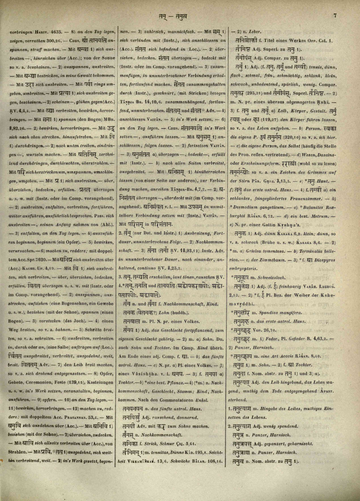
tanayaḥ [tanoti kulaṃ, tan-kayan] 1 A son. 2 A male descendant. 3 (In astrol.) N. of the fifth lunar mansion. — yā A daughter; giri˚, kaliṃda˚ &c. — yau (dual) A son and a daughter. — yaṃ Posterity, family, offspring.
Cappeller 1887 Word type unspecified
Original text · German · Word type unspecified
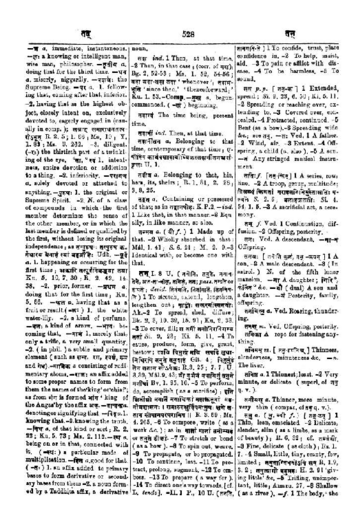
tánaya fortdauernd, (sich) fortflanzend. m. Sohn; f. ā Tochter; n. Nachkommenschaft, Kinder und Kindeskinder. 0
Burnouf 1866 substantive masculine
Original text · French · substantive masculine
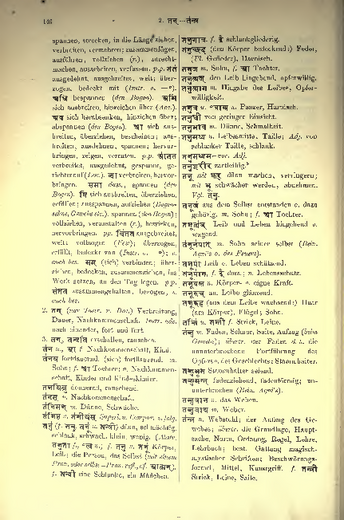
tanaya tanaya m. (sfx. aya) [f. ā fils, fille.
Occurrences in source texts (1)
SVU 1 occurrence
Continue with AYI Free
Image source: AYI archive.