

virāma विराम – cessation; ending; rest
substantive masculine
Dictionary sources
AYI dictionary substantive masculine
cessation; ending; rest
Derived from
Cappeller 1891 substantive masculine
Original text · English · substantive masculine
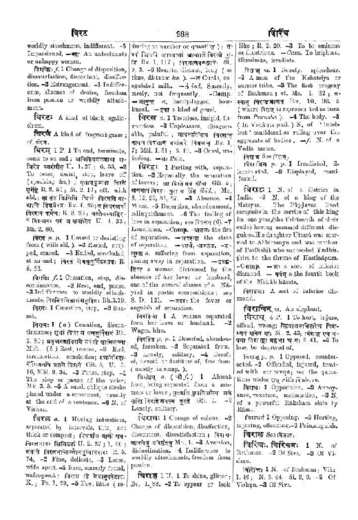
virāma ·m. cessation, rest, end, pause, caesura, stop and its sign (g.).
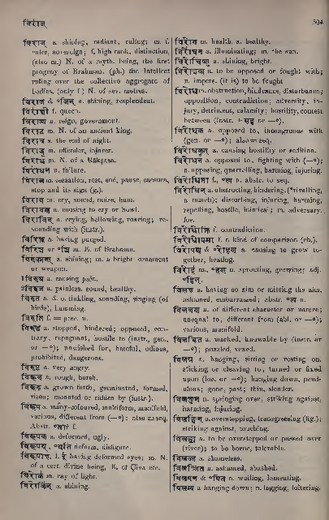
Monier-Williams 1872 substantive masculine
Original text · English · substantive masculine
Vi-rāma, as, m. leaving off, cessation, rest, repose, discontinuance (of working, speaking, &c.); stop- page, stop, pause, pause of the voice, stoppage of sound; (in gram.) ‘the stop,’ N. of a small oblique stroke placed under a consonant to denote that it is quiescent, i. e. that it has no vowel inherent or other- wise pronounced after it, (this mark is sometimes used in the middle of conjunctions of consonants; but its proper use, according to native grammarians, is only as a stop at the end of a sentence ending in a conso- nant); end, conclusion, term; N. of Viṣṇu.
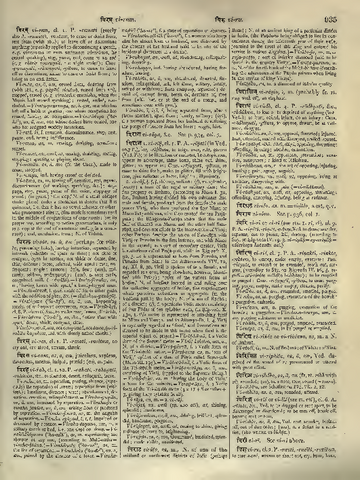
Petersburger 1855 substantive masculine
Original text · German · substantive masculine
virāma (von ram mit vi) m. 1〉 das Aufhören; Schluss, Ende TRIK. 3,2,29. ŚĀṄKH. GṚHY. 4,8. YOGAS. 1,18. HARIV. 12108. cumbā˚ VARĀH. BṚH. S. 78,8. UTTARAR. 49,3 (63,5). adharmasya BHĀG. P. 10,50,10. sudhāṃ vinā na prayayurvirāmam ruhten nicht Spr. 2585. adhīṣva bho iti brūyādvirāmo 'stviti cāramet M. 2,73. MṚCCH. 44,14. rajaniridānīmiyamapi yāti virāmam GĪT. 5,14. Ende eines Wortes, — eines Satzes, Pause: pūrveṇa cedvirāmaḥ AV. PRĀT. 2,38. AV. PRĀT. 4,79. virāmo 'vasānam P. 1,4,110. VOP. 2,43, Comm. īdūdvirāma auf ī und ū auslautend AK. 3,6,1,2. turuvirāmaka auf tu und ru auslautend AK. 2,13. trivirāmaṃ (?) daśavarṇaṃ ṣaṇmātramuvāca piṅgalaḥ sūtram Ind. St. 8,216. avirāmam ohne Unterlass GĪT. 11,9. — 2〉 Ende eines Pāda, Cäsur innerhalb eines Pāda ŚRUT. 16. ŚRUT. 38. ŚRUT. 42. — 3〉 das die Abwesenheit eines a anzeigende Zeichen unterhalb eines Consonanten am Ende eines Satzes. — 4〉 das Abstehen, Sichenthalten VOP. 5,20. — 5〉 neben rāma unter den Beiww. Viṣṇuʼs MBH. 13,6992. PAÑCAR. 4,8,43. Śivaʼs ŚIV.
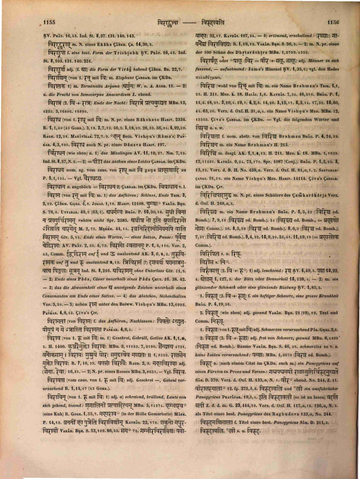
Böhtlingk 1879 substantive masculine
Original text · German · substantive masculine
virāma m. — 1〉 das Aufhören; Schluss, Ende. — 2〉 Ende eines Wortes, — eines Satzes, Pause. Am Ende eines adj. Comp. auslautend auf. — 3〉 Ende eines Stollens, Cäsur innerhalb eines Stollens. — 4〉 das die Abwesenheit eines a anzeigende Zeichen [Page6-113-b] unterhalb eines Consonanten (ursprünglich nur am Ende eines Satzes.) — 5〉 das Abstehen, Sichenthalten Chr. 221,15. — 6〉 Abspannung, languor CARAKA. 2,1. — 7〉 Bein. Viṣṇuʼs und Śivaʼs.
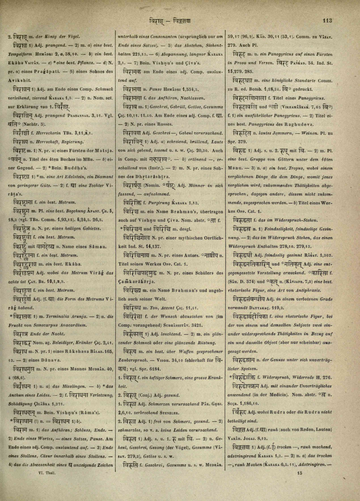
Apte 1890 substantive masculine
Original text · English · substantive masculine
virāmaḥ 1 (a) Cessation, discontinuance; sudhāṃ vinā na prayayurvirāmaṃ Bh. 2. 80; pravṛttasyāvirāme bhavaṃtī śāsitavyā Mbh. (b) Rest, repose. 2 End, termination, conclusion; rajaniridānīmiyamapi yāti virāmaṃ Gīt. 5; U. 3. 16, Māl. 9. 34. 3 Pause, stop. 4 The stop or pause of the voice; Mk. 3. 5. 5 A small oblique stroke placed under a consonant, usually at the end of a sentence. 6 N. of Viṣṇu.
Cappeller 1887 substantive masculine
Original text · German · substantive masculine
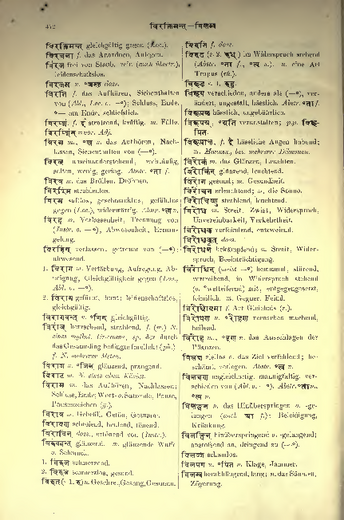
virāma m. das Aufhören, Nachlassen; Schluss, Ende; Worte- o. Satzende, Pause, Pausenzeichen (g.).
Burnouf 1866 substantive masculine
Original text · French · substantive masculine
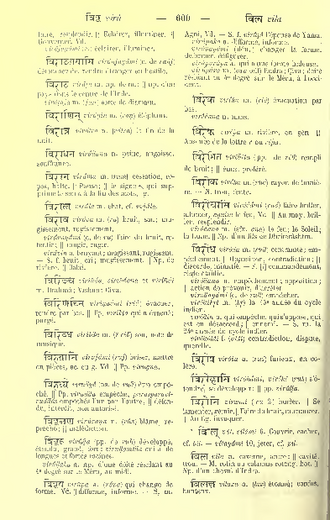
virāma virāma m. (ram) cessation, repos, halte. Pause; le signe qui supprime le son a à la fin des mots, tg.
Occurrences in source texts (2)
PYS 1 occurrence
VBT 1 occurrence
Continue with AYI Free
Image source: AYI archive.